Hinged Dispensing Cap Market Size and Growth
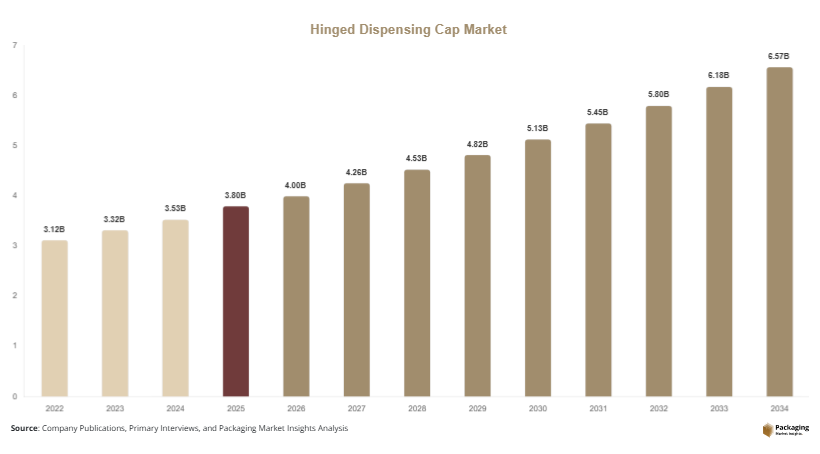
The global hinged dispensing cap market size was valued at approximately USD 3.8 billion in 2025 and is expected to reach USD 4.0 billion in 2026. By 2034, the market is projected to reach nearly USD 6.6 billion, expanding at a CAGR of 6.4% during 2025–2034. The hinged dispensing cap market is experiencing consistent growth due to rising demand for convenient, resealable, and spill-resistant packaging solutions across food, beverage, personal care, pharmaceutical, and household product industries. Hinged dispensing caps are widely used in packaging applications that require controlled product dispensing, improved user convenience, and contamination prevention. These closures provide functional advantages such as easy opening, secure resealing, and accurate dispensing, making them increasingly popular among manufacturers seeking enhanced consumer-friendly packaging formats.
One of the major growth factors driving the market is the increasing consumption of packaged personal care and cosmetic products. Hinged dispensing caps are extensively used in shampoos, lotions, creams, and liquid soaps due to their convenience and controlled dispensing features. Another important growth factor is the rising demand for hygienic and leak-proof packaging solutions in food and pharmaceutical applications. Consumers are increasingly preferring packaging that minimizes contamination risks while improving ease of use. Additionally, rapid expansion of the e-commerce and retail packaging sectors is supporting market growth, as manufacturers seek durable and resealable closure systems that improve product handling and transportation safety.
Key Highlights
- Asia Pacific dominated the market with a 37.9% share in 2025.
- Latin America is projected to grow at the fastest CAGR of 6.9%.
- Polypropylene hinged dispensing caps led the material segment with a 58.6% share.
- Flip-top hinged caps dominated the product type segment with a 43.5% share.
- Personal care applications led the end-use segment with 39.8% share.
- The US remained the dominant country with a market size of USD 710 million in 2025 and USD 748 million in 2026.
Explore more data points, trends and opportunities Download Free Sample Report
Market Trends
Increasing Adoption of Sustainable and Lightweight Dispensing Closures
Sustainability initiatives are significantly influencing the hinged dispensing cap market as manufacturers increasingly adopt lightweight and recyclable closure solutions. Packaging companies are focusing on reducing plastic consumption through optimized cap designs and thinner resin structures without compromising functionality or durability. Recyclable polypropylene and bio-based plastics are becoming more common in dispensing closure manufacturing. Consumer goods companies are also seeking environmentally responsible packaging components to support sustainability commitments and comply with evolving regulatory standards. In addition, manufacturers are developing mono-material dispensing caps that improve recyclability within existing waste management systems. These developments are expected to drive continued innovation in sustainable dispensing closure technologies throughout the forecast period.
Rising Demand for Functional and Ergonomic Packaging Designs
Functional packaging designs are becoming an important trend across the hinged dispensing cap market. Consumers increasingly prefer dispensing closures that provide ease of use, accurate dispensing, and leak-proof functionality for personal care, food, and healthcare products. Manufacturers are introducing ergonomic cap structures, one-hand opening mechanisms, and controlled-flow dispensing systems to improve consumer convenience. Hinged dispensing caps are also being customized for premium product packaging to improve shelf appeal and brand differentiation. In addition, travel-sized and portable packaging formats are supporting demand for secure and compact dispensing closures. The growing focus on convenience-oriented packaging is expected to strengthen market demand across multiple industries.
Market Drivers
Growing Demand for Convenient and Hygienic Packaging Solutions
The increasing demand for convenient and hygienic packaging solutions is a major factor driving the hinged dispensing cap market. Consumers are increasingly preferring packaging formats that reduce contamination risks and improve ease of product dispensing. Hinged dispensing caps provide secure resealing and controlled product flow, making them suitable for food sauces, liquid soaps, shampoos, and pharmaceutical products. The growing awareness regarding hygiene and product safety is encouraging manufacturers to adopt dispensing closures that minimize direct product contact during use. Furthermore, the rise of portable and travel-friendly packaging is increasing the demand for leak-resistant hinged dispensing cap systems across various consumer product categories.
Expansion of Personal Care and Household Product Industries
Rapid growth in the global personal care and household product industries is another key driver supporting the hinged dispensing cap market. Products such as shampoos, conditioners, lotions, detergents, and cleaning liquids extensively utilize dispensing caps for convenient and controlled product application. Rising disposable incomes, changing grooming habits, and increasing urbanization are supporting the growth of packaged personal care products globally. Manufacturers are also investing in innovative closure designs to improve packaging aesthetics and consumer engagement. Additionally, household cleaning product manufacturers are adopting dispensing caps with improved sealing performance to enhance packaging safety during transportation and storage.
Market Restraint
Fluctuating Raw Material Prices and Recycling Challenges
One of the key restraints affecting the hinged dispensing cap market is the volatility in raw material prices, especially petroleum-based plastics such as polypropylene and polyethylene. Changes in crude oil prices directly influence resin costs, increasing production expenses for dispensing closure manufacturers. These fluctuations can reduce profit margins and create pricing challenges for packaging companies operating in highly competitive markets. In addition, recycling challenges associated with multi-component dispensing caps can limit sustainability performance. Certain hinged cap structures contain springs, silicone valves, or mixed plastic materials that complicate recycling processes and increase waste management difficulties. For example, packaging manufacturers supplying complex dispensing closures for cosmetic products may face regulatory pressure to redesign products for improved recyclability. Compliance with sustainability standards and investments in recyclable materials can increase operational costs, particularly for smaller manufacturers with limited technological resources.
Market Opportunities
Expansion of Bio-Based and Recyclable Closure Solutions
The increasing focus on sustainable packaging is creating substantial opportunities for the hinged dispensing cap market. Manufacturers are investing in recyclable dispensing closures and bio-based polymers to reduce environmental impact and support circular economy initiatives. Consumer goods companies are increasingly demanding mono-material cap solutions compatible with existing recycling infrastructure. Bio-based plastics derived from renewable feedstocks are also gaining attention as alternatives to traditional petroleum-based materials. Furthermore, lightweight cap designs are helping companies reduce packaging waste and transportation costs. These sustainability-focused developments are expected to create long-term growth opportunities for manufacturers specializing in eco-friendly hinged dispensing cap technologies.
Rising Demand for Premium and Customized Packaging
The growing demand for premium packaging formats presents significant opportunities for the hinged dispensing cap market. Cosmetic, personal care, and food companies are increasingly investing in customized dispensing closures that improve branding and consumer experience. Hinged dispensing caps with metallic finishes, embossed logos, and advanced dispensing functions are becoming popular in premium product categories. Manufacturers are also developing specialized dispensing systems for products requiring precise flow control and contamination prevention. The expansion of premium skincare, healthcare, and gourmet food markets is expected to drive continued demand for innovative dispensing closure designs globally.
Report Scope
| Report Metric | Details |
|---|---|
| Market Size in 2025 | USD 3.8 Billion |
| Market Size in 2026 | USD 4.0 Billion |
| Market Size in 2034 | USD 6.6 Billion |
| CAGR | 6.4% (2026-2034) |
| Base Year for Estimation | 2025 |
| Historical Data | 2022-2024 |
| Forecast Period | 2026-2034 |
| Report Coverage | Revenue Forecast, Competitive Landscape, Supply Chain Disruption, Growth Factors, Environment & Regulatory Landscape and Trends |
| Geographies Covered | North America, Europe, APAC, Middle East and Africa, LATAM |
| Countries Covered | U.S., Canada, U.K., Germany, France, Spain, Italy, Russia, Nordic, Benelux, Rest of Europe, China, South Korea, Japan, India, Australia, Singapore, Taiwan, South East Asia, Rest of Asia-Pacific, UAE, Turky, Saudi Arabia, South Africa, Egypt, Nigeria, Rest of MEA, Brazil, Mexico, Argentina, Chile, Colombia, Rest of LATAM |
Explore more data points, trends and opportunities Download Free Sample Report
Segmental Analysis
By Material
Polypropylene hinged dispensing caps dominated the hinged dispensing cap market in 2024, accounting for approximately 58.6% of total market revenue. Polypropylene is widely preferred because of its durability, chemical resistance, lightweight structure, and cost efficiency. Personal care, food, and household product manufacturers extensively utilize polypropylene dispensing closures due to their compatibility with high-speed molding processes and leak-resistant performance. These caps also provide design flexibility for various dispensing functions including flip-top and snap-open systems. The growing adoption of lightweight packaging and improvements in resin processing technologies continue to support strong demand for polypropylene dispensing caps across global packaging industries.
Bio-based plastic dispensing caps are expected to witness the fastest growth, registering a CAGR of 7.2% during the forecast period. Sustainability concerns and regulatory pressure to reduce petroleum-based plastic consumption are encouraging manufacturers to adopt renewable material alternatives. Bio-based polymers derived from sugarcane and other renewable feedstocks are gaining attention in cosmetic and personal care packaging applications. Companies are increasingly investing in recyclable and compostable dispensing closure technologies to strengthen sustainable packaging portfolios. The expansion of environmentally conscious consumer markets and growing investment in green packaging innovations are expected to support strong growth within this segment.
By Product Type
Flip-top hinged dispensing caps dominated the hinged dispensing cap market in 2024 with a revenue share of approximately 43.5%. These closures are widely used in personal care, food, and household cleaning products because they provide convenient one-hand operation and reliable resealing functionality. Flip-top dispensing systems are especially common in shampoos, conditioners, sauces, lotions, and liquid soaps. Manufacturers prefer these closures because they improve consumer convenience while maintaining product safety and spill resistance. Advances in ergonomic design and decorative packaging customization are further supporting the widespread adoption of flip-top hinged dispensing cap solutions across consumer goods industries.
Child-resistant dispensing caps are expected to grow at the fastest CAGR of 6.8% through 2034. Pharmaceutical and household chemical manufacturers increasingly require secure dispensing systems that prevent accidental product exposure while maintaining convenient dispensing performance for adult users. Child-resistant closures with push-and-turn or locking mechanisms are becoming more common in healthcare and chemical packaging applications. Regulatory emphasis on packaging safety and rising awareness regarding accidental poisoning risks are encouraging broader adoption of specialized dispensing cap systems. Technological advancements in ergonomic safety closures are expected to further support segment growth during the forecast period.
By End-Use
Personal care applications dominated the hinged dispensing cap market in 2024, accounting for approximately 39.8% of total market revenue. Products including shampoos, lotions, facial cleansers, conditioners, and liquid soaps extensively use dispensing closures because they provide controlled product dispensing and improved consumer convenience. Premium cosmetic and skincare brands are increasingly adopting customized hinged caps to strengthen packaging aesthetics and improve shelf appeal. Rising global demand for beauty and hygiene products continues to support growth in dispensing closure consumption across the personal care sector.
Pharmaceutical applications are projected to grow at the fastest CAGR of 6.7% during the forecast period. Pharmaceutical companies increasingly require dispensing closures that support contamination prevention, tamper evidence, and dosage accuracy for liquid medicines and healthcare products. The growing production of nutraceuticals, syrups, and liquid healthcare formulations is driving demand for secure dispensing systems. In addition, regulatory emphasis on child-resistant and hygienic packaging solutions is encouraging healthcare manufacturers to adopt advanced dispensing cap technologies. Investments in pharmaceutical packaging modernization are expected to create sustained growth opportunities within this segment.
Hinged Dispensing Cap Market Segmentations
By Material
- Polypropylene Hinged Dispensing Caps
- Polyethylene Hinged Dispensing Caps
- Bio-Based Plastic Caps
- Recyclable Composite Caps
By Product Type
- Flip-Top Hinged Caps
- Snap-Top Dispensing Caps
- Child-Resistant Dispensing Caps
- Disc-Top Dispensing Caps
By End-User
- Personal Care
- Pharmaceuticals
- Food & Beverage
- Household Chemicals
- Industrial Products
By Distribution Channel
- Direct Sales
- Packaging Distributors
- Online Packaging Suppliers
- Industrial Supply Networks
Regional Analysis
North America
North America accounted for approximately 27.1% of the global hinged dispensing cap market share in 2025 and is projected to grow at a CAGR of 5.8% during the forecast period. Strong demand from personal care, pharmaceutical, and food packaging industries is supporting regional market growth. Manufacturers are increasingly investing in recyclable dispensing cap technologies and lightweight packaging solutions to address sustainability requirements. The region also benefits from advanced packaging manufacturing infrastructure and strong consumer demand for convenient and hygienic product packaging.
The United States dominates the North American market because of its extensive personal care and household product manufacturing industries. One unique growth factor is the increasing demand for travel-sized consumer product packaging requiring compact and leak-proof dispensing closures. Personal care brands are increasingly adopting ergonomic hinged dispensing caps to improve convenience for mobile and on-the-go consumer lifestyles.
Europe
Europe held around 22.8% of the hinged dispensing cap market share in 2025 and is expected to grow at a CAGR of 5.6% through 2034. Sustainability regulations and increasing adoption of recyclable packaging materials are major factors influencing market development in the region. Packaging companies are investing in mono-material dispensing cap technologies to improve recyclability and reduce environmental impact. The personal care and food industries are also focusing on premium dispensing closure designs to strengthen product differentiation and support eco-friendly branding strategies.
Germany remains the dominant country in the European market due to its advanced packaging manufacturing capabilities and strong cosmetic industry presence. One unique growth factor is the increasing use of dispensing caps in organic and premium skincare packaging applications. Manufacturers are focusing on sustainable closure systems that align with environmentally conscious consumer preferences across Europe.
Asia Pacific
Asia Pacific dominated the hinged dispensing cap market with a 37.9% share in 2025 and is projected to grow at a CAGR of 6.8% during the forecast period. Rising consumption of packaged personal care products, rapid urbanization, and expansion of household product industries are supporting regional market growth. Packaging manufacturers are increasingly investing in automated closure molding technologies to improve production efficiency and meet growing demand from consumer goods companies. Expanding retail infrastructure and increasing disposable incomes are also contributing to higher packaged product consumption.
China leads the Asia Pacific market because of its large-scale manufacturing base and growing consumer goods industries. One unique growth factor is the rapid growth of e-commerce packaging requiring durable and leak-resistant dispensing closures. Domestic manufacturers are expanding production capacities to support increasing demand for packaged cosmetics, shampoos, and household cleaning products.
Middle East & Africa
The Middle East & Africa region accounted for approximately 5.4% of the global hinged dispensing cap market share in 2025 and is expected to grow at a CAGR of 5.9% during the forecast period. Growth in packaged food, personal care, and healthcare products is contributing to increasing demand for dispensing closures across the region. Manufacturers are gradually adopting advanced closure technologies to improve packaging quality and product safety. Rising urbanization and expansion of organized retail sectors are also supporting market development.
Saudi Arabia dominates the regional market due to increasing investments in consumer goods manufacturing and retail packaging infrastructure. One unique growth factor is the growing demand for hygienic personal care packaging driven by rising tourism and hospitality sector expansion. Packaging companies are introducing dispensing closures designed for high-temperature transportation and storage conditions.
Latin America
Latin America represented nearly 6.8% of the global hinged dispensing cap market share in 2025 and is projected to grow at the fastest CAGR of 6.9% during the forecast period. Increasing demand for packaged cosmetics, food condiments, and household cleaning products is driving market growth across the region. Manufacturers are investing in cost-effective and lightweight dispensing closure solutions to support competitive pricing strategies and improve product convenience.
Brazil remains the leading country in the Latin American market because of its large beauty and personal care industry. One unique growth factor is the increasing consumption of haircare and skincare products packaged with flip-top dispensing caps. Regional packaging companies are expanding manufacturing capacities to support growing domestic and export-oriented consumer product industries.
Competitive Landscape
The hinged dispensing cap market is moderately competitive, with leading manufacturers focusing on sustainable packaging innovations, ergonomic dispensing technologies, and lightweight closure designs. Companies are investing in recyclable materials, precision molding technologies, and customized dispensing solutions to strengthen their market presence. Strategic collaborations with personal care, pharmaceutical, and food packaging companies are also supporting product innovation and regional expansion.
AptarGroup, Inc. remains one of the leading companies in the market due to its extensive dispensing closure portfolio and strong global packaging presence. In 2024, the company introduced a recyclable mono-material hinged dispensing cap designed for personal care packaging applications. Other major market participants include Silgan Dispensing Systems, Berry Global Inc., Closure Systems International, and Mold-Rite Plastics. These companies are increasingly focusing on sustainable material development, advanced dispensing functionality, and lightweight packaging technologies to address changing consumer preferences and regulatory requirements.
Key Players List
- AptarGroup, Inc.
- Silgan Dispensing Systems
- Berry Global Inc.
- Closure Systems International
- Mold-Rite Plastics
- Bericap GmbH & Co. KG
- O.Berk Company LLC
- United Caps Luxembourg S.A.
- Weener Plastics Group
- Comar LLC
- RPC Group plc
- Pact Group Holdings Ltd.
- Phoenix Closures Inc.
- Guala Closures Group
- ALPLA Group