Squeeze And Semi Squeeze Bottles Market Size and Growth
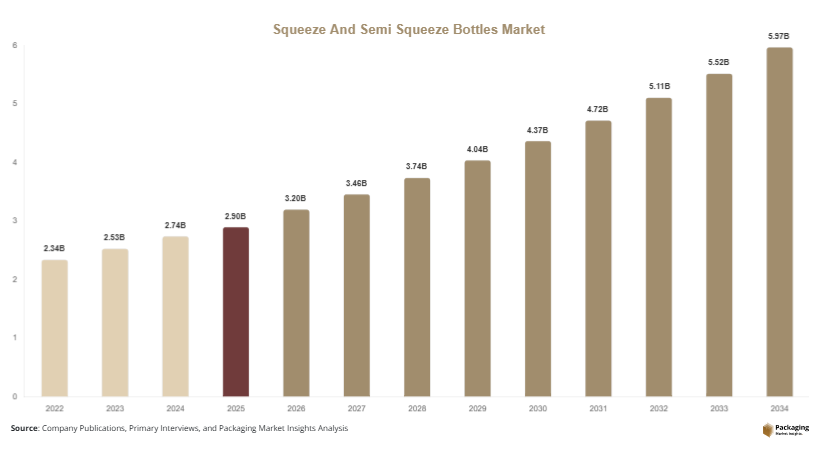
In 2025, the global squeeze and semi squeeze bottles market size is estimated at USD 2.9 billion, which is projected to reach USD 3.2 billion in 2026. By 2034, the market is expected to attain approximately USD 6.1 billion, registering a CAGR of 8.1% (2025–2034). The squeeze and semi squeeze bottles market is witnessing steady growth due to rising demand from food & beverage, personal care, household cleaning, pharmaceutical, and industrial packaging industries. These bottles are widely used for controlled dispensing of liquids, gels, and semi-viscous products, offering convenience, portion control, and product hygiene.
Growth in the market is primarily driven by increasing consumption of packaged food products, rising demand for convenient dispensing packaging formats, and expanding personal care product usage. The shift toward on-the-go consumption lifestyles is significantly influencing packaging design trends, where squeeze bottles offer ease of use and controlled dispensing. Additionally, semi squeeze bottles are gaining traction in pharmaceutical and healthcare applications due to their precise dosage control and contamination prevention features.
Key Highlights
- Market size (2025): The Squeeze And Semi Squeeze Bottles Market is valued at USD 2.9 Billion in 2025, driven by increasing demand from food, personal care, and healthcare packaging applications. Growth is supported by rising consumer preference for convenient, hygienic, and easy-to-use dispensing packaging formats across global markets.
- Market size (2026): The market is expected to reach USD 3.2 Billion in 2026, reflecting steady expansion in packaged food consumption and growing adoption of ergonomic bottle designs in personal care and pharmaceutical industries.
- Forecast value (2034): By 2034, the market is projected to reach USD 6.1 Billion, supported by increasing demand for recyclable, lightweight, and durable packaging solutions across FMCG, healthcare, and retail sectors worldwide.
- CAGR (2025–2034): The market is expected to grow at a CAGR of 8.1% during 2025–2034, driven by strong demand from food, personal care, and healthcare sectors, along with rising adoption of sustainable and lightweight packaging materials.
- Strong demand from food, personal care, and healthcare sectors: Demand is increasing due to expanding consumption of packaged food products, rising use of cosmetic and hygiene products, and growing pharmaceutical packaging needs that require controlled dispensing and contamination-free solutions.
- Rising adoption of recyclable and lightweight packaging materials: Manufacturers are shifting toward HDPE, LDPE, and PET-based bottles as industries prioritize sustainability goals, reduce plastic waste, and improve transportation efficiency through lightweight packaging solutions.
Explore more data points, trends and opportunities Download Free Sample Report
Market Trends
Shift Toward Ergonomic and User-Friendly Packaging Designs
The squeeze and semi squeeze bottles market is experiencing a strong trend toward ergonomic packaging solutions designed to improve user convenience and product accessibility. Manufacturers are focusing on bottle designs that allow controlled dispensing with minimal effort, reducing product waste and enhancing consumer experience. This trend is especially prominent in personal care products such as shampoos, lotions, and sanitizers, where ease of use is a key purchasing factor. Advanced nozzle designs, flip-top caps, and anti-drip mechanisms are being integrated into squeeze bottle structures to improve functionality. Additionally, brands are using packaging innovation as a differentiation strategy in competitive retail environments, leading to continuous improvements in bottle shape, flexibility, and material strength.
Increasing Adoption of Sustainable and Refillable Bottle Systems
Sustainability is emerging as a major trend shaping the squeeze and semi squeeze bottles industry. Manufacturers are increasingly adopting recyclable plastics, bio-based polymers, and refillable packaging systems to reduce environmental impact. Regulatory pressures and consumer awareness regarding plastic waste are accelerating this transition. Companies are introducing lightweight bottle designs that use less raw material while maintaining durability and performance. Refillable squeeze bottles are gaining traction in household cleaning and personal care segments, where consumers prefer cost-effective and environmentally responsible packaging solutions. This trend is also supported by circular economy initiatives and brand commitments to reduce single-use plastic consumption.
Market Drivers
Expansion of Packaged Food and Personal Care Consumption
The increasing global demand for packaged food and personal care products is a major driver for the squeeze and semi squeeze bottles market. Consumers are shifting toward ready-to-use, hygienic, and convenient packaging formats that offer easy dispensing and portion control. Squeeze bottles are widely used in sauces, condiments, cooking oils, lotions, and skincare products due to their practicality and efficiency. The rise in urbanization, busy lifestyles, and dual-income households is further driving consumption of packaged goods. Additionally, food service industries such as quick-service restaurants and delivery platforms rely heavily on squeeze bottles for sauces and dressings, strengthening overall market demand.
Technological Advancements in Plastic Molding and Bottle Design
Technological advancements in blow molding, injection molding, and extrusion processes are significantly driving market growth. These technologies enable manufacturers to produce lightweight, durable, and cost-efficient squeeze bottles with complex geometries and improved functionality. Innovations in multi-layer plastic structures are enhancing barrier properties, ensuring longer shelf life for sensitive products such as cosmetics and pharmaceuticals. Automation in manufacturing processes is also improving production efficiency and reducing waste. Furthermore, advancements in polymer science are enabling the development of flexible yet strong materials that maintain shape integrity during repeated squeezing, enhancing consumer usability.
Market Restraints
Environmental Concerns and Plastic Waste Regulations
A major restraint in the squeeze and semi squeeze bottles market is increasing environmental concern regarding plastic waste generation and strict regulatory frameworks targeting single-use plastics. Governments across Europe, North America, and parts of Asia are implementing policies that restrict plastic consumption and encourage recycling or biodegradable alternatives. This has placed pressure on manufacturers to redesign packaging solutions and invest in sustainable materials, which often increases production costs. Additionally, public awareness regarding plastic pollution is influencing consumer behavior, leading to a gradual shift toward reusable or alternative packaging formats such as glass or metal containers in certain premium segments. For example, personal care brands are increasingly being required to adopt refill systems or recyclable bottle structures, which may limit demand for traditional squeeze bottles in the long term. These regulatory and environmental challenges are pushing manufacturers to innovate, but transition costs remain a significant barrier for small and mid-sized producers.
Market Opportunities
Growth in Refillable and Reusable Packaging Systems
The increasing demand for refillable and reusable packaging presents a major opportunity for the squeeze and semi squeeze bottles market. Consumers are becoming more environmentally conscious and prefer packaging systems that reduce waste and offer long-term usability. Refillable squeeze bottles are being widely adopted in household cleaning, personal care, and food service applications. Brands are introducing refill stations in retail outlets and subscription-based refill delivery models, creating new business opportunities for packaging manufacturers. Additionally, durable squeeze bottles designed for multiple reuse cycles are gaining popularity, supported by innovations in high-strength recyclable plastics.
Expansion in Emerging Economies and Retail Modernization
Emerging economies in Asia Pacific, Latin America, and Africa offer significant growth opportunities due to rising disposable incomes, urbanization, and expansion of modern retail channels. Increasing demand for packaged food, cosmetics, and healthcare products is driving adoption of squeeze and semi squeeze bottles. Local manufacturers are investing in advanced packaging technologies to meet global quality standards. Additionally, the rapid expansion of e-commerce platforms is boosting demand for leak-proof, travel-friendly packaging formats. As retail infrastructure continues to modernize, demand for convenient dispensing packaging solutions is expected to grow significantly.
Report Scope
| Report Metric | Details |
|---|---|
| Market Size in 2025 | USD 2.9 Billion |
| Market Size in 2026 | USD 3.2 Billion |
| Market Size in 2034 | USD 6.1 Billion |
| CAGR | 8.1% (2026-2034) |
| Base Year for Estimation | 2025 |
| Historical Data | 2022-2024 |
| Forecast Period | 2026-2034 |
| Report Coverage | Revenue Forecast, Competitive Landscape, Supply Chain Disruption, Growth Factors, Environment & Regulatory Landscape and Trends |
| Geographies Covered | North America, Europe, APAC, Middle East and Africa, LATAM |
| Countries Covered | U.S., Canada, U.K., Germany, France, Spain, Italy, Russia, Nordic, Benelux, Rest of Europe, China, South Korea, Japan, India, Australia, Singapore, Taiwan, South East Asia, Rest of Asia-Pacific, UAE, Turky, Saudi Arabia, South Africa, Egypt, Nigeria, Rest of MEA, Brazil, Mexico, Argentina, Chile, Colombia, Rest of LATAM |
Explore more data points, trends and opportunities Download Free Sample Report
Segmental Analysis
By Material Type
HDPE squeeze bottles held the dominant share of approximately 41% in 2024, driven by their durability, chemical resistance, and cost-effectiveness. These bottles are widely used in food, household, and personal care applications due to their strong structural integrity and recyclability. HDPE also provides excellent moisture resistance and flexibility, making it suitable for repeated squeezing applications without deformation. Its widespread availability and compatibility with mass production further strengthen its dominance in the market.
PET semi squeeze bottles are expected to grow at a CAGR of 9.0% (2025–2034), driven by increasing demand for transparent and premium packaging formats. PET offers superior clarity, lightweight properties, and enhanced aesthetic appeal, making it highly suitable for cosmetics, skincare, and pharmaceutical products. Rising consumer preference for visually attractive packaging and brand differentiation is further accelerating adoption of PET-based semi squeeze bottles.
By Application
Food & beverage packaging dominated the market with approximately 46% share in 2024, driven by strong demand for sauces, condiments, dressings, and cooking oils. Squeeze bottles provide controlled dispensing, hygiene benefits, and convenience, making them widely used in both household and commercial food service applications. Increasing demand for takeaway and delivery food services further supports segment dominance.
Personal care applications are expected to grow at a CAGR of 8.7% (2025–2034), driven by rising consumption of skincare, haircare, and cosmetic products. Squeeze bottles are widely used for lotions, shampoos, creams, and gels due to their ease of use and controlled dispensing features. Growth is also supported by increasing premiumization in personal care packaging.
By End-Use Industry
FMCG held the dominant share of approximately 48% in 2024, driven by high global consumption of packaged food, beverages, and personal care products. Squeeze bottles are preferred due to their convenience, portability, and branding flexibility. Strong retail penetration and expanding supermarket chains further reinforce FMCG dominance in this market.
Healthcare is expected to grow at a CAGR of 8.5% (2025–2034), driven by increasing demand for controlled dispensing in pharmaceutical syrups, topical medicines, and sanitizing products. Strict hygiene standards and precise dosage requirements are major factors supporting adoption of squeeze and semi squeeze bottles in healthcare applications.
Squeeze And Semi Squeeze Bottles Market Segmentations
By Material Type
- HDPE Bottles
- LDPE Bottles
- PET Semi Squeeze Bottles
By Application
- Food & Beverage
- Personal Care
- Household Care
- Pharmaceuticals
By End-Use Industry
- FMCG
- Healthcare
- Retail & E-commerce
- Food Service
- Industrial
Regional Analysis
North America
North America accounted for approximately 27% share of the squeeze and semi squeeze bottles market in 2025, with a projected CAGR of 7.9% during 2025–2034. The region shows strong demand across food service, personal care, and pharmaceutical packaging sectors. High consumer preference for convenience packaging and strong penetration of branded FMCG products are key supporting factors. The market also benefits from advanced packaging automation and widespread adoption of ergonomic dispensing solutions.
The United States dominates the regional market due to its large FMCG and food processing industries. A key growth factor is the rising demand for on-the-go food consumption and ready-to-use condiments, which significantly increases the adoption of squeeze bottles in restaurants, quick-service chains, and household applications.
Europe
Europe held around 23% market share in 2025, with a projected CAGR of 8.0% (2025–2034). The market is strongly influenced by sustainability regulations restricting single-use plastics and promoting recyclable packaging materials. Demand is also driven by strong personal care, cosmetics, and pharmaceutical packaging industries. European consumers increasingly prefer premium, eco-friendly, and reusable packaging formats.
Germany leads the region due to its advanced packaging machinery and chemical processing industries. A key growth factor is the EU’s circular economy policies, which are pushing manufacturers to adopt recyclable and lightweight squeeze bottle designs across FMCG and healthcare packaging applications.
Asia Pacific
Asia Pacific dominated the market with approximately 33% share in 2025, and is expected to grow at the fastest CAGR of 8.8% during 2025–2034. The region benefits from rapid urbanization, rising disposable incomes, and strong growth in packaged food and personal care consumption. Expanding manufacturing capabilities and cost-efficient production further support regional dominance.
China leads the market due to its large-scale packaging production base and export-oriented FMCG industry. A key growth factor is the rapid expansion of e-commerce and food delivery platforms, which significantly increases demand for durable, leak-proof squeeze and semi squeeze bottle packaging.
Middle East & Africa
The Middle East & Africa accounted for approximately 8% market share in 2025, with a projected CAGR of 7.8% (2025–2034). Growth is driven by increasing retail modernization, rising urban population, and expanding food service industries. Demand for packaged consumer goods is steadily increasing across major economies in the region.
Saudi Arabia dominates the regional market due to economic diversification initiatives under Vision programs. A key growth factor is the expansion of hospitality, tourism, and quick-service restaurant chains, which rely heavily on squeeze bottles for sauces, condiments, and food preparation applications.
Latin America
Latin America held around 9% share in 2025, with a projected CAGR of 7.9% (2025–2034). The market is supported by growing FMCG consumption, increasing urbanization, and expansion of modern retail channels. Rising demand for packaged food and personal care products is further strengthening market growth.
Brazil leads the region due to its strong food processing and beverage industry. A key growth factor is the increasing adoption of convenient packaging formats in urban households, especially for sauces, oils, and personal care products.
Competitive Landscape
The market is moderately fragmented with strong competition among packaging manufacturers focusing on sustainability and innovation. Key players include Berry Global Inc., Amcor plc, Plastipak Holdings, Silgan Holdings, and Gerresheimer AG. These companies focus on lightweight packaging, recyclable materials, and advanced bottle design technologies.
Amcor plc is a leading player due to its global production network and sustainable packaging innovations. Recent developments include expansion of recyclable plastic bottle production and introduction of refillable squeeze packaging solutions.
Key Players List
- Berry Global Inc.
- Amcor plc
- Plastipak Holdings Inc.
- Silgan Holdings Inc.
- Gerresheimer AG
- AptarGroup Inc.
- Alpla Group
- RPC Group (Berry Global)
- Pretium Packaging
- Comar LLC
- Graham Packaging Company
- Weener Plastics
- Alpha Packaging
- C.L. Smith Company
- Mold-Rite Plastics