Bottles Market Size
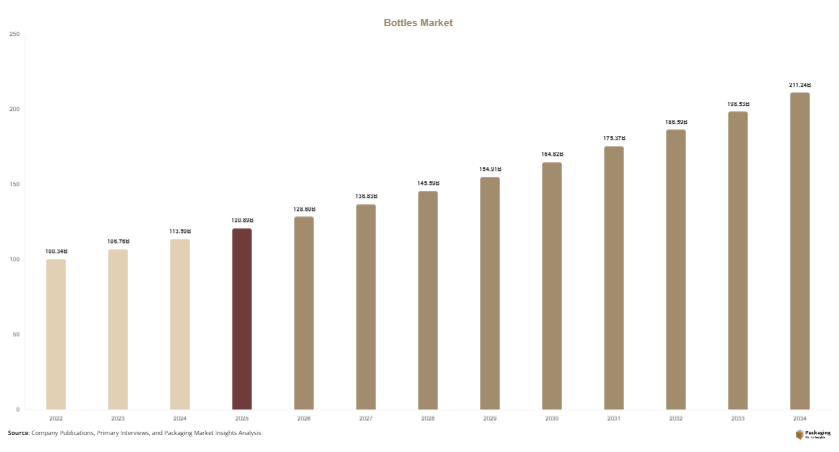
Bottle market size is projected at USD 128.60 billion in 2026 and is expected to hit USD 210.90 billion by 2034 with a CAGR of 6.4%. Growing demand for sustainable, lightweight, and high-performance packaging across food, beverage, pharmaceutical, and personal care industries continues to support market expansion. The report delivers comprehensive analysis covering production volumes, segmentation, regional performance, and the competitive landscape.
The bottle market comprises rigid packaging containers manufactured using plastic, glass, and metal for packaging liquids, semi-liquids, and specialty products. Global production exceeded 1.96 trillion bottle units in 2026, utilizing more than 67.5 million metric tons of packaging materials. Food and beverage applications accounted for nearly 68% of total bottle consumption, while plastic bottles represented approximately 61% of global production. Recyclable packaging adoption surpassed 45%, reinforcing long-term development across the bottle market.
Explore more data points, trends and opportunities Download Free Sample Report
Bottles Market Trends
Rising Adoption of Sustainable Bottle Packaging
Manufacturers continue increasing recycled material usage and lightweight bottle designs to reduce environmental impact. Global recycled bottle production exceeded 28.4 million metric tons, while lightweight packaging initiatives reduced resin consumption by nearly 18%. More than 58% of beverage manufacturers now incorporate recyclable bottle packaging, strengthening the bottles' market.
Automation and Smart Manufacturing in Bottle Production
Advanced blow molding, injection molding, and automated inspection technologies continue improving manufacturing efficiency. Annual production exceeded 1.96 trillion bottle units, while automated production lines increased manufacturing productivity by 22%. Smart factory implementation surpassed 52% among major bottle manufacturers, supporting continued innovation in the bottles market.
Bottles Market Drivers
Growing Demand from Beverage and Packaged Food Industries
Expanding consumption of bottled beverages and packaged food products continues driving bottle demand worldwide. Global bottled beverage production exceeded 920 billion units, while packaged food shipments increased by 10% during 2026. More than 74% of beverage packaging utilizes bottles due to convenience, product safety, and transportation efficiency, accelerating the bottle market.
Bottles Market Restraints
Volatility in Raw Material Prices
Price fluctuations in plastic resins, glass, aluminum, and energy continue affecting manufacturing profitability. Raw materials account for approximately 64% of production costs, while annual price variations range between 9% and 17%. Supply chain disruptions continue influencing production planning throughout the bottles market.
Bottles Market Opportunities
Expansion of Recyclable and Refillable Packaging Solutions
Government sustainability initiatives and corporate recycling commitments continue creating growth opportunities. Global investments exceeding USD 5.1 billion supported bottle recycling and refill infrastructure during 2026. More than 41% of packaging companies expanded reusable bottle portfolios, creating significant opportunities across the bottles market.
Challenges in Bottles Market
Balancing Sustainability with Manufacturing Costs
Bottle manufacturers continue investing in lightweight materials, recycled content, and advanced production technologies while maintaining product performance. Industry participants allocate approximately 8% of annual revenue to research and development, while quality control requires over 6,000 inspection points per production cycle. These factors remain ongoing challenges for the bottle market.
Report Scope
| Report Metric | Details |
|---|---|
| Market Size in 2025 | USD 120.89 Billion |
| Market Size in 2026 | USD 128.60 Billion |
| Market Size in 2034 | USD 210.90 Billion |
| CAGR | 6.4% (2026-2034) |
| Base Year for Estimation | 2025 |
| Historical Data | 2022-2024 |
| Forecast Period | 2026-2034 |
| Report Coverage | Revenue Forecast, Competitive Landscape, Supply Chain Disruption, Growth Factors, Environment & Regulatory Landscape and Trends |
| Geographies Covered | North America, Europe, APAC, Middle East and Africa, LATAM |
| Countries Covered | U.S., Canada, U.K., Germany, France, Spain, Italy, Russia, Nordic, Benelux, Rest of Europe, China, South Korea, Japan, India, Australia, Singapore, Taiwan, South East Asia, Rest of Asia-Pacific, UAE, Turkey, Saudi Arabia, South Africa, Egypt, Nigeria, Rest of MEA, Brazil, Mexico, Argentina, Chile, Colombia, Rest of LATAM |
Explore more data points, trends and opportunities Download Free Sample Report
Bottles Market Segmentation
The market is segmented by material and end-use industry to evaluate demand across packaging applications. Plastic bottles account for approximately 61% of total production, while food and beverage applications contribute nearly 68% of worldwide bottle consumption. Annual manufacturing exceeds 1.96 trillion bottle units globally.
By Material
Plastic bottles dominate the market with approximately 61% share. Annual production exceeds 1.19 trillion units, offering lightweight construction, high durability, and cost-effective manufacturing. These bottles are widely used for beverages, edible oils, household chemicals, and personal care products.
Glass bottles account for approximately 26% of global production, exceeding 510 billion units annually. Their superior chemical resistance, premium appearance, and recyclability make them suitable for alcoholic beverages, pharmaceuticals, and cosmetics.
Metal bottles contribute approximately 13% of production, with annual output exceeding 255 billion units. These bottles provide excellent durability, thermal insulation, and long service life for beverages and reusable packaging applications.
By End-use Industry
Food and beverage remain the largest application with approximately 68% market share. Annual consumption exceeds 1.33 trillion bottle units, supporting bottled water, soft drinks, juices, dairy products, sauces, and edible oils. High consumer demand continues driving production growth.
Pharmaceutical applications account for approximately 18% of global demand. Annual production exceeds 353 billion bottle units, supporting liquid medicines, syrups, healthcare solutions, and nutraceutical products while maintaining stringent regulatory compliance.
Personal care and cosmetics contribute approximately 14% of market demand, with more than 274 billion bottle units produced annually. Bottles provide product protection, branding advantages, and dispensing convenience across skincare, haircare, and hygiene products.
Bottles Market Segmentations
Material
- Plastic Bottles
- Glass Bottles
- Metal Bottles
End-use Industry
- Food & Beverage
- Pharmaceuticals
- Personal Care & Cosmetics
Bottles, Regional Outlook
North America
North America accounts for approximately 26% of global bottle demand. Annual production exceeds 17.4 million metric tons, with the United States representing nearly 80% of regional consumption. Beverage packaging remains the dominant application.
Europe
Europe contributes approximately 27% of worldwide demand. Germany, France, Italy, Spain, and the United Kingdom account for over 71% of regional production. Annual manufacturing exceeds 18.2 million metric tons, supported by advanced recycling infrastructure.
Asia-Pacific
Asia-Pacific dominates the market with approximately 40% share. China, India, Japan, and Southeast Asian countries contribute more than 82% of regional production. Manufacturing exceeds 27 million metric tons, supported by rapid industrialization and expanding consumer goods industries.
Latin America
Latin America represents approximately 4% of global demand. Brazil and Mexico contribute nearly 68% of regional production, supported by beverage manufacturing and packaged food expansion.
Middle East & Africa
The Middle East & Africa account for approximately 3% of worldwide bottle consumption. GCC countries and South Africa continue investing in food processing, beverage manufacturing, and pharmaceutical production, supporting stable market growth.
Top Players in the Bottles Market
- Amcor plc
- Berry Global Inc.
- O-I Glass, Inc.
- Ardagh Group S.A.
- ALPLA Group
- Plastipak Holdings, Inc.
- Gerresheimer AG
- Silgan Holdings Inc.
- Verallia SA
- Vidrala S.A.
- Graham Packaging Company
- Ball Corporation
- Crown Holdings, Inc.
- AptarGroup, Inc.
- Alpha Packaging
Amcor plc
- Estimated market presence: 10–12%
- Leading global supplier of rigid and flexible bottle packaging solutions.
- Strong manufacturing footprint across North America, Europe, Asia-Pacific, and Latin America.
- Extensive portfolio serving food, beverage, pharmaceutical, and personal care industries.
- Significant investments in recyclable materials, lightweight packaging, and circular economy initiatives strengthen production capabilities. Continuous innovation and sustainability strategies reinforce the company's leadership across global bottle packaging markets.
O-I Glass, Inc.
- Estimated market presence: 8–10%
- Global leader in glass bottle manufacturing with advanced production facilities worldwide.
- Strong presence across beverage, pharmaceutical, and food packaging industries.
- Continuous investments in furnace modernization, recycled glass utilization, and energy-efficient manufacturing improve operational performance.
- Premium product quality and global customer relationships continue strengthening competitive positioning within the international bottle manufacturing industry.