Tottle Containers Market Size and Growth
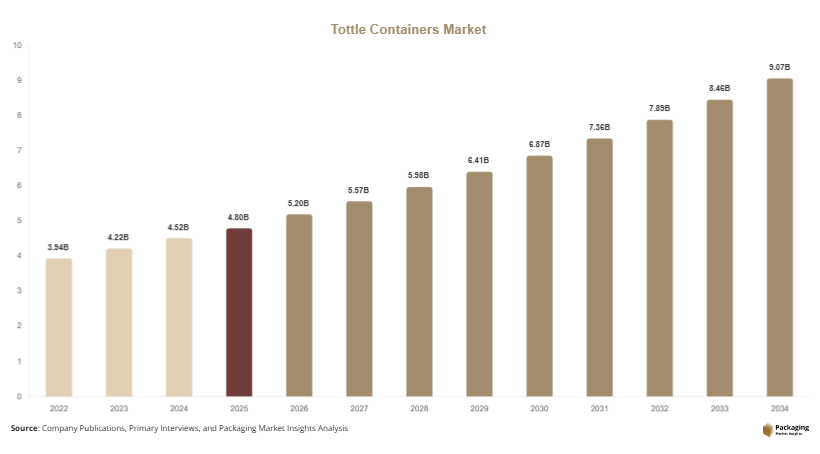
The global tottle containers market size was valued at approximately USD 4.8 billion in 2025 and is projected to reach nearly USD 5.2 billion in 2026. By 2034, the market is forecast to reach around USD 9.1 billion, expanding at a CAGR of 7.2% during 2025–2034. The tottle containers market is experiencing steady expansion due to rising demand for flexible and user-friendly packaging formats across personal care, cosmetics, pharmaceuticals, and food applications. Tottle containers combine the structural stability of bottles with the squeezability of tubes, making them suitable for premium creams, gels, lotions, sauces, and healthcare products.
Growing consumer preference for convenient dispensing packaging is one of the key growth factors supporting the market. Tottle containers offer controlled product dispensing, portability, and enhanced shelf appeal, making them attractive for brands seeking packaging differentiation. In the cosmetics sector, skincare and haircare companies are increasingly shifting toward lightweight and squeezable packaging solutions to improve user experience and reduce product waste.
Key Highlights
- Asia Pacific dominated the market with a 39.1% share in 2025.
- Latin America is projected to grow at the fastest CAGR of 7.8%.
- Plastic tottle containers led the type segment with a 58.6% share.
- Polyethylene material dominated with a 49.4% share.
- Personal care & cosmetics applications led the segment with 46.8% share.
- The US remained the dominant country with a market size of USD 1.1 billion in 2025 and USD 1.2 billion in 2026.
Explore more data points, trends and opportunities Download Free Sample Report
Market Trends
Rising Adoption of Sustainable and Recyclable Tottle Packaging
Sustainability has become a major trend shaping the tottle containers market as global brands focus on reducing packaging waste and improving recyclability. Manufacturers are increasingly using mono-material polyethylene structures and post-consumer recycled plastics to create eco-friendly packaging solutions. Beauty and skincare companies are launching recyclable tottle containers that support circular economy goals while maintaining product protection and aesthetics. Many packaging suppliers are also introducing lightweight designs that reduce raw material consumption and transportation costs. The growing popularity of refillable cosmetic packaging systems is expected to further support sustainable tottle container demand over the forecast period.
Increasing Use of Premium Decorative Packaging Designs
Premiumization trends in cosmetics, wellness, and personal care industries are driving demand for visually attractive tottle containers with advanced decoration technologies. Brands are adopting matte finishes, metallic coatings, embossing, digital printing, and soft-touch textures to improve product shelf visibility and consumer engagement. Luxury skincare companies increasingly use customized dispensing closures and ergonomic packaging formats to create differentiated brand experiences. Digital printing advancements are enabling shorter production runs and personalized packaging campaigns for niche product launches. Future growth is expected from smart packaging integration, including QR codes and connected packaging technologies that improve customer interaction and product authentication.
Market Drivers
Expansion of Global Personal Care and Cosmetics Industry
The rapid growth of the global personal care and cosmetics industry is a major driver for the tottle containers market. Consumers increasingly prefer packaging formats that provide convenience, portability, and controlled dispensing for creams, lotions, gels, and serums. Tottle containers are widely adopted because they combine functionality with attractive shelf presentation. The expansion of skincare brands, male grooming products, and premium beauty solutions is increasing packaging demand across developed and emerging economies. For example, several cosmetic manufacturers in the United States and South Korea are introducing travel-friendly and refillable packaging formats to attract environmentally conscious consumers and younger demographics.
Rising E-Commerce Packaging Requirements
The expansion of online retail channels is significantly increasing demand for durable and leak-resistant packaging formats. Tottle containers provide better product protection during transportation compared to traditional jars and rigid bottles. E-commerce companies and direct-to-consumer brands prefer packaging solutions that reduce product leakage and damage risks while maintaining product aesthetics. Growing online sales of beauty, pharmaceutical, and wellness products are accelerating the adoption of lightweight packaging designs. In addition, manufacturers are improving cap sealing technologies and impact resistance properties to meet evolving logistics and fulfillment requirements in global e-commerce supply chains.
Market Restraint
Fluctuating Raw Material Costs and Recycling Infrastructure Challenges
One of the primary restraints affecting the tottle containers market is the volatility in plastic resin prices and limited recycling infrastructure in several developing economies. Polyethylene and polypropylene prices fluctuate due to changes in crude oil costs, supply chain disruptions, and geopolitical conditions. Rising raw material costs directly affect manufacturing margins for packaging producers and increase product prices for end users. In addition, sustainable packaging adoption is constrained in regions where recycling systems remain underdeveloped. Many countries still lack effective collection and sorting infrastructure for flexible and mixed-material packaging waste. For example, smaller cosmetic companies in emerging economies often face challenges in sourcing affordable recycled materials while complying with sustainability regulations. These factors may slow large-scale adoption of eco-friendly tottle packaging solutions in price-sensitive markets.
Market Opportunities
Growth in Pharmaceutical and Healthcare Packaging Applications
The increasing demand for hygienic and contamination-resistant packaging in pharmaceutical applications presents strong growth opportunities for the tottle containers market. Healthcare companies are adopting tottle containers for topical creams, ointments, medicated gels, and dermatology products due to their controlled dispensing features. Aging populations and rising healthcare spending are increasing pharmaceutical packaging demand globally. In addition, manufacturers are developing tamper-evident and child-resistant closures for medical applications. Future opportunities are expected from growth in over-the-counter healthcare products and personalized medicine packaging solutions in developed markets.
Rising Demand for Bio-Based and Refillable Packaging
Growing environmental awareness is creating opportunities for bio-based and refillable tottle container solutions. Packaging manufacturers are investing in sugarcane-based polyethylene, biodegradable polymers, and reusable dispensing systems to meet sustainability targets. Beauty and wellness brands are increasingly introducing refill pouches and reusable outer packaging formats to reduce single-use plastic waste. Refillable packaging programs are becoming popular in premium skincare and luxury cosmetic categories across Europe and North America. Future demand is expected to increase as governments introduce stricter plastic reduction regulations and consumers prioritize environmentally responsible packaging products.
Report Scope
| Report Metric | Details |
|---|---|
| Market Size in 2025 | USD 4.8 Billion |
| Market Size in 2026 | USD 5.2 Billion |
| Market Size in 2034 | USD 9.1 Billion |
| CAGR | 7.2% (2026-2034) |
| Base Year for Estimation | 2025 |
| Historical Data | 2022-2024 |
| Forecast Period | 2026-2034 |
| Report Coverage | Revenue Forecast, Competitive Landscape, Supply Chain Disruption, Growth Factors, Environment & Regulatory Landscape and Trends |
| Geographies Covered | North America, Europe, APAC, Middle East and Africa, LATAM |
| Countries Covered | U.S., Canada, U.K., Germany, France, Spain, Italy, Russia, Nordic, Benelux, Rest of Europe, China, South Korea, Japan, India, Australia, Singapore, Taiwan, South East Asia, Rest of Asia-Pacific, UAE, Turky, Saudi Arabia, South Africa, Egypt, Nigeria, Rest of MEA, Brazil, Mexico, Argentina, Chile, Colombia, Rest of LATAM |
Explore more data points, trends and opportunities Download Free Sample Report
Segmental Analysis
By Type
Rigid tottle containers dominated the Tottle Containers Market in 2024 and accounted for approximately 58.7% of the global market share. These containers are widely used in cosmetics, skincare, pharmaceutical creams, and personal care products because they provide excellent structural integrity and premium shelf appearance. Brands increasingly prefer rigid tottles for lotions, serums, sunscreens, and facial cleansers due to their controlled dispensing and compatibility with advanced decoration technologies. Major beauty and healthcare companies are investing in high-clarity rigid packaging with improved barrier protection to maintain product stability and extend shelf life. In North America and Europe, rigid tottle containers are commonly used in premium skincare products because consumers associate them with hygiene and product safety. Additionally, manufacturers are incorporating recyclable polyethylene and polypropylene materials into rigid packaging production to comply with sustainability regulations. Growing retail sales of personal grooming products and increased demand for aesthetically appealing packaging continue to support the dominance of rigid tottle containers across global consumer goods industries.
Flexible tottle containers are projected to witness the fastest CAGR of 7.4% during 2025–2034. These containers are gaining strong popularity because they reduce material consumption, lower transportation costs, and improve convenience for end users. Flexible tottles are increasingly used in travel-size cosmetics, liquid soaps, haircare products, and nutraceutical formulations where lightweight packaging is essential. Brands operating in e-commerce channels are adopting flexible packaging solutions to reduce shipping weight and minimize product breakage during transit. In Asia Pacific, demand for flexible tottle containers is increasing due to rapid expansion of affordable beauty and wellness brands targeting younger consumers. Manufacturers are also developing mono-material flexible containers that simplify recycling processes and align with circular economy initiatives. Digital printing technologies are further improving the visual appeal of flexible tottles while enabling short-run customized packaging production. As sustainability targets become stricter and companies focus on packaging optimization, flexible tottle containers are expected to gain substantial adoption across cosmetics, pharmaceutical, and household product applications over the forecast period.
By Material
Plastic materials dominated the Tottle Containers Market in 2024 with a market share of nearly 64.2%. Polyethylene (PE), polypropylene (PP), and PET remain the most widely used materials because of their durability, flexibility, chemical resistance, and cost efficiency. Plastic tottle containers are extensively utilized in personal care, healthcare, food, and cosmetic applications due to their lightweight properties and compatibility with high-speed manufacturing lines. Many global packaging producers continue to expand production capacities for recyclable plastic packaging as consumer goods demand rises worldwide. In the cosmetics industry, plastic tottles allow brands to create customized designs, vibrant labeling, and ergonomic packaging formats that improve shelf visibility. Pharmaceutical companies also rely on plastic materials because they provide excellent product protection against contamination and leakage. Furthermore, recycled plastic integration is becoming increasingly common, especially in the United States and Europe, where sustainability mandates encourage the use of post-consumer recycled content. Continuous innovation in bio-based plastics and recyclable polymer technologies is expected to strengthen the long-term position of plastic materials within the global market.
Biodegradable and paper-based materials are anticipated to register the fastest CAGR of 8.1% during the forecast period. Rising environmental awareness and increasing restrictions on single-use plastics are encouraging companies to adopt sustainable alternatives for cosmetic and personal care packaging. Several brands are introducing paper-laminated tottle containers and biodegradable resin packaging to improve sustainability performance and reduce carbon emissions. In Europe, regulatory pressure regarding plastic waste management is accelerating investments in compostable and fiber-based packaging technologies. Consumer preference for eco-friendly packaging is also growing rapidly among younger demographics, particularly in premium skincare and organic product categories. Packaging manufacturers are collaborating with material science companies to improve moisture resistance and durability in paper-based tottle packaging formats. In addition, advances in barrier coating technologies are enabling sustainable materials to compete with traditional plastics in terms of product protection and shelf life. As governments strengthen recycling regulations and multinational brands increase sustainable packaging commitments, biodegradable and paper-based materials are expected to experience substantial growth across global markets.
By End-Use
Cosmetics and personal care applications dominated the Tottle Containers Market in 2024, accounting for nearly 46.8% of total revenue share. The increasing global demand for skincare, haircare, and beauty products has significantly contributed to packaging consumption across this segment. Tottle containers are highly preferred in cosmetics because they combine the advantages of bottles and tubes, offering easy dispensing, product protection, and premium visual appeal. Leading cosmetic brands are focusing on innovative packaging shapes, airless dispensing systems, and sustainable materials to improve customer engagement and brand differentiation. The rapid expansion of online beauty retail platforms is also increasing the need for durable and leak-resistant packaging solutions that can withstand transportation stress. In countries such as the United States, South Korea, Japan, and France, premium skincare brands continue to invest heavily in aesthetically advanced tottle packaging designs. Furthermore, rising consumer interest in travel-friendly and portable cosmetic products is accelerating demand for compact and lightweight tottle containers. The combination of product convenience, branding opportunities, and sustainability initiatives continues to strengthen the dominance of cosmetics and personal care applications in the global market.
Pharmaceutical and nutraceutical applications are projected to grow at the fastest CAGR of 7.8% from 2025 to 2034. Growing healthcare awareness, rising demand for topical medicines, and expanding consumption of wellness products are driving the use of secure and hygienic packaging formats. Pharmaceutical manufacturers increasingly prefer tottle containers for ointments, gels, creams, and liquid supplements because they provide controlled dispensing and minimize contamination risks. In addition, nutraceutical brands are adopting specialized tottle packaging for protein gels, herbal formulations, and immunity-boosting products. The growth of aging populations in North America, Europe, and parts of Asia Pacific is further contributing to higher pharmaceutical packaging demand. Manufacturers are also introducing tamper-evident closures and antimicrobial packaging technologies to meet stricter healthcare regulations. Smart labeling solutions, including QR codes and digital authentication systems, are becoming more common in pharmaceutical packaging to improve product traceability and consumer trust. As healthcare spending increases globally and wellness trends continue to expand, pharmaceutical and nutraceutical applications are expected to create strong long-term growth opportunities for tottle container manufacturers.
Tottle Containers Market Segmentations
By Type
- Plastic Tottle Containers
- Bio-Based Tottle Containers
- Refillable Tottle Containers
- Multi-Layer Tottle Containers
By Material
- Polyethylene
- Polypropylene
- Recycled Plastics
- Bio-Based Polymers
By End-User
- Personal Care & Cosmetics
- Pharmaceuticals
- Food & Beverage
- Household Products
- Nutraceuticals
Regional Analysis
North America
North America accounted for 27.8% of the global tottle containers market share in 2025 and is projected to expand at a CAGR of 6.9% during the forecast period. The region benefits from strong demand for premium cosmetic and personal care packaging products. Growing online beauty retail sales and increasing adoption of sustainable packaging formats are supporting market expansion. Manufacturers in the United States and Canada are investing in recycled resin packaging technologies and lightweight dispensing solutions to meet sustainability commitments. In addition, rising pharmaceutical packaging demand is contributing to the growth of advanced tottle container applications across healthcare and wellness sectors.
The United States dominates the North American market due to strong consumer demand for skincare, nutraceutical, and healthcare products. One unique growth driver is the rapid expansion of direct-to-consumer beauty brands that prioritize innovative packaging designs and premium aesthetics. Several cosmetic startups are adopting digitally printed tottle containers with refillable dispensing systems to improve brand visibility and customer retention. The increasing popularity of clean-label and organic beauty products is also encouraging sustainable packaging investments throughout the country.
Europe
Europe held approximately 24.3% of the global market share in 2025 and is forecast to grow at a CAGR of 6.7% through 2034. Strict environmental regulations and rising demand for recyclable packaging are major growth contributors across the region. Cosmetic, pharmaceutical, and food packaging companies are increasingly adopting mono-material tottle packaging to comply with circular economy targets. Countries such as Germany, France, and Italy are witnessing strong investments in advanced packaging manufacturing technologies. Growing demand for luxury cosmetic packaging and refillable beauty solutions is also supporting market expansion in Europe.
Germany represents the leading country in the European tottle containers market due to its strong packaging manufacturing infrastructure and sustainability initiatives. A unique growth factor is the country’s focus on recycled-content packaging standards for consumer goods industries. Several German packaging companies are launching PCR-based tottle containers for premium cosmetic brands. Demand is also increasing from pharmaceutical and wellness product manufacturers seeking hygienic dispensing solutions with improved recyclability and reduced environmental impact.
Asia Pacific
Asia Pacific dominated the global tottle containers market with a 39.1% share in 2025 and is expected to register a CAGR of 7.6% through 2034. Rapid urbanization, rising disposable incomes, and expanding cosmetics industries are major growth drivers in the region. Countries including China, Japan, South Korea, and India are witnessing increased consumption of skincare, personal hygiene, and healthcare products. Packaging manufacturers are expanding regional production capacities to meet growing consumer demand. In addition, the region benefits from low manufacturing costs and strong export activities in beauty and pharmaceutical packaging products.
China remains the dominant country in Asia Pacific due to its extensive cosmetic manufacturing base and strong packaging production capabilities. One unique growth driver is the rapid growth of livestream e-commerce and online beauty retail platforms. Chinese cosmetic brands increasingly prefer customized and visually attractive tottle packaging formats to improve product visibility in digital retail environments. Local packaging firms are also investing in biodegradable plastic materials and smart dispensing technologies to support sustainable packaging trends in the domestic market.
Middle East & Africa
The Middle East & Africa region accounted for 4.9% of the global market share in 2025 and is projected to grow at a CAGR of 6.4% during the forecast period. Increasing demand for premium personal care and healthcare products is supporting packaging market growth across Gulf countries and parts of Africa. Expanding retail infrastructure and rising investments in pharmaceutical manufacturing are contributing to regional demand for advanced dispensing packaging solutions. The growth of tourism and hospitality sectors is also increasing demand for travel-size cosmetic and hygiene packaging products throughout the region.
Saudi Arabia dominates the Middle East & Africa market due to expanding investments in cosmetics, wellness, and pharmaceutical manufacturing industries. A unique growth factor is the increasing localization of packaging production facilities under industrial diversification programs. Several packaging companies are establishing regional manufacturing plants to reduce import dependence and improve supply chain efficiency. Rising consumer interest in luxury skincare and halal-certified beauty products is also supporting demand for premium tottle packaging formats.
Latin America
Latin America represented 3.9% of the global market share in 2025 and is anticipated to grow at the fastest CAGR of 7.8% through 2034. Rising urban populations and growing personal care product consumption are supporting regional market growth. Countries such as Brazil and Mexico are witnessing increasing demand for affordable yet attractive packaging solutions across cosmetics and healthcare industries. The expansion of e-commerce channels and retail modernization is encouraging companies to adopt durable and visually appealing dispensing containers. Sustainable packaging initiatives are also gaining traction among regional consumer goods manufacturers.
Brazil remains the leading country in the Latin American market due to its large cosmetics and personal care industry. One unique growth driver is the increasing demand for refillable and reusable packaging systems in beauty products. Brazilian cosmetic brands are introducing refill pouch programs and recyclable packaging formats to attract environmentally conscious consumers. Local manufacturers are also investing in flexible dispensing technologies and lightweight plastic packaging materials to improve product affordability and transportation efficiency.
Competitive Landscape
The tottle containers market is moderately consolidated, with leading companies focusing on sustainable packaging innovations, capacity expansions, and strategic partnerships. Major manufacturers are investing in recyclable material technologies, lightweight packaging solutions, and digital printing capabilities to strengthen market competitiveness. Companies are also emphasizing customization and premium packaging aesthetics to meet evolving consumer preferences across cosmetics, pharmaceuticals, and food sectors.
Albea Group is one of the leading companies in the market due to its extensive packaging product portfolio and strong global manufacturing presence. The company recently introduced recyclable mono-material tottle packaging solutions for cosmetic applications to support sustainability initiatives. Berry Global, EPL Limited, Huhtamaki, and Amcor are also actively expanding their dispensing packaging product lines through innovation and acquisitions. Several companies are partnering with beauty and healthcare brands to develop refillable and eco-friendly packaging systems that reduce plastic waste and improve consumer engagement.
Key Players List
- Albea Group
- Berry Global Inc.
- Amcor plc
- EPL Limited
- Huhtamaki Oyj
- Silgan Holdings Inc.
- AptarGroup, Inc.
- Gerresheimer AG
- CCL Industries
- Montebello Packaging
- Essel Propack Ltd.
- Hoffmann Neopac AG
- Raepak Ltd.
- HCP Packaging
- Frapak Packaging