Pharmaceutical Plastic Bottles Market Size and Growth
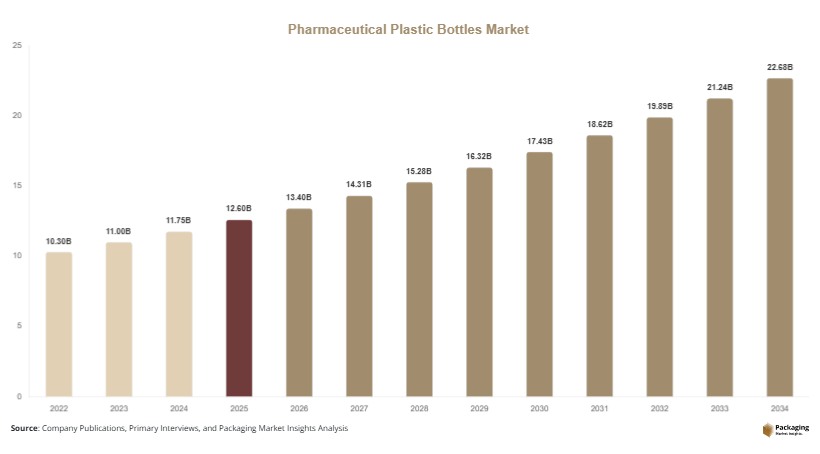
The global market size was valued at approximately USD 12.6 billion in 2025 and is projected to reach nearly USD 13.4 billion in 2026. By 2034, the market is forecasted to grow to around USD 22.7 billion, registering a CAGR of 6.8% during 2025–2034. The pharmaceutical plastic bottles market is witnessing consistent growth due to rising pharmaceutical production, increasing healthcare expenditure, and growing demand for safe and lightweight packaging solutions. Pharmaceutical plastic bottles are widely used for packaging tablets, capsules, syrups, liquid formulations, and nutraceutical products because they provide durability, chemical resistance, and cost efficiency.
The expansion of the pharmaceutical industry remains one of the major growth factors supporting market development. Increasing global demand for generic medicines, over-the-counter drugs, and dietary supplements has accelerated the need for reliable packaging solutions. Pharmaceutical plastic bottles are preferred because they offer strong barrier protection, lightweight transportation advantages, and compatibility with automated filling systems. Another important growth factor is the increasing adoption of child-resistant and tamper-evident closures. Regulatory authorities across developed and emerging economies are emphasizing packaging safety standards, which is encouraging manufacturers to introduce advanced bottle designs and secure closure technologies.
Key Highlights
- Asia Pacific dominated the market with a 36.8% share in 2025.
- Latin America is projected to grow at the fastest CAGR of 7.2%.
- Round bottles led the type segment with a 41.5% share.
- HDPE materials dominated with a 46.9% share.
- Solid oral drug applications led the segment with 49.3% share.
- The US remained the dominant country with a market size of USD 3.1 billion in 2025 and USD 3.3 billion in 2026.
Explore more data points, trends and opportunities Download Free Sample Report
Market Trends
Rising Adoption of Sustainable and Recyclable Pharmaceutical Packaging
Sustainability has become an important trend influencing the pharmaceutical plastic bottles market as regulatory agencies and pharmaceutical companies focus on reducing plastic waste. Manufacturers are increasingly producing recyclable PET and HDPE bottles using post-consumer recycled materials without compromising pharmaceutical safety standards. Several pharmaceutical brands are introducing lightweight bottle structures to reduce resin usage and transportation emissions. For example, nutraceutical companies in North America are transitioning toward recyclable plastic containers with reduced carbon footprints to meet sustainability goals. The growing demand for environmentally responsible healthcare packaging is expected to encourage further investment in bio-based plastics, recyclable closures, and mono-material packaging systems. Over the forecast period, sustainability-driven innovations are likely to reshape raw material sourcing and packaging design strategies across the industry.
Integration of Smart and Anti-Counterfeit Packaging Technologies
The increasing prevalence of counterfeit medicines is driving pharmaceutical companies to integrate advanced packaging technologies into plastic bottle solutions. Smart labeling, QR codes, RFID-enabled packaging, and tamper-evident closures are gaining popularity across prescription drug packaging applications. Pharmaceutical manufacturers are using digital tracking systems to improve supply chain visibility and patient safety. For instance, several European pharmaceutical firms have implemented serialized packaging systems on HDPE medicine bottles to comply with drug traceability regulations. The future impact of this trend is expected to be substantial as healthcare providers and regulatory authorities prioritize authentication and traceability. Smart packaging technologies may also support patient engagement through digital dosage tracking and medication adherence systems.
Market Drivers
Expanding Global Pharmaceutical Production
The continuous growth of pharmaceutical manufacturing worldwide is a major driver supporting the pharmaceutical plastic bottles market. Rising demand for generic medicines, chronic disease treatments, and over-the-counter healthcare products has increased packaging requirements across developed and emerging economies. Pharmaceutical plastic bottles are widely preferred because they are lightweight, durable, and compatible with high-speed filling and labeling equipment. Countries such as India and China are significantly expanding pharmaceutical production capacities, increasing demand for cost-effective packaging solutions. For example, generic drug manufacturers increasingly use HDPE bottles for tablet packaging because they provide moisture resistance and lower transportation costs compared to glass alternatives. As pharmaceutical output continues to rise globally, the requirement for plastic bottle packaging is expected to grow steadily.
Increasing Demand for Child-Resistant and Tamper-Evident Packaging
The growing emphasis on medication safety and regulatory compliance is driving adoption of advanced pharmaceutical plastic bottle designs. Governments and healthcare organizations are implementing stricter regulations regarding child-resistant closures and tamper-evident packaging to prevent accidental drug consumption and product contamination. Pharmaceutical companies are therefore investing in innovative bottle closure systems that improve product security and consumer confidence. For example, cough syrups and prescription medications increasingly use induction-sealed plastic bottles with child-resistant caps. The growing elderly population and rising consumption of home healthcare products are further contributing to demand for secure and user-friendly packaging formats. This trend is expected to continue supporting long-term market growth.
Market Restraint
Environmental Concerns and Regulatory Pressure on Plastic Usage
One of the major restraints affecting the pharmaceutical plastic bottles market is increasing environmental concern regarding plastic waste generation. Governments and environmental organizations are implementing stricter regulations related to single-use plastics and recycling standards, which may increase compliance costs for packaging manufacturers. Pharmaceutical packaging requires strict material purity and contamination control, making recycling processes more complex compared to conventional consumer packaging. Additionally, certain pharmaceutical applications still rely on multilayer plastic structures that are difficult to recycle. For example, some liquid medicine bottles require specialized barrier layers that limit recyclability within standard waste management systems. Rising resin prices and sustainability-related investments are also increasing operational expenses for bottle manufacturers. Small and medium-sized pharmaceutical companies may face financial challenges while transitioning toward sustainable packaging alternatives. Although recyclable and bio-based materials are gaining attention, large-scale adoption remains gradual due to cost, regulatory approvals, and performance limitations in highly sensitive pharmaceutical applications.
Market Opportunities
Growth in Nutraceutical and Dietary Supplement Packaging
The rapid expansion of the nutraceutical and dietary supplement industry presents significant opportunities for pharmaceutical plastic bottle manufacturers. Increasing health awareness, preventive healthcare trends, and aging populations are driving demand for vitamins, protein supplements, herbal products, and immunity boosters. Plastic bottles are widely preferred in this segment because they provide convenience, lightweight transportation, and effective moisture protection. Nutraceutical companies are increasingly adopting customized bottle designs and premium labeling to improve brand visibility in retail and e-commerce channels. Future opportunities are expected to expand further as sports nutrition and wellness products gain popularity among younger consumers and fitness-focused populations across global markets.
Expansion of Pharmaceutical Manufacturing in Emerging Economies
Emerging economies are creating strong growth opportunities for the pharmaceutical plastic bottles market due to increasing healthcare investments and local drug production. Countries such as India, Brazil, Indonesia, and Vietnam are expanding pharmaceutical manufacturing capacities to reduce import dependence and strengthen domestic healthcare systems. This trend is increasing demand for affordable and scalable packaging solutions. Plastic bottle manufacturers are establishing regional production facilities to support local pharmaceutical companies with shorter delivery timelines and lower logistics costs. Future applications are expected to include high-barrier packaging for biologics, pediatric medicines, and specialized liquid formulations as healthcare infrastructure continues improving in developing regions.
Report Scope
| Report Metric | Details |
|---|---|
| Market Size in 2025 | USD 12.6 Billion |
| Market Size in 2026 | USD 13.4 Billion |
| Market Size in 2034 | USD 22.7 Billion |
| CAGR | 6.8% (2026-2034) |
| Base Year for Estimation | 2025 |
| Historical Data | 2022-2024 |
| Forecast Period | 2026-2034 |
| Report Coverage | Revenue Forecast, Competitive Landscape, Supply Chain Disruption, Growth Factors, Environment & Regulatory Landscape and Trends |
| Geographies Covered | North America, Europe, APAC, Middle East and Africa, LATAM |
| Countries Covered | U.S., Canada, U.K., Germany, France, Spain, Italy, Russia, Nordic, Benelux, Rest of Europe, China, South Korea, Japan, India, Australia, Singapore, Taiwan, South East Asia, Rest of Asia-Pacific, UAE, Turky, Saudi Arabia, South Africa, Egypt, Nigeria, Rest of MEA, Brazil, Mexico, Argentina, Chile, Colombia, Rest of LATAM |
Explore more data points, trends and opportunities Download Free Sample Report
Segmental Analysis
By Type
Round bottles dominated the pharmaceutical plastic bottles market in 2024, accounting for approximately 41.5% of the global market share. These bottles are widely used for tablets, capsules, syrups, and nutraceutical products because of their manufacturing efficiency, storage convenience, and compatibility with automated pharmaceutical filling lines. Pharmaceutical companies prefer round bottle designs because they provide better structural integrity during transportation and allow efficient labeling processes. HDPE and PET round bottles are commonly used for prescription and over-the-counter medicines due to their moisture resistance and lightweight properties. Several pharmaceutical manufacturers are also adopting ergonomic round bottle designs with child-resistant closures to improve consumer safety and convenience. The dominance of this segment is further supported by rising global demand for oral solid dosage packaging across retail pharmacies and hospital distribution channels.
Dropper bottles are expected to emerge as the fastest-growing subsegment, expanding at a CAGR of 7.5% during the forecast period. Increasing demand for ophthalmic solutions, nasal sprays, liquid supplements, and pediatric medicines is supporting growth in this category. Pharmaceutical companies are developing advanced dropper bottle systems with controlled dispensing mechanisms to improve dosage accuracy and reduce contamination risks. The segment is also benefiting from rising demand for home healthcare products and herbal liquid formulations. PET and LDPE dropper bottles are increasingly used for eye care and essential oil applications because of their portability and ease of use. Future growth is expected to be driven by expanding pharmaceutical innovation in liquid medicine formulations and increasing adoption of precision dispensing packaging systems.
By Material
HDPE materials held the dominant market share of 46.9% in 2024 due to their strong chemical resistance, durability, and moisture barrier properties. HDPE bottles are widely used for packaging tablets, capsules, powders, and liquid pharmaceuticals because they provide excellent product protection while remaining lightweight and cost-effective. Pharmaceutical manufacturers prefer HDPE materials because they are compatible with a wide range of formulations and can withstand varying transportation conditions. The material is also commonly used in child-resistant and tamper-evident packaging applications. Several healthcare companies are adopting recyclable HDPE bottles to align with sustainability goals while maintaining regulatory compliance. The segment continues to benefit from increasing production of generic medicines and nutraceutical products across developed and emerging economies.
PET materials are projected to be the fastest-growing subsegment, registering a CAGR of 7.1% through 2034. PET bottles are gaining popularity due to their transparency, lightweight structure, and recyclability advantages. The material is increasingly used for syrups, vitamins, liquid supplements, and over-the-counter healthcare products where product visibility is important for consumer confidence. Pharmaceutical companies are investing in recycled PET bottle technologies to reduce environmental impact and comply with sustainability regulations. PET materials also support premium packaging aesthetics, making them attractive for nutraceutical and wellness product packaging. Future market growth is expected to be driven by increasing demand for eco-friendly pharmaceutical packaging and expanding investments in closed-loop recycling systems.
By End-Use
Solid oral drug packaging dominated the pharmaceutical plastic bottles market in 2024, accounting for approximately 49.3% of total market revenue. Tablets and capsules remain the most widely consumed pharmaceutical dosage forms globally, creating strong demand for durable and moisture-resistant bottle packaging solutions. Pharmaceutical companies extensively use HDPE and PET bottles for solid oral medications because they provide extended shelf life, easy storage, and compatibility with automated packaging lines. Rising demand for generic medicines and chronic disease treatments is further strengthening the dominance of this segment. Retail pharmacies, hospitals, and online healthcare platforms continue to rely on plastic bottle packaging for oral drug distribution due to its transportation efficiency and reduced breakage risk compared to glass packaging.
Nutraceutical packaging is anticipated to grow at the fastest CAGR of 7.4% during the forecast period. Increasing consumer interest in preventive healthcare, fitness supplements, and immunity products is accelerating demand for specialized pharmaceutical bottle packaging solutions. Nutraceutical brands are increasingly focusing on attractive bottle designs, lightweight materials, and sustainable packaging structures to improve product differentiation in retail and e-commerce channels. PET and recyclable plastic bottles are gaining popularity in this segment because they provide transparency and strong shelf appeal. The expansion of sports nutrition products, herbal supplements, and wellness beverages is expected to create long-term opportunities for innovative pharmaceutical bottle packaging manufacturers.
Pharmaceutical Plastic Bottles Market Segmentations
By Type
- Round Bottles
- Dropper Bottles
- Oval Bottles
- Liquid Bottles
- Wide-Mouth Bottles
By Material
- HDPE
- PET
- LDPE
- Polypropylene
- PVC
By End-User
- Solid Oral Drugs
- Liquid Pharmaceuticals
- Nutraceuticals
- Topical Medicines
- Ophthalmic Products
By Distribution Channel
- Direct Pharmaceutical Supply
- Online Healthcare Distribution
- Retail Pharmacies
- Hospital Pharmacies
- Industrial Packaging Suppliers
Regional Analysis
North America
North America accounted for approximately 31.4% of the global pharmaceutical plastic bottles market share in 2025 and is projected to grow at a CAGR of 6.1% during the forecast period. The region benefits from a highly developed pharmaceutical industry, advanced healthcare infrastructure, and strong demand for over-the-counter medicines and prescription drugs. Pharmaceutical companies in the United States and Canada are increasingly adopting lightweight and recyclable plastic bottle packaging to improve sustainability and transportation efficiency. The expansion of online pharmacy services and direct-to-consumer healthcare distribution is also supporting market growth. In addition, strict drug safety regulations continue encouraging adoption of tamper-evident and child-resistant bottle packaging systems.
The United States dominates the North American market due to its large pharmaceutical manufacturing base and extensive retail pharmacy network. One unique growth driver is the increasing demand for packaging solutions compatible with automated pharmaceutical dispensing systems. Hospitals and pharmacies are investing in digital medication management technologies that require standardized bottle dimensions and labeling systems. Several U.S.-based pharmaceutical companies are also expanding production of nutraceuticals and dietary supplements, which is driving additional demand for PET and HDPE bottle packaging. Investments in sustainable packaging initiatives are expected to further strengthen market development in the country.
Europe
Europe represented nearly 25.2% of the global market share in 2025 and is forecast to expand at a CAGR of 5.9% through 2034. The region’s market growth is supported by stringent pharmaceutical packaging regulations, increasing healthcare expenditure, and rising adoption of recyclable packaging materials. European pharmaceutical manufacturers are focusing on sustainable packaging innovations while maintaining compliance with strict product safety standards. Demand for pharmaceutical plastic bottles is increasing across Germany, France, Italy, and the United Kingdom due to growing production of generic medicines and healthcare supplements. Additionally, the region is witnessing strong demand for high-barrier bottles used in liquid and moisture-sensitive drug applications.
Germany remains the dominant country in the European pharmaceutical plastic bottles market because of its strong pharmaceutical manufacturing sector and advanced packaging technologies. A unique growth driver is the increasing adoption of serialized and traceable packaging systems to comply with European drug authentication regulations. Pharmaceutical companies are integrating digital codes and smart labels into plastic bottles to improve supply chain transparency and combat counterfeit medicines. The expansion of biotechnology drug production in Germany is also creating demand for specialized pharmaceutical bottle packaging with enhanced chemical resistance and barrier performance.
Asia Pacific
Asia Pacific dominated the global pharmaceutical plastic bottles market with a 36.8% share in 2025 and is expected to register a CAGR of 7.5% during the forecast period. Rapid population growth, increasing healthcare access, and expanding pharmaceutical manufacturing activities are major contributors to regional market growth. Countries such as China, India, Japan, and South Korea are witnessing rising demand for affordable medicine packaging solutions due to increasing chronic disease prevalence and healthcare consumption. The region also benefits from lower manufacturing costs and expanding export-oriented pharmaceutical production. Rising investments in healthcare infrastructure and pharmaceutical industrial zones are supporting further packaging demand.
China is the dominant country in the Asia Pacific market due to its large pharmaceutical production capacity and strong export activities. One unique growth driver is the rapid expansion of domestic e-commerce healthcare platforms and online medicine delivery services. Pharmaceutical plastic bottles are increasingly used for secure transportation of liquid medicines, supplements, and prescription drugs sold through online channels. Chinese packaging manufacturers are investing in automated bottle production technologies and recyclable resin materials to improve operational efficiency and sustainability. The growth of contract pharmaceutical manufacturing in China is also contributing to rising packaging demand across regional and international markets.
Middle East & Africa
The Middle East & Africa accounted for approximately 4.7% of the global market share in 2025 and is projected to grow at a CAGR of 6.4% during the forecast period. Increasing healthcare investments, pharmaceutical imports, and rising awareness regarding medicine safety are driving demand for pharmaceutical plastic bottles across the region. Countries including Saudi Arabia, the UAE, and South Africa are expanding healthcare infrastructure and encouraging local pharmaceutical manufacturing. Demand for liquid medicine packaging and over-the-counter healthcare products is also increasing steadily. The region is witnessing growing adoption of lightweight plastic packaging formats that improve transportation efficiency under varying climatic conditions.
The United Arab Emirates leads the regional market due to its advanced pharmaceutical distribution network and healthcare modernization initiatives. A unique growth factor is the increasing establishment of regional pharmaceutical logistics hubs supporting medicine distribution across Gulf countries and Africa. Pharmaceutical suppliers in the UAE are adopting durable HDPE bottle packaging to withstand long-distance transportation and high-temperature conditions. In addition, government investments in local pharmaceutical production facilities are encouraging demand for pharmaceutical-grade packaging materials and secure bottle closure systems across the region.
Latin America
Latin America held approximately 1.9% of the global pharmaceutical plastic bottles market share in 2025 and is anticipated to grow at the fastest CAGR of 7.2% during the forecast period. The region is benefiting from improving healthcare access, rising pharmaceutical consumption, and increasing investments in domestic drug manufacturing. Countries such as Brazil and Mexico are expanding production of generic medicines and healthcare supplements, driving demand for cost-effective packaging solutions. Flexible healthcare policies and growth in retail pharmacy chains are also contributing to market expansion. In addition, pharmaceutical exports within the region are supporting demand for lightweight and durable bottle packaging formats.
Brazil dominates the Latin American market due to its strong pharmaceutical production industry and large consumer healthcare market. One unique growth driver is the rising demand for nutraceutical and herbal medicine packaging. Brazilian consumers are increasingly purchasing vitamins, herbal supplements, and immunity products, particularly through online retail channels. Pharmaceutical packaging manufacturers are therefore expanding production of PET bottles with enhanced shelf appeal and moisture resistance. Investments in domestic pharmaceutical packaging production facilities are expected to improve regional supply capabilities and reduce import dependence over the coming years.
Competitive Landscape
The pharmaceutical plastic bottles market is moderately competitive, with global packaging manufacturers focusing on sustainability, pharmaceutical safety compliance, and production efficiency to strengthen their market positions. Gerresheimer AG remains one of the leading companies in the market due to its extensive pharmaceutical packaging portfolio and strong international manufacturing presence. The company recently expanded its pharmaceutical plastic packaging production capabilities in Asia to support growing healthcare demand.
Other major companies operating in the market include Berry Global Inc., Amcor plc, AptarGroup Inc., and Alpha Packaging. These players are investing heavily in recyclable packaging materials, lightweight bottle technologies, and smart packaging solutions to comply with changing pharmaceutical regulations and sustainability goals. Strategic collaborations with pharmaceutical companies and regional production expansions are common growth strategies. Several manufacturers are also integrating automation technologies into bottle manufacturing facilities to improve operational efficiency and product consistency. Increasing investments in child-resistant closure systems and anti-counterfeit packaging technologies are expected to remain key competitive strategies over the forecast period.
Key Players List
- Gerresheimer AG
- Berry Global Inc.
- Amcor plc
- AptarGroup Inc.
- Alpha Packaging
- Comar LLC
- Drug Plastics Group
- Alpla Group
- SGD Pharma
- Weener Plastics
- Silgan Holdings Inc.
- Cospack America Corp.
- Pretium Packaging
- Origin Pharma Packaging
- Comar Packaging
- Plastipak Holdings Inc.
- O.Berk Company LLC
- Kaufman Container