Pet Bottle Blow Molding Machine Market Size and Growth
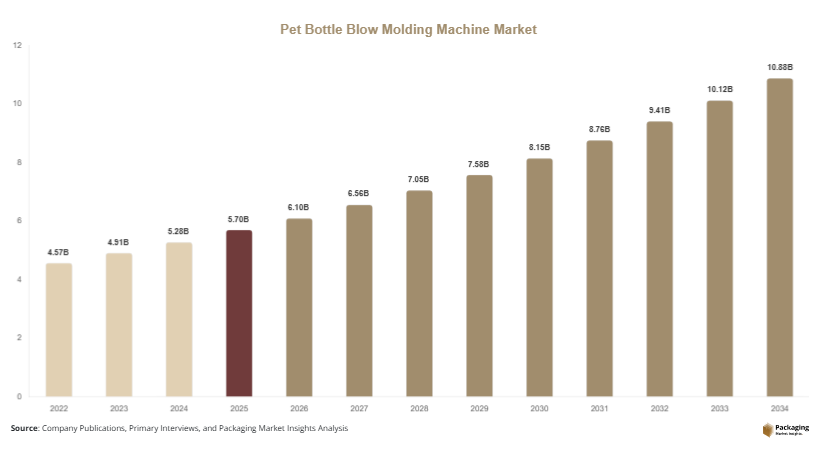
The global pet bottle blow molding machine market size was valued at approximately USD 5.7 billion in 2025 and is projected to reach around USD 6.1 billion in 2026. By 2034, the market is expected to attain nearly USD 10.9 billion, expanding at a CAGR of 7.5% during 2025–2034. The market is benefiting from increasing investments in beverage packaging infrastructure and rising adoption of automation technologies in plastic packaging production facilities. Manufacturers are increasingly focusing on energy-efficient and high-speed blow molding systems to improve production efficiency and reduce operational costs.
One of the primary growth factors is the growing global demand for bottled beverages and packaged drinking water. Urbanization, changing consumer lifestyles, and increasing preference for convenient packaged products are accelerating PET bottle production worldwide. Another important factor is the increasing adoption of recyclable PET packaging materials as industries focus on sustainable packaging solutions. In addition, technological advancements in fully automatic blow molding systems, servo-driven machines, and IoT-enabled monitoring platforms
Key Highlights:
- Asia Pacific dominated the market with a 41.2% share in 2025.
- Latin America is projected to grow at the fastest CAGR of 8.1%.
- Automatic blow molding machines led the type segment with a 48.7% share.
- Virgin PET material dominated with a 54.1% share.
- Beverage packaging applications led the end-use segment with 46.5% share.
- The US remained the dominant country with a market size of USD 1.3 billion in 2025 and USD 1.4 billion in 2026.
Explore more data points, trends and opportunities Download Free Sample Report
Market Trends
Growing Adoption of Energy-Efficient and Servo-Driven Machines
The pet bottle blow molding machine market is increasingly shifting toward energy-efficient and servo-driven machine technologies. Manufacturers are focusing on reducing operational costs and electricity consumption while maintaining high production efficiency. Servo-driven blow molding systems provide better precision, lower maintenance requirements, and improved production speed compared to traditional hydraulic machines. For example, beverage packaging companies are increasingly installing servo-controlled automatic blow molding systems capable of reducing energy consumption by up to 25% in high-volume production facilities. This trend is particularly strong in regions with rising industrial energy costs and strict sustainability regulations. Future advancements are expected to include AI-enabled energy optimization and predictive maintenance systems that further improve operational efficiency and machine reliability.
Rising Integration of Recycled PET Processing Capabilities
The increasing use of recycled PET materials is another significant trend shaping the market. Packaging manufacturers are investing in blow molding machines capable of processing high percentages of recycled PET resin while maintaining bottle quality and structural integrity. Governments and consumer brands are increasingly promoting circular packaging initiatives to reduce plastic waste and improve sustainability performance. For example, beverage companies are introducing bottles manufactured with 50% or more recycled PET content, requiring advanced molding technologies with enhanced temperature and material control systems. Future market growth is expected to be supported by stricter packaging sustainability regulations and increasing investment in closed-loop recycling infrastructure across the packaging industry.
Market Drivers
Expansion of Bottled Beverage and Packaged Water Industries
The rapid expansion of bottled beverage and packaged water industries is a major driver for the pet bottle blow molding machine market. Urbanization, changing dietary habits, and increasing demand for portable beverage packaging are supporting large-scale PET bottle production worldwide. Beverage manufacturers are continuously expanding production capacities to meet growing consumer demand for bottled water, carbonated drinks, juices, and sports beverages. For example, beverage bottling facilities in Asia and North America are investing in high-speed automatic blow molding systems to improve manufacturing efficiency and increase bottle output. This growing demand for packaged beverages continues driving substantial investment in advanced PET bottle manufacturing equipment globally.
Increasing Automation in Packaging Manufacturing
The growing adoption of automation technologies in packaging manufacturing facilities is another important market driver. Packaging companies are implementing automated blow molding systems to improve operational efficiency, reduce labor costs, and maintain consistent bottle quality. Modern blow molding machines equipped with touchscreen controls, robotic bottle handling systems, and IoT-based monitoring capabilities are improving productivity across production lines. For instance, large pharmaceutical and food packaging manufacturers are increasingly using fully automated PET bottle production systems integrated with filling and labeling equipment. As manufacturers continue prioritizing efficiency and production scalability, demand for advanced automated blow molding systems is expected to rise steadily.
Market Restraint
One of the key restraints affecting the pet bottle blow molding machine market is the high capital investment associated with advanced automated production systems. Fully automatic and servo-driven blow molding machines require substantial initial expenditure, making adoption difficult for small and medium-sized packaging manufacturers. In addition, maintenance costs, spare part expenses, and technical training requirements increase overall operational expenditure. For example, smaller beverage manufacturers in developing economies often rely on semi-automatic systems due to budget limitations and lower production volumes. Fluctuations in raw material prices and growing environmental concerns regarding plastic packaging also create market uncertainty. Increasing regulations on single-use plastics in certain countries may further affect investment decisions within the PET packaging industry.
Market Opportunities
Expansion of Recycled PET Packaging Production
The rising demand for recycled PET packaging presents significant opportunities for the pet bottle blow molding machine market. Beverage, personal care, and food companies are increasingly adopting recycled PET bottles to meet sustainability goals and reduce environmental impact. This transition is creating strong demand for advanced blow molding systems capable of processing recycled resin without compromising bottle quality. For example, global beverage brands are investing in bottle manufacturing facilities equipped with high-performance recycled PET processing technologies. Future opportunities are expected to emerge from stricter recycling regulations and increasing investment in circular packaging infrastructure. Manufacturers offering machines optimized for recycled PET production are likely to gain substantial competitive advantages.
Growth of Smart Factory and Industry 4.0 Integration
The increasing adoption of Industry 4.0 technologies is creating major growth opportunities in the market. Packaging manufacturers are integrating smart monitoring systems, cloud-based analytics, and predictive maintenance solutions into blow molding operations to improve efficiency and reduce downtime. For instance, modern PET bottle production facilities are implementing IoT-enabled machines capable of real-time production monitoring and automated defect detection. These technologies improve operational control while reducing maintenance costs and material waste. Future advancements in AI-assisted production optimization and digital twin technologies are expected to further transform PET bottle manufacturing processes. As smart manufacturing adoption expands globally, demand for digitally connected blow molding systems is likely to increase significantly.
Report Scope
| Report Metric | Details |
|---|---|
| Market Size in 2025 | USD 5.7 Billion |
| Market Size in 2026 | USD 6.1 Billion |
| Market Size in 2034 | USD 10.9 Billion |
| CAGR | 7.5% (2026-2034) |
| Base Year for Estimation | 2025 |
| Historical Data | 2022-2024 |
| Forecast Period | 2026-2034 |
| Report Coverage | Revenue Forecast, Competitive Landscape, Supply Chain Disruption, Growth Factors, Environment & Regulatory Landscape and Trends |
| Geographies Covered | North America, Europe, APAC, Middle East and Africa, LATAM |
| Countries Covered | U.S., Canada, U.K., Germany, France, Spain, Italy, Russia, Nordic, Benelux, Rest of Europe, China, South Korea, Japan, India, Australia, Singapore, Taiwan, South East Asia, Rest of Asia-Pacific, UAE, Turky, Saudi Arabia, South Africa, Egypt, Nigeria, Rest of MEA, Brazil, Mexico, Argentina, Chile, Colombia, Rest of LATAM |
Explore more data points, trends and opportunities Download Free Sample Report
Segmental Analysis
Type Segment
Automatic blow molding machines dominated the type segment with approximately 48.7% market share in 2024. These systems are widely preferred because they offer high production efficiency, reduced labor dependency, and consistent bottle quality across large-scale manufacturing operations. Beverage, pharmaceutical, and food packaging companies increasingly rely on automatic blow molding systems for high-speed production environments. For example, bottled water manufacturers commonly use automatic machines capable of producing thousands of PET bottles per hour with minimal operational interruptions. The dominance of this segment is also supported by increasing automation adoption and integration of intelligent control systems in packaging production facilities. Automatic machines provide enhanced precision, reduced material wastage, and improved operational safety compared to manual or semi-automatic alternatives. Rising demand for high-volume bottle production continues supporting strong market growth within this segment.
Fully electric blow molding machines are expected to emerge as the fastest-growing subsegment with a CAGR of 8.6% during 2025–2034. Growth is driven by increasing demand for energy-efficient and environmentally sustainable manufacturing equipment. Fully electric systems offer lower energy consumption, reduced maintenance requirements, and improved production precision compared to hydraulic machines. For example, premium beverage packaging companies are increasingly installing fully electric blow molding systems to reduce electricity costs and meet sustainability targets. Future growth is expected to be supported by stricter industrial energy regulations and rising adoption of smart factory technologies. The integration of AI-enabled monitoring systems and predictive maintenance platforms is also expected to accelerate demand for electric blow molding machines globally.
Material Segment
Virgin PET material accounted for the dominant material segment with approximately 54.1% share in 2024. Virgin PET remains highly preferred because it provides superior transparency, durability, food safety compliance, and structural consistency for beverage and pharmaceutical packaging applications. Packaging manufacturers extensively use virgin PET resin for producing bottles used in bottled water, carbonated drinks, edible oils, and personal care products. For example, pharmaceutical packaging companies rely on virgin PET bottles to ensure purity and contamination resistance for liquid medications. The dominance of this segment is also linked to its compatibility with high-speed automatic blow molding systems and ability to maintain consistent bottle quality across mass production operations. Strong global demand for food-grade PET bottles continues supporting segment growth.
Recycled PET material is projected to be the fastest-growing subsegment with a CAGR of 8.9% during the forecast period. Growth is driven by increasing sustainability initiatives and rising regulatory pressure regarding plastic waste reduction. Beverage and consumer goods companies are increasingly adopting recycled PET bottles to meet environmental targets and improve brand sustainability performance. For instance, global beverage companies are introducing packaging lines using bottles manufactured with high recycled PET content. Future demand is expected to rise further due to expanding recycling infrastructure and growing consumer preference for environmentally responsible packaging solutions. Advances in recycled resin purification and processing technologies are also expected to support widespread adoption.
End-Use Segment
Beverage packaging applications dominated the end-use segment with approximately 46.5% market share in 2024. PET bottles remain widely used across bottled water, carbonated drinks, juices, sports beverages, and dairy beverage industries due to their lightweight structure, durability, and cost efficiency. Beverage companies increasingly invest in advanced blow molding systems to support high-speed bottle production and diverse packaging formats. For example, multinational beverage manufacturers operate fully automated PET bottle production lines integrated with filling and labeling systems to improve operational efficiency. The dominance of this segment is also supported by rising global beverage consumption and increasing demand for convenient portable packaging. Expanding packaged water consumption across developing economies continues contributing to strong market demand.
Pharmaceutical packaging is expected to register the fastest CAGR of 8.4% through 2034. Growth is driven by increasing pharmaceutical production, rising healthcare expenditure, and growing demand for contamination-resistant packaging solutions. Pharmaceutical companies increasingly use PET bottles for syrups, liquid medicines, supplements, and healthcare products due to their durability and lightweight properties. For example, pharmaceutical packaging manufacturers are investing in precision blow molding systems capable of producing tamper-resistant medical-grade PET bottles. Future market expansion is expected to be supported by increasing pharmaceutical exports and rising adoption of recyclable healthcare packaging materials. Technological advancements in sterile bottle production systems are also likely to strengthen segment growth globally.
Pet Bottle Blow Molding Machine Market Segmentations
By Type
- Automatic Blow Molding Machines
- Semi-Automatic Blow Molding Machines
- Fully Electric Blow Molding Machines
- Stretch Blow Molding Machines
- Injection Blow Molding Machines
By Material
- Virgin PET Material
- Recycled PET Material
- Bio-Based PET Material
- High-Clarity PET Material
- Multi-Layer PET Material
By End-User
- Beverage Packaging
- Pharmaceutical Packaging
- Personal Care Packaging
- Household Chemical Packaging
- Food Packaging
Regional Analysis
North America
North America accounted for approximately 24.8% share of the pet bottle blow molding machine market in 2025 and is expected to grow at a CAGR of 6.9% during 2025–2034. The region benefits from advanced packaging manufacturing infrastructure, strong beverage consumption, and increasing automation adoption across production facilities. Beverage companies are heavily investing in energy-efficient PET bottle production systems to improve operational efficiency and sustainability performance. The growing packaged water and ready-to-drink beverage markets are significantly supporting regional demand for high-speed blow molding equipment. Increasing use of lightweight PET bottles in food and pharmaceutical industries is also contributing to steady market growth across North America.
The United States dominates the regional market due to its extensive beverage manufacturing industry and strong investment in packaging automation technologies. A unique growth driver is the increasing adoption of recycled PET bottle production systems among major beverage companies. For example, several beverage bottling plants in the country are upgrading existing production lines with machines compatible with high recycled PET content. Canada is also witnessing rising demand for energy-efficient blow molding equipment driven by sustainability initiatives and packaging modernization programs. Future regional growth is expected to be supported by smart factory investments and advanced packaging production technologies.
Europe
Europe represented nearly 21.5% market share in 2025 and is projected to expand at a CAGR of 7.1% during the forecast period. The region is characterized by strict sustainability regulations, increasing demand for recyclable packaging, and rising adoption of energy-efficient manufacturing systems. Packaging companies across Europe are investing in advanced blow molding technologies capable of reducing material waste and electricity consumption. Demand for recycled PET bottle production is particularly strong due to regional circular economy initiatives. Growth in pharmaceutical and cosmetic packaging applications is also supporting demand for precision PET bottle manufacturing equipment.
Germany leads the European market because of its advanced industrial machinery sector and strong packaging manufacturing base. A major growth driver is the increasing transition toward fully electric blow molding systems designed to improve production efficiency and reduce carbon emissions. For example, German beverage packaging facilities are increasingly deploying high-speed electric blow molding machines integrated with automated quality inspection systems. France and Italy are also contributing significantly to market growth through expansion of food packaging and personal care bottle manufacturing operations. Future growth is expected to remain strong due to sustainability-focused packaging investments.
Asia Pacific
Asia Pacific dominated the pet bottle blow molding machine market with approximately 41.2% share in 2025 and is projected to register the fastest CAGR of 8.3% during 2025–2034. Rapid industrialization, growing beverage consumption, and expansion of food processing industries are strongly supporting market growth across the region. Countries such as China, India, Japan, and Indonesia are experiencing increasing demand for PET bottles used in beverages, edible oils, pharmaceuticals, and household products. Rising urban populations and changing consumer lifestyles are significantly increasing packaged product consumption. In addition, low manufacturing costs and expanding packaging production capacities are encouraging investment in blow molding equipment.
China dominates the regional market due to its extensive plastic packaging manufacturing industry and strong export-oriented production base. A key growth driver is the rapid expansion of bottled water and ready-to-drink beverage manufacturing facilities. For example, Chinese beverage companies are investing heavily in fully automatic high-speed PET bottle production lines to support rising domestic and export demand. India is also emerging rapidly due to increasing packaged food consumption and expansion of pharmaceutical bottle manufacturing operations. Japan remains an important contributor because of its adoption of precision manufacturing technologies and energy-efficient blow molding systems.
Middle East & Africa
The Middle East & Africa region accounted for approximately 5.8% market share in 2025 and is expected to grow at a CAGR of 7.4% during the forecast period. Market growth is supported by increasing packaged beverage demand, expansion of food processing industries, and rising investment in industrial manufacturing infrastructure. Countries across the Gulf region are experiencing rising bottled water consumption due to climatic conditions and urban population growth. Packaging manufacturers are increasingly investing in automated PET bottle production facilities to meet regional demand for beverages, personal care products, and household chemicals.
Saudi Arabia dominates the regional market due to its growing beverage production sector and expanding industrial packaging infrastructure. A unique growth driver is the increasing establishment of local PET bottle manufacturing facilities aimed at reducing import dependency. For example, packaging companies in Riyadh and Jeddah are investing in high-output automatic blow molding systems for bottled water production. South Africa is also experiencing rising demand due to growing consumption of packaged consumer goods and expansion of local beverage bottling operations. Future regional growth is expected to be supported by industrial diversification initiatives and increasing packaging demand.
Latin America
Latin America held nearly 6.7% market share in 2025 and is projected to grow at a CAGR of 8.1% during 2025–2034. The market is benefiting from increasing beverage production, expanding retail packaging demand, and growing investments in packaging manufacturing infrastructure. PET bottles are widely used across carbonated beverages, bottled water, edible oils, and personal care products in the region. Rising urbanization and changing consumer lifestyles are supporting strong demand for packaged liquid products. Packaging manufacturers are increasingly modernizing production facilities with automatic and energy-efficient blow molding systems.
Brazil dominates the Latin American market due to its large beverage industry and expanding food packaging sector. A major growth driver is the increasing demand for affordable packaged drinking water and soft beverages across urban and semi-urban areas. For example, Brazilian beverage bottlers are investing in high-capacity PET bottle manufacturing systems to improve output efficiency and reduce production costs. Mexico is also witnessing rising demand for pharmaceutical and food-grade PET packaging. Future market expansion is expected to be supported by retail growth, packaging modernization, and increasing adoption of recyclable PET bottle technologies.
Competitive Landscape
The pet bottle blow molding machine market is moderately competitive, with manufacturers focusing on automation, energy efficiency, and smart manufacturing integration to strengthen market position. Companies are investing in high-speed production systems, recycled PET processing technologies, and digitally connected machine platforms to address changing industry requirements. Strategic partnerships with beverage, pharmaceutical, and packaging companies are increasingly shaping competitive dynamics.
Krones AG remains one of the leading players due to its strong global presence and advanced PET bottle manufacturing technologies. The company continues investing in energy-efficient and high-speed blow molding systems integrated with intelligent monitoring solutions. Sidel Group is focusing on sustainable packaging production technologies and recycled PET-compatible machine systems for beverage manufacturers. Nissei ASB Machine Co., Ltd. is expanding its portfolio of fully automatic and compact blow molding equipment designed for pharmaceutical and food packaging applications.
Other major companies are emphasizing servo-driven systems, automation software integration, and reduced energy consumption technologies. Product innovation, capacity expansion, and regional manufacturing investments continue influencing market competition. Growing demand for recyclable PET packaging is expected to further accelerate technological advancements across the industry.
Key Players List
- Krones AG
- Sidel Group
- Nissei ASB Machine Co., Ltd.
- Sacmi Imola S.C.
- Aoki Technical Laboratory, Inc.
- SIPA S.p.A.
- KHS GmbH
- Tech-Long Inc.
- Parker Plastic Machinery Co., Ltd.
- Chumpower Machinery Corp.
- Pet All Manufacturing Inc.
- SMF Maschinenfabrik GmbH
- Jomar Corporation
- Zhejiang Huangyan Lingma Plastic Machinery Co., Ltd.
- Global Pet Industries Pvt. Ltd.