Multilayer PET Bottles Market Size and Growth
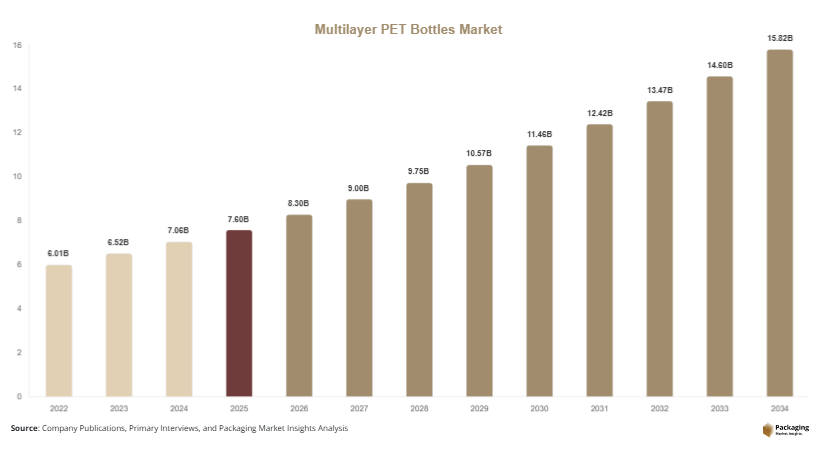
The multilayer PET bottles market was valued at approximately USD 7.6 billion in 2025 and is projected to reach USD 8.3 billion in 2026, expanding to nearly USD 15.9 billion by 2034, registering a CAGR of 8.4% from 2025 to 2034. Multilayer PET bottles are widely used across food and beverage, pharmaceutical, and personal care industries due to their ability to prevent oxygen ingress, moisture loss, and contamination. The multilayer PET bottles market is witnessing steady growth as industries increasingly demand advanced packaging solutions that offer enhanced barrier properties, longer shelf life, and improved product protection.
A key growth factor driving the market is the increasing demand for packaged beverages and ready-to-consume food products. Consumers are seeking convenience, portability, and longer shelf life, which multilayer PET bottles effectively provide. Another important factor is the advancement in barrier technologies, such as oxygen scavengers and nylon layers, which enhance product preservation. Additionally, the growing emphasis on reducing food waste is encouraging manufacturers to adopt packaging solutions that extend product freshness.
Key Highlights:
- Asia Pacific dominated the market with a 37.9% share in 2025, while Latin America is projected to grow at the fastest CAGR of 8.9%.
- Barrier PET bottles led the type segment with a 46.5% share, while recycled multilayer PET bottles are expected to grow at a CAGR of 9.2%.
- Food & beverage applications dominated with a 62.1% share, while pharmaceutical applications are forecasted to grow at a CAGR of 8.6%.
- Carbonated beverages led the end-use segment with 33.8% share, while functional drinks are expected to grow at a CAGR of 9.5%.
- China remained the dominant country with a market size of USD 1.8 billion in 2025 and USD 2.0 billion in 2026.
Explore more data points, trends and opportunities Download Free Sample Report
Market Trends
Increasing adoption of high-barrier multilayer packaging technologies
The growing need for extended shelf life and product protection is driving the adoption of high-barrier multilayer PET bottles. These bottles incorporate advanced materials such as nylon, EVOH, and oxygen scavengers to enhance resistance against gas permeability. This feature is particularly important for beverages, dairy products, and pharmaceutical liquids that require stable storage conditions. Manufacturers are focusing on improving barrier performance while maintaining recyclability and cost efficiency. The integration of innovative layer structures is enabling better preservation of flavor, aroma, and nutritional value. This trend is expected to continue as industries prioritize quality and safety in packaging solutions.
Rising focus on sustainable and recyclable multilayer PET solutions
Sustainability is becoming a key focus in the multilayer PET bottles market, with companies developing eco-friendly packaging solutions. Traditional multilayer structures pose recycling challenges, but advancements in material science are addressing these issues. Manufacturers are introducing recyclable multilayer PET bottles and increasing the use of post-consumer recycled content. Lightweighting initiatives are also reducing material usage and carbon emissions. Additionally, regulatory pressure and consumer awareness are encouraging companies to adopt sustainable practices. This trend is driving innovation in design and production processes, supporting the long-term growth of the market.
Market Drivers
Growing demand for packaged beverages and convenience products
The increasing consumption of packaged beverages is a major driver of the multilayer PET bottles market. Urbanization and changing lifestyles have led to higher demand for ready-to-drink products such as juices, soft drinks, and functional beverages. Multilayer PET bottles offer durability, lightweight properties, and enhanced barrier performance, making them suitable for these applications. The ability to maintain product freshness and extend shelf life is a significant advantage. Additionally, the expansion of retail and distribution channels is supporting the growth of packaged beverage consumption, further driving market demand.
Expansion of pharmaceutical and personal care industries
The pharmaceutical and personal care sectors are contributing significantly to market growth. Multilayer PET bottles are used for packaging liquid medicines, syrups, and personal care products due to their protective properties. The increasing demand for healthcare products, driven by an aging population and rising health awareness, is boosting the need for reliable packaging solutions. Additionally, the growth of the personal care industry, including skincare and haircare products, is supporting the adoption of multilayer PET bottles. These industries require packaging that ensures product safety and quality, driving market expansion.
Market Restraint
Challenges in recycling and higher production complexity
The multilayer PET bottles market faces challenges related to recycling and production complexity. Multilayer structures often combine different materials, making separation and recycling difficult. This can limit their acceptance in regions with strict recycling regulations. Additionally, the manufacturing process for multilayer PET bottles is more complex and costly compared to single-layer PET bottles. This complexity can increase production costs and reduce profit margins for manufacturers. For example, the use of specialized barrier layers requires advanced equipment and expertise, which may not be accessible to smaller companies. These factors can hinder market growth and require continuous innovation to address sustainability concerns.
Market Opportunities
Development of recyclable multilayer PET technologies
The development of recyclable multilayer PET technologies presents significant opportunities for market growth. Companies are investing in research to create materials that maintain barrier properties while being compatible with existing recycling systems. Innovations such as mono-material multilayer designs and improved separation techniques are gaining traction. These advancements are helping address environmental concerns and meet regulatory requirements. As sustainability becomes a priority, the adoption of recyclable multilayer PET bottles is expected to increase, creating new growth opportunities for manufacturers.
Growth in emerging markets and expanding retail infrastructure
Emerging economies offer substantial growth potential for the multilayer PET bottles market. Rapid urbanization, increasing disposable incomes, and changing consumer preferences are driving demand for packaged products. The expansion of retail infrastructure, including supermarkets and e-commerce platforms, is further supporting market growth. Additionally, the growing middle-class population is increasing consumption of beverages and personal care products. These factors are creating opportunities for manufacturers to expand their presence in emerging markets and capture new customer segments.
Report Scope
| Report Metric | Details |
|---|---|
| Market Size in 2025 | USD 7.6 Billion |
| Market Size in 2026 | USD 8.3 Billion |
| Market Size in 2034 | USD 15.9 Billion |
| CAGR | 8.4% (2026-2034) |
| Base Year for Estimation | 2025 |
| Historical Data | 2022-2024 |
| Forecast Period | 2026-2034 |
| Report Coverage | Revenue Forecast, Competitive Landscape, Supply Chain Disruption, Growth Factors, Environment & Regulatory Landscape and Trends |
| Geographies Covered | North America, Europe, APAC, Middle East and Africa, LATAM |
| Countries Covered | U.S., Canada, U.K., Germany, France, Spain, Italy, Russia, Nordic, Benelux, Rest of Europe, China, South Korea, Japan, India, Australia, Singapore, Taiwan, South East Asia, Rest of Asia-Pacific, UAE, Turky, Saudi Arabia, South Africa, Egypt, Nigeria, Rest of MEA, Brazil, Mexico, Argentina, Chile, Colombia, Rest of LATAM |
Explore more data points, trends and opportunities Download Free Sample Report
Segmental Analysis
By Type
Barrier PET bottles dominated the segment with a market share of 46.5% in 2024, driven by their ability to protect products from oxygen and moisture. These bottles are widely used in food and beverage applications due to their effectiveness in preserving freshness and extending shelf life. The increasing demand for high-quality packaging solutions is supporting the growth of this segment. Additionally, advancements in barrier technologies are improving performance and enabling their use in a wider range of applications.
Recycled multilayer PET bottles are expected to grow at a CAGR of 9.2% during the forecast period. The increasing focus on sustainability and regulatory pressure to reduce plastic waste are driving the adoption of recycled materials. Manufacturers are incorporating post-consumer recycled content into multilayer PET bottles to improve environmental performance. Additionally, innovations in recycling technologies are enhancing the feasibility of using recycled materials, supporting segment growth.
By Application
Food and beverage applications accounted for the largest share of 62.1% in 2024, driven by the high consumption of packaged beverages and food products. Multilayer PET bottles are widely used in this segment due to their durability and barrier properties. The increasing demand for convenience products and extended shelf life is supporting the growth of this segment. Additionally, the expansion of retail and e-commerce channels is driving demand for reliable packaging solutions.
Pharmaceutical applications are expected to grow at a CAGR of 8.6% during the forecast period. The increasing demand for liquid medicines and healthcare products is driving the need for high-performance packaging. Multilayer PET bottles provide protection against contamination and ensure product stability. Additionally, regulatory requirements for safe and compliant packaging are supporting the adoption of multilayer PET bottles in the pharmaceutical industry.
By End-Use
Carbonated beverages dominated the segment with a share of 33.8% in 2024, driven by their widespread consumption globally. Multilayer PET bottles are preferred for carbonated drinks due to their ability to retain carbonation and prevent gas leakage. The increasing demand for soft drinks and flavored beverages is supporting the growth of this segment. Additionally, the availability of various bottle sizes and designs enhances consumer convenience.
Functional drinks are expected to be the fastest-growing subsegment, registering a CAGR of 9.5% during the forecast period. The rising popularity of health-focused beverages such as sports drinks and energy drinks is driving demand. Multilayer PET bottles are suitable for these products due to their ability to maintain quality and freshness. Additionally, innovative packaging designs and branding strategies are attracting consumers, supporting segment growth.
Multilayer PET Bottles Market Segmentations
By Type
- Barrier PET Bottles
- Recycled Multilayer PET Bottles
- Oxygen Scavenger PET Bottles
- Others
By Application
- Food & Beverage
- Pharmaceutical
- Personal Care
By End-User
- Carbonated Beverages
- Functional Drinks
- Dairy Products
- Liquid Medicines
Regional Analysis
North America
North America accounted for approximately 24.1% of the market share in 2025 and is expected to grow at a CAGR of 7.6% during the forecast period. The region’s well-established food and beverage industry and high demand for packaged products are key growth drivers. The presence of advanced packaging technologies and strong regulatory frameworks is supporting the adoption of multilayer PET bottles. Additionally, increasing consumer preference for convenient and sustainable packaging solutions is contributing to market expansion.
The United States dominates the regional market due to its large consumer base and strong industrial infrastructure. A unique growth factor is the increasing adoption of recyclable packaging solutions driven by environmental regulations. Companies are focusing on developing sustainable multilayer PET bottles to meet consumer expectations and regulatory requirements, supporting market growth in the country.
Europe
Europe held a market share of around 22.5% in 2025 and is projected to grow at a CAGR of 7.8%. The region’s strict environmental regulations and focus on sustainability are driving demand for advanced packaging solutions. The food and beverage industry is a major contributor to market growth, with increasing demand for high-barrier packaging. Additionally, innovations in recycling technologies are supporting the adoption of multilayer PET bottles.
Germany leads the European market due to its strong manufacturing base and advanced packaging industry. A key growth factor is the implementation of stringent recycling regulations, which encourage the development of sustainable packaging solutions. These policies are driving innovation and supporting the growth of the multilayer PET bottles market in the region.
Asia Pacific
Asia Pacific dominated the market with a share of 37.9% in 2025 and is expected to grow at a CAGR of 9.1%. Rapid urbanization, population growth, and increasing disposable incomes are driving demand for packaged food and beverages. The expansion of retail and e-commerce sectors is further supporting market growth. Additionally, the growing pharmaceutical industry in the region is contributing to increased demand for multilayer PET bottles.
China is the leading country in the region, supported by its large manufacturing capacity and growing consumer base. A major growth factor is the increasing demand for packaged beverages and personal care products. Government initiatives to promote industrial growth and sustainability are also contributing to market expansion.
Middle East & Africa
The Middle East & Africa region accounted for a market share of 7.2% in 2025 and is projected to grow at a CAGR of 8.3%. Increasing urbanization and rising disposable incomes are driving demand for packaged products. The region is also witnessing growth in the food and beverage industry, which is supporting the adoption of multilayer PET bottles. Improvements in retail infrastructure and distribution networks are further contributing to market growth.
Saudi Arabia is a dominant country in this region, driven by its growing consumer market and economic development. A unique growth factor is the increasing investment in packaging and manufacturing industries. These investments are enhancing production capabilities and supporting the adoption of advanced packaging solutions.
Latin America
Latin America held a market share of 8.3% in 2025 and is expected to grow at the fastest CAGR of 8.9%. The region’s growing middle-class population and increasing demand for convenience products are key drivers of market growth. The expansion of retail channels and rising consumption of packaged beverages are also contributing to market development.
Brazil is the leading country in Latin America, supported by its large beverage industry. A key growth factor is the increasing popularity of functional and ready-to-drink beverages. This trend is driving demand for multilayer PET bottles, supporting market growth in the region.
Competitive Landscape
The multilayer PET bottles market is characterized by intense competition among global and regional players focusing on innovation, sustainability, and capacity expansion. Companies are investing in advanced technologies to improve product performance and reduce environmental impact. Strategic partnerships and acquisitions are common as companies aim to strengthen their market presence and expand their product portfolios.
Amcor plc is recognized as a leading player in the market, supported by its strong global presence and extensive product offerings. The company recently introduced sustainable multilayer PET bottle solutions with improved recyclability. Other key players are focusing on lightweight designs and advanced barrier technologies to enhance product differentiation. Sustainability initiatives and compliance with regulatory standards are key focus areas for market participants.
Key Players List
- Amcor plc
- Berry Global Inc.
- ALPLA Group
- Plastipak Holdings Inc.
- Graham Packaging Company
- Silgan Holdings Inc.
- Resilux NV
- RETAL Industries Ltd.
- Logoplaste
- Esterform Packaging Ltd.
- Indorama Ventures Public Company Limited
- Toyo Seikan Group Holdings Ltd.
- Sidel Group
- Krones AG
- GTX Hanex Plastic Sp. z o.o.