Blow Molded Plastic Bottles Market Size
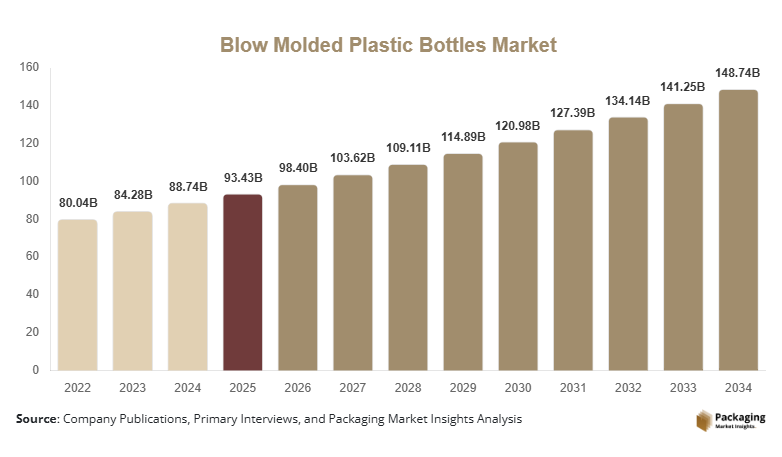
The blow-molded plastic bottles market size is projected at USD 98.6 billion in 2026 and is expected to hit USD 156.4 billion by 2034 with a CAGR of 5.9%.” The market expansion is supported by rising demand for lightweight packaging formats, increasing beverage consumption, and growing adoption of recyclable plastic containers across industries. The report provides detailed segmentation analysis, production trends, competitive landscape evaluation, regional performance assessment, and industry insights covering historical years 2022–2024, base year 2025, current year 2026, and forecast period 2026–2034.
The blow-molded plastic bottles market includes manufacturing processes that transform thermoplastic materials into hollow containers through extrusion blow molding, injection blow molding, and stretch blow molding technologies. Increasing investments in sustainable packaging solutions, lightweight bottle designs, and high-performance polymer materials are influencing the market structure and competitive positioning.
Blow-molded plastic bottle production exceeded 500 billion units globally in 2025, with beverage packaging accounting for nearly 45% of total consumption, followed by pharmaceutical and personal care applications. PET-based bottles represented approximately 52% of production volume due to their transparency, durability, and recycling compatibility, reinforcing long-term demand for blow-molded plastic bottles.
Explore more data points, trends and opportunities Download Free Sample Report
Blow Molded Plastic Bottles Market Trends
Increasing Adoption of Sustainable Blow Molding Technologies
The blow-molded plastic bottle market trend is shifting toward recycled polymers, bio-based plastics, and lightweight bottle designs. Global production of plastic bottles surpassed 500 billion units annually, with recycled PET adoption increasing by more than 18% between 2022 and 2025. Manufacturers are implementing advanced blow molding equipment that reduces material consumption by 10–25% while maintaining structural performance. Beverage companies are increasing recycled content usage, with some packaging lines incorporating more than 30% recycled PET materials. These developments are accelerating sustainability-focused transformation within the blow-molded plastic bottles market.
Technology upgrades in stretch blow molding systems have improved production efficiency by nearly 20%, enabling manufacturers to produce high-strength bottles with reduced resin requirements. Automated inspection systems, digital monitoring, and energy-efficient machinery are gaining adoption across large-scale production facilities. The rising demand for water, carbonated beverages, healthcare, and cosmetic sectors continues to support the expansion of the blow-molded plastic bottles market.
Rising Demand Across Beverage and Healthcare Applications
Global beverage packaging demand accounted for more than 45% of blow-molded bottle consumption in 2025, supported by increasing packaged water, functional beverage, and ready-to-drink product sales. Pharmaceutical packaging applications contributed approximately 12–15% of overall demand, driven by requirements for lightweight, chemical-resistant, and tamper-resistant containers. Personal care brands increased the use of customized plastic bottles by nearly 10% annually due to premium packaging requirements.
Manufacturers are developing bottles with improved barrier properties, enhanced recyclability, and customized shapes to meet sector-specific requirements. Around 65% of new bottle production lines installed after 2023 incorporated automation technologies to improve productivity and reduce waste. These trends are strengthening the long-term growth prospects of the blow-molded plastic bottles market.
Blow Molded Plastic Bottles Market Drivers
Growing Demand for Lightweight and Cost-Effective Packaging Solutions
The increasing preference for lightweight packaging is a major driver for the blow-molded plastic bottles market, as plastic containers reduce transportation costs and material consumption compared with glass alternatives. Lightweight bottle designs can reduce resin usage by 15–30%, while global beverage industries consume more than 220 billion plastic bottles annually. Rising urbanization, expanding retail networks, and increasing consumption of packaged beverages are contributing to market growth. The pharmaceutical and personal care industries are also adopting blow molded bottles due to production flexibility and cost advantages, supporting continued expansion of the blow molded plastic bottles market.
Blow Molded Plastic Bottles Market Restraints
Environmental Concerns Associated with Plastic Waste Generation
Plastic waste management challenges remain a significant restraint for the blow-molded plastic bottles market. Globally, plastic packaging accounts for more than 40% of plastic consumption, creating regulatory pressure for improved recycling systems. Several regions have introduced regulations requiring recycled content levels of 25–30% in packaging materials. Limited recycling infrastructure in developing economies and fluctuating polymer prices impact manufacturing costs. These environmental challenges influence consumer preferences and encourage companies to invest in alternative materials and circular economy models within the blow-molded plastic bottles market.
Blow Molded Plastic Bottles Market Opportunities
Expansion of Recycled and Bio-Based Plastic Bottle Manufacturing
The growing adoption of sustainable materials creates significant opportunities for the blow-molded plastic bottles market. Recycled PET usage is expected to increase by more than 20% during the forecast period as brands target lower carbon emissions and regulatory compliance. Advanced recycling technologies can process millions of tons of plastic waste annually, improving raw material availability. Emerging economies are also increasing investments in beverage and healthcare packaging infrastructure, creating opportunities for manufacturers offering recyclable and high-performance blow-molded bottle solutions.
Challenges in the Blow-Molded Plastic Bottles Market
Managing Regulatory Compliance and Material Innovation Requirements
The blow-molded plastic bottles market faces challenges related to strict environmental regulations, changing consumer expectations, and rising research costs. Manufacturers need to invest millions of dollars in recycling technologies, sustainable materials, and production upgrades. Compliance requirements across regions differ significantly, with some markets targeting 50% or higher recycling rates for plastic packaging. Balancing cost efficiency, product durability, and sustainability remains a key challenge for industry participants.
Report Scope
| Report Metric | Details |
|---|---|
| Market Size in 2025 | USD 93.43 Billion |
| Market Size in 2026 | USD 98.40 Billion |
| Market Size in 2034 | USD 148.70 Billion |
| CAGR | 5.3% (2026-2034) |
| Base Year for Estimation | 2025 |
| Historical Data | 2022-2024 |
| Forecast Period | 2026-2034 |
| Report Coverage | Revenue Forecast, Competitive Landscape, Supply Chain Disruption, Growth Factors, Environment & Regulatory Landscape and Trends |
| Geographies Covered | North America, Europe, APAC, Middle East and Africa, LATAM |
| Countries Covered | U.S., Canada, U.K., Germany, France, Spain, Italy, Russia, Nordic, Benelux, Rest of Europe, China, South Korea, Japan, India, Australia, Singapore, Taiwan, South East Asia, Rest of Asia-Pacific, UAE, Turkey, Saudi Arabia, South Africa, Egypt, Nigeria, Rest of MEA, Brazil, Mexico, Argentina, Chile, Colombia, Rest of LATAM |
Explore more data points, trends and opportunities Download Free Sample Report
Blow Molded Plastic Bottles Market Segmentation
The blow molded plastic bottles market segmentation is based on material type and application, with PET dominating approximately 52% of global production due to its recyclability and suitability for beverage packaging. HDPE contributes around 30% share because of chemical resistance and durability, while PP accounts for nearly 18% demand. Application segmentation shows beverages leading with approximately 45% share, followed by pharmaceuticals and personal care sectors.
BY TYPE
PET represents the largest segment in the blow-molded plastic bottles market, accounting for nearly 52% of global bottle production in 2025. More than 260 billion PET bottles were manufactured globally due to high transparency, lightweight structure, and recycling advantages. PET bottles are widely used for water, carbonated drinks, juices, and functional beverages. Advanced PET blow molding technologies allow manufacturers to reduce bottle weight by 15–25% while maintaining strength and shelf-life performance.
HDPE holds approximately 30% market share and is extensively used in household chemicals, pharmaceuticals, and personal care packaging. Global HDPE bottle production exceeded 150 billion units in 2025. The material provides excellent impact resistance, chemical stability, and moisture protection. HDPE blow-molded bottles are produced in various capacities ranging from 50 ml containers to large industrial packaging formats, supporting diverse end-use applications.
PP accounts for nearly 18% of blow-molded plastic bottle market demand, with production exceeding 90 billion units annually. PP bottles are preferred for applications requiring thermal resistance, rigidity, and chemical compatibility. Pharmaceutical and specialty packaging manufacturers increasingly use PP materials due to sterilization capabilities and durability. Technological improvements have enhanced PP bottle production efficiency by approximately 15% in recent years.
BY APPLICATION
The beverage segment dominates the blow-molded plastic bottles market with approximately 45% share in 2025. Global beverage bottle production exceeded 220 billion units, driven by bottled water, soft drinks, sports drinks, and ready-to-drink beverages. PET bottles represent more than 70% of beverage packaging demand due to lightweight characteristics and consumer convenience. Increasing demand for portable packaging formats continues to support this application segment.
Pharmaceutical applications contribute nearly 15% of market demand, with production exceeding 70 billion bottles annually. Blow molded bottles are used for liquid medicines, supplements, and healthcare formulations due to safety, durability, and contamination protection features. Approximately 60% of pharmaceutical plastic bottle production uses HDPE materials because of chemical resistance and stability requirements.
Personal care applications account for nearly 12% share of the market, supported by demand for shampoos, lotions, skincare products, and cosmetic formulations. More than 50 billion bottles are produced annually for personal care products. Brands are increasingly adopting customized shapes, premium finishes, and recyclable materials to improve consumer engagement and sustainability performance.
Blow Molded Plastic Bottles Market Segmentations
Material Type
- PET (Polyethylene Terephthalate)
- HDPE (High-Density Polyethylene)
- PP (Polypropylene)
Application
- Beverages
- Pharmaceuticals
- Personal Care
Technology Type
- Extrusion Blow Molding
- Injection Blow Molding
- Stretch Blow Molding
Blow-Molded Plastic Bottles Market: Regional Counties Outlook
North America
North America accounted for approximately 28% of the global blow-molded plastic bottles market share in 2025, supported by strong beverage, pharmaceutical, and personal care industries. The United States contributes more than 80% of regional production, with over 120 billion plastic bottles manufactured annually. Increasing recycled PET adoption and advanced recycling infrastructure are influencing regional market development.
Europe
Europe represented around 24% market share, driven by sustainability regulations and circular packaging initiatives. Countries including Germany, France, Italy, and the United Kingdom are investing in recycled plastic production technologies. The region produced more than 100 billion blow-molded bottles in 2025, with beverage packaging accounting for nearly 50% of consumption.
Asia-Pacific
Asia-Pacific is the fastest-growing region, contributing approximately 35% of global market volume. China, India, and Japan are major contributors, with regional production exceeding 170 billion units annually. Expanding beverage consumption, pharmaceutical manufacturing, and urban population growth are supporting demand for blow-molded plastic bottles.
Latin America and Middle East & Africa
These regions collectively accounted for nearly 13% market share in 2025. Brazil, Mexico, the UAE, and South Africa are increasing investments in packaging manufacturing facilities. Growing retail expansion and rising packaged beverage consumption are creating new opportunities for market participants.
Top Players In The Blow-Molded Plastic Bottles Market
- Amcor plc
- Berry Global Inc.
- Silgan Holdings Inc.
- ALPLA Group
- Graham Packaging Company
- Plastipak Holdings Inc.
- Logoplaste
- Resilux NV,
- Berlin Packaging
- Container Corporation of India
- CCL Industries Inc.
- Gerresheimer AG
Amcor plc holds a significant global position with an estimated 10–12% share in advanced plastic packaging solutions. Focuses on recyclable PET bottle technologies, lightweight packaging, and sustainable material innovation. Operates across beverage, healthcare, and consumer packaging sectors with extensive manufacturing capabilities. Invests heavily in recycled content integration and circular economy initiatives to strengthen its blow-molded plastic bottle market positioning. Berry Global Inc. Maintains a strong market presence with approximately 8–10% share in plastic packaging production. Provides blow-molded bottle solutions for healthcare, personal care, and industrial applications. Focuses on automation, material efficiency, and sustainable packaging development. Expanding production capacity and recycling initiatives support its competitive position in the global blow-molded plastic bottles market.