Plastic Jar Packaging Market Size and Growth
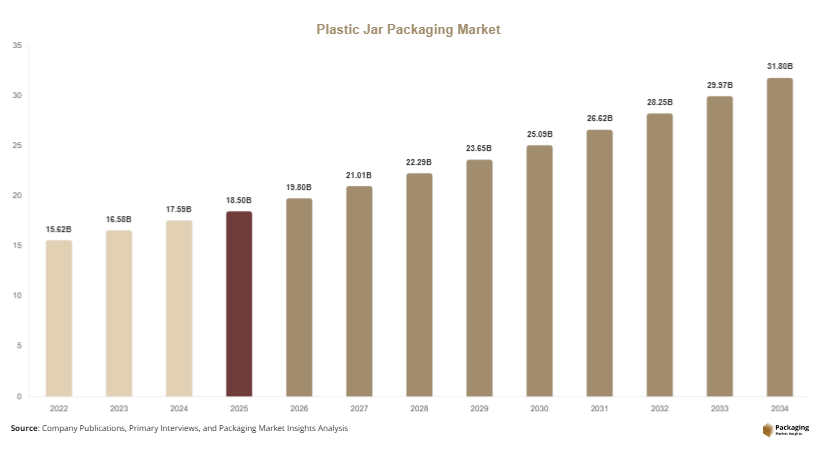
The plastic jar packaging market is experiencing steady growth due to increasing demand across food & beverage, cosmetics, pharmaceuticals, and household product industries. Plastic jars are widely used for storing and packaging products such as creams, powders, supplements, spreads, and processed foods due to their durability, lightweight structure, and cost efficiency. In 2025, the market size is estimated at USD 18.5 billion, and it is projected to reach approximately USD 19.8 billion in 2026. By 2034, the market is expected to grow to USD 33.6 billion, registering a compound annual growth rate (CAGR) of 6.1% from 2025 to 2034.
One of the primary growth factors is the rising consumption of packaged food and convenience products. Plastic jars provide excellent storage and protection, making them ideal for products such as sauces, spreads, and ready-to-eat items. Another key factor is the growing demand from the cosmetics and personal care industry. Plastic jars are widely used for creams, lotions, and gels due to their ease of use and aesthetic appeal.
Key Highlights:
- The market is projected to reach USD 33.6 billion by 2034, reflecting steady expansion driven by increasing demand across multiple industries. Growth is supported by rising consumption of packaged products globally.
- The market is expected to grow at a CAGR of 6.1% during 2025–2034. This growth rate indicates consistent demand and ongoing advancements in packaging technologies.
- Demand is growing across food, cosmetics, and pharmaceutical sectors. These industries rely on plastic jars for safe, convenient, and durable product storage and distribution.
- There is increasing adoption of lightweight and sustainable packaging materials. Manufacturers are focusing on recyclable and eco-friendly plastics to meet environmental regulations and consumer expectations.
- Expansion of e-commerce and retail distribution channels is driving market growth. Efficient and durable packaging solutions are needed to ensure product safety during shipping and handling.
Explore more data points, trends and opportunities Download Free Sample Report
Market Trends
Increasing Adoption of Recyclable and Bio-Based Plastic Materials
Sustainability is becoming a major trend in the plastic jar packaging market, with manufacturers focusing on recyclable and bio-based materials. Companies are investing in the development of eco-friendly plastics that reduce environmental impact while maintaining performance. The use of recycled polyethylene terephthalate (rPET) and biodegradable polymers is gaining traction across industries. Regulatory pressures and consumer awareness are encouraging businesses to adopt sustainable packaging solutions. Additionally, advancements in material technology are improving the strength and durability of eco-friendly plastics, making them suitable for a wide range of applications.
Growth of Customization and Premium Packaging Designs
Customization and premium packaging designs are gaining importance in the plastic jar packaging market. Companies are using innovative shapes, colors, and labeling techniques to enhance product appeal and differentiate their brands. Advanced printing technologies and design innovations are enabling manufacturers to create visually appealing packaging solutions. This trend is particularly prominent in the cosmetics and personal care industry, where packaging plays a key role in influencing consumer purchasing decisions. As competition increases, businesses are investing in customized packaging to strengthen brand identity and improve customer experience.
Market Drivers
Rising Demand from Food and Beverage Industry
The increasing demand for packaged food and beverages is a major driver of the plastic jar packaging market. Plastic jars are widely used for storing products such as sauces, spreads, and snacks due to their durability and convenience. The growing trend of ready-to-eat and convenience foods is driving demand for efficient packaging solutions. Additionally, plastic jars provide excellent barrier properties, ensuring product freshness and safety. The expansion of the food processing industry and the increasing popularity of packaged foods are further supporting market growth.
Expansion of Cosmetics and Personal Care Sector
The growth of the cosmetics and personal care industry is significantly driving the plastic jar packaging market. Plastic jars are commonly used for creams, lotions, and gels due to their ease of use and aesthetic appeal. The increasing demand for skincare and beauty products is boosting the use of plastic jar packaging. Additionally, the trend of premium and customized packaging is driving innovation in jar design and materials. As consumer awareness of personal care products continues to grow, the demand for plastic jar packaging is expected to increase.
Market Restraint
Environmental Concerns Related to Plastic Waste
Environmental concerns related to plastic waste pose a significant challenge to the plastic jar packaging market. Increasing awareness of plastic pollution and its impact on the environment has led to stricter regulations on plastic usage. Governments and regulatory bodies are implementing policies to reduce plastic waste and promote sustainable alternatives. For example, bans on single-use plastics in certain regions are affecting the demand for plastic packaging. Additionally, consumers are increasingly opting for eco-friendly products, which may limit the growth of traditional plastic jars. Manufacturers are required to invest in sustainable materials and recycling technologies, which can increase production costs and impact profitability.
Market Opportunities
Development of Sustainable and Recyclable Packaging Solutions
The growing focus on sustainability presents significant opportunities for the plastic jar packaging market. Companies are investing in the development of recyclable and biodegradable plastic materials to meet regulatory requirements and consumer preferences. Innovations in material science are enabling the production of eco-friendly plastic jars without compromising performance. Additionally, businesses are adopting circular economy practices, such as recycling and reuse, to reduce environmental impact. This trend is expected to create new growth opportunities for market players.
Growth in Emerging Markets and Urbanization
Emerging markets offer substantial opportunities for the plastic jar packaging market due to rapid urbanization and increasing consumer spending. The growing middle-class population and changing lifestyles are driving demand for packaged products. Additionally, the expansion of retail and e-commerce channels is improving product accessibility. Manufacturers are focusing on establishing production facilities in these regions to meet growing demand and reduce costs. As urbanization continues to rise, the demand for plastic jar packaging is expected to increase significantly.
Report Scope
| Report Metric | Details |
|---|---|
| Market Size in 2025 | USD 18.5 Billion |
| Market Size in 2026 | USD 19.8 Billion |
| Market Size in 2034 | USD 33.6 Billion |
| CAGR | 6.1% (2026-2034) |
| Base Year for Estimation | 2025 |
| Historical Data | 2022-2024 |
| Forecast Period | 2026-2034 |
| Report Coverage | Revenue Forecast, Competitive Landscape, Supply Chain Disruption, Growth Factors, Environment & Regulatory Landscape and Trends |
| Geographies Covered | North America, Europe, APAC, Middle East and Africa, LATAM |
| Countries Covered | U.S., Canada, U.K., Germany, France, Spain, Italy, Russia, Nordic, Benelux, Rest of Europe, China, South Korea, Japan, India, Australia, Singapore, Taiwan, South East Asia, Rest of Asia-Pacific, UAE, Turky, Saudi Arabia, South Africa, Egypt, Nigeria, Rest of MEA, Brazil, Mexico, Argentina, Chile, Colombia, Rest of LATAM |
Explore more data points, trends and opportunities Download Free Sample Report
Segmental Analysis
By Material Type
The polyethylene terephthalate (PET) segment dominated the plastic jar packaging market in 2024, accounting for approximately 52% of the total market share. PET is widely used due to its transparency, strength, and recyclability. It is suitable for a wide range of applications, including food and beverages, cosmetics, and pharmaceuticals. Additionally, PET jars offer excellent barrier properties, ensuring product safety and freshness. The growing demand for sustainable packaging solutions is further supporting the dominance of this segment.
The polypropylene (PP) segment is expected to be the fastest-growing, with a projected CAGR of 6.5% during the forecast period. PP jars offer advantages such as heat resistance and durability, making them suitable for various applications. The increasing demand for versatile and cost-effective packaging solutions is driving the growth of this segment. Additionally, advancements in PP recycling technologies are supporting market expansion.
By Application
The food and beverage segment held the largest share in 2024, accounting for nearly 48% of the market. Plastic jars are widely used for packaging products such as sauces, spreads, and snacks. The growing demand for convenience foods is driving the adoption of plastic jar packaging. Additionally, the expansion of the food processing industry is supporting the growth of this segment.
The cosmetics segment is projected to be the fastest-growing, with a CAGR of 6.8% during the forecast period. The increasing demand for skincare and beauty products is driving the use of plastic jar packaging. Additionally, the trend of premium and customized packaging is supporting the growth of this segment.
By End-Use
The consumer goods segment dominated the market in 2024, holding around 57% share. This segment includes food, cosmetics, and household products, which are major users of plastic jar packaging. The increasing demand for convenient and durable packaging solutions is driving growth in this segment.
The pharmaceutical segment is expected to witness the fastest growth, with a CAGR of 6.7%. Plastic jars are widely used for packaging supplements and medicines due to their safety and durability. The growth of the pharmaceutical industry is supporting the adoption of plastic jar packaging solutions.
Plastic Jar Packaging Market Segmentations
Material Type
- PET (Polyethylene Terephthalate)
- PP (Polypropylene)
- HDPE (High-Density Polyethylene)
Application
- Food & Beverage Packaging
- Cosmetics & Personal Care
- Pharmaceutical Packaging
- Household Products
End-Use
- Consumer Goods Industry
- Pharmaceutical Industry
Regional Analysis
North America
North America accounted for approximately 31% of the plastic jar packaging market share in 2025 and is expected to grow at a CAGR of 5.8% during the forecast period. The region’s strong consumer goods industry and high demand for packaged products are key factors driving market growth. Companies in North America are focusing on sustainable packaging solutions to meet regulatory requirements and consumer preferences.
The United States dominates the regional market due to its large food and beverage and cosmetics industries. A unique growth factor in this region is the increasing adoption of recyclable packaging materials. Businesses are investing in eco-friendly plastic jars to reduce environmental impact, supporting market expansion.
Europe
Europe held around 26% market share in 2025 and is projected to grow at a CAGR of 5.6%. The region’s strict environmental regulations and focus on sustainability are influencing the plastic jar packaging market. Companies are adopting innovative materials and production processes to comply with regulatory standards.
Germany is a leading country in the European market, supported by its strong manufacturing base. A key growth factor is the increasing demand for premium packaging solutions in the cosmetics industry. This is driving innovation and growth in the market.
Asia Pacific
Asia Pacific accounted for approximately 28% market share in 2025 and is expected to register the highest CAGR of 7.2%. Rapid urbanization, population growth, and expanding consumer markets are driving demand for plastic jar packaging in this region.
China dominates the Asia Pacific market due to its large manufacturing base and growing consumer goods industry. A unique growth factor is the rapid expansion of e-commerce platforms. This is increasing the demand for durable and cost-effective packaging solutions.
Middle East & Africa
The Middle East & Africa region held about 8% market share in 2025 and is projected to grow at a CAGR of 6.3%. The region is experiencing growth due to improving economic conditions and increasing consumer awareness.
The United Arab Emirates is a key market in this region, driven by its growing retail and cosmetics industries. A unique growth factor is the increasing demand for premium packaging solutions, supporting market growth.
Latin America
Latin America accounted for nearly 7% market share in 2025 and is expected to grow at a CAGR of 6.0%. The region’s expanding consumer base and improving economic conditions are contributing to market growth.
Brazil dominates the Latin American market due to its large population and growing food industry. A key growth factor is the increasing demand for packaged food products. This is driving the adoption of plastic jar packaging solutions.
Competitive Landscape
The plastic jar packaging market is moderately competitive, with several global and regional players focusing on innovation and sustainability. Companies are investing in advanced materials and manufacturing technologies to improve product quality and performance. Strategic partnerships and acquisitions are common as companies aim to expand their market presence.
Berry Global Inc. is a leading player in the market, known for its extensive range of plastic packaging solutions. The company has recently introduced recyclable plastic jars to support sustainability initiatives. Other key players are also focusing on developing eco-friendly materials and innovative designs to meet evolving customer demands. The competitive landscape is characterized by continuous innovation and a strong emphasis on sustainability.
Key Players List
- Berry Global Inc.
- Amcor plc
- Alpla Group
- Plastipak Holdings Inc.
- Gerresheimer AG
- RPC Group Plc
- Silgan Holdings Inc.
- Alpha Packaging
- Graham Packaging Company
- Cospack America Corp.
- Weener Plastics Group
- Comar LLC
- Berlin Packaging
- Pretium Packaging LLC
- Consolidated Container Company