Pet Preforms Market Size
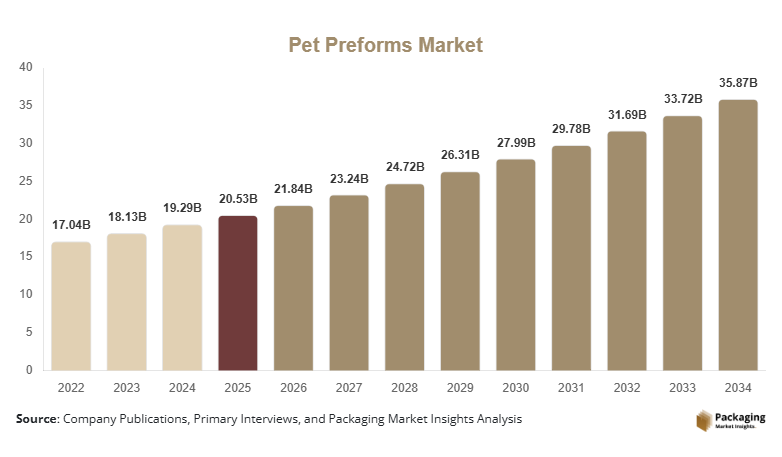
The pet food market size is projected at USD 21.84 billion in 2026 and is expected to hit USD 35.76 billion by 2034 with a CAGR of 6.4%. The report provides a comprehensive analysis of production capacity, pricing trends, regional consumption, supply chain developments, market segmentation, and the competitive landscape across major economies. It further evaluates manufacturing innovations, investment opportunities, and demand patterns throughout the forecast period.
PET preforms are injection-molded intermediate products manufactured from polyethylene terephthalate resin and subsequently blow-molded into bottles and containers for beverages, food, pharmaceuticals, and personal care products. Global production exceeded 645 billion units during 2025, with beverages accounting for approximately 71% of total consumption. The 28 mm neck finish represented nearly 49% of total production, while food packaging contributed 16% and personal care applications accounted for 13%. Manufacturing automation exceeded 67% across large production facilities, reinforcing the pet preforms market.
Explore more data points, trends and opportunities Download Free Sample Report
Pet Preforms Market Trends
Lightweight Packaging and Recycled PET Adoption
Manufacturers continue reducing resin consumption through lightweight preform designs while increasing recycled PET integration. More than 118 billion lightweight PET preforms were manufactured during 2025, while recycled PET utilization increased by 19% year-over-year. Approximately 58% of newly introduced beverage preforms incorporated recycled content, improving sustainability and strengthening the PET preforms market.
High-Speed Manufacturing and Smart Production
Advanced injection molding technologies and automated quality inspection systems continue improving production efficiency. High-speed manufacturing lines produced over 420 billion preforms annually, while robotic handling systems were implemented across 63% of newly commissioned facilities. Beverage packaging demand increased by 7.2%, and pharmaceutical packaging production expanded by 8.1%, supporting the PET preforms market.
Pet Preforms Market Drivers
Growing Consumption of Bottled Beverages
Rising global demand for bottled water, carbonated drinks, juices, edible oils, and dairy beverages continues driving production. Beverage manufacturers consumed more than 458 billion PET preforms during 2025, while bottled water production increased by 8.5%. Beverage packaging represented approximately 71% of total demand, accelerating expansion across the PET preforms market.
Pet Preforms Market Restraints
Volatility in PET Resin Prices
Fluctuations in crude oil prices and resin availability continue affecting production economics. PET resin contributes nearly 62% of total manufacturing costs, while logistics account for approximately 11%. Resin price fluctuations ranged between 12% and 20% during 2025, increasing procurement risks for manufacturers producing more than 5 billion units annually. These pricing pressures remain a restraint for the pet preforms market.
Pet Preforms Market Opportunities
Expansion of Sustainable Packaging Solutions
Increasing investment in recycled PET production and circular packaging initiatives presents substantial growth opportunities. Recycled PET production capacity exceeded 9 million metric tons, while sustainability investments surpassed USD 1.2 billion in 2025. Consumer preference for recyclable packaging increased by 24%, creating new opportunities across the PET preforms market.
Challenges in Pet Preforms Market
Recycling Infrastructure and Regulatory Compliance
Although PET is widely recyclable, collection and recycling efficiency remain inconsistent across regions. Global PET bottle collection rates average approximately 58%, while food-grade recycled PET recovery remains below 42% in several developing economies. Compliance with evolving sustainability regulations requires investments exceeding USD 850 million, creating ongoing challenges for the PET preforms market.
Report Scope
| Report Metric | Details |
|---|---|
| Market Size in 2025 | USD 20.53 Billion |
| Market Size in 2026 | USD 21.84 Billion |
| Market Size in 2034 | USD 35.76 Billion |
| CAGR | 6.4% (2026-2034) |
| Base Year for Estimation | 2025 |
| Historical Data | 2022-2024 |
| Forecast Period | 2026-2034 |
| Report Coverage | Revenue Forecast, Competitive Landscape, Supply Chain Disruption, Growth Factors, Environment & Regulatory Landscape and Trends |
| Geographies Covered | North America, Europe, APAC, Middle East and Africa, LATAM |
| Countries Covered | U.S., Canada, U.K., Germany, France, Spain, Italy, Russia, Nordic, Benelux, Rest of Europe, China, South Korea, Japan, India, Australia, Singapore, Taiwan, South East Asia, Rest of Asia-Pacific, UAE, Turkey, Saudi Arabia, South Africa, Egypt, Nigeria, Rest of MEA, Brazil, Mexico, Argentina, Chile, Colombia, Rest of LATAM |
Explore more data points, trends and opportunities Download Free Sample Report
Pet Preforms Market Segmentation
The market is segmented by neck finish and end-use industry, with 28 mm preforms accounting for approximately 49% of total production, while beverage applications contribute nearly 71% of worldwide consumption. Global production exceeded 645 billion units during 2025, supported by increasing demand for lightweight and recyclable packaging.
By Neck Finish
28 mm preforms dominate the market with approximately 49% share and production exceeding 316 billion units annually. These preforms are widely used for bottled water, carbonated beverages, juices, and edible oils while offering excellent sealing performance and lightweight construction.
30 mm preforms account for nearly 29% of market volume, with annual production exceeding 187 billion units. These products provide improved filling efficiency, pressure resistance, and compatibility with premium beverage packaging applications.
38 mm preforms contribute approximately 22% of total production, exceeding 142 billion units annually. They are primarily utilized for dairy products, juices, sports drinks, and wide-mouth packaging requiring enhanced dispensing performance.
By End-use Industry
Beverages dominate with approximately 71% of total demand, consuming more than 458 billion units annually. Applications include bottled water, soft drinks, juices, edible oils, dairy beverages, and functional drinks with high production efficiency and broad packaging compatibility.
Food applications account for approximately 16% of total demand and exceed 103 billion units annually. PET preforms are widely used for sauces, condiments, confectionery products, and processed food packaging requiring transparency and durability.
Personal Care represents nearly 13% of market consumption, with production exceeding 84 billion units annually. Applications include shampoos, lotions, liquid soaps, cosmetics, and household cleaning products requiring chemical resistance and premium appearance.
Pet Preforms Market Segmentations
Neck Finish
- 28 mm
- 30 mm
- 38 mm
End-use Industry
- Beverages
- Food
- Personal Care
Pet Preforms Regional Outlook
North America
North America accounts for approximately 24% of global demand, producing more than 154 billion units annually. The United States contributes nearly 82% of regional output, supported by bottled beverage manufacturing and advanced recycling infrastructure.
Europe
Europe represents approximately 26% of worldwide consumption and produces over 168 billion units annually. Germany, France, Italy, and Spain collectively contribute more than 70% of regional manufacturing, driven by sustainability initiatives and beverage packaging demand.
Asia-Pacific
The Asia-Pacific dominates the market with approximately a 41% share and production exceeding 264 billion units annually. China contributes nearly 51% of regional output, followed by India, Japan, and Southeast Asian countries supported by expanding beverage industries and rising consumer demand.
Latin America
Latin America accounts for approximately 6% of global demand. Brazil and Mexico together contribute nearly 68% of regional production, supported by bottled beverage manufacturing and food packaging expansion.
Middle East & Africa
The Middle East & Africa represent nearly 3% of worldwide consumption. Saudi Arabia, the UAE, and South Africa account for more than 61% of regional demand, supported by growing beverage production and urbanization.
Top Players In The Pet Preforms Market
- Retal Industries Ltd.
- ALPLA Group
- Plastipak Holdings, Inc.
- Amcor plc
- Indorama Ventures Public Company Limited
- Resilux NV
- PET Power B.V.
- Logoplaste Group
- Esterform Packaging Ltd.
- Manjushree Technopack Limited
- Chemco Group
- GTX Hanex Plastic Sp. z o.o.
Retal Industries Ltd. Estimated global market presence of 9–11% in PET preform manufacturing. Operates integrated manufacturing facilities across Europe, Asia, and North America. Focuses on lightweight preforms, recycled PET solutions, and high-speed production technologies. Serves beverage, food, and personal care manufacturers through continuous investments in automation, quality control, and sustainable packaging innovations. ALPLA Group has an estimated market presence of 8–10% across global PET packaging solutions. Maintains a strong presence in beverage and food packaging through integrated preform and bottle manufacturing. Invests significantly in recycling technologies, lightweight packaging, and circular economy initiatives. Continues expanding production capacity and strategic partnerships while strengthening sustainable packaging capabilities worldwide.