Supplements Nutrition Packaging Market Size and Growth
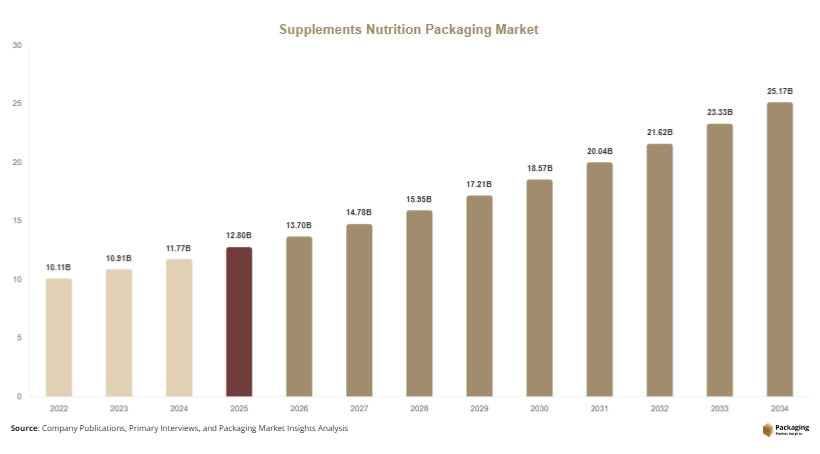
The global supplements nutrition packaging market size is estimated at USD 12.8 billion in 2025, and it is projected to reach USD 13.7 billion in 2026. By 2034, the market is expected to reach USD 25.6 billion, expanding at a CAGR of 7.9% during 2025–2034. The supplements nutrition packaging market is experiencing strong structural expansion, driven by increasing global health awareness, rising preventive healthcare consumption, and the rapid growth of dietary supplements, vitamins, and nutraceutical products. Packaging plays a critical role in this market by ensuring product stability, protecting sensitive nutritional compounds, and improving shelf life.
One of the primary growth factors is the increasing global demand for dietary supplements, particularly vitamins, minerals, protein powders, and herbal formulations. Aging populations in developed countries and fitness-oriented lifestyles among younger consumers are driving consistent consumption. Another major factor is the rising adoption of e-commerce channels for nutrition products, which requires durable, tamper-proof, and moisture-resistant packaging formats to maintain product integrity during shipping. Additionally, advancements in sustainable packaging materials, including recyclable bottles, bio-based pouches, and lightweight containers, are shaping the future of this market.
Key Highlights:
- Asia Pacific dominated the market with a 37.4% share in 2025.
- Latin America is projected to grow at the fastest CAGR of 6.2%.
- Plastic bottles led the type segment with a 29.6% share.
- Plastic packaging dominated with a 52.3% share.
- Tablets & capsules supplements led the segment with a 43.1% share.
- The US remained the dominant country with a market size of USD 3.4 billion in 2025 and USD 3.7 billion in 2026.
Explore more data points, trends and opportunities Download Free Sample Report
Market Trends
Rise of Sustainable and Recyclable Supplement Packaging
A major trend in the supplements nutrition packaging market is the shift toward sustainable and recyclable packaging solutions. Manufacturers are increasingly replacing conventional plastic containers with recyclable PET bottles, glass jars, and biodegradable pouches. This transition is driven by rising environmental awareness among consumers and corporate sustainability commitments. For example, vitamin brands in Europe are introducing compostable refill packs for daily supplement sachets. The trend is also supported by regulatory pressure to reduce single-use plastics in packaging. In the future, circular packaging systems, where supplement containers are collected and reused, are expected to become more common in premium nutrition segments.
Growth of Smart Packaging and Personalized Nutrition Systems
Another important trend is the adoption of smart packaging integrated with digital technologies. Supplement companies are using QR codes, NFC tags, and app-connected packaging to provide dosage tracking, nutritional guidance, and authenticity verification. For instance, personalized vitamin subscription services offer daily supplement packs with digital reminders linked through packaging scans. This enhances user engagement and compliance. The trend is expected to expand further with AI-driven nutrition platforms that connect packaging data with personalized health recommendations, transforming packaging into an interactive wellness tool.
Market Drivers
Increasing Global Demand for Dietary Supplements
The rising demand for dietary supplements is a key driver of the supplements nutrition packaging market. Consumers are increasingly focusing on preventive healthcare, immunity boosting, fitness enhancement, and nutritional balance. This has significantly increased consumption of vitamins, protein powders, probiotics, and herbal supplements. For example, in North America, fitness-oriented consumers regularly purchase protein powders in resealable packaging formats. This sustained demand directly drives packaging innovation, particularly in moisture-proof and oxygen-resistant containers that preserve product efficacy.
Expansion of E-commerce Nutrition Product Sales
The rapid growth of e-commerce platforms has significantly increased demand for secure and durable supplement packaging. Online sales require packaging that can withstand long-distance transportation, temperature variations, and handling stress. As a result, companies are adopting tamper-evident seals, moisture-barrier bottles, and lightweight protective packaging. For instance, direct-to-consumer supplement brands use subscription boxes with compartmentalized packaging for monthly nutrition kits. This shift toward online retail continues to accelerate packaging innovation.
Market Restraint
High Cost of Advanced Functional and Sustainable Packaging Materials
One of the key restraints in the supplements nutrition packaging market is the high cost associated with advanced packaging materials. Sustainable alternatives such as biodegradable polymers, glass-based containers, and multilayer barrier films are significantly more expensive than traditional plastic packaging. Small and mid-sized supplement manufacturers often face difficulties adopting these materials due to cost constraints. Additionally, maintaining product stability in natural and organic supplement formulations requires specialized barrier technologies, increasing production complexity. For example, herbal supplement producers in emerging economies often rely on basic plastic containers due to affordability, limiting the adoption of advanced packaging solutions. This cost barrier slows down large-scale transition to sustainable packaging formats despite growing environmental awareness.
Market Opportunities
Expansion of Personalized Nutrition and Subscription Packaging Models
The growing trend of personalized nutrition presents a major opportunity for packaging innovation. Subscription-based supplement services are gaining popularity, offering customized vitamin packs tailored to individual health needs. These services require segmented, portion-controlled packaging systems that ensure daily dosage accuracy. For example, companies in the U.S. and Europe are offering weekly or monthly supplement kits organized by time of consumption. This model increases demand for smart, compartmentalized, and user-friendly packaging formats. In the future, AI-driven nutrition personalization will further expand demand for adaptive packaging systems integrated with digital health tracking.
Growth in Functional Food and Herbal Supplement Packaging
The increasing consumption of functional foods and herbal supplements presents another strong opportunity. Consumers are shifting toward natural, plant-based, and immunity-boosting products, requiring specialized packaging that preserves active ingredients. For example, probiotic supplements require moisture-resistant and temperature-controlled packaging to maintain effectiveness. Herbal capsules and powders also require UV-protected containers to prevent degradation. As demand for natural wellness products continues to rise globally, packaging innovation focused on preservation and sustainability will expand significantly.
Report Scope
| Report Metric | Details |
|---|---|
| Market Size in 2025 | USD 12.8 Billion |
| Market Size in 2026 | USD 13.7 Billion |
| Market Size in 2034 | USD 25.6 Billion |
| CAGR | 7.9% (2026-2034) |
| Base Year for Estimation | 2025 |
| Historical Data | 2022-2024 |
| Forecast Period | 2026-2034 |
| Report Coverage | Revenue Forecast, Competitive Landscape, Supply Chain Disruption, Growth Factors, Environment & Regulatory Landscape and Trends |
| Geographies Covered | North America, Europe, APAC, Middle East and Africa, LATAM |
| Countries Covered | U.S., Canada, U.K., Germany, France, Spain, Italy, Russia, Nordic, Benelux, Rest of Europe, China, South Korea, Japan, India, Australia, Singapore, Taiwan, South East Asia, Rest of Asia-Pacific, UAE, Turky, Saudi Arabia, South Africa, Egypt, Nigeria, Rest of MEA, Brazil, Mexico, Argentina, Chile, Colombia, Rest of LATAM |
Explore more data points, trends and opportunities Download Free Sample Report
Segmental Analysis
By Type
Plastic bottles dominated the market in 2024 with a 41.6% share, due to their cost efficiency, durability, and lightweight properties. They are widely used for vitamins, capsules, and powders. For example, multivitamin brands commonly use HDPE bottles with tamper-evident seals to ensure product safety and shelf stability.
Blister packaging is the fastest-growing segment with a CAGR of 8.3%, driven by demand for single-dose convenience and improved dosage control. This format is widely used in tablet and capsule supplements.
By Material
Plastic packaging dominated with a 53.2% share in 2024, due to affordability and flexibility. It is widely used in mass-market supplements.
Biodegradable materials are the fastest-growing segment with a CAGR of 8.0%, driven by sustainability regulations and consumer preference for eco-friendly packaging.
By End-Use
Tablets and capsules led with a 44.5% share in 2024, due to high global consumption of vitamin supplements. These products require moisture-resistant packaging for stability.
Powder-based nutrition is the fastest-growing segment with a CAGR of 8.4%, driven by fitness trends and protein supplement demand.
Supplements Nutrition Packaging Market Segmentations
By Product Type
- Bottles & Jars
- Blister Packs
- Sachets & Stick Packs
- Capsules & Tablet Containers
By Material
- Plastic (PET, HDPE, PP)
- Glass
- Paper & Paperboard
- Biodegradable & Compostable Materials
By End-User
- Vitamins & Dietary Supplements
- Protein & Sports Nutrition
- Herbal & Botanical Supplements
- Functional Food & Nutraceuticals
By Distribution Channel
- Pharmacies & Drug Stores
- Online Retail & E-commerce Platforms
- Supermarkets & Hypermarkets
- Direct-to-Consumer Subscription Brands
Regional Analysis
North America
North America accounted for approximately 32.8% share in 2025, with a projected CAGR of 7.5% during 2025–2034. The region is a major market due to high dietary supplement consumption, strong retail infrastructure, and increasing health awareness. Consumers actively purchase vitamins, protein supplements, and wellness products through both online and offline channels. Packaging innovation is strongly focused on safety, convenience, and sustainability.
The United States dominates the regional market due to its large nutraceutical industry. A key growth driver is the expansion of direct-to-consumer supplement brands, which rely heavily on subscription-based packaging formats. For example, personalized vitamin packs delivered monthly are widely adopted in urban markets.
Europe
Europe held a 27.4% share in 2025, and is expected to grow at a CAGR of 7.8%. Growth is driven by rising demand for organic supplements, strict packaging regulations, and sustainability-focused consumer behavior. Countries such as Germany, the UK, and France are leading adopters of eco-friendly supplement packaging.
Germany dominates the region due to its strong pharmaceutical and nutraceutical manufacturing base. A key driver is the adoption of recyclable glass and paper-based supplement packaging aligned with EU sustainability directives.
Asia Pacific
Asia Pacific dominated the market with a 37.4% share in 2025, and is projected to grow at a CAGR of 8.6%. Rising disposable income, growing health awareness, and expanding middle-class population are driving demand. Countries like China, India, Japan, and South Korea are witnessing rapid growth in supplement consumption.
China remains the dominant country due to its large-scale nutraceutical production. A key driver is the expansion of online health platforms offering packaged supplement subscriptions.
Middle East & Africa
The region accounted for a 4.1% share in 2025, with a projected CAGR of 6.9%. Growth is driven by increasing health awareness and rising demand for imported supplements. Urbanization and retail expansion are supporting market growth.
The UAE dominates the region due to strong retail and pharmacy networks. A key driver is the increasing adoption of premium imported supplement brands with high-quality packaging standards.
Latin America
Latin America held a 2.3% share in 2025, with the fastest projected CAGR of 8.2%. Growth is driven by rising fitness trends and increasing adoption of dietary supplements in Brazil and Mexico.
Brazil dominates the region due to its growing wellness industry. A key driver is increasing demand for protein and sports nutrition supplements requiring durable packaging formats.
Competitive Landscape
The supplements nutrition packaging market is moderately fragmented, with key players focusing on sustainability, product safety, and smart packaging innovation. Major companies include Amcor Plc, Berry Global Inc., Gerresheimer AG, Sonoco Products Company, and Mondi Group. Among these, Amcor Plc is a leading player due to its strong portfolio of sustainable flexible and rigid packaging solutions.
Companies are investing in recyclable materials, lightweight packaging, and digital integration technologies. Berry Global is expanding its recycled plastic packaging portfolio, while Gerresheimer focuses on pharmaceutical-grade supplement containers. Strategic collaborations with nutraceutical brands are increasing to develop customized packaging solutions. Recent developments include expansion of biodegradable packaging production and introduction of smart labeling systems for supplements.
Key Players List
- Amcor Plc
- Berry Global Inc.
- Gerresheimer AG
- Sonoco Products Company
- Mondi Group
- Huhtamaki Oyj
- AptarGroup Inc.
- Constantia Flexibles
- DS Smith Plc
- Uflex Ltd.
- Winpak Ltd.
- Coveris Holdings
- Sealed Air Corporation
- CCL Industries Inc.
- Reynolds Group Holdings