On The Go Packaging Market Size and Growth
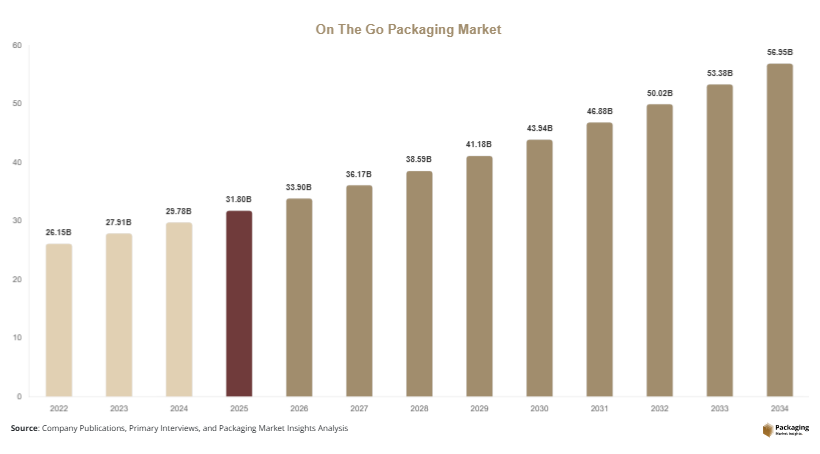
The global on the go packaging market was valued at USD 31.8 billion in 2025 and is projected to reach USD 33.9 billion in 2026. The market is expected to expand at a CAGR of 6.7% during 2025–2034, reaching approximately USD 60.8 billion by 2034. Rising demand for convenience food products, rapid urbanization, and the expansion of food delivery services are major factors contributing to market growth. On-the-go packaging solutions are designed to improve portability, convenience, freshness retention, and ease of consumption for busy consumers seeking ready-to-eat and ready-to-drink products.
The growing preference for mobile lifestyles and changing eating habits have significantly increased the demand for compact, lightweight, and durable packaging formats. Foodservice providers, beverage manufacturers, and retail chains are increasingly investing in innovative packaging solutions that improve consumer convenience while maintaining product safety and shelf appeal. Packaging formats such as cups, pouches, clamshells, trays, wraps, and portable containers are witnessing strong adoption across food and beverage applications.
Key Highlights
- Asia Pacific dominated the market with a 36.9% share in 2025.
- Latin America is projected to grow at the fastest CAGR of 7.3%.
- Flexible pouches led the type segment with a 28.7% share.
- Plastic materials dominated with a 49.6% share.
- Food applications led the end-use segment with 61.4% share.
- The US remained the dominant country with a market size of USD 8.4 billion in 2025 and USD 8.9 billion in 2026.
Explore more data points, trends and opportunities Download Free Sample Report
Market Trends
Rising Adoption of Sustainable Foodservice Packaging
Sustainability is becoming a major trend across the on the go packaging market as consumers and regulatory authorities increasingly demand environmentally responsible packaging solutions. Foodservice operators and beverage brands are shifting from conventional single-use plastics toward recyclable paper containers, compostable trays, and biodegradable packaging materials. Packaging companies are investing in fiber-based structures and bio-based coatings that improve sustainability without compromising food safety and durability.
For example, several quick-service restaurant chains are replacing plastic takeaway containers with molded fiber trays and paper cups featuring water-based barrier coatings. Beverage manufacturers are also introducing recyclable portable packaging for cold coffee and ready-to-drink beverages. Future demand for sustainable packaging solutions is expected to rise as governments introduce stricter regulations on plastic waste reduction and consumers prioritize environmentally friendly purchasing decisions.
Growth of Smart and Functional Portable Packaging
The increasing integration of functional and smart packaging technologies is another important trend shaping the on the go packaging market. Packaging manufacturers are developing microwave-safe containers, resealable pouches, spill-resistant lids, and freshness-monitoring labels designed to improve convenience for mobile consumers.
For instance, meal delivery brands are increasingly adopting insulated and temperature-retaining packaging formats to maintain food quality during transportation. QR-enabled packaging is also gaining traction, allowing consumers to access nutritional information, promotions, and recycling instructions through mobile devices. Future adoption of connected packaging technologies is expected to strengthen consumer engagement and improve supply chain transparency across foodservice and retail applications.
Market Drivers
Rapid Expansion of Food Delivery Services
The rapid growth of online food delivery platforms is one of the strongest drivers supporting the on the go packaging market. Restaurants, cloud kitchens, and convenience food providers increasingly require durable and portable packaging solutions capable of protecting products during transportation.
Food delivery companies are adopting leak-proof containers, insulated packaging, and tamper-evident sealing technologies to improve customer experience and food safety. For example, quick-service restaurants are investing in compartmentalized meal packaging that maintains temperature and prevents product mixing during delivery. The increasing popularity of app-based meal ordering and direct-to-consumer food distribution is expected to sustain long-term demand for portable food packaging products.
Increasing Urbanization and Mobile Consumer Lifestyles
Growing urban populations and changing consumer lifestyles are significantly driving demand for on-the-go packaging products worldwide. Consumers increasingly prefer portable meals, snacks, and beverages that fit into busy schedules involving commuting, office work, travel, and outdoor activities.
On-the-go packaging improves convenience by offering lightweight transportation, easy handling, and resealable functionality. Beverage manufacturers are increasingly introducing portable drink containers designed for fitness enthusiasts and office consumers. For example, convenience stores and supermarkets are expanding ready-to-eat food sections supported by compact packaging formats suitable for immediate consumption. The ongoing shift toward convenience-driven retail purchasing is expected to support market expansion over the forecast period.
Market Restraint
Environmental Concerns Related to Single-Use Packaging Waste
One of the major restraints affecting the on the go packaging market is the growing concern regarding single-use packaging waste and environmental pollution. Portable food and beverage packaging products are often designed for short-term consumption, resulting in significant volumes of disposable packaging waste globally.
Plastic containers, wrappers, cups, and multilayer flexible packaging structures are difficult to recycle in several regions due to inadequate waste management infrastructure and contamination issues. Governments across Europe and North America are introducing stricter regulations targeting disposable plastics and non-recyclable foodservice packaging materials. For example, bans on certain single-use plastic products are encouraging foodservice operators to transition toward alternative packaging solutions, increasing operational costs.
In addition, sustainable packaging materials such as biodegradable plastics and compostable containers often involve higher production costs compared to conventional packaging materials. Smaller foodservice providers may face financial challenges when adopting eco-friendly alternatives. These factors may limit rapid market adoption in price-sensitive regions and create supply chain challenges for packaging manufacturers transitioning toward sustainable materials.
Market Opportunities
Expansion of Sustainable Fiber-Based Packaging Solutions
The increasing demand for environmentally friendly packaging is creating major growth opportunities within the on the go packaging market. Packaging manufacturers are investing heavily in recyclable paper trays, molded fiber containers, and compostable foodservice packaging products to align with sustainability goals and regulatory requirements.
Foodservice chains and beverage companies are increasingly adopting renewable fiber-based materials to reduce dependency on conventional plastics. Several retail brands are introducing compostable takeaway packaging and paper-based snack containers to improve brand perception and environmental compliance. Future opportunities are expected to emerge from innovations in water-resistant paper coatings and lightweight recyclable packaging technologies suitable for high-volume food delivery operations.
Growth of Premium Convenience Food Packaging
The expansion of premium convenience food products is opening new opportunities for advanced on-the-go packaging solutions. Consumers increasingly seek premium portable meals, healthy snacks, and specialty beverages packaged in visually appealing and functional containers.
Packaging companies are introducing premium portable packaging with transparent windows, ergonomic designs, and high-barrier materials that improve freshness retention and brand differentiation. For example, ready-to-drink protein beverages and premium meal kits increasingly utilize aesthetically designed portable containers targeted at urban consumers. Future demand for premium packaging is expected to rise alongside the growth of health-focused convenience foods and specialty retail distribution channels.
Report Scope
| Report Metric | Details |
|---|---|
| Market Size in 2025 | USD 31.8 Billion |
| Market Size in 2026 | USD 33.9 Billion |
| Market Size in 2034 | USD 60.8 Billion |
| CAGR | 6.7% (2026-2034) |
| Base Year for Estimation | 2025 |
| Historical Data | 2022-2024 |
| Forecast Period | 2026-2034 |
| Report Coverage | Revenue Forecast, Competitive Landscape, Supply Chain Disruption, Growth Factors, Environment & Regulatory Landscape and Trends |
| Geographies Covered | North America, Europe, APAC, Middle East and Africa, LATAM |
| Countries Covered | U.S., Canada, U.K., Germany, France, Spain, Italy, Russia, Nordic, Benelux, Rest of Europe, China, South Korea, Japan, India, Australia, Singapore, Taiwan, South East Asia, Rest of Asia-Pacific, UAE, Turky, Saudi Arabia, South Africa, Egypt, Nigeria, Rest of MEA, Brazil, Mexico, Argentina, Chile, Colombia, Rest of LATAM |
Explore more data points, trends and opportunities Download Free Sample Report
Segmental Analysis
By Type
Flexible pouches dominated the on the go packaging market with approximately 28.7% of the global market share in 2024. Flexible pouch packaging is widely used for snacks, beverages, sauces, dairy products, and ready-to-eat meals because it offers lightweight transportation, resealability, and strong barrier protection. Food manufacturers increasingly prefer pouch packaging because it reduces material usage and transportation costs compared to rigid packaging formats. Several beverage brands are introducing portable drink pouches featuring ergonomic spouts and recyclable material structures to improve convenience for mobile consumers. Flexible pouches also support visually attractive printing and branding opportunities, making them highly suitable for retail shelves and online food delivery applications. The continued growth of convenience food consumption and snack packaging demand is expected to sustain strong market dominance for flexible pouches.
Clamshell containers are expected to register the fastest CAGR of 7.5% during the forecast period due to increasing demand for takeaway meals and food delivery applications. Clamshell packaging provides strong structural protection and convenient handling for burgers, salads, bakery products, and ready meals. Foodservice operators increasingly prefer recyclable fiber-based clamshell containers because they improve portability and align with sustainability regulations. Packaging companies are also introducing microwave-safe and compostable clamshell designs suitable for modern foodservice operations. Future growth is expected to be driven by expanding online food ordering platforms and increasing adoption of sustainable takeaway packaging solutions.
By Material
Plastic materials accounted for approximately 49.6% of the global on the go packaging market in 2024, making them the dominant material segment. Plastic packaging materials are widely used because they offer flexibility, durability, moisture resistance, and cost efficiency. Polypropylene, PET, and polyethylene are commonly utilized for beverage cups, food containers, wraps, and flexible snack packaging applications. Packaging manufacturers continue investing in lightweight plastic designs and recyclable polymer technologies to improve environmental performance while maintaining functionality. Plastic materials also support transparent packaging structures that enhance product visibility and consumer appeal across retail shelves.
Paper-based materials are projected to witness the fastest CAGR of 7.8% during the forecast period due to growing demand for sustainable and biodegradable packaging alternatives. Restaurants, cafes, and food delivery providers increasingly prefer paper containers, molded fiber trays, and recyclable wraps to reduce environmental impact. Several packaging manufacturers are introducing water-resistant paper coatings and compostable fiber packaging suitable for hot and cold food applications. Future demand for paper-based packaging is expected to rise as governments strengthen restrictions on single-use plastics and consumers prioritize eco-friendly packaging solutions.
By End-Use
Food applications dominated the on the go packaging market with approximately 61.4% of the global market share in 2024. Rising consumption of ready meals, bakery products, snacks, salads, and takeaway foods continues to drive strong demand for portable food packaging solutions. Foodservice operators increasingly require leak-proof, temperature-resistant, and tamper-evident packaging products capable of maintaining food quality during transportation. Several quick-service restaurant chains are investing in compartmentalized meal packaging and sustainable takeaway containers designed for delivery applications. In addition, supermarkets and convenience stores are expanding grab-and-go food sections supported by compact packaging formats suitable for immediate consumption. The continued growth of urban lifestyles and mobile eating habits is expected to strengthen future segment demand.
Beverage packaging is projected to register the fastest CAGR of 7.2% during the forecast period due to rising consumption of ready-to-drink coffee, energy drinks, smoothies, and flavored beverages. Beverage companies are introducing lightweight bottles, portable cups, and resealable containers designed for convenience-focused consumers. Packaging manufacturers are also developing insulated beverage packaging and recyclable cup solutions to support sustainability initiatives. Future growth is expected to be supported by increasing fitness trends, outdoor consumption activities, and expansion of premium beverage retail channels.
On The Go Packaging Market Segmentations
By Type
- Flexible Pouches
- Clamshell Containers
- Cups & Tubs
- Trays
- Wraps & Sachets
By Material
- Plastic
- Paper & Paperboard
- Aluminum
- Bioplastics
- Composite Materials
By End-User
- Food
- Beverages
- Bakery & Confectionery
- Dairy Products
- Convenience Meals
North America
North America accounted for approximately 32.6% of the global on the go packaging market in 2025 and is projected to register a CAGR of 6.2% during the forecast period. Strong demand for ready-to-eat meals, expansion of online food delivery services, and rising consumption of portable beverages are major factors supporting regional market growth. The United States and Canada continue to witness increasing adoption of sustainable takeaway packaging products across restaurant chains and retail foodservice outlets. In addition, growing demand for microwaveable and resealable packaging solutions is strengthening innovation across the region.
The United States remains the dominant country within the North American market because of its extensive fast-food industry and advanced convenience retail infrastructure. One unique growth driver is the rapid expansion of premium meal delivery subscriptions and ready-to-consume healthy food products. Restaurants and grocery chains are increasingly adopting insulated food containers and tamper-evident delivery packaging to improve customer satisfaction. The increasing popularity of mobile ordering platforms and drive-through foodservice models is also accelerating demand for lightweight and portable packaging formats.
Europe
Europe represented nearly 26.1% of the global on the go packaging market in 2025 and is expected to grow at a CAGR of 6.4% through 2034. Strong sustainability regulations and rising demand for eco-friendly foodservice packaging are major growth factors supporting the regional market. European consumers increasingly prefer recyclable takeaway packaging and biodegradable food containers as awareness regarding environmental sustainability continues to rise. Packaging companies are investing in paper-based and compostable packaging technologies designed for portable food applications.
Germany remains the dominant country in the European market due to its strong packaged food industry and growing focus on circular economy initiatives. One important growth driver is the rapid transition toward reusable and recyclable takeaway packaging systems across restaurants and cafes. Several foodservice companies are introducing deposit-return packaging models and compostable meal containers to reduce packaging waste. In addition, increasing demand for premium convenience meals and specialty beverages is driving innovation in functional and visually appealing portable packaging solutions.
Asia Pacific
Asia Pacific dominated the on the go packaging market with a 36.9% share in 2025 and is forecast to grow at a CAGR of 7.0% through 2034. Rapid urbanization, rising disposable incomes, and strong expansion of convenience retail channels are significantly supporting market growth across the region. Countries such as China, India, Japan, and South Korea are witnessing strong demand for portable food and beverage packaging due to changing lifestyles and increasing consumption of ready-to-eat products.
China remains the dominant country within the regional market because of its large food delivery ecosystem and expanding convenience store network. One unique growth driver is the rapid expansion of app-based meal delivery services and cloud kitchen operations. Packaging suppliers are investing in cost-efficient takeaway containers and insulated food packaging designed for high-volume delivery operations. India is also witnessing growing demand for affordable and lightweight food packaging products due to increasing urban middle-class populations and expanding quick-service restaurant chains.
Middle East & Africa
The Middle East & Africa accounted for approximately 5.1% of the global on the go packaging market in 2025 and is projected to witness a CAGR of 6.6% during the forecast period. Increasing tourism activities, urban retail expansion, and rising demand for packaged convenience foods are contributing to regional market growth. Quick-service restaurants and beverage retailers are increasingly adopting portable packaging solutions suitable for takeaway and delivery applications.
Saudi Arabia remains the dominant country within the regional market because of its growing foodservice industry and expanding urban consumer base. One major growth driver is the increasing investment in modern retail infrastructure and international restaurant chains. Food packaging suppliers are introducing durable and heat-resistant packaging products designed for hot climate conditions and long transportation distances. The United Arab Emirates is also witnessing rising demand for premium takeaway packaging due to tourism growth and increasing consumption of ready-to-drink beverages.
Latin America
Latin America held approximately 3.3% of the global on the go packaging market in 2025 and is expected to register the fastest CAGR of 7.3% during the forecast period. Expanding urban populations, rising food delivery adoption, and increasing convenience food consumption are major factors supporting regional market growth. Packaging companies are introducing affordable and lightweight takeaway packaging formats designed for quick-service restaurants and street food vendors.
Brazil remains the dominant country within the regional market due to its large packaged food industry and increasing digital food ordering activities. One unique growth driver is the rapid growth of convenience retail and mobile food delivery applications across urban areas. Restaurants and beverage companies are increasingly adopting recyclable takeaway containers and flexible snack packaging to improve operational efficiency and consumer convenience. Mexico is also witnessing rising demand for portable beverage packaging due to increasing consumption of ready-to-drink coffee and flavored beverages.
Competitive Landscape
The on the go packaging market is highly competitive, with major packaging companies focusing on sustainability, lightweight materials, and convenience-oriented product innovation to strengthen market position. Companies are investing in recyclable packaging technologies, smart food packaging, and advanced barrier materials designed for portable food and beverage applications.
Amcor plc remains one of the leading players in the market because of its broad flexible packaging portfolio and strong global manufacturing presence. The company continues investing in recyclable food packaging technologies and lightweight portable packaging solutions designed for food delivery and convenience retail applications.
Berry Global Inc., Huhtamaki Oyj, Sonoco Products Company, and Sealed Air Corporation are also major participants operating across the global market. These companies are focusing on sustainable packaging innovation, regional manufacturing expansion, and partnerships with foodservice operators to strengthen competitiveness. Packaging suppliers are increasingly collaborating with restaurant chains and beverage manufacturers to develop customized packaging products that improve convenience, branding, and sustainability performance.
Key Players List
- Amcor plc
- Berry Global Inc.
- Huhtamaki Oyj
- Sonoco Products Company
- Sealed Air Corporation
- Mondi Group
- Smurfit Kappa Group
- WestRock Company
- DS Smith Plc
- Coveris Holdings S.A.
- Graphic Packaging International LLC
- Pactiv Evergreen Inc.
- Dart Container Corporation
- Genpak LLC
- Novolex Holdings LLC
- Tetra Pak International S.A.
- Winpak Ltd.