Feed Encapsulation Market Size and Growth
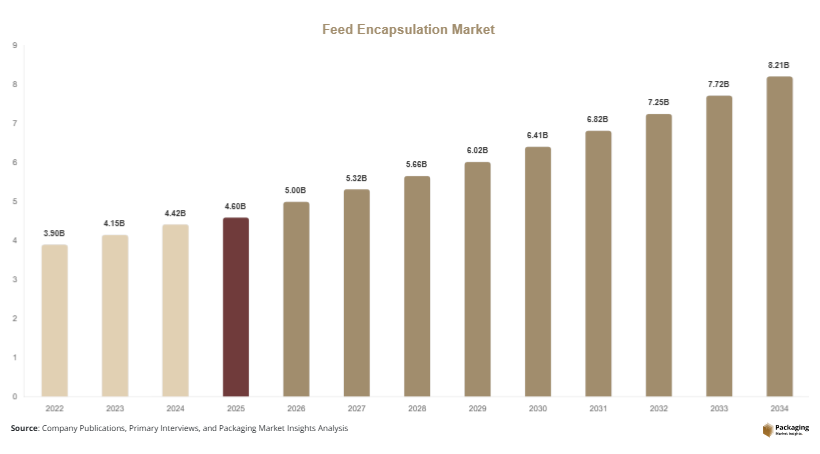
The feed encapsulation market size was valued at approximately USD 4.6 billion in 2025 and is projected to reach USD 5.0 billion in 2026. Over the forecast period from 2025 to 2034, the market is expected to expand at a CAGR of 6.4%, reaching an estimated USD 8.7 billion by 2034. The growing need for controlled release of nutrients and protection of sensitive feed additives is driving the demand for encapsulation technologies. The feed encapsulation market is gaining traction as the livestock and aquaculture industries increasingly adopt advanced nutritional solutions to improve feed efficiency and animal health.
One of the primary growth factors is the increasing demand for high-quality animal protein, which is encouraging farmers to adopt efficient feed solutions. Encapsulation helps improve nutrient absorption and reduces feed wastage, thereby enhancing productivity. Another significant factor is the rising focus on animal health and disease prevention. Encapsulated additives such as vitamins, enzymes, and probiotics provide targeted delivery and stability, supporting better livestock performance. Additionally, regulatory restrictions on antibiotic usage in animal feed are driving the adoption of alternative solutions, including encapsulated feed additives.
Key Highlights:
- Asia Pacific dominated the market with a 38.5% share in 2025, while Latin America is projected to grow at the fastest CAGR of 6.8%.
- Vitamins led the type segment with a 31.2% share, while enzymes are expected to grow at a CAGR of 6.9%.
- Lipid-based encapsulation dominated with a 46.7% share, while polymer-based encapsulation is forecasted to grow at a CAGR of 6.5%.
- Poultry applications led the segment with 42.6% share, while aquaculture is expected to grow at a CAGR of 7.1%.
- China remained the dominant country with a market size of USD 0.9 billion in 2025 and USD 1.0 billion in 2026.
Explore more data points, trends and opportunities Download Free Sample Report
Market Trends
Increasing Adoption of Precision Nutrition in Animal Feed
The feed encapsulation market is witnessing a shift toward precision nutrition, where feed formulations are tailored to meet specific nutritional requirements of livestock. Encapsulation technologies play a crucial role in delivering nutrients in a controlled manner, ensuring optimal absorption and minimizing waste. Farmers and feed manufacturers are adopting these solutions to improve feed efficiency and reduce production costs. The use of encapsulated additives allows for targeted delivery of nutrients, enhancing animal performance and productivity. This trend is particularly prominent in poultry and aquaculture industries, where precise nutrition is critical for growth and health.
Advancements in Encapsulation Technologies
Technological advancements are significantly influencing the feed encapsulation market. Innovations in encapsulation methods, such as nano-encapsulation and multi-layer coating, are improving the stability and effectiveness of feed additives. These technologies protect sensitive ingredients from environmental factors such as heat, moisture, and oxidation. Additionally, they enable controlled release of nutrients, ensuring consistent performance. Manufacturers are investing in research and development to enhance encapsulation efficiency and reduce production costs. This trend is expected to drive market growth by improving product quality and expanding application areas.
Market Drivers
Rising Demand for High-Quality Animal Protein
The increasing global demand for meat, dairy, and seafood products is a major driver of the feed encapsulation market. Consumers are seeking high-quality protein sources, which requires efficient feed solutions to enhance livestock productivity. Encapsulation technologies improve nutrient utilization and support better growth rates, making them essential for modern animal farming. The expansion of poultry, swine, and aquaculture industries is further driving demand for encapsulated feed additives. As population growth continues, the need for sustainable and efficient food production is expected to support market expansion.
Reduction in Antibiotic Usage in Animal Feed
Regulatory restrictions on antibiotic use in animal feed are driving the adoption of alternative solutions such as encapsulated additives. Encapsulation allows for the delivery of probiotics, enzymes, and other functional ingredients that support animal health without the use of antibiotics. This approach helps improve immunity and reduce the risk of diseases, aligning with regulatory requirements and consumer preferences. The shift toward antibiotic-free feed solutions is expected to drive demand for encapsulation technologies in the coming years.
Market Restraint
High Cost of Encapsulation Technologies
The feed encapsulation market faces challenges due to the high cost associated with advanced encapsulation technologies. Developing and implementing encapsulation processes requires significant investment in equipment and research. Small and medium-sized feed manufacturers may find it difficult to adopt these technologies due to cost constraints. For example, nano-encapsulation and multi-layer coating processes involve complex production methods, increasing operational expenses. Additionally, maintaining consistent quality and performance can be challenging, further impacting profitability. These factors may limit the widespread adoption of encapsulation technologies, particularly in cost-sensitive markets.
Market Opportunities
Growth in Aquaculture Industry
The rapid expansion of the aquaculture industry presents significant opportunities for the feed encapsulation market. Aquaculture requires specialized feed solutions to ensure efficient nutrient delivery and minimize environmental impact. Encapsulation technologies help improve feed stability in water and reduce nutrient leaching, enhancing feed efficiency. The increasing demand for seafood and sustainable aquaculture practices is driving the adoption of encapsulated feed additives. This segment is expected to contribute significantly to market growth.
Development of Innovative Encapsulated Feed Additives
The development of innovative encapsulated feed additives offers new growth opportunities for the market. Manufacturers are focusing on creating advanced formulations that enhance nutrient delivery and improve animal health. Innovations such as microencapsulation and controlled-release systems are gaining traction, providing better performance and cost efficiency. These advancements are enabling the development of customized feed solutions tailored to specific animal requirements. As research and development activities continue, the market is expected to witness the introduction of new and improved products.
Report Scope
| Report Metric | Details |
|---|---|
| Market Size in 2025 | USD 4.6 Billion |
| Market Size in 2026 | USD 5.0 Billion |
| Market Size in 2034 | USD 8.7 Billion |
| CAGR | 6.4% (2026-2034) |
| Base Year for Estimation | 2025 |
| Historical Data | 2022-2024 |
| Forecast Period | 2026-2034 |
| Report Coverage | Revenue Forecast, Competitive Landscape, Supply Chain Disruption, Growth Factors, Environment & Regulatory Landscape and Trends |
| Geographies Covered | North America, Europe, APAC, Middle East and Africa, LATAM |
| Countries Covered | U.S., Canada, U.K., Germany, France, Spain, Italy, Russia, Nordic, Benelux, Rest of Europe, China, South Korea, Japan, India, Australia, Singapore, Taiwan, South East Asia, Rest of Asia-Pacific, UAE, Turky, Saudi Arabia, South Africa, Egypt, Nigeria, Rest of MEA, Brazil, Mexico, Argentina, Chile, Colombia, Rest of LATAM |
Explore more data points, trends and opportunities Download Free Sample Report
Segmental Analysis
By Type
Vitamins accounted for the largest share of the feed encapsulation market in 2024, contributing approximately 31.2% of total revenue. These encapsulated vitamins are widely used to improve animal health and productivity. Encapsulation protects vitamins from degradation caused by heat and moisture, ensuring their effectiveness during feed processing and storage. The increasing demand for high-quality feed additives is driving the adoption of encapsulated vitamins.
Enzymes are the fastest-growing segment, expected to register a CAGR of 6.9% during the forecast period. Encapsulated enzymes improve nutrient digestion and absorption, enhancing feed efficiency. The growing focus on sustainable farming practices is driving the adoption of enzyme-based feed solutions.
By Technology
Lipid-based encapsulation accounted for the largest share in 2024, contributing 46.7% of the total market. This technology is widely used due to its ability to protect sensitive ingredients and provide controlled release. Lipid-based encapsulation is suitable for various feed additives, including vitamins and probiotics.
Polymer-based encapsulation is expected to grow at the fastest rate, with a CAGR of 6.5% over the forecast period. This technology offers improved stability and controlled release, making it suitable for advanced feed formulations. The increasing demand for high-performance feed solutions is driving the adoption of polymer-based encapsulation.
By Application
Poultry applications accounted for the largest share of the market in 2024, contributing 42.6% of total revenue. The demand for efficient feed solutions in poultry farming is driving this segment. Encapsulation helps improve nutrient utilization and supports better growth rates.
Aquaculture is the fastest-growing segment, with a projected CAGR of 7.1%. The increasing demand for seafood and sustainable aquaculture practices is driving this segment. Encapsulation technologies help improve feed stability in water and reduce nutrient loss, supporting market growth.
Feed Encapsulation Market Segmentations
By Type
- Vitamins
- Enzymes
- Minerals
- Probiotics
By Technology
- Lipid-Based Encapsulation
- Polymer-Based Encapsulation
- Spray Drying
By Application
- Poultry
- Swine
- Ruminants
- Aquaculture
Regional Analysis
North America
North America accounted for approximately 26.7% of the feed encapsulation market share in 2025 and is projected to grow at a CAGR of 6.0% during the forecast period. The region benefits from a well-established livestock industry and advanced feed manufacturing practices. Increasing adoption of precision nutrition and sustainable farming methods is driving market growth.
The United States dominates the North American market due to its large-scale livestock production and strong focus on innovation. A key growth factor is the increasing demand for high-quality animal protein, which is encouraging the adoption of advanced feed solutions.
Europe
Europe held around 22.4% of the market share in 2025 and is expected to grow at a CAGR of 5.9% through 2034. The region is characterized by strict regulations on animal feed and a strong emphasis on sustainability. These factors are encouraging the adoption of encapsulated feed additives.
Germany leads the European market, supported by its advanced agricultural practices and focus on animal welfare. The shift toward antibiotic-free feed solutions is a key factor driving market growth in the region.
Asia Pacific
Asia Pacific emerged as the largest regional market, accounting for 38.5% of the global share in 2025. The region is expected to grow at a CAGR of 6.7% during the forecast period. Rapid population growth and increasing demand for animal protein are driving market expansion.
China dominates the Asia Pacific market due to its large livestock and aquaculture industries. The expansion of poultry and aquaculture sectors is a major growth factor, increasing demand for advanced feed solutions.
Middle East & Africa
The Middle East & Africa region accounted for approximately 6.1% of the market share in 2025 and is projected to grow at a CAGR of 6.2%. Increasing investments in agriculture and livestock farming are driving demand for feed solutions.
The United Arab Emirates leads the regional market, supported by growing investments in food security initiatives. The adoption of advanced feed technologies is a key factor driving market growth.
Latin America
Latin America held a market share of around 6.3% in 2025 and is expected to grow at the fastest CAGR of 6.8% during the forecast period. The region is experiencing growth in livestock and aquaculture industries.
Brazil dominates the Latin American market due to its large agricultural sector. Increasing demand for meat exports is driving the adoption of advanced feed solutions, supporting market growth.
Competitive Landscape
The feed encapsulation market is moderately competitive, with several global and regional players focusing on innovation and product development. Companies are investing in research and development to enhance encapsulation technologies and improve feed additive performance. Strategic collaborations and partnerships are common strategies used to expand market presence.
BASF SE is recognized as a leading player in the market, driven by its extensive product portfolio and focus on innovation. The company recently introduced advanced encapsulated feed additives to improve nutrient delivery and efficiency. Other key players are also focusing on sustainability and cost optimization to remain competitive in the market.
Key Players List
- BASF SE
- Cargill, Incorporated
- Archer Daniels Midland Company
- Koninklijke DSM N.V.
- Evonik Industries AG
- Balchem Corporation
- Kerry Group plc
- Ingredion Incorporated
- DuPont de Nemours, Inc.
- Roquette Frères
- Sensient Technologies Corporation
- Givaudan SA
- Symrise AG
- Tate & Lyle PLC
- FrieslandCampina Ingredients