Customized Tea Packaging Market Size and Growth
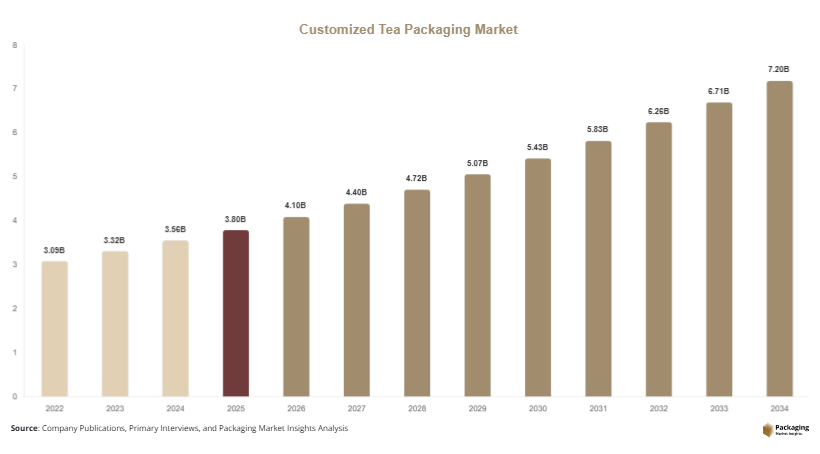
The global customized tea packaging market size was valued at approximately USD 3.8 billion in 2025 and is expected to reach nearly USD 4.1 billion in 2026. By 2034, the market is projected to expand to around USD 7.2 billion, registering a CAGR of 7.3% during 2025–2034. Customized tea packaging solutions are increasingly used by tea manufacturers, specialty tea brands, cafés, and online retailers to improve product presentation, preserve freshness, and strengthen brand identity in highly competitive markets. The customized tea packaging market is witnessing notable growth due to changing consumer preferences, increasing premium tea consumption, and rising demand for sustainable packaging formats.
One of the major growth factors supporting the market is the increasing popularity of premium and specialty teas, including herbal, organic, wellness, and flavored tea products. Consumers are seeking visually appealing and high-quality packaging that reflects product authenticity and freshness. Another significant factor is the rapid expansion of e-commerce platforms, where attractive and durable packaging plays an important role in customer engagement and safe product delivery. Tea brands are increasingly investing in customized pouches, rigid boxes, and printed cartons to improve online visibility and enhance unboxing experiences.
Key Highlights
- Asia Pacific dominated the market with a 39.8% share in 2025.
- Latin America is projected to grow at the fastest CAGR of 7.8%.
- Flexible pouches led the packaging type segment with a 36.2% share.
- Paper & paperboard materials dominated with a 44.7% share.
- Retail applications led the market with 48.5% share.
- The US remained the dominant country with a market size of USD 740 million in 2025 and USD 790 million in 2026.
Explore more data points, trends and opportunities Download Free Sample Report
Market Trends
Rising Adoption of Sustainable and Eco-Friendly Packaging
Sustainability has become a major trend in the customized tea packaging market as tea brands increasingly focus on environmentally responsible packaging solutions. Manufacturers are replacing plastic laminates with recyclable paper-based materials, compostable films, and biodegradable pouches to meet consumer expectations and environmental regulations. Tea consumers are becoming more aware of packaging waste and are actively choosing brands that use sustainable packaging practices. Flexible paper pouches, reusable tea tins, and plant-based packaging films are gaining popularity across premium and organic tea categories. This trend is also encouraging packaging companies to invest in lightweight materials and water-based printing technologies that reduce environmental impact while maintaining product quality and shelf appeal.
Growth of Personalized and Premium Packaging Designs
Personalized packaging is becoming increasingly important in the tea industry as brands compete through visual identity and customer engagement. Tea companies are adopting customized packaging with premium finishes, embossed printing, metallic labels, and limited-edition seasonal designs to strengthen brand recognition. Luxury tea brands are particularly investing in rigid boxes and decorative packaging formats for gifting purposes. In addition, digital printing technology allows small and medium-sized tea businesses to create short-run customized designs with lower production costs. Personalized packaging also supports direct-to-consumer marketing strategies, subscription tea services, and social media promotion, making it a significant trend shaping the future of the customized tea packaging market.
Market Drivers
Increasing Demand for Premium and Specialty Tea Products
The growing consumption of premium and specialty tea products is one of the primary drivers of the customized tea packaging market. Consumers are increasingly purchasing herbal, wellness, green, and flavored teas that require attractive and functional packaging to preserve freshness and aroma. Tea brands are using customized packaging as a branding tool to communicate product quality, origin, and health benefits. Packaging designs featuring resealable closures, premium graphics, and transparent windows are helping companies improve customer appeal in retail stores and online marketplaces. The expansion of luxury tea gifting and café culture is further contributing to demand for sophisticated packaging formats across global markets.
Expansion of E-commerce and Subscription-Based Tea Sales
The rapid growth of online tea sales and subscription-based delivery services is driving demand for durable and visually appealing tea packaging solutions. E-commerce platforms require packaging that protects tea products from moisture, contamination, and physical damage during shipping. Customized tea packaging also plays an important role in improving customer experience through attractive presentation and premium unboxing experiences. Subscription tea brands are increasingly using personalized labels, reusable containers, and eco-friendly pouches to strengthen customer retention and brand loyalty. As online tea retail continues to expand globally, demand for innovative and protective packaging solutions is expected to rise steadily.
Market Restraint
High Cost of Premium and Sustainable Packaging Materials
One of the major restraints affecting the customized tea packaging market is the high cost associated with premium packaging materials and sustainable packaging solutions. Tea companies increasingly prefer recyclable paperboard, compostable films, metal tins, and high-quality printing finishes to improve brand image and environmental performance. However, these materials often involve higher production and sourcing costs compared to conventional plastic packaging. Small and medium-sized tea brands may struggle to adopt advanced packaging formats due to budget limitations and fluctuating raw material prices.
For example, luxury tea brands using rigid gift boxes, foil stamping, and biodegradable laminates often face higher packaging expenses that can increase overall product pricing. This may reduce competitiveness in price-sensitive markets where consumers prioritize affordability over premium packaging aesthetics. In addition, sustainable materials sometimes require specialized manufacturing equipment and longer production cycles, increasing operational complexity for packaging suppliers. Regulatory compliance related to compostability, recyclability, and food safety labeling further adds to packaging development costs. These financial challenges may limit adoption rates among emerging tea brands and regional packaging manufacturers operating with restricted investment capacity.
Market Opportunities
Growth of Luxury Tea Gifting Packaging
The increasing popularity of premium tea gifting presents strong growth opportunities for customized tea packaging manufacturers. Consumers are purchasing specialty teas for festive occasions, corporate gifting, and wellness-focused gift sets, creating demand for decorative and premium packaging formats. Tea brands are investing in rigid boxes, magnetic closure packaging, embossed finishes, and reusable tea tins to enhance visual appeal and customer experience. Personalized gift packaging also supports limited-edition product launches and seasonal marketing campaigns. As tea gifting becomes more common across developed and emerging markets, demand for innovative luxury packaging solutions is expected to expand significantly during the forecast period.
Expansion of Smart and Interactive Packaging
Smart packaging technologies are creating new opportunities in the customized tea packaging market. Tea brands are increasingly integrating QR codes, augmented reality features, and digital authentication labels into packaging designs to improve customer interaction and product transparency. Consumers can access brewing instructions, ingredient details, sourcing information, and promotional content through interactive packaging features. Smart packaging also supports anti-counterfeit measures and strengthens supply chain traceability for premium tea products. As digital engagement becomes more important in consumer purchasing decisions, adoption of connected packaging solutions is expected to increase across both retail and e-commerce channels.
Report Scope
| Report Metric | Details |
|---|---|
| Market Size in 2025 | USD 3.8 Billion |
| Market Size in 2026 | USD 4.1 Billion |
| Market Size in 2034 | USD 7.2 Billion |
| CAGR | 7.3% (2026-2034) |
| Base Year for Estimation | 2025 |
| Historical Data | 2022-2024 |
| Forecast Period | 2026-2034 |
| Report Coverage | Revenue Forecast, Competitive Landscape, Supply Chain Disruption, Growth Factors, Environment & Regulatory Landscape and Trends |
| Geographies Covered | North America, Europe, APAC, Middle East and Africa, LATAM |
| Countries Covered | U.S., Canada, U.K., Germany, France, Spain, Italy, Russia, Nordic, Benelux, Rest of Europe, China, South Korea, Japan, India, Australia, Singapore, Taiwan, South East Asia, Rest of Asia-Pacific, UAE, Turky, Saudi Arabia, South Africa, Egypt, Nigeria, Rest of MEA, Brazil, Mexico, Argentina, Chile, Colombia, Rest of LATAM |
Explore more data points, trends and opportunities Download Free Sample Report
Segmental Analysis
By Packaging Type
Flexible pouches dominated the customized tea packaging market in 2024, accounting for approximately 36.2% of the total market share. These packaging formats are widely preferred due to their lightweight structure, resealable functionality, and strong barrier protection against moisture and oxygen. Tea manufacturers use flexible pouches for loose-leaf teas, herbal blends, and flavored tea products because they preserve freshness while reducing transportation costs. Flexible pouches also support customized printing and branding designs, allowing companies to improve shelf visibility and consumer appeal. Their compatibility with sustainable materials and stand-up pouch formats further contributes to their strong adoption across retail and e-commerce channels.
Biodegradable tea packaging is projected to be the fastest-growing subsegment, expanding at a CAGR of 8.1% during the forecast period. Increasing environmental awareness and stricter regulations on single-use plastics are driving demand for compostable and eco-friendly tea packaging solutions. Tea brands are increasingly adopting biodegradable pouches, plant-based films, and recyclable sachets to improve sustainability performance and attract environmentally conscious consumers. Advancements in biodegradable barrier materials are also improving product shelf life and moisture resistance. As sustainable branding becomes more important in the tea industry, adoption of biodegradable packaging formats is expected to accelerate globally.
By Material
Paper & paperboard materials held the largest share of 44.7% in 2024 due to their recyclability, printing flexibility, and premium visual appeal. These materials are commonly used for tea cartons, rigid boxes, labels, and gift packaging because they support high-quality graphics and decorative finishes. Paper-based packaging also aligns with sustainability initiatives adopted by tea brands and retailers worldwide. Manufacturers prefer paperboard materials because they are lightweight, customizable, and compatible with digital printing technologies. Growing consumer preference for eco-friendly packaging continues to support demand for paper-based tea packaging formats across premium and mainstream product categories.
Compostable materials are anticipated to witness the fastest growth, registering a CAGR of 8.3% during the forecast period. Increasing regulatory pressure regarding plastic waste reduction is encouraging tea companies to adopt compostable packaging solutions made from renewable resources. Compostable films and laminates offer environmental benefits while maintaining packaging performance and product freshness. Tea brands focused on organic and wellness products are particularly investing in compostable packaging to strengthen sustainable brand positioning. Improvements in material durability and industrial composting compatibility are expected to drive wider adoption of these materials across global markets.
By Application
Retail packaging accounted for the largest market share of 48.5% in 2024 due to the strong presence of supermarkets, specialty tea stores, and organized retail channels. Tea products sold through retail environments require packaging that improves shelf visibility, protects freshness, and communicates product information effectively. Customized packaging with attractive graphics, transparent windows, and premium finishes helps brands differentiate products in competitive retail spaces. In addition, retail-ready packaging supports seasonal promotions and gift-oriented tea collections. The continued expansion of premium tea retail outlets and wellness-focused stores is expected to sustain strong demand for customized tea packaging solutions.
E-commerce tea packaging is projected to grow at the fastest CAGR of 8.5% during the forecast period. The growth of online tea sales and direct-to-consumer subscription services is increasing demand for durable and visually appealing packaging formats. E-commerce packaging solutions focus on lightweight structures, moisture resistance, and secure sealing to protect tea products during transportation. Tea brands are also investing in customized shipping boxes, branded inserts, and sustainable mailers to improve customer satisfaction and enhance unboxing experiences. Rising international online tea trade and digital marketing activities are expected to further support growth in this segment.
Customized Tea Packaging Market Segmentations
By Packaging Type
- Flexible Pouches
- Rigid Boxes
- Tea Sachets
- Metal Tea Tins
- Biodegradable Packaging
By Material
- Paper & Paperboard
- Plastic
- Compostable Materials
- Aluminum Foil
By Application
- Retail Packaging
- E-commerce Packaging
- Gift Packaging
- Foodservice Packaging
Regional Analysis
North America
North America accounted for approximately 25.7% of the global customized tea packaging market share in 2025 and is projected to grow at a CAGR of 6.4% during the forecast period. The regional market benefits from increasing consumption of specialty tea products, growing café culture, and strong demand for premium packaging formats. Sustainable packaging adoption is also rising as tea brands focus on recyclable materials and environmentally responsible branding strategies.
The United States dominates the North American market due to its expanding organic tea industry and growing online tea subscription services. A unique growth factor is the increasing demand for personalized tea gift packaging during seasonal events and wellness-focused promotional campaigns. Tea brands are investing in premium packaging formats to strengthen customer engagement and brand recognition across retail and digital platforms.
Europe
Europe held nearly 23.4% of the global market share in 2025 and is expected to grow at a CAGR of 6.1% through 2034. Strong environmental regulations and increasing preference for sustainable packaging solutions are supporting market growth across the region. Tea brands are increasingly adopting compostable and paper-based packaging materials to comply with waste reduction targets and changing consumer expectations.
Germany remains the dominant country within the European customized tea packaging market due to its established tea retail sector and advanced packaging manufacturing industry. A unique growth factor is the rising popularity of herbal and wellness teas that require premium and informative packaging designs. Manufacturers are focusing on recyclable pouches and luxury gift boxes to meet evolving consumer preferences.
Asia Pacific
Asia Pacific dominated the customized tea packaging market with a 39.8% share in 2025 and is projected to register a CAGR of 7.7% during the forecast period. Rising tea consumption, growing middle-class populations, and expansion of premium tea brands are driving demand for customized packaging solutions in the region. Rapid urbanization and increasing online retail activity are also contributing to market expansion.
China leads the regional market due to its strong tea production industry and high consumption of specialty tea products. A unique growth factor is the cultural significance of tea gifting, particularly during festivals and business events. This trend is increasing demand for luxury tea packaging formats such as decorative tins, rigid boxes, and customized printed cartons across domestic and export markets.
Middle East & Africa
The Middle East & Africa region represented approximately 5.1% of the global market share in 2025 and is expected to grow at a CAGR of 6.5% during the assessment period. Rising urbanization, increasing disposable income, and growing interest in premium tea beverages are supporting demand for customized tea packaging solutions. The hospitality sector is also contributing to market growth through rising consumption of specialty teas.
The United Arab Emirates dominates the regional market due to its expanding luxury retail industry and premium food packaging sector. A unique growth factor is the increasing demand for decorative tea gift packaging among high-income consumers and tourists. Tea brands are introducing premium packaging formats with gold foil printing and luxury finishes to strengthen product positioning in the regional market.
Latin America
Latin America accounted for nearly 6.0% of the global customized tea packaging market share in 2025 and is projected to grow at the fastest CAGR of 7.8% during the forecast period. Increasing tea consumption, rising health awareness, and expanding retail distribution networks are contributing to market growth. Packaging companies are also benefiting from growing demand for eco-friendly and lightweight packaging formats across the region.
Brazil remains the dominant country in the Latin American market due to its growing herbal tea industry and expanding food retail sector. A unique growth factor is the increasing popularity of wellness-oriented tea products among younger consumers. This trend is encouraging tea brands to adopt modern and visually appealing packaging solutions to improve product visibility and strengthen customer engagement.
Competitive Landscape
The customized tea packaging market is moderately fragmented, with several global and regional packaging manufacturers competing through product innovation, sustainable material development, and premium printing capabilities. Companies are focusing on eco-friendly packaging formats, digital printing technologies, and luxury packaging designs to strengthen market presence and meet changing consumer preferences. Strategic partnerships with tea brands and expansion of flexible packaging production capacities are also becoming common growth strategies across the industry.
Amcor Plc remains one of the leading companies in the market due to its broad sustainable packaging portfolio and advanced flexible packaging solutions. In 2024, the company introduced recyclable tea pouch packaging with improved barrier protection designed specifically for premium tea products and online retail distribution.
Other major companies operating in the market include Mondi Group, Sonoco Products Company, Huhtamaki Oyj, and Constantia Flexibles. These companies are investing in lightweight packaging materials, compostable films, and customized printing solutions to strengthen product differentiation and expand customer reach across global tea markets.
Key Players List
- Amcor Plc
- Mondi Group
- Sonoco Products Company
- Huhtamaki Oyj
- Constantia Flexibles
- WestRock Company
- DS Smith Plc
- Sealed Air Corporation
- Smurfit Kappa Group
- ProAmpac
- Coveris Holdings S.A.
- UFlex Ltd.
- Clondalkin Group
- Printpack Inc.
- Glenroy Inc.