Halal Packaging Market Size and Growth
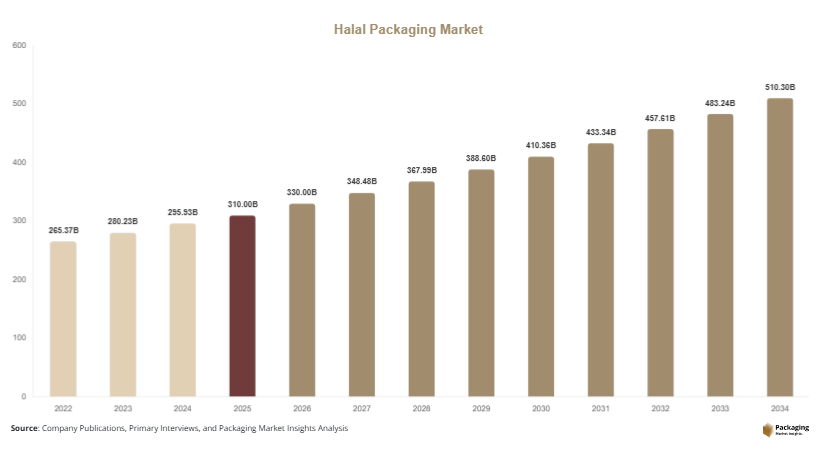
The global halal packaging market size was valued at approximately USD 310 billion in 2025 and is projected to reach USD 330 billion in 2026. Over the forecast period, the market is expected to grow significantly, reaching nearly USD 540 billion by 2034, registering a compound annual growth rate (CAGR) of 5.6% from 2025 to 2034. The growth reflects the increasing consumption of halal food, pharmaceuticals, and cosmetics across both Muslim-majority and non-Muslim regions. The halal packaging market is expanding steadily, driven by the rising demand for halal-certified products and increasing awareness of compliance standards across supply chains.
One of the key growth factors is the rising global Muslim population, which is increasing demand for halal-compliant products and packaging solutions. Consumers are becoming more conscious about product authenticity, leading to a stronger focus on traceability and certification. Another factor driving market growth is the expansion of halal-certified supply chains, where packaging plays a critical role in maintaining product integrity and preventing contamination. Additionally, the increasing adoption of halal standards in non-food sectors such as pharmaceuticals and personal care is contributing to market expansion.
Key Highlights:
- Asia Pacific dominated the market with a 41.5% share in 2025, while Latin America is projected to grow at the fastest CAGR of 6.3%.
- Flexible packaging led the type segment with a 46.8% share, while rigid packaging is expected to grow at a CAGR of 5.9%.
- Plastic packaging dominated with a 53.2% share, while paper-based packaging is forecasted to grow at a CAGR of 5.7%.
- Food & beverage applications led the segment with 48.6% share, while pharmaceutical packaging is expected to grow at a CAGR of 6.1%.
- Indonesia remained the dominant country with a market size of USD 28.4 billion in 2025 and USD 30.1 billion in 2026.
Explore more data points, trends and opportunities Download Free Sample Report
Market Trends
Increasing Demand for Certified and Traceable Packaging Solutions
The halal packaging market is witnessing a growing emphasis on certification and traceability as consumers demand greater transparency. Packaging plays a vital role in ensuring that halal products remain uncontaminated throughout the supply chain. Manufacturers are adopting advanced labeling systems, including QR codes and digital authentication tools, to provide detailed product information. These technologies help verify halal compliance and build consumer trust. The trend is particularly prominent in the food and pharmaceutical sectors, where strict adherence to halal standards is essential for market acceptance.
Adoption of Sustainable and Eco-Friendly Packaging Materials
Sustainability is emerging as a significant trend in the halal packaging market, with companies focusing on environmentally friendly materials. Consumers are increasingly seeking products that align with both ethical and environmental values. As a result, manufacturers are exploring biodegradable, recyclable, and compostable packaging solutions that meet halal requirements. The integration of sustainability with halal compliance is driving innovation in packaging materials. This trend is expected to gain momentum as regulatory bodies and industry stakeholders emphasize the importance of sustainable practices.
Market Drivers
Growth of Global Halal Food and Beverage Industry
The expansion of the halal food and beverage sector is a major driver of the halal packaging market. Increasing consumer demand for halal-certified products is encouraging manufacturers to adopt compliant packaging solutions. The rise in international trade of halal products is also boosting demand for standardized packaging that meets certification requirements. Packaging plays a crucial role in maintaining product integrity and ensuring compliance with halal guidelines, making it an essential component of the supply chain.
Rising Awareness of Halal Compliance Across Industries
Awareness of halal standards is increasing across various industries, including pharmaceuticals, cosmetics, and personal care. Consumers are becoming more informed about product ingredients and manufacturing processes, leading to higher demand for halal-certified packaging. Companies are investing in compliance measures to meet these expectations and gain market acceptance. This growing awareness is driving the adoption of halal packaging solutions across multiple sectors.
Market Restraint
Complexity of Certification and Compliance Requirements
The halal packaging market faces challenges due to the complexity of certification and compliance processes. Different regions have varying halal standards and regulatory frameworks, making it difficult for manufacturers to maintain consistency. Obtaining certification can be time-consuming and costly, particularly for small and medium-sized enterprises. For example, a packaging manufacturer exporting products to multiple countries may need to comply with different certification bodies, increasing operational complexity. These challenges can limit market growth and create barriers for new entrants.
Market Opportunities
Expansion of Halal Packaging in Non-Food Sectors
The application of halal packaging is expanding beyond food and beverages into sectors such as pharmaceuticals and cosmetics. This presents significant growth opportunities for market players. Consumers are increasingly seeking halal-certified personal care and healthcare products, driving demand for compliant packaging solutions. Companies can leverage this trend by developing specialized packaging designs that meet the unique requirements of these industries.
Growth in Emerging Markets with Increasing Muslim Population
Emerging markets with growing Muslim populations offer substantial opportunities for the halal packaging market. Countries in Asia, Africa, and the Middle East are experiencing increased demand for halal products. Government initiatives promoting halal industries are further supporting market growth. Packaging manufacturers can expand their presence in these regions by establishing local production facilities and forming strategic partnerships.
Report Scope
| Report Metric | Details |
|---|---|
| Market Size in 2025 | USD 310 Billion |
| Market Size in 2026 | USD 330 Billion |
| Market Size in 2034 | USD 540 Billion |
| CAGR | 5.6% (2026-2034) |
| Base Year for Estimation | 2025 |
| Historical Data | 2022-2024 |
| Forecast Period | 2026-2034 |
| Report Coverage | Revenue Forecast, Competitive Landscape, Supply Chain Disruption, Growth Factors, Environment & Regulatory Landscape and Trends |
| Geographies Covered | North America, Europe, APAC, Middle East and Africa, LATAM |
| Countries Covered | U.S., Canada, U.K., Germany, France, Spain, Italy, Russia, Nordic, Benelux, Rest of Europe, China, South Korea, Japan, India, Australia, Singapore, Taiwan, South East Asia, Rest of Asia-Pacific, UAE, Turky, Saudi Arabia, South Africa, Egypt, Nigeria, Rest of MEA, Brazil, Mexico, Argentina, Chile, Colombia, Rest of LATAM |
Explore more data points, trends and opportunities Download Free Sample Report
Segmental Analysis
By Material Type
Plastic packaging dominated the halal packaging market in 2024, accounting for approximately 53.2% of the total share. Plastic materials are widely used due to their durability, flexibility, and ability to maintain product integrity. These materials provide effective barriers against contamination, which is essential for halal compliance. Additionally, advancements in plastic packaging technologies are improving performance and sustainability, making them suitable for various applications.
Paper-based packaging is expected to be the fastest-growing segment, with a CAGR of 5.7%. Paper materials are gaining popularity due to their eco-friendly properties and compatibility with halal requirements. Manufacturers are developing advanced paper packaging solutions with improved strength and moisture resistance. This trend is supported by increasing consumer demand for sustainable packaging options.
By Packaging Type
Flexible packaging dominated the packaging type segment in 2024, holding a market share of 46.8%. Flexible materials such as pouches and films are widely used due to their cost-effectiveness and versatility. These packaging solutions are suitable for a wide range of products and offer convenience in handling and storage. The ability to incorporate halal certification labels and tamper-proof features further enhances their appeal.
Rigid packaging is expected to be the fastest-growing segment, with a CAGR of 5.9%. Rigid materials such as containers and bottles provide enhanced protection and durability. These packaging solutions are increasingly used in premium products and pharmaceuticals. The growing demand for high-quality packaging is driving the adoption of rigid packaging in the halal market.
By Application
Food & beverage dominated the application segment in 2024, accounting for 48.6% of the market share. The demand for halal-certified food products is driving the need for compliant packaging solutions. Packaging plays a crucial role in maintaining product quality and ensuring adherence to halal standards. The expansion of the global food industry is further supporting segment growth.
Pharmaceutical packaging is expected to be the fastest-growing segment, with a CAGR of 6.1%. The increasing demand for halal-certified medicines and healthcare products is driving this segment. Packaging solutions must meet strict regulatory and compliance requirements, creating opportunities for innovation. The focus on patient safety and product integrity is supporting the growth of halal pharmaceutical packaging.
Halal Packaging Market Segmentations
By Material Type
- Plastic Packaging
- Paper Packaging
- Metal Packaging
By Packaging Type
- Flexible Packaging
- Rigid Packaging
By Application
- Food & Beverage
- Pharmaceuticals
- Cosmetics & Personal Care
- Others
Regional Analysis
North America
North America accounted for approximately 17.8% of the halal packaging market share in 2025 and is projected to grow at a CAGR of 4.9% during the forecast period. The region’s growth is driven by increasing demand for halal-certified products among diverse consumer groups. The presence of established retail and distribution networks supports the adoption of halal packaging solutions. Additionally, regulatory frameworks are evolving to accommodate the growing halal market.
The United States dominates the North American market due to its large consumer base and expanding halal food industry. A unique growth factor in this region is the increasing availability of halal products in mainstream retail channels, which is driving demand for compliant packaging solutions. Companies are focusing on enhancing product visibility and consumer trust through certified packaging.
Europe
Europe held a market share of around 19.3% in 2025 and is expected to grow at a CAGR of 5.2%. The region is characterized by a growing Muslim population and increasing demand for halal-certified products. Regulatory support and certification frameworks are encouraging the adoption of halal packaging solutions. The region’s advanced logistics infrastructure also facilitates efficient distribution.
Germany is the leading country in the European market, supported by its strong manufacturing and retail sectors. A key growth factor in Europe is the emphasis on product transparency and quality assurance, which is driving the adoption of certified halal packaging solutions across industries.
Asia Pacific
Asia Pacific dominated the halal packaging market with a 41.5% share in 2025 and is projected to grow at a CAGR of 6.0%. The region’s growth is driven by a large Muslim population and increasing demand for halal products. Countries such as Indonesia, Malaysia, and India are key contributors to market expansion.
Indonesia remains the dominant country in this region due to its large population and strong halal industry. A unique growth factor is the government’s support for halal certification and industry development, which is encouraging the adoption of compliant packaging solutions.
Middle East & Africa
The Middle East & Africa region accounted for 13.6% of the market share in 2025 and is projected to grow at a CAGR of 5.8%. The region has a strong demand for halal products, supported by cultural and religious factors. Increasing investments in food processing and packaging industries are driving market growth.
Saudi Arabia leads the market in this region, driven by its well-established halal industry. A unique growth factor is the focus on food security and local production, which is increasing demand for reliable packaging solutions that meet halal standards.
Latin America
Latin America held a market share of 7.8% in 2025 and is expected to grow at the fastest CAGR of 6.3%. The region is witnessing increasing demand for halal products due to rising exports to Muslim-majority countries. Packaging manufacturers are adapting to meet certification requirements.
Brazil dominates the Latin American market due to its strong agricultural and food export sectors. A key growth factor is the expansion of halal-certified exports, which is driving demand for compliant packaging solutions.
Competitive Landscape
The halal packaging market is characterized by the presence of global and regional players focusing on compliance, innovation, and sustainability. Companies are investing in advanced technologies to develop packaging solutions that meet halal certification requirements. Strategic partnerships and expansions are common strategies adopted by market participants.
Amcor plc is a leading player in the market, known for its focus on sustainable and compliant packaging solutions. The company recently introduced new packaging designs that support halal certification and improve product safety. Other major players, including Mondi Group, Berry Global Inc., Sonoco Products Company, and Sealed Air Corporation, are also strengthening their market presence through innovation and expansion strategies.
Key Players List
- Amcor plc
- Mondi Group
- Berry Global Inc.
- Sonoco Products Company
- Sealed Air Corporation
- Tetra Pak International S.A.
- Huhtamaki Oyj
- Uflex Ltd.
- Coveris Holdings S.A.
- Winpak Ltd.
- Constantia Flexibles Group
- ProAmpac LLC
- Clondalkin Group
- Bemis Company Inc.
- Albea Group