Premix Packaging Machine Market Size and GRowth
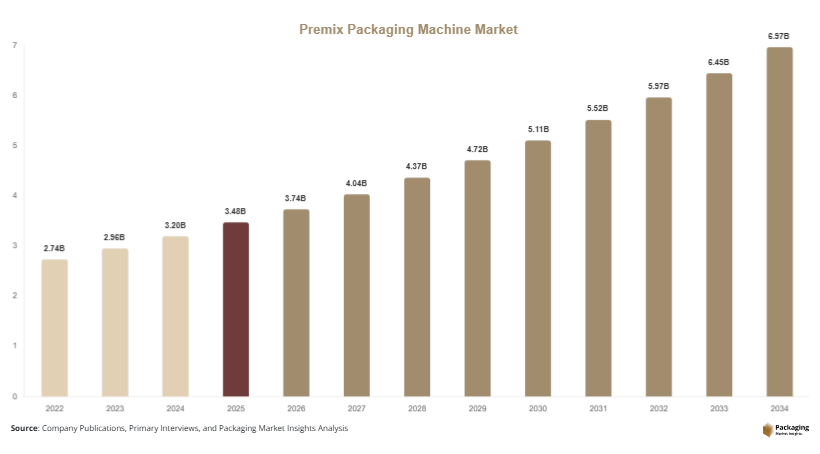
The global premix packaging machine market size was valued at approximately USD 3.48 billion in 2025 and is projected to reach USD 3.74 billion in 2026. By 2034, the market is expected to reach nearly USD 6.98 billion, expanding at a CAGR of 8.1% during 2025–2034. Increasing automation across manufacturing industries and growing demand for packaged convenience products are major factors supporting market growth.
The premix packaging machine market is witnessing steady expansion as food processing, beverage manufacturing, pharmaceutical, and chemical industries increasingly adopt automated packaging technologies to improve production efficiency and product consistency. Premix packaging machines are widely used for filling, sealing, weighing, and packaging powdered and granulated premix products such as beverage mixes, nutritional supplements, bakery ingredients, spices, and pharmaceutical formulations. These systems help manufacturers improve productivity, minimize contamination risks, and maintain accurate dosage control during packaging operations.
Key Highlights
- Asia Pacific dominated the market with a 38.2% share in 2025.
- Latin America is projected to grow at the fastest CAGR of 8.9%.
- Vertical premix packaging machines led the type segment with a 46.8% market share.
- Food & beverage applications accounted for 51.4% share in 2025 due to rising processed food demand.
- Automatic machines dominated the automation segment with a 63.7% market share.
- The US remained the leading country in North America with a market size of USD 0.74 billion in 2025 and USD 0.79 billion in 2026.
Explore more data points, trends and opportunities Download Free Sample Report
Market Trends
Integration of Smart Automation and IoT Technologies
One of the major trends shaping the premix packaging machine market is the growing integration of smart automation technologies and Industrial IoT systems into packaging operations. Manufacturers are increasingly deploying packaging machines equipped with real-time monitoring sensors, predictive maintenance systems, and cloud-based operational analytics. These technologies help reduce downtime, improve packaging precision, and optimize machine performance. For example, food processing facilities are implementing AI-enabled packaging systems that automatically adjust filling and sealing parameters based on product consistency and packaging speed. This trend is expected to accelerate as manufacturers prioritize operational efficiency and digital transformation initiatives across production facilities.
Rising Demand for Flexible and Multi-Format Packaging Systems
Another significant trend is the increasing demand for flexible packaging machines capable of handling multiple pouch, sachet, and container formats. Manufacturers are seeking equipment that can quickly switch between different packaging sizes and product categories without major production interruptions. For instance, beverage premix companies are adopting modular packaging machines that can package powdered drinks, protein mixes, and nutritional supplements on the same production line. This flexibility reduces operational costs and supports product diversification strategies. Future advancements in robotic handling systems and automated changeover technologies are expected to further improve production adaptability and efficiency.
Market Drivers
Expansion of Processed Food and Beverage Industries
The rapid growth of processed food and beverage industries is a key factor driving the premix packaging machine market. Rising urbanization, changing dietary habits, and increasing demand for convenience products are encouraging manufacturers to expand production capacity. Premix packaging machines are widely used for packaging coffee mixes, powdered beverages, spices, bakery premixes, and nutritional supplements. For example, instant beverage manufacturers in Asia Pacific are investing in high-speed automated packaging lines to meet increasing consumer demand. Additionally, retail expansion and online grocery platforms are increasing the need for efficient and hygienic packaging systems that ensure product quality and shelf stability.
Increasing Adoption of Automation in Manufacturing
The growing shift toward industrial automation is another major growth driver. Manufacturers are increasingly replacing manual packaging operations with automated systems to reduce labor dependency, improve productivity, and minimize packaging errors. Automatic premix packaging machines offer benefits such as higher throughput, consistent packaging accuracy, and lower operational costs. For instance, pharmaceutical manufacturers are deploying fully automated premix packaging systems for powdered formulations to comply with strict hygiene regulations. Rising labor costs and the need for operational efficiency are expected to further strengthen demand for advanced packaging automation technologies.
Market Restraint
High Initial Investment and Maintenance Costs
Despite strong growth potential, the premix packaging machine market faces challenges related to high initial investment requirements and maintenance expenses. Advanced packaging systems equipped with robotic automation, smart sensors, and integrated digital controls require substantial capital investment, making them less accessible for small and medium-sized enterprises. For example, high-speed automatic packaging lines used in pharmaceutical and food manufacturing facilities involve significant installation and calibration costs, which may limit adoption among budget-constrained manufacturers.
Maintenance and technical support requirements also present operational challenges. Packaging machines handling powdered and granulated materials require regular cleaning, calibration, and component replacement to maintain packaging accuracy and hygiene standards. Downtime caused by mechanical failures or software issues can disrupt production schedules and increase operational costs. In addition, companies operating in developing regions may face shortages of skilled technicians capable of maintaining advanced packaging equipment.
Another challenge is the integration of new packaging systems with existing production infrastructure. Older manufacturing facilities may require costly modifications to accommodate automated premix packaging machinery. These financial and operational constraints can slow market penetration, particularly among smaller manufacturers and regional packaging operators.
Market Opportunities
Growth in Nutritional Supplements and Health Products
The increasing popularity of nutritional supplements and health-focused products presents significant opportunities for premix packaging machine manufacturers. Protein powders, dietary supplements, functional beverages, and sports nutrition products require accurate filling and contamination-free packaging systems. Manufacturers are investing in advanced packaging technologies capable of handling sensitive powdered formulations while maintaining product quality. For example, sports nutrition companies are adopting automated sachet and pouch packaging systems to improve packaging efficiency and brand presentation. Rising health awareness and expanding fitness industries are expected to support long-term demand for specialized premix packaging solutions.
Expansion of Sustainable Packaging Solutions
The shift toward sustainable packaging is creating new growth opportunities in the market. Packaging manufacturers are increasingly developing machines compatible with recyclable, biodegradable, and paper-based packaging materials. Premix packaging machines designed for eco-friendly pouches and compostable sachets are gaining attention across food and personal care industries. For instance, beverage manufacturers are introducing paper-laminated premix packaging formats to reduce plastic usage. Future advancements in sealing technologies and material compatibility systems are expected to accelerate adoption of sustainable packaging machinery globally.
Report Scope
| Report Metric | Details |
|---|---|
| Market Size in 2025 | USD 3.48 Billion |
| Market Size in 2026 | USD 3.74 Billion |
| Market Size in 2034 | USD 6.98 Billion |
| CAGR | 8.1% (2026-2034) |
| Base Year for Estimation | 2025 |
| Historical Data | 2022-2024 |
| Forecast Period | 2026-2034 |
| Report Coverage | Revenue Forecast, Competitive Landscape, Supply Chain Disruption, Growth Factors, Environment & Regulatory Landscape and Trends |
| Geographies Covered | North America, Europe, APAC, Middle East and Africa, LATAM |
| Countries Covered | U.S., Canada, U.K., Germany, France, Spain, Italy, Russia, Nordic, Benelux, Rest of Europe, China, South Korea, Japan, India, Australia, Singapore, Taiwan, South East Asia, Rest of Asia-Pacific, UAE, Turky, Saudi Arabia, South Africa, Egypt, Nigeria, Rest of MEA, Brazil, Mexico, Argentina, Chile, Colombia, Rest of LATAM |
Explore more data points, trends and opportunities Download Free Sample Report
Segmental Analysis
By Type
Vertical premix packaging machines dominated the market with a 46.8% share in 2024, primarily due to their high efficiency, compact footprint, and suitability for packaging powdered and granulated products. These machines are widely used in food, beverage, pharmaceutical, and chemical industries because they support high-speed packaging operations while maintaining accurate filling and sealing performance. Manufacturers prefer vertical systems because they require less floor space and can handle multiple packaging formats such as sachets, pouches, and stick packs. For example, instant coffee and nutritional powder manufacturers extensively use vertical premix packaging machines to improve productivity and reduce product wastage. Increasing adoption of automated vertical systems in high-volume manufacturing facilities continues to strengthen segment dominance.
Horizontal premix packaging machines are expected to be the fastest-growing segment, registering a CAGR of 8.8% during the forecast period. Growth is driven by increasing demand for advanced packaging flexibility and improved product presentation. Horizontal machines are particularly suitable for premium packaging applications requiring complex pouch designs and resealable packaging formats. Manufacturers in the pharmaceutical and nutraceutical sectors are increasingly adopting these systems for accurate packaging of powdered supplements and medicinal premixes. Future innovations in robotic feeding systems and servo-driven automation technologies are expected to enhance packaging precision and operational efficiency. The growing preference for retail-ready and visually appealing packaging solutions will further support segment expansion.
By Automation
Automatic premix packaging machines accounted for approximately 63.7% market share in 2024, supported by rising industrial automation and increasing demand for high-speed packaging operations. Automatic systems offer advantages such as reduced labor dependency, higher production capacity, and consistent packaging quality. Food and beverage manufacturers are increasingly replacing semi-automatic operations with fully automated packaging lines to improve productivity and maintain hygiene standards. For example, dairy premix and powdered beverage producers are implementing automatic filling and sealing systems integrated with smart monitoring technologies. The ability to reduce operational errors and improve packaging efficiency continues to drive strong adoption across industrial manufacturing sectors.
Semi-automatic machines are projected to be the fastest-growing segment with a CAGR of 7.9% during 2025–2034. Growth is driven by increasing demand from small and medium-sized manufacturers seeking affordable automation solutions. Semi-automatic systems provide operational flexibility while requiring lower capital investment compared to fully automated lines. These machines are widely used in regional food processing facilities, spice packaging operations, and small-scale pharmaceutical production units. Manufacturers are introducing compact and energy-efficient semi-automatic machines with improved user interfaces and modular designs to attract cost-sensitive businesses. Expanding industrialization in developing economies is expected to support future demand for semi-automatic packaging equipment.
By End-Use
The food & beverage segment dominated the premix packaging machine market with a 51.4% share in 2024, driven by increasing demand for packaged convenience foods, instant beverages, bakery mixes, and nutritional products. Packaging machines are essential for maintaining hygiene, ensuring accurate filling, and improving shelf life in food manufacturing operations. Instant beverage manufacturers, coffee premix producers, and bakery ingredient suppliers are increasingly investing in automated packaging technologies to meet growing consumer demand. For example, powdered soup and ready-to-drink beverage brands are adopting advanced pouch packaging systems to improve operational efficiency and reduce packaging waste. Expansion of modern retail channels and e-commerce grocery platforms further strengthens demand in this segment.
Pharmaceutical and nutraceutical applications are expected to grow at the fastest CAGR of 8.6% during the forecast period. Growth is supported by rising production of powdered medicines, dietary supplements, and functional nutrition products. These industries require contamination-free packaging environments and highly accurate dosage systems, increasing demand for advanced automated machinery. Pharmaceutical manufacturers are implementing integrated packaging systems with real-time quality monitoring and traceability features to comply with regulatory requirements. Increasing global focus on preventive healthcare and nutritional wellness is expected to create long-term opportunities for premix packaging equipment suppliers serving healthcare industries.
Premix Packaging Machine Market Segmentations
By Product Type
- Vertical Premix Packaging Machines
- Horizontal Premix Packaging Machines
- Rotary Packaging Machines
- Multi-Lane Packaging Machines
By Automation
- Automatic Machines
- Semi-Automatic Machines
- Manual Packaging Machines
By End-Use
- Food & Beverage
- Pharmaceuticals
- Nutraceuticals
- Chemicals
- Personal Care Products
Regional Analysis
North America
North America accounted for approximately 27.6% market share in 2025 and is projected to grow at a CAGR of 7.5% during 2025–2034. The region benefits from advanced manufacturing infrastructure and high adoption of industrial automation technologies. Food processing, pharmaceutical, and nutraceutical industries are major users of premix packaging machines. Increasing investment in automated production lines and smart factory technologies is supporting market expansion across the United States and Canada.
The United States dominates the regional market due to its strong packaged food and healthcare manufacturing sectors. A unique growth factor is the increasing use of AI-driven packaging quality inspection systems in food processing plants. Major manufacturers are integrating machine vision technologies to improve packaging accuracy and reduce product wastage in high-speed production facilities.
Europe
Europe held around 24.9% market share in 2025 and is expected to expand at a CAGR of 7.8% during the forecast period. The region’s growth is supported by stringent food safety regulations and increasing automation across industrial manufacturing sectors. Demand for hygienic and energy-efficient packaging systems is particularly strong in Germany, France, and Italy.
Germany leads the European market because of its advanced industrial machinery manufacturing capabilities. A unique growth factor is the strong adoption of sustainable and energy-efficient packaging systems across food and pharmaceutical industries. German packaging machine manufacturers are developing low-energy equipment with automated monitoring systems to improve production efficiency and reduce environmental impact.
Asia Pacific
Asia Pacific dominated the market with 38.2% share in 2025 and is projected to register a CAGR of 8.7%, the highest among all regions. Rapid industrialization, expanding processed food industries, and increasing manufacturing automation are driving regional demand. Countries such as China, India, and Japan are investing heavily in packaging infrastructure and factory modernization.
China dominates the regional market due to its large-scale food and beverage production sector. A unique growth factor is the rapid expansion of domestic instant beverage and nutritional supplement manufacturing industries. Chinese companies are increasingly deploying automated packaging machinery to improve export competitiveness and production efficiency in high-volume manufacturing operations.
Middle East & Africa
The Middle East & Africa represented nearly 4.6% market share in 2025 and is expected to grow at a CAGR of 6.9% during the forecast period. Increasing investments in food processing and pharmaceutical manufacturing are contributing to market growth. Demand for packaged food products and nutritional supplements is rising across urban populations.
Saudi Arabia dominates the regional market due to expanding food processing industries and industrial diversification initiatives. A unique growth factor is the growing investment in domestic pharmaceutical manufacturing facilities, which require advanced premix packaging systems for powdered formulations and nutritional products.
Latin America
Latin America accounted for approximately 4.7% market share in 2025 and is projected to expand at a CAGR of 8.9%, making it one of the fastest-growing regions. Rising demand for packaged foods, instant beverages, and retail-ready products is supporting market growth. Brazil and Mexico are key contributors to regional expansion.
Brazil leads the Latin American market because of its growing processed food and agricultural industries. A unique growth factor is the increasing demand for automated packaging systems in coffee premix and powdered beverage manufacturing. Regional food companies are investing in flexible packaging machinery to improve operational efficiency and product distribution capabilities.
Competitive Landscape
The premix packaging machine market is moderately competitive, with global packaging machinery manufacturers focusing on automation, digital integration, and energy-efficient system development. Key companies operating in the market include Bosch Packaging Technology, IMA Group, Syntegon Technology GmbH, Nichrome India Ltd., and Viking Masek Global Packaging Technologies. Among these, Syntegon Technology GmbH is recognized as a leading player due to its strong product portfolio and advanced automation capabilities in food and pharmaceutical packaging systems.
Manufacturers are investing in AI-enabled packaging technologies, predictive maintenance systems, and modular machine designs to improve operational flexibility and production efficiency. Strategic collaborations with food processing and pharmaceutical companies are helping equipment providers expand their market presence. Recent developments include the launch of smart packaging systems with remote monitoring capabilities and the expansion of sustainable packaging compatibility features for recyclable pouch materials.
Key Players List
- Syntegon Technology GmbH
- Bosch Packaging Technology
- IMA Group
- Nichrome India Ltd.
- Viking Masek Global Packaging Technologies
- Fuji Machinery Co., Ltd.
- Ishida Co., Ltd.
- BW Flexible Systems
- Premier Tech Ltd.
- All-Fill Inc.
- Mespack SL
- Hayssen Flexible Systems
- GEA Group
- Coesia Group
- Rovema GmbH