Sublimation Paper Market Size
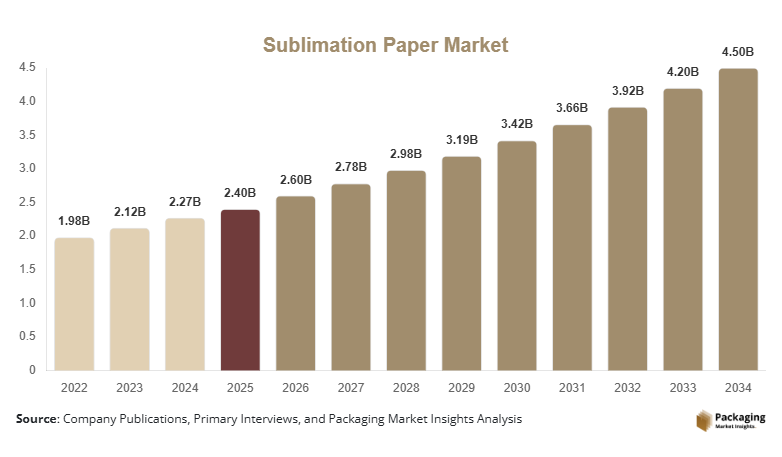
The sublimation paper market size is projected at USD 2.6 billion in 2026 and is expected to hit USD 4.5 billion by 2034 with a CAGR of 7.1%. Rising demand for digital textile printing, customized merchandise, and high-quality transfer printing technologies continues to support market expansion. The report provides comprehensive quantitative analysis covering production capacity, segmentation, competitive landscape, technological developments, and regional performance across the forecast period.
Sublimation paper is a specially coated transfer paper designed to carry sublimation inks and release them efficiently onto polyester fabrics, ceramics, metals, and coated substrates under heat and pressure. Global production exceeded 9.4 billion square meters during 2025 and is forecast to surpass 15.8 billion square meters by 2034. Textile printing contributes approximately 58% of total demand, promotional products account for 27%, while industrial printing represents nearly 15%. Digital printing adoption has crossed 71% among commercial printing facilities, reinforcing the sublimation paper market.
Explore more data points, trends and opportunities Download Free Sample Report
Sublimation Paper Market Trends
Expansion of digital textile printing technologies
Digital textile printing installations increased by 16% during 2025, while global sublimation paper production expanded by over 780 million square meters. Manufacturers are introducing high-speed coated papers supporting printing speeds above 1,200 m²/hour with transfer efficiencies exceeding 96%. Increasing apparel customization and sportswear production continue strengthening the sublimation paper market.
The industry is witnessing greater adoption of lightweight coated papers, recyclable base materials, and low-moisture coating technologies. More than 64% of commercial transfer printing facilities now utilize automated color management systems, improving print consistency by approximately 18%. Demand from home décor, signage, and personalized gift applications continues expanding across global markets, supporting the sublimation paper market.
Sublimation Paper Drivers
Growing adoption of customized textile printing
Increasing consumer demand for personalized apparel, sportswear, fashion accessories, and branded merchandise is accelerating digital textile printing investments. Global customized textile production increased by 14%, while polyester fabric consumption expanded by 11% in 2025. Heat transfer printing capacity exceeded 5.6 billion square meters, supporting continued expansion of the sublimation paper market.
Sublimation Paper Restraints
Volatility in pulp and coating raw material prices
Fluctuating pulp prices between 9% and 15% annually and rising specialty coating costs increase manufacturing expenses. Energy contributes nearly 22% of production costs, while transportation expenses have risen by approximately 8%. These pricing pressures affect converter margins and moderately restrain the sublimation paper market.
Sublimation Paper Opportunities
Growing demand for sustainable transfer printing materials
Demand for recyclable and FSC-certified paper products increased by 19% during 2025, while environmentally friendly coating technologies recorded adoption above 24% among leading manufacturers. Expanding digital printing industries in the Asia-Pacific and Latin America create long-term opportunities for the sublimation paper market.
Challenges in Sublimation Paper Market
Maintaining consistent transfer efficiency across applications
Manufacturers must ensure coating uniformity above 98% while maintaining moisture content below 5% for reliable transfer performance. Quality rejection rates between 2% and 4%, increasing production automation costs, and compatibility requirements across multiple printer technologies remain significant operational challenges for the sublimation paper market.
Report Scope
| Report Metric | Details |
|---|---|
| Market Size in 2025 | USD 2.4 Billion |
| Market Size in 2026 | USD 2.6 Billion |
| Market Size in 2034 | USD 4.5 Billion |
| CAGR | 7.1% (2026-2034) |
| Base Year for Estimation | 2025 |
| Historical Data | 2022-2024 |
| Forecast Period | 2026-2034 |
| Report Coverage | Revenue Forecast, Competitive Landscape, Supply Chain Disruption, Growth Factors, Environment & Regulatory Landscape and Trends |
| Geographies Covered | North America, Europe, APAC, Middle East and Africa, LATAM |
| Countries Covered | U.S., Canada, U.K., Germany, France, Spain, Italy, Russia, Nordic, Benelux, Rest of Europe, China, South Korea, Japan, India, Australia, Singapore, Taiwan, South East Asia, Rest of Asia-Pacific, UAE, Turkey, Saudi Arabia, South Africa, Egypt, Nigeria, Rest of MEA, Brazil, Mexico, Argentina, Chile, Colombia, Rest of LATAM |
Explore more data points, trends and opportunities Download Free Sample Report
Sublimation Paper Market Segmentation
The market is segmented by product type and application, with high release papers accounting for approximately 49% of total revenue. Textile printing remains the dominant application, contributing nearly 58% of global consumption due to expanding apparel and sportswear manufacturing.
By Product Type
High release paper holds approximately 49% market share, with production exceeding 4.6 billion square meters annually. The product delivers transfer efficiencies above 96%, fast ink release, and excellent color vibrancy, making it suitable for premium textile and sportswear printing.
Medium-release paper represents nearly 33% of market demand and annual production exceeding 3.1 billion square meters. It provides balanced ink transfer, consistent drying characteristics, and cost-effective performance across commercial garment printing applications.
Low-release paper contributes around 18% of the market with production above 1.7 billion square meters. The product is commonly used for specialty industrial applications requiring controlled ink transfer and enhanced dimensional stability.
By Application
Textile printing accounts for approximately 58% of global demand, with annual consumption exceeding 5.5 billion square meters. Sublimation paper supports high-resolution graphics, durable color reproduction, and production efficiency across fashion apparel, sportswear, and home textile manufacturing.
Promotional products contribute nearly 27% of market demand, supported by production exceeding 2.5 billion square meters. Applications include mugs, phone cases, promotional gifts, signage, and customized merchandise utilizing high-definition heat transfer technology.
Industrial printing represents approximately 15% market share, consuming more than 1.4 billion square meters annually. The segment serves coated metal panels, decorative laminates, engineered components, and specialty graphics requiring stable transfer performance.
Sublimation Paper Market Segmentations
Product Type
- High Release Paper
- Medium Release Paper
- Low Release Paper
Application
- Textile Printing
- Promotional Products
- Industrial Printing
Sublimation Paper Regional Outlook
North America
North America accounts for approximately 26% of global revenue. The United States contributes nearly 79% of regional demand, supported by advanced digital printing infrastructure and expanding customized apparel production exceeding 1.8 billion square meters annually.
Europe
Europe represents around 29% of the market. Germany, Italy, the United Kingdom, and France remain leading producers of digital textile products, with annual sublimation paper consumption exceeding 2.7 billion square meters.
Asia-Pacific
Asia-Pacific dominates with approximately 38% market share. China contributes nearly 46% of regional production, followed by India, Japan, and South Korea. Strong textile exports and rapid industrialization continue driving regional demand.
Latin America
Latin America accounts for approximately 4% of global demand, with Brazil and Mexico leading regional consumption through expanding garment manufacturing and promotional printing industries.
Middle East & Africa
The Middle East & Africa contribute nearly 3% of market revenue. Growth is supported by increasing investments in textile manufacturing, commercial printing facilities, and customized promotional product production.
Top Players In Sublimation Paper
- Ahlstrom Oyj
- Hansol Paper Co., Ltd.,
- Neenah Coldenhove
- Mitsubishi Paper Mills Limited
- Sappi Limited
- Koehler Paper SE,
- Guangdong Guanhao High-Tech Co., Ltd.,
- JK Paper Ltd.,
- Fedrigoni S.p.A.,
- Nordic Paper AS
Ahlstrom Oyj estimated global market presence of approximately 13%. Strong position in specialty coated transfer papers across Europe, North America, and Asia. Focuses on premium sublimation papers with high transfer efficiency, optimized coating technology, consistent dimensional stability, and sustainable fiber sourcing. The company continues investing in advanced paper engineering, production automation, and environmentally responsible manufacturing to strengthen its competitive position across textile printing and industrial transfer applications. Hansol Paper Co., Ltd. Estimated market presence of approximately 10%. Leading supplier serving textile printing, commercial graphics, and industrial transfer applications. The company emphasizes high-speed production capability, premium coating consistency, sustainable paper manufacturing, and continuous product innovation. Investments in digital printing compatibility, global distribution expansion, and advanced quality control systems enable Hansol Paper to strengthen its presence across major textile manufacturing regions.