Butcher Paper Market Size
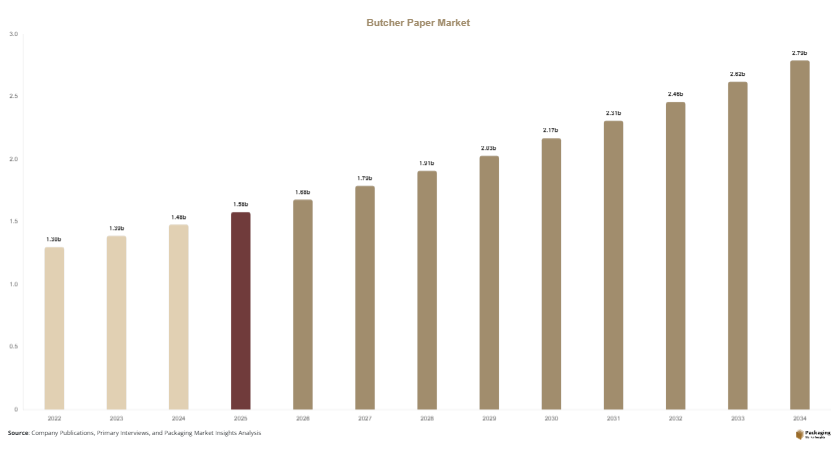
Butcher Paper market size is projected at USD 1.68 billion in 2026 and is expected to hit USD 2.79 billion by 2034 with a CAGR of 6.55%. The report offers comprehensive quantitative insights into production capacity, pricing trends, raw material availability, supply chain analysis, competitive benchmarking, and end-user demand. It further evaluates market segmentation, regional performance, and strategic developments to provide a complete assessment of the competitive landscape.
The Butcher Paper Market comprises uncoated and treated kraft paper used for wrapping meat, seafood, deli products, smoked foods, industrial goods, and creative applications. Global production exceeded 8.9 million metric tons in 2025, with food packaging contributing nearly 62% of total consumption, industrial packaging accounting for 23%, and arts & crafts representing approximately 15%. Brown butcher paper held around 49% of production volume, followed by white butcher paper at 36% and treated paper at 15%. Rising preference for recyclable paper-based packaging continues supporting the Butcher Paper Market.
Explore more data points, trends and opportunities Download Free Sample Report
Butcher Paper Market Trends
Growing Preference for Sustainable Food Wrapping Solutions
Food retailers, supermarkets, and restaurants are increasingly replacing plastic wrapping materials with recyclable butcher paper. Global paper-based food wrapping production surpassed 9.2 million metric tons annually, while sustainable packaging adoption exceeded 67% across organized retail. Advanced kraft processing technologies have improved tensile strength by nearly 18%, moisture resistance by 15%, and printability for branded packaging, reinforcing the Butcher Paper Market.
Demand for premium smoked meat packaging and food-grade wrapping continues expanding worldwide. Nearly 71% of barbecue restaurants utilize treated butcher paper for smoking applications, while more than 58% of fresh meat retailers prefer breathable paper packaging over conventional plastic wraps. Investments exceeding USD 420 million in paper converting equipment continue supporting production efficiency and innovation within the Butcher Paper Market.
Butcher Paper Market Drivers
Increasing Demand for Eco-Friendly Food Packaging
Growing environmental regulations and consumer preference for recyclable materials continue driving paper packaging adoption. Food packaging demand exceeded 5.5 million metric tons during 2025, while sustainable packaging usage increased by 11.8% year-over-year. More than 74% of organized food retailers have adopted recyclable wrapping materials, accelerating investments in kraft paper production and strengthening the Butcher Paper Market.
Butcher Paper Market Restraints
Fluctuating Wood Pulp and Raw Material Prices
Volatility in wood pulp prices directly impacts manufacturing costs. Kraft pulp prices fluctuated by nearly 13% during recent years, while transportation expenses increased approximately 9%. Energy costs account for nearly 17% of paper production expenditure, limiting profit margins for manufacturers and creating pricing challenges across the Butcher Paper Market.
Butcher Paper Market Opportunities
Expansion of Premium Food Service and Retail Packaging
Premium grocery stores, butcher shops, and food delivery services increasingly utilize customized butcher paper. More than 52% of food service companies are investing in branded paper packaging, while digital printing adoption has grown by 24%. Annual production of customized butcher paper is expected to exceed 3 million metric tons before 2030, creating significant opportunities for the Butcher Paper Market.
Challenges in Butcher Paper Market
Maintaining Food Safety and Regulatory Compliance
Manufacturers must comply with stringent food-contact regulations across international markets. More than 68% of exports require multiple food safety certifications, while laboratory testing may increase production costs by 7–10%. Maintaining consistent moisture resistance, strength, and food-grade quality standards remains a major operational challenge for the Butcher Paper Market.
Report Scope
| Report Metric | Details |
|---|---|
| Market Size in 2025 | USD 1.58 billion |
| Market Size in 2026 | USD 1.68 billion |
| Market Size in 2034 | USD 2.79 billion |
| CAGR | 6.55% (2026-2034) |
| Base Year for Estimation | 2025 |
| Historical Data | 2022-2024 |
| Forecast Period | 2026-2034 |
| Report Coverage | Revenue Forecast, Competitive Landscape, Supply Chain Disruption, Growth Factors, Environment & Regulatory Landscape and Trends |
| Geographies Covered | North America, Europe, APAC, Middle East and Africa, LATAM |
| Countries Covered | U.S., Canada, U.K., Germany, France, Spain, Italy, Russia, Nordic, Benelux, Rest of Europe, China, South Korea, Japan, India, Australia, Singapore, Taiwan, South East Asia, Rest of Asia-Pacific, UAE, Turky, Saudi Arabia, South Africa, Egypt, Nigeria, Rest of MEA, Brazil, Mexico, Argentina, Chile, Colombia, Rest of LATAM |
Explore more data points, trends and opportunities Download Free Sample Report
Butcher Paper Market Segmentation
The market is segmented by type and application, with food packaging accounting for nearly 62% of total revenue and brown butcher paper representing approximately 49% of global production. Continuous improvements in kraft paper technology and sustainable manufacturing processes are supporting broad market adoption.
By Type
White Butcher Paper
White butcher paper represents approximately 36% of total demand and is widely used in supermarkets, delis, and food service businesses. Annual production exceeds 3.2 million metric tons, offering high printability, clean appearance, and FDA-compliant food-contact properties.
Brown Butcher Paper
Brown butcher paper dominates with nearly 49% market share and production exceeding 4.4 million metric tons annually. It provides superior breathability, durability, and cost efficiency, making it the preferred solution for meat wrapping and barbecue smoking applications.
Treated Butcher Paper
Treated butcher paper contributes nearly 15% of global consumption. Production surpassed 1.3 million metric tons during 2025 due to increasing demand for moisture-resistant food wrapping. Specialized coatings improve grease resistance while maintaining product freshness.
By Application
Food Packaging
Food packaging accounts for approximately 62% of total consumption. More than 5.5 million metric tons are utilized annually across butcher shops, supermarkets, restaurants, seafood packaging, and barbecue applications. High food safety compliance and breathability continue driving demand.
Industrial Packaging
Industrial packaging represents nearly 23% of market demand. Annual consumption exceeds 2 million metric tons for wrapping machinery parts, metal products, glass items, and industrial components requiring surface protection during transportation.
Arts & Crafts
Arts & crafts applications contribute around 15% of total demand. More than 1.3 million metric tons are consumed annually in educational institutions, creative studios, gift wrapping, and decorative projects due to excellent durability and print compatibility.
Butcher Paper Market Segmentations
Type
- White Butcher Paper
- Brown Butcher Paper
- Treated Butcher Paper
Application
- Food Packaging
- Industrial Packaging
- Arts & Crafts
Butcher Paper Regional Outlook
North America
North America accounts for approximately 36% of global demand. The United States contributes nearly 84% of regional consumption, supported by extensive food processing and barbecue industries. Annual production exceeds 3.2 million metric tons, driven by sustainable food packaging initiatives.
Europe
Europe represents approximately 27% of the global market. Germany, France, Italy, and the United Kingdom contribute over 72% of regional production. Food packaging applications account for nearly 61% of regional demand, supported by strict sustainability regulations.
Asia-Pacific
Asia-Pacific holds approximately 29% of global consumption and remains the fastest-growing production hub. China contributes nearly 46% of regional output, followed by India at 19%, Japan at 15%, and South Korea at 8%. Production exceeds 2.6 million metric tons annually.
Latin America
Latin America contributes nearly 5% of global demand. Brazil accounts for approximately 43% of regional consumption, while Mexico contributes nearly 28%, supported by expanding food retail and meat processing industries.
Middle East & Africa
The Middle East & Africa represent around 3% of the global market. GCC countries and South Africa continue investing in food processing infrastructure, increasing demand for food-grade paper packaging products.
Top players in Butcher Paper Market
- Georgia-Pacific LLC
- International Paper Company
- WestRock Company
- Mondi plc
- Smurfit Westrock
- Stora Enso Oyj
- Nordic Paper Holding AB
- Twin Rivers Paper Company
- Seaman Paper Company
- Vizille Paper Mills
- Oji Holdings Corporation
- Nippon Paper Industries Co., Ltd.
Georgia-Pacific LLC
-
Holds an estimated 13–15% global market share.
-
Maintains a leading position in kraft paper manufacturing for food packaging.
-
Operates integrated pulp and paper mills with high-capacity converting facilities across North America.
-
Invests in sustainable forestry, recyclable paper solutions, and manufacturing automation, enabling large-scale production while supporting food safety compliance and customized butcher paper offerings for commercial and retail customers.
International Paper Company
-
Accounts for approximately 10–12% of the global market.
-
Strong presence across industrial and food-grade paper packaging segments.
-
Operates an extensive manufacturing and distribution network across multiple continents.
-
Focuses on sustainable fiber sourcing, premium kraft paper grades, and advanced converting technologies that improve production efficiency while strengthening its position in food service, retail, and industrial packaging markets.