Old Corrugated Containers Market Size
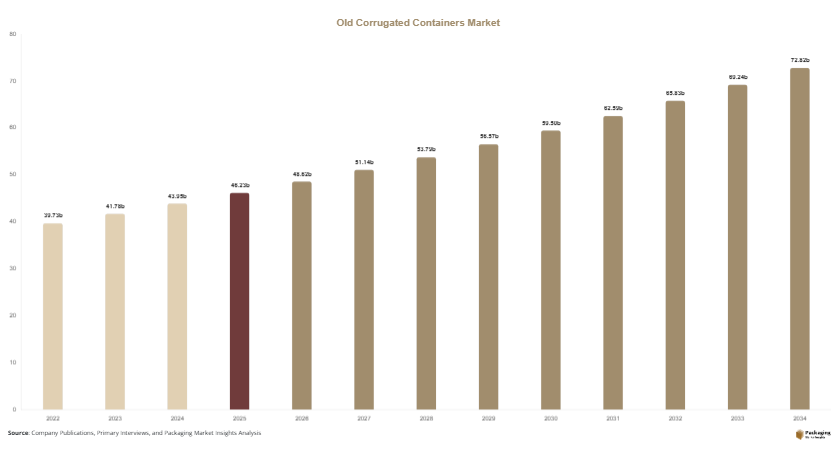
Old Corrugated Containers market size is projected at USD 48.62 billion in 2026 and is expected to hit USD 72.84 billion by 2034 with a CAGR of 5.18%.
The market is supported by rising recycling rates, expanding corrugated packaging production, and increasing sustainability regulations across industrial economies. The report evaluates production volumes, trade statistics, market segmentation, technological developments, competitive landscape, and investment opportunities across major regional markets while providing comprehensive quantitative and qualitative assessments.
The Old Corrugated Containers market represents the collection, processing, trading, and recycling of used corrugated cardboard generated from commercial, industrial, retail, and residential sectors. Global recovered fiber production exceeded 285 million metric tons during 2025, while old corrugated containers accounted for approximately 39% of total recovered paper volumes. Recycling penetration surpassed 82% across developed economies, with packaging applications contributing nearly 71% of recovered fiber utilization. Growing e-commerce shipments exceeding 190 billion parcels annually continue to increase OCC availability and strengthen the Old Corrugated Containers market.
Explore more data points, trends and opportunities Download Free Sample Report
Old Corrugated Containers Market Trends
Increasing Digital Commerce Expanding OCC Recovery
Rapid expansion of online retail continues to increase corrugated packaging consumption worldwide. Global corrugated box production surpassed 205 million metric tons, while automated sorting facilities processed more than 118 million metric tons of OCC annually. Smart optical sorting technologies improved material recovery efficiency by 18%, reducing contamination below 4% in advanced recycling facilities. These developments continue strengthening the Old Corrugated Containers market.
Growing investments in AI-enabled recycling systems and automated baling facilities are improving processing efficiency. More than 2,800 recycling plants globally have integrated advanced sensor-based separation technologies, increasing throughput by nearly 22% while lowering operational costs by 14%. Industrial packaging demand continues expanding across manufacturing, logistics, and retail sectors, reinforcing the Old Corrugated Containers market.
Old Corrugated Containers Drivers
Growing Demand for Sustainable Packaging Materials
Corporate sustainability commitments and circular economy initiatives continue driving recycled fiber utilization. More than 68% of packaging manufacturers increased recycled content targets, while recycled fiber consumption exceeded 175 million metric tons globally. Regulatory mandates requiring recycled packaging content between 30% and 70% across multiple countries further accelerate demand. Expanding investments exceeding USD 9 billion in recycling infrastructure continue supporting the Old Corrugated Containers market.
Old Corrugated Containers Restraints
Price Volatility and Raw Material Quality Variations
Recovered fiber pricing remains vulnerable to fluctuations in export demand, logistics costs, and contamination rates. Average OCC prices experienced annual swings of nearly 28%, while contamination levels above 8% reduce processing yields by approximately 12%. Transportation expenses increased by nearly 9%, affecting profitability for recyclers and processors despite strong long-term recycling demand.
Old Corrugated Containers Opportunities
Expansion of Circular Economy Investments
Governments and private organizations continue investing heavily in recycling capacity expansion. More than 420 new recovery facilities are expected to become operational before 2030, increasing processing capacity by over 36 million metric tons annually. Digital waste tracking platforms, automated collection systems, and improved fiber recovery technologies are creating new revenue streams and export opportunities for industry participants.
Challenges in Old Corrugated Containers
Collection Infrastructure Gaps Across Emerging Economies
Collection efficiency remains below 55% in several developing markets despite rising corrugated packaging consumption. Limited recycling awareness, fragmented waste collection systems, and insufficient sorting capacity reduce recovery potential. Processing losses exceeding 11 million metric tons annually continue limiting material availability for manufacturers while increasing dependence on virgin fiber.
Report Scope
| Report Metric | Details |
|---|---|
| Market Size in 2025 | USD 46.23 billion |
| Market Size in 2026 | USD 48.62 billion |
| Market Size in 2034 | USD 72.84 billion |
| CAGR | 5.18% (2026-2034) |
| Base Year for Estimation | 2025 |
| Historical Data | 2022-2024 |
| Forecast Period | 2026-2034 |
| Report Coverage | Revenue Forecast, Competitive Landscape, Supply Chain Disruption, Growth Factors, Environment & Regulatory Landscape and Trends |
| Geographies Covered | North America, Europe, APAC, Middle East and Africa, LATAM |
| Countries Covered | U.S., Canada, U.K., Germany, France, Spain, Italy, Russia, Nordic, Benelux, Rest of Europe, China, South Korea, Japan, India, Australia, Singapore, Taiwan, South East Asia, Rest of Asia-Pacific, UAE, Turky, Saudi Arabia, South Africa, Egypt, Nigeria, Rest of MEA, Brazil, Mexico, Argentina, Chile, Colombia, Rest of LATAM |
Explore more data points, trends and opportunities Download Free Sample Report
Old Corrugated Containers Market Segmentation
The market is segmented according to product quality and end-use applications. Recycled OCC accounts for nearly 49% of processed volumes, while paper mills contribute approximately 58% of total consumption due to continuous recycled paper production.
By Type
Recycled OCC
Recycled OCC represents the largest segment with nearly 49% market share. Annual processing exceeds 105 million metric tons, supporting kraft linerboard production with moisture content generally maintained below 12% and contamination below 3% in premium facilities.
Mixed OCC
Mixed OCC contributes approximately 31% of global volumes. Processing exceeds 66 million metric tons annually, supplying medium-grade recycled fiber for industrial paper products. Improvements in sorting technology continue enhancing fiber quality and yield.
Premium OCC
Premium OCC accounts for around 20% of total supply and is characterized by cleaner fiber streams with contamination below 2%. Production supports high-quality containerboard manufacturing and premium recycled packaging applications.
By Application
Paper Mills
Paper mills dominate consumption with approximately 58% market share, utilizing more than 124 million metric tons annually. Recovered OCC fibers are converted into linerboard, fluting medium, and recycled paper products with recycled content frequently exceeding 80%.
Packaging Manufacturers
Packaging manufacturers account for nearly 27% of utilization. Demand continues increasing as sustainable packaging adoption surpasses 64% across consumer goods industries, supporting lightweight corrugated packaging production.
Recycling Facilities
Recycling facilities contribute approximately 15% through sorting, baling, and preprocessing operations. Modern facilities process over 450,000 metric tons annually while achieving automated recovery rates exceeding 92%.
Old Corrugated Containers Market Segmentations
Type
- Recycled OCC
- Mixed OCC
- Premium OCC
Application
- Paper Mills
- Packaging Manufacturers
- Recycling Facilities
Distribution Channel
- Direct Sales
- Paper Recovery Companies
- Waste Collection Agencies
- Recycling Cooperatives
- Online Material Trading Platforms
Old Corrugated Containers Regional Outlook
North America
North America accounts for approximately 34% of global production and recycling. The United States contributes nearly 82% of regional recovered volumes, while Canada continues expanding recycled containerboard manufacturing. Regional processing exceeds 46 million metric tons annually, supported by mature collection infrastructure and high recycling participation.
Europe
Europe represents nearly 29% of the market. Germany, France, Italy, and the United Kingdom collectively contribute over 71% of regional production. Recycling rates exceed 87%, while investments in circular economy programs continue increasing recovered fiber utilization.
Asia-Pacific
Asia-Pacific holds around 30% of global activity, led by China, India, Japan, and South Korea. Regional corrugated packaging production exceeds 92 million metric tons, supported by manufacturing growth, urbanization, and expanding e-commerce logistics.
Latin America
Latin America contributes approximately 4% of the market. Brazil and Mexico remain leading producers, supported by growing retail packaging demand and increasing investments in municipal recycling infrastructure.
Middle East & Africa
The Middle East & Africa account for nearly 3% of global production. Rising industrialization, packaging consumption, and government sustainability initiatives continue supporting recycling capacity expansion across the region.
Top players in Old Corrugated Containers
- DS Smith plc
- Smurfit Westrock
- International Paper Company
- Pratt Industries
- Nine Dragons Paper Holdings
- Lee & Man Paper Manufacturing Ltd.
- Mondi plc
- Cascades Inc.
- Saica Group
- Stora Enso Oyj
- Klabin S.A.
- Oji Holdings Corporation
- Nippon Paper Industries Co., Ltd.
- SCA AB
- Georgia-Pacific LLC
DS Smith plc
-
Holds an estimated 7–9% global market position through integrated recycling and packaging operations.
-
Operates hundreds of collection centers processing millions of metric tons of recovered fiber annually.
-
Focuses on circular packaging solutions, advanced recycling technology, digital supply chain optimization, and long-term sustainability investments. Continuous expansion of recovery infrastructure, fiber quality enhancement, and strategic partnerships strengthens its competitive position across Europe and North America while supporting increasing recycled packaging demand.
Smurfit Westrock
-
Maintains approximately 8–10% market participation with extensive containerboard and recycling operations.
-
Processes significant recovered OCC volumes across multiple continents.
-
The company continues investing in automated recovery facilities, high-efficiency paper mills, and sustainable packaging innovations. Integrated manufacturing, extensive logistics capabilities, and strong customer relationships across consumer goods, industrial, and e-commerce sectors reinforce its leadership while improving recycled fiber utilization and operational efficiency.