Duplex Paper And Board Market Size
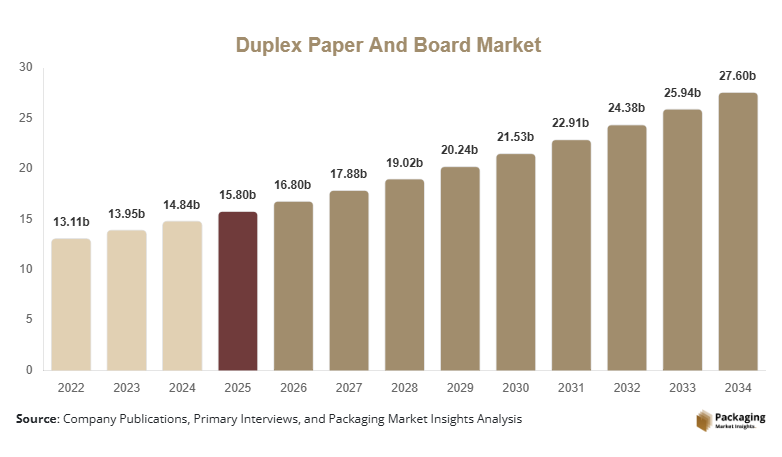
Duplex Paper And Board market size is projected at USD 16.8 billion in 2026 and is expected to hit USD 27.5 billion by 2034 with a CAGR of 6.4%.” The market expansion is driven by rising demand for sustainable paper-based packaging, increasing replacement of plastic packaging, and growing consumption across food, pharmaceutical, and consumer goods industries. The report provides detailed segmentation analysis, competitive landscape evaluation, production trends, technological advancements, and regional insights covering historical years 2022–2024 and forecast period 2026–2034.
Duplex Paper And Board Market refers to multi-layer paperboard products manufactured using two different paper surfaces, generally consisting of a coated or smooth top layer and a recycled or uncoated bottom layer. Global duplex paper and board production exceeded 32 million tons in 2025, with packaging applications accounting for nearly 72% of total consumption. Coated duplex boards represent approximately 48% of market demand due to their superior printability, strength, and visual appeal. Adoption is increasing across FMCG, pharmaceutical packaging, retail cartons, and food packaging sectors, where more than 60% of manufacturers are shifting toward recyclable paper-based materials. These factors continue to strengthen Duplex Paper And Board Market Growth.
Explore more data points, trends and opportunities Download Free Sample Report
Duplex Paper And Board Market Trends
Rising Adoption of Sustainable Paper-Based Packaging Solutions
The increasing focus on recyclable and biodegradable packaging materials is driving the adoption of duplex paper and board products. In 2025, global consumption of duplex paperboard for packaging applications exceeded 23 million tons, supported by demand from food, beverage, healthcare, and retail sectors. Approximately 65% of packaging converters are investing in paper-based alternatives to reduce plastic dependency. Advanced coating technologies have improved moisture resistance, durability, and print quality by more than 30%, supporting the expansion of Duplex Paper And Board Market Trends.
Growth of High-Quality Printing and Premium Packaging Applications
Demand for visually attractive packaging solutions is increasing the adoption of coated duplex boards in premium consumer goods segments. More than 8 million tons of coated duplex boards were consumed globally in 2025, with applications in cosmetics, electronics, pharmaceuticals, and branded food packaging. Digital printing compatibility, improved surface smoothness, and lightweight structures are encouraging manufacturers to adopt advanced duplex boards. Around 45% of premium packaging producers now utilize coated duplex board solutions, supporting Duplex Paper And Board Market Demand.
Duplex Paper And Board Drivers
Increasing Demand for Sustainable Packaging Materials
Growing environmental regulations and consumer preference for recyclable packaging are major drivers of Duplex Paper And Board Market Growth. More than 70% of global packaging companies are adopting paper-based materials, while duplex boards reduce plastic packaging usage by nearly 20–35% in several applications. Food and beverage packaging contributes approximately 40% of total duplex board consumption, supported by increasing retail and e-commerce activities. Rising demand for eco-friendly cartons and folding boxes continues to accelerate Duplex Paper And Board Market expansion.
Duplex Paper And Board Restraints
Fluctuating Raw Material Prices and Production Costs
The market faces challenges due to fluctuations in pulp prices and energy costs. Raw materials account for approximately 55–65% of total duplex board manufacturing costs, while pulp price variations of 10–20% annually impact profitability. Small and medium manufacturers experience additional pressure due to high machinery investment requirements, with modern production lines costing between USD 15 million and USD 50 million. These factors create limitations for faster Duplex Paper And Board Market adoption.
Duplex Paper And Board Opportunities
Expansion of Recyclable Packaging Infrastructure
Increasing investments in circular economy initiatives create significant opportunities for duplex paper and board manufacturers. Global demand for sustainable packaging materials is expected to exceed 500 million tons by 2034, creating new growth opportunities. More than 80% of FMCG companies have sustainability targets requiring recyclable packaging solutions. Innovations in barrier coatings, lightweight board structures, and recycled fiber technologies are expected to improve Duplex Paper And Board Market Opportunities.
Challenges in Duplex Paper And Board
Competition from Alternative Packaging Materials
Duplex paper and board products face competition from corrugated packaging, flexible films, and bio-based alternatives. Approximately 25% of packaging manufacturers are exploring alternative materials due to performance and cost considerations. Additionally, water resistance and durability limitations compared with plastic packaging remain concerns. Manufacturers are investing in improved coatings and fiber technologies to overcome challenges affecting Duplex Paper And Board Market Insights.
Report Scope
| Report Metric | Details |
|---|---|
| Market Size in 2025 | USD 15.8 billion |
| Market Size in 2026 | USD 16.8 billion |
| Market Size in 2034 | USD 27.5 billion |
| CAGR | 6.4% (2026-2034) |
| Base Year for Estimation | 2025 |
| Historical Data | 2022-2024 |
| Forecast Period | 2026-2034 |
| Report Coverage | Revenue Forecast, Competitive Landscape, Supply Chain Disruption, Growth Factors, Environment & Regulatory Landscape and Trends |
| Geographies Covered | North America, Europe, APAC, Middle East and Africa, LATAM |
| Countries Covered | U.S., Canada, U.K., Germany, France, Spain, Italy, Russia, Nordic, Benelux, Rest of Europe, China, South Korea, Japan, India, Australia, Singapore, Taiwan, South East Asia, Rest of Asia-Pacific, UAE, Turky, Saudi Arabia, South Africa, Egypt, Nigeria, Rest of MEA, Brazil, Mexico, Argentina, Chile, Colombia, Rest of LATAM |
Explore more data points, trends and opportunities Download Free Sample Report
Duplex Paper And Board Market Segmentation
Duplex Paper And Board Market segmentation is based on type and application. Coated duplex board dominates with approximately 48% market share due to superior printing characteristics, while packaging boxes account for nearly 50% of application demand. Growing adoption across food, healthcare, and retail industries is increasing market penetration globally.
By Type
Coated Duplex Board
Coated duplex board represents the largest segment with approximately 48% market share. Production exceeded 15 million tons in 2025 due to high demand for premium packaging and printing applications. These boards typically range between 200–600 GSM and provide excellent surface finish, brightness, and printability. Coated duplex boards are widely used in pharmaceutical cartons, cosmetic packaging, and branded consumer goods packaging.
Uncoated Duplex Board
Uncoated duplex board accounts for nearly 30% share and is preferred for cost-effective packaging solutions. Global production reached approximately 10 million tons in 2025, with thickness ranging from 250–700 GSM. These boards are commonly used in industrial packaging, transportation cartons, and basic retail applications due to their durability and affordability.
White Back Duplex Board
White back duplex board contributes around 22% market share and is increasingly adopted for packaging applications requiring improved appearance and moderate strength. More than 7 million tons were produced in 2025, mainly for food cartons, household products, and consumer packaging. The segment benefits from demand for recyclable packaging formats with enhanced visual quality.
By Application
Packaging Boxes
Packaging boxes dominate the application segment with nearly 50% market share. More than 16 million tons of duplex board were consumed for cartons and boxes in 2025. The segment includes pharmaceutical boxes, electronics packaging, FMCG cartons, and retail packaging. Adoption penetration exceeds 65% among packaging converters due to recyclability and cost efficiency.
Printing & Publishing
Printing and publishing applications account for approximately 20% share. Around 6 million tons of duplex board were used in 2025 for books, brochures, promotional materials, and commercial printing. Improved surface quality and compatibility with digital printing technologies continue to support demand.
Food & Beverage Packaging
Food and beverage packaging contributes nearly 22% market share, driven by demand for recyclable food cartons and takeaway packaging. More than 7 million tons of duplex board are consumed annually in this segment. Moisture-resistant coatings and food-safe treatments are increasing adoption across restaurants, retail chains, and packaged food manufacturers.
Duplex Paper And Board Market Segmentations
Type
- Coated Duplex Board
- Uncoated Duplex Board
- White Back Duplex Board
Application
- Packaging Boxes
- Printing & Publishing
- Food & Beverage Packaging
End-Use Industry
- Food & Beverage
- Pharmaceuticals & Healthcare
- Consumer Goods
- Retail & E-Commerce
- Industrial Packaging
Duplex Paper And Board Regional Outlook
North America
North America holds approximately 28% of the global Duplex Paper And Board Market Share. The region consumed more than 8 million tons in 2025, supported by strong demand from food packaging, retail, and pharmaceutical industries. The United States contributes nearly 75% of regional consumption due to advanced packaging infrastructure and sustainability initiatives.
Europe
Europe accounts for around 30% market share, driven by Germany, France, Italy, and the United Kingdom. The region produces more than 10 million tons annually, with recyclable packaging regulations supporting adoption. Food packaging and consumer goods applications represent over 65% of regional demand.
Asia-Pacific
Asia-Pacific is the fastest-growing region with approximately 34% market share. China, India, Japan, and South Korea are major contributors, collectively accounting for more than 80% of regional consumption. The region produced over 12 million tons of duplex board in 2025 due to expanding FMCG and e-commerce industries.
Latin America and Middle East & Africa
These regions collectively account for nearly 8% market share. Increasing retail expansion, food processing growth, and packaging modernization are supporting demand. Brazil, Mexico, UAE, and South Africa represent key markets.
Top players in Duplex Paper And Board Market
- International Paper Company
- Stora Enso Oyj
- WestRock Company
- Smurfit Kappa Group
- Mondi Group
- Asia Pulp & Paper (APP)
- Nippon Paper Industries Co., Ltd.
- ITC Limited
- Oji Holdings Corporation
- DS Smith Plc
- Mayr-Melnhof Karton AG
- Sappi Limited
International Paper Company
-
Holds a strong global position with approximately 10–12% presence in paper-based packaging solutions.
-
Provides duplex board products for food, retail, and industrial packaging applications.
-
Operates extensive manufacturing facilities across North America and global markets.
-
Focuses on recycled fiber utilization and sustainable packaging innovations.
-
Invests in lightweight board technologies to improve efficiency and reduce material consumption.
Smurfit Kappa Group
-
Maintains approximately 8–10% market positioning in sustainable paper packaging.
-
Specializes in recyclable paperboard solutions for FMCG, food, and beverage industries.
-
Operates more than 350 production facilities globally.
-
Focuses on circular packaging systems and fiber-based product innovation.
-
Supports customers transitioning from plastic packaging to renewable alternatives.