Baking And Cooking Paper Market Size
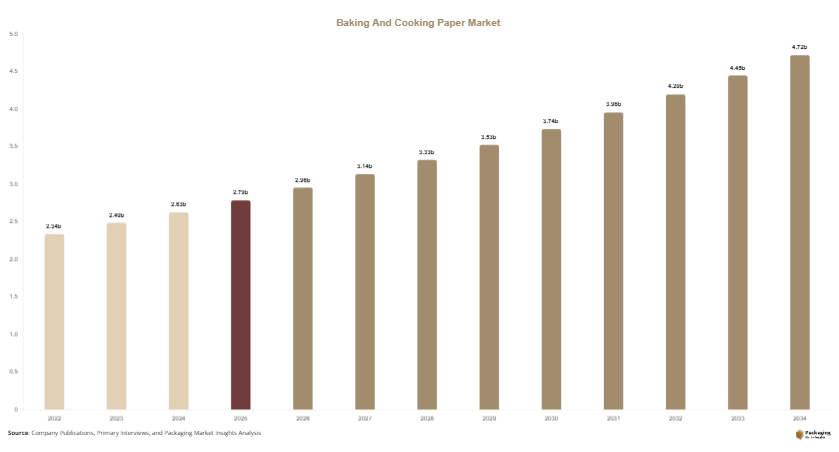
Baking And Cooking Paper market size is projected at USD 2.96 billion in 2026 and is expected to hit USD 4.71 billion by 2034 with a CAGR of 6.0%. Rising demand for convenient food preparation, sustainable packaging materials, and premium baking products continues to support industry expansion across developed and emerging economies. The report provides comprehensive data on production, consumption, segmentation, pricing trends, distribution channels, and competitive landscape to support strategic business decisions across the global Baking And Cooking Paper market.
The Baking And Cooking Paper market comprises specialty paper products designed to withstand high temperatures, prevent food adhesion, and improve cooking efficiency across residential and commercial applications. Global production exceeded 9.8 billion square meters in 2025, while industrial utilization surpassed 81% across commercial food processing facilities. Household adoption reached approximately 64% in developed economies, and commercial bakeries represented nearly 46% of total consumption volume. Parchment paper accounted for approximately 48% of total production, followed by greaseproof paper at 31% and wax paper at 21%, reinforcing the importance of the Baking And Cooking Paper market.
Explore more data points, trends and opportunities Download Free Sample Report
Baking And Cooking Paper Market Trends
Growing Adoption of Sustainable and Silicone-Coated Paper
Manufacturers are increasingly investing in biodegradable coatings and FSC-certified paper materials to reduce environmental impact. More than 57% of newly introduced baking papers now incorporate sustainable raw materials, while silicone-coated parchment production exceeded 4.2 billion square meters during 2025. Commercial food manufacturers continue replacing aluminum foil with premium baking papers, improving operational efficiency by nearly 18% and reducing waste generation by 22%, strengthening the Baking And Cooking Paper market.
Digital manufacturing technologies and precision coating equipment have increased production efficiency by approximately 14%, enabling improved heat resistance above 220°C for premium products. Foodservice operators expanded baking paper utilization by 17% year-over-year due to increasing demand for ready-to-eat foods, convenience meals, and bakery products. Rising investment in automated converting equipment further supports consistent product quality across the Baking And Cooking Paper market.
Baking And Cooking Paper Drivers
Expanding Global Bakery Production and Convenience Food Consumption
Rapid expansion of bakery chains, frozen food production, and ready-to-cook meal demand continues driving market expansion. Global bakery output surpassed 180 million metric tons, while commercial bakery investments increased by 11% during 2025. More than 69% of industrial baking facilities now utilize parchment paper for production efficiency, reducing cleaning costs by nearly 24% and supporting continuous demand across the Baking And Cooking Paper market.
Baking And Cooking Paper Restraints
Volatility in Wood Pulp and Specialty Coating Prices
Fluctuating prices of cellulose pulp, silicone coatings, and specialty chemicals continue affecting production costs. Raw material expenses increased approximately 13%, while transportation costs rose nearly 9% across several exporting countries. Profit margins for small manufacturers declined by almost 5%, limiting investment in capacity expansion despite increasing global demand.
Baking And Cooking Paper Opportunities
Expansion of Sustainable Food Packaging Solutions
Growing regulatory emphasis on recyclable and compostable packaging presents significant opportunities. Sustainable baking papers accounted for nearly 38% of premium product launches during 2025, while foodservice adoption exceeded 42% in environmentally regulated markets. Investments in barrier coating technologies increased by approximately 19%, creating additional revenue opportunities across industrial and household applications.
Challenges in Baking And Cooking Paper
Competition from Alternative Food Preparation Materials
Reusable silicone baking mats, aluminum foil, and non-stick cookware continue creating competitive pressure. Alternative reusable products recorded adoption growth exceeding 15%, particularly among environmentally conscious households. Manufacturers must continuously improve product durability, heat resistance, and sustainability while maintaining competitive pricing within the Baking And Cooking Paper market.
Report Scope
| Report Metric | Details |
|---|---|
| Market Size in 2025 | USD 2.79 billion |
| Market Size in 2026 | USD 2.96 billion |
| Market Size in 2034 | USD 4.71 billion |
| CAGR | 6.0% (2026-2034) |
| Base Year for Estimation | 2025 |
| Historical Data | 2022-2024 |
| Forecast Period | 2026-2034 |
| Report Coverage | Revenue Forecast, Competitive Landscape, Supply Chain Disruption, Growth Factors, Environment & Regulatory Landscape and Trends |
| Geographies Covered | North America, Europe, APAC, Middle East and Africa, LATAM |
| Countries Covered | U.S., Canada, U.K., Germany, France, Spain, Italy, Russia, Nordic, Benelux, Rest of Europe, China, South Korea, Japan, India, Australia, Singapore, Taiwan, South East Asia, Rest of Asia-Pacific, UAE, Turky, Saudi Arabia, South Africa, Egypt, Nigeria, Rest of MEA, Brazil, Mexico, Argentina, Chile, Colombia, Rest of LATAM |
Explore more data points, trends and opportunities Download Free Sample Report
Baking And Cooking Paper Market Segmentation
The market is segmented according to product type and application, with parchment paper accounting for approximately 48% of industry revenue due to its superior heat resistance and non-stick performance. Commercial bakeries contributed nearly 44% of overall consumption, followed by foodservice establishments and household users.
By Type
Parchment Paper
Parchment paper represents the largest category with nearly 48% market share. Production exceeded 4.7 billion square meters, featuring silicone-coated surfaces capable of resisting temperatures above 220°C. The segment benefits from extensive usage across industrial bakeries, food processing plants, and premium household kitchens.
Wax Paper
Wax paper contributes approximately 21% of global demand with production surpassing 2.1 billion square meters. Designed primarily for wrapping, storage, and low-temperature food preparation, wax-coated paper offers moisture resistance and improved shelf-life protection across food packaging applications.
Greaseproof Paper
Greaseproof paper accounts for nearly 31% of industry consumption, with annual production exceeding 3.0 billion square meters. Its oil-resistant fiber structure enables widespread use in bakery packaging, snack wrapping, and foodservice operations requiring high grease resistance without additional coatings.
By Application
Household
Household applications account for approximately 33% of consumption. More than 420 million households regularly utilize baking paper for baking, roasting, and food storage. Consumer penetration continues increasing through supermarkets, e-commerce platforms, and premium kitchen product retailers.
Commercial Bakeries
Commercial bakeries dominate with nearly 44% market share, consuming over 4.3 billion square meters annually. High-volume bread, pastry, pizza, and confectionery production requires consistent heat resistance, non-stick performance, and improved operational efficiency, making this the leading application segment.
Foodservice
Foodservice establishments represent approximately 23% of demand. Restaurants, hotels, quick-service chains, and catering businesses increasingly adopt baking paper to improve hygiene, reduce cleaning time by nearly 20%, and maintain consistent food quality across large-scale cooking operations.
Baking And Cooking Paper Market Segmentations
Type
- Parchment Paper
- Wax Paper
- Greaseproof Paper
Application
- Household
- Commercial Bakeries
- Foodservice
Baking And Cooking Paper Regional Outlook
North America
North America accounted for approximately 32% of global revenue during 2025. The United States represented over 78% of regional consumption, supported by advanced bakery manufacturing and high household penetration. Regional production exceeded 2.9 billion square meters, while commercial bakery applications generated nearly 51% of demand.
Europe
Europe represented nearly 29% of the global market. Germany, France, Italy, and the United Kingdom collectively contributed over 71% of regional production. Sustainable paper manufacturing increased by approximately 16%, while premium bakery product consumption continued supporting industrial demand.
Asia-Pacific
Asia-Pacific held approximately 28% market share and recorded the fastest expansion. China, Japan, India, and South Korea generated nearly 74% of regional output. Production surpassed 2.8 billion square meters, supported by expanding food processing industries, urbanization, and rising disposable income.
Latin America
Latin America contributed approximately 6% of total market revenue. Brazil and Mexico represented nearly 63% of regional demand, driven by bakery industry expansion and increasing adoption of packaged food products across urban markets.
Middle East & Africa
The Middle East & Africa accounted for nearly 5% of global demand. Saudi Arabia, the UAE, and South Africa remained leading consumers due to expanding hospitality, foodservice, and commercial baking industries, with annual production exceeding 420 million square meters.
Top players in Baking And Cooking Paper
- Ahlstrom
- Mondi Group
- Nordic Paper
- Delfort Group
- Mitsubishi Paper Mills
- KRPA Holding
- Expera Specialty Solutions
- Cosmos Paper
- Vizille Paper Mills
- Scan Holdings
- Georgia-Pacific
- McNairn Packaging
- Pudumjee Paper Products
- SAGA Papers
- Metsa Group
Ahlstrom
-
Holds an estimated 11% global market share.
-
Operates advanced specialty paper manufacturing facilities across Europe and North America.
-
Focuses on sustainable fiber sourcing, premium parchment technologies, and food-grade specialty paper production.
-
Strong presence across commercial bakery, food packaging, and industrial food processing sectors with continuous investment in environmentally friendly manufacturing technologies.
Mondi Group
-
Accounts for approximately 9% of the global market.
-
Maintains diversified specialty paper operations supported by integrated pulp production.
-
Invests heavily in recyclable barrier paper technologies and sustainable product innovation.
-
Serves bakery manufacturers, foodservice operators, and packaging companies across more than 100 countries through an extensive global distribution network.