Disposable Plates Market Size
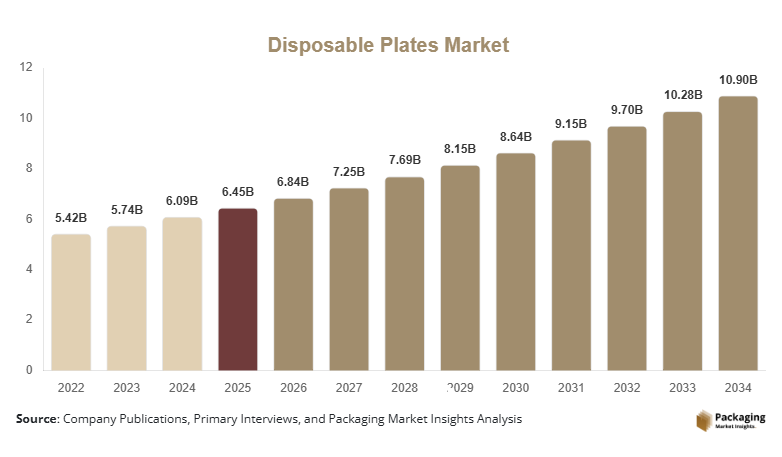
Disposable plates' market size is projected at USD 6.84 billion in 2026 and is expected to reach USD 10.92 billion by 2034, expanding at a CAGR of 6.0% during the forecast period. The report evaluates historical performance from 2022 to 2024, considers 2025 as the base year, and analyzes market performance across materials, end users, regional demand, production capacity, consumption volume, and the competitive landscape to support strategic decision-making.
Disposable plates are single-use serving products manufactured primarily from paper, plastic, bagasse, and other biodegradable materials for residential and commercial food-serving applications. Global production exceeded 122 billion units in 2025, with foodservice accounting for approximately 57% of total consumption, households contributing 28%, and institutional buyers representing nearly 15%. Biodegradable products now represent nearly 38% of worldwide shipments, while developed markets report penetration above 65% in organized retail channels, reinforcing long-term market expansion.
Explore more data points, trends and opportunities Download Free Sample Report
Disposable Plates Trends
Rising Adoption of Sustainable Materials
Manufacturers are increasing investment in molded fiber, sugarcane bagasse, and coated paper technologies to reduce environmental impact. Global production of eco-friendly disposable plates surpassed 46 billion units in 2025, representing an annual increase of 11.4%. Automated molding technologies have improved production efficiency by nearly 18%, while biodegradable product adoption has exceeded 52% across organized foodservice operators, strengthening industry competitiveness.
Growing regulatory emphasis on reducing conventional plastics has accelerated commercialization of compostable products across restaurants, catering services, and quick-service restaurants. More than 70% of newly announced production facilities emphasize renewable raw materials, while digital quality inspection systems have reduced manufacturing defects by approximately 12% and improved output consistency across high-volume manufacturing operations.
Disposable Plates Drivers
Expanding Food Delivery and Quick-Service Restaurant Networks
The rapid growth of online food delivery, takeaway services, and organized catering continues to stimulate demand for disposable serving products. Global online meal deliveries exceeded 195 billion orders during 2025, while quick-service restaurants increased outlet expansion by approximately 8% worldwide. Food packaging expenditure has grown by nearly 9% annually, encouraging manufacturers to expand production capacity beyond 130 billion units over the next several years.
Disposable Plates, Restraints
Raw Material Price Volatility and Environmental Regulations
Fluctuations in pulp, polymer, and agricultural residue prices continue to influence manufacturing costs. Paper pulp prices experienced variations exceeding 15% in several international markets during recent years, while compliance investments for environmental regulations increased production costs by approximately 6–10%. These factors may reduce operating margins for small and medium-scale manufacturers.
Disposable Plates Opportunities
Innovation in Compostable and Premium Disposable Products
Demand for compostable tableware continues to expand across hospitality, healthcare, and institutional dining. Premium biodegradable products recorded shipment growth exceeding 14% during 2025, while investment in molded fiber production increased by over USD 420 million globally. Advanced water-resistant coatings and microwave-safe products are creating new revenue opportunities across commercial foodservice applications.
Challenges in Disposable Plates Market
Balancing Cost Competitiveness with Sustainability
Manufacturers face challenges in maintaining affordable pricing while complying with evolving sustainability standards. Compostable products often cost 18–35% more than conventional alternatives, while certification expenses and supply chain adjustments increase operational complexity. Maintaining production efficiency above 90% utilization without compromising environmental compliance remains a significant challenge for industry participants.
Report Scope
| Report Metric | Details |
|---|---|
| Market Size in 2025 | USD 6.45 Billion |
| Market Size in 2026 | USD 6.84 Billion |
| Market Size in 2034 | USD 10.92 Billion |
| CAGR | 6.0% (2026-2034) |
| Base Year for Estimation | 2025 |
| Historical Data | 2022-2024 |
| Forecast Period | 2026-2034 |
| Report Coverage | Revenue Forecast, Competitive Landscape, Supply Chain Disruption, Growth Factors, Environment & Regulatory Landscape and Trends |
| Geographies Covered | North America, Europe, APAC, Middle East and Africa, LATAM |
| Countries Covered | U.S., Canada, U.K., Germany, France, Spain, Italy, Russia, Nordic, Benelux, Rest of Europe, China, South Korea, Japan, India, Australia, Singapore, Taiwan, South East Asia, Rest of Asia-Pacific, UAE, Turky, Saudi Arabia, South Africa, Egypt, Nigeria, Rest of MEA, Brazil, Mexico, Argentina, Chile, Colombia, Rest of LATAM |
Explore more data points, trends and opportunities Download Free Sample Report
Disposable Plates Market Segmentation
The market is segmented by material and end user to evaluate demand patterns across residential and commercial applications. Paper-based products account for approximately 45% of global consumption, followed by plastic at 32% and bagasse at 23%. Foodservice remains the dominant end-user segment with nearly 57% market contribution.
By Material
Paper disposable plates represent the largest category owing to affordability, recyclability, and widespread availability. Annual production exceeds 55 billion units, while coated paper technologies have improved moisture resistance by nearly 20%.
Plastic disposable plates continue to serve applications requiring durability and low cost. Production remains above 39 billion units, although market share has gradually declined because of regulatory restrictions and growing environmental awareness.
Bagasse products demonstrate the fastest expansion due to their compostable characteristics. Global production surpassed 28 billion units, with annual shipment growth exceeding 12% across commercial foodservice establishments.
By End User
Household consumption contributes approximately 28% of global demand, supported by celebrations, picnics, and convenience-oriented lifestyles. Retail penetration continues to rise across supermarkets and e-commerce platforms.
Foodservice represents the leading application with nearly 57% market share. Restaurants, cafés, catering businesses, and takeaway outlets collectively consume more than 69 billion units annually because of increasing food delivery volumes.
Educational institutions, hospitals, corporate cafeterias, and government organizations account for approximately 15% of market demand. Procurement contracts increasingly specify biodegradable products to satisfy sustainability objectives.
Disposable Plates Market Segmentations
Material
- Paper
- Plastic
- Bagasse
End User
- Households
- Foodservice
- Institutional
Disposable Plates Regional Outlook
North America
North America contributes approximately 29% of global revenue, supported by strong foodservice infrastructure and high consumer spending. The United States accounts for nearly 82% of regional consumption, while Canada continues expanding biodegradable product adoption.
Europe
Europe represents nearly 24% of worldwide demand, driven by environmental regulations and circular economy initiatives. Germany, France, Italy, and the United Kingdom collectively account for more than 68% of regional production.
Asia-Pacific
Asia-Pacific leads global consumption with approximately 36% market share. China and India contribute over 61% of regional manufacturing volume, supported by expanding urbanization, rising disposable income, and increasing organized food delivery services.
Latin America
Latin America contributes approximately 6% of global demand. Brazil and Mexico remain the largest regional consumers, supported by hospitality expansion and improving retail distribution networks.
Middle East & Africa
The Middle East & Africa accounts for nearly 5% of worldwide consumption. Growth is supported by tourism, catering services, and infrastructure development across Gulf Cooperation Council countries and South Africa.
Top Players in Disposable Plates Market
- Huhtamaki
- Dart Container Corporation
- Georgia-Pacific LLC
- Pactiv Evergreen
- Duni Group
- Genpak LLC
- Graphic Packaging International
- Vegware Ltd.
- Lollicup USA Inc.
- Dopla S.p.A.
- Eco-Products Inc.
- Biopac UK Ltd.
Huhtamaki
- Estimated global market presence of approximately 9–11%
- Extensive portfolio covering paper, molded fiber, and compostable products
- Manufacturing facilities across multiple continents improve supply chain resilience
- Strong focus on sustainable packaging innovation and premium foodservice solutions
Dart Container Corporation
- Estimated market presence of approximately 7–9%
- Leading supplier to foodservice and institutional customers
- A broad manufacturing footprint supports high-volume production and rapid distribution
- Continuous investment in product development, automation, and operational efficiency strengthens competitive positioning