Solid Board For Food Packaging Market Size and Growth
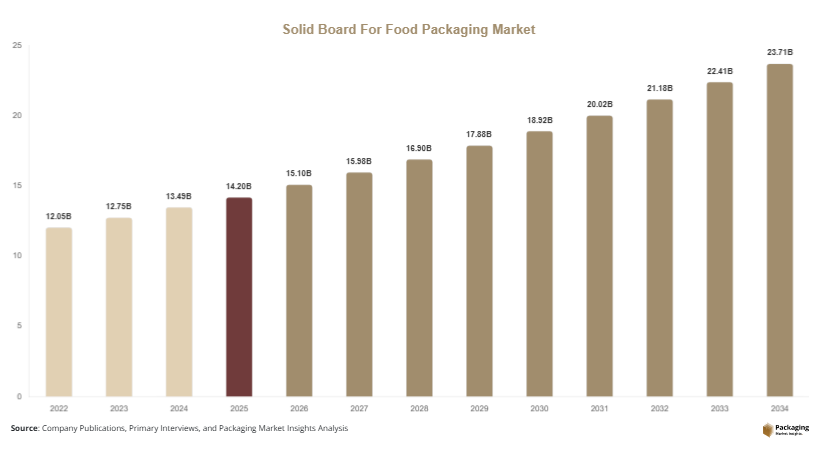
The solid board for food packaging market is witnessing steady expansion, driven by increasing demand for sustainable and durable packaging solutions across global food supply chains. The market size was valued at approximately USD 14.2 billion in 2025 and is estimated to reach USD 15.1 billion in 2026, reflecting consistent demand from food manufacturers and retail channels. Over the forecast period, the market is projected to grow at a CAGR of 5.8% from 2025 to 2034, reaching nearly USD 24.8 billion by 2034.
Solid board packaging, known for its rigidity, high load-bearing capacity, and recyclability, is widely used in packaging fresh produce, frozen foods, bakery items, and ready-to-eat meals. One of the primary growth factors is the global shift toward eco-friendly packaging solutions, as regulatory authorities and consumers increasingly prefer materials that reduce environmental impact. Additionally, the expansion of the processed food industry and rising consumption of packaged food products are contributing to the adoption of solid board packaging formats.
Key Highlights:
- Market size projected to reach USD 24.8 billion by 2034
- CAGR of 5.8% from 2025 to 2034
- Strong demand from processed and packaged food sectors
- Increasing preference for recyclable and sustainable packaging
- Growth driven by e-commerce and retail expansion
Explore more data points, trends and opportunities Download Free Sample Report
Market Trends
Rising Adoption of Sustainable and Recyclable Packaging Materials
Sustainability remains a defining trend in the solid board for food packaging market, with manufacturers focusing on recyclable, biodegradable, and compostable solutions. Solid board, being fiber-based, aligns well with circular economy goals and regulatory mandates aimed at reducing plastic waste. Companies are investing in water-based coatings and bio-based barriers to enhance functionality while maintaining environmental compliance. Retailers and food brands are also promoting eco-friendly packaging as part of their sustainability commitments, which further accelerates adoption. This trend is particularly visible in developed markets, where consumers actively prefer packaging that reflects environmental responsibility, leading to increased demand for certified and responsibly sourced solid board materials.
Integration of Smart Packaging and Functional Coatings
The market is witnessing growing integration of functional enhancements such as moisture resistance, grease barriers, and temperature control features. Advanced coatings are being developed to extend shelf life and maintain product freshness without compromising recyclability. Additionally, smart packaging technologies, including QR codes and traceability features, are being incorporated into solid board packaging to improve supply chain transparency. These innovations are particularly useful in high-value food segments such as organic products and ready-to-eat meals. The combination of durability and technological integration is positioning solid board as a competitive solution in modern packaging ecosystems, especially in markets where product quality and traceability are critical.
Market Drivers
Growth in Packaged and Processed Food Consumption
The rising consumption of packaged and processed food products is a key driver of the solid board for food packaging market. Urbanization, busy lifestyles, and increasing disposable incomes are encouraging consumers to opt for convenient food options, which require reliable packaging. Solid board packaging offers structural integrity, making it suitable for handling, stacking, and transportation. Food manufacturers are increasingly adopting solid board for applications such as frozen foods, dairy products, and ready meals. Moreover, the expansion of organized retail and supermarket chains is driving demand for visually appealing and durable packaging, further boosting the use of solid board solutions across various food categories.
Regulatory Push Toward Sustainable Packaging Solutions
Governments and regulatory bodies worldwide are implementing stringent policies to reduce plastic usage and promote sustainable alternatives. These regulations are encouraging food packaging companies to shift toward fiber-based materials such as solid board. Compliance with environmental standards has become a priority for manufacturers, leading to increased investment in sustainable packaging technologies. Solid board packaging meets these requirements due to its recyclability and lower environmental footprint. Additionally, certifications related to sustainable sourcing are gaining importance, influencing procurement decisions. This regulatory push is expected to remain a strong driver, particularly in regions with strict environmental policies and active sustainability initiatives.
Market Restraint
High Production Costs and Competition from Flexible Packaging
One of the major restraints affecting the solid board for food packaging market is the relatively higher production cost compared to alternative materials such as flexible plastics. The manufacturing process for solid board involves multiple stages, including pulping, pressing, and coating, which can increase operational expenses. Additionally, fluctuations in raw material prices, particularly wood pulp, can impact profit margins for manufacturers.
Flexible packaging solutions, which are lightweight and cost-effective, pose strong competition, especially in price-sensitive markets. For example, small-scale food producers often prefer flexible pouches due to lower packaging costs and ease of transportation. This creates a challenge for solid board manufacturers to balance cost efficiency with performance. Although advancements in production technology are helping reduce costs, the price disparity remains a limiting factor, particularly in developing regions where affordability is a key consideration.
Market Opportunities
Expansion in Emerging Markets
Emerging markets present significant growth opportunities for the solid board for food packaging market due to increasing urbanization and rising demand for packaged food. Countries in Asia Pacific, Latin America, and Africa are experiencing rapid growth in retail infrastructure and food processing industries. As consumers in these regions shift toward packaged and convenience foods, the demand for reliable and sustainable packaging solutions is increasing. Solid board packaging is gaining traction due to its strength and recyclability, making it suitable for diverse applications. Local manufacturers are also investing in production facilities to meet growing demand, creating a favorable environment for market expansion.
Innovation in Barrier Coatings and Lightweight Designs
Technological advancements in barrier coatings and lightweight materials are opening new opportunities for market growth. Manufacturers are developing innovative coatings that enhance moisture and grease resistance while maintaining recyclability. These advancements enable solid board packaging to be used in a wider range of food applications, including high-moisture and oily products. Additionally, lightweight designs are reducing material usage and transportation costs, improving overall efficiency. This combination of performance and sustainability is attracting food manufacturers seeking cost-effective and environmentally friendly packaging solutions. Continuous innovation in this area is expected to drive long-term growth and competitiveness in the market.
Report Scope
| Report Metric | Details |
|---|---|
| Market Size in 2025 | USD 14.2 Billion |
| Market Size in 2026 | USD 15.1 Billion |
| Market Size in 2034 | USD 24.8 Billion |
| CAGR | 5.8% (2026-2034) |
| Base Year for Estimation | 2025 |
| Historical Data | 2022-2024 |
| Forecast Period | 2026-2034 |
| Report Coverage | Revenue Forecast, Competitive Landscape, Supply Chain Disruption, Growth Factors, Environment & Regulatory Landscape and Trends |
| Geographies Covered | North America, Europe, APAC, Middle East and Africa, LATAM |
| Countries Covered | U.S., Canada, U.K., Germany, France, Spain, Italy, Russia, Nordic, Benelux, Rest of Europe, China, South Korea, Japan, India, Australia, Singapore, Taiwan, South East Asia, Rest of Asia-Pacific, UAE, Turky, Saudi Arabia, South Africa, Egypt, Nigeria, Rest of MEA, Brazil, Mexico, Argentina, Chile, Colombia, Rest of LATAM |
Explore more data points, trends and opportunities Download Free Sample Report
Regional Analysis
North America
North America accounted for approximately 28% market share in 2025, with a projected CAGR of around 5.2% during the forecast period. The region benefits from a well-established food processing industry and high adoption of sustainable packaging solutions. Strong regulatory frameworks supporting environmentally friendly materials are also contributing to market growth. Demand for solid board packaging is particularly high in the United States and Canada, where consumers prioritize quality and sustainability in packaged food products.
The United States dominates the regional market due to its advanced retail infrastructure and high consumption of packaged foods. A unique growth factor is the increasing demand for ready-to-eat and frozen meals, which require durable and protective packaging. Food manufacturers are investing in high-quality packaging materials to maintain product integrity during storage and transportation, further boosting demand for solid board solutions.
Europe
Europe held nearly 25% market share in 2025, with a forecast CAGR of 5.5%. The region is characterized by stringent environmental regulations and strong emphasis on sustainability. The adoption of recyclable packaging materials is widespread, driving demand for solid board packaging. Countries such as Germany, France, and the United Kingdom are leading contributors to market growth due to their advanced food processing industries.
Germany is the dominant country in this region, supported by its strong manufacturing base and focus on sustainable practices. A unique growth factor is the increasing use of certified sustainable packaging materials, which aligns with regulatory requirements and consumer preferences. This trend is encouraging manufacturers to adopt solid board solutions that meet environmental standards.
Asia Pacific
Asia Pacific accounted for around 30% market share in 2025 and is expected to register the fastest CAGR of 6.5% during the forecast period. Rapid urbanization, population growth, and rising disposable incomes are driving demand for packaged food products. The region is witnessing significant investments in food processing and packaging industries, creating strong demand for solid board materials.
China leads the regional market due to its large population and expanding food industry. A unique growth factor is the rapid growth of e-commerce grocery platforms, which require durable packaging solutions for safe delivery. This has increased the adoption of solid board packaging in both domestic and export markets.
Middle East & Africa
The Middle East & Africa region held approximately 9% market share in 2025, with a projected CAGR of 5.7%. The market is gradually expanding due to increasing urbanization and growth in the food retail sector. Governments in the region are also promoting sustainable packaging solutions, which is expected to drive demand for solid board packaging.
The United Arab Emirates is a key contributor to regional growth. A unique growth factor is the expansion of premium food retail and hospitality sectors, which require high-quality packaging for branding and product protection. This is encouraging the adoption of solid board materials in various food applications.
Latin America
Latin America captured nearly 8% market share in 2025, with a forecast CAGR of 5.4%. The region is experiencing steady growth in the food processing industry, supported by increasing consumer demand for packaged food products. Solid board packaging is gaining popularity due to its durability and environmental benefits.
Brazil dominates the regional market, driven by its large food manufacturing sector. A unique growth factor is the increasing demand for export-oriented food packaging, which requires robust materials to ensure product safety during transportation. This is boosting the adoption of solid board solutions in the region.
Solid Board For Food Packaging Market Segmentations
Type
- Coated Solid Board
- Uncoated Solid Board
Application
- Food Cartons
- Trays
- Clamshells
- Others
End-Use
- Food Processing Industry
- Retail & E-commerce
- Food Service Industry
Segmental Analysis
By Type
The coated solid board segment dominated the market in 2024, accounting for approximately 58% share. This dominance is attributed to its superior barrier properties, which make it suitable for packaging food products that require protection from moisture, grease, and contaminants. Coated solid board is widely used in applications such as frozen foods, dairy products, and ready-to-eat meals. Its ability to enhance product shelf life while maintaining structural integrity makes it a preferred choice among manufacturers. Additionally, advancements in coating technologies have improved recyclability, further increasing its adoption in sustainable packaging solutions.
The uncoated solid board segment is expected to be the fastest-growing, with a projected CAGR of 6.2% during the forecast period. Growth is driven by increasing demand for eco-friendly packaging materials that are easier to recycle. Uncoated solid board is gaining popularity in applications where high barrier properties are not required, such as dry food packaging. Manufacturers are focusing on improving the strength and durability of uncoated boards to expand their application range. This trend is particularly evident in regions with strict environmental regulations, where recyclability is a key factor influencing packaging choices.
By Application
Food cartons emerged as the dominant application segment in 2024, holding around 46% market share. These cartons are widely used for packaging products such as cereals, bakery items, and frozen foods. The popularity of food cartons is driven by their ability to provide protection, branding opportunities, and convenience. Solid board cartons offer excellent printability, allowing manufacturers to create visually appealing packaging that enhances product visibility on retail shelves. Additionally, their structural strength ensures safe transportation and storage, making them a preferred choice for various food applications.
Trays and clamshells are expected to be the fastest-growing application segment, with a CAGR of 6.7%. The growth is driven by increasing demand for ready-to-eat and takeaway food products. These packaging formats provide convenience and ease of handling, making them suitable for modern lifestyles. Solid board trays and clamshells are also gaining popularity due to their sustainability benefits, as they can replace plastic alternatives. Innovations in design and functionality are further enhancing their appeal, driving their adoption across different food categories.
By End-Use
The food processing industry dominated the end-use segment in 2024, accounting for approximately 52% share. This dominance is attributed to the high demand for packaging solutions that ensure product safety and extend shelf life. Solid board packaging is widely used in this industry due to its strength, durability, and compatibility with various food products. Manufacturers are increasingly adopting solid board materials to meet regulatory requirements and consumer expectations for sustainable packaging. The growth of the food processing industry, particularly in emerging markets, is further driving demand for solid board packaging.
The retail and e-commerce segment is projected to be the fastest-growing, with a CAGR of 6.9%. The rapid expansion of online grocery platforms and retail chains is increasing the need for durable packaging solutions that can withstand handling and transportation. Solid board packaging offers the required strength and protection, making it suitable for e-commerce applications. Additionally, the emphasis on sustainable packaging in retail is encouraging the adoption of solid board materials. This trend is expected to continue as consumers increasingly prefer environmentally friendly packaging options.
Competitive Landscape
The solid board for food packaging market is moderately fragmented, with several global and regional players competing based on product quality, innovation, and sustainability. Leading companies are focusing on expanding their product portfolios and investing in research and development to enhance performance and recyclability. Strategic collaborations, mergers, and acquisitions are also common as companies aim to strengthen their market presence.
One of the leading players in the market is International Paper, which holds a strong position due to its extensive product range and global distribution network. A recent development includes the company’s investment in advanced coating technologies to improve the functionality of solid board packaging while maintaining sustainability standards. Other major players are also adopting similar strategies, focusing on innovation and capacity expansion to meet growing demand.
Key Players List
- International Paper Company
- WestRock Company
- Smurfit Kappa Group
- Stora Enso Oyj
- Mondi Group
- DS Smith Plc
- Nippon Paper Industries Co., Ltd.
- Packaging Corporation of America
- Georgia-Pacific LLC
- Klabin S.A.
- Mayr-Melnhof Karton AG
- Sappi Limited
- Oji Holdings Corporation
- Cascades Inc.
- Rengo Co., Ltd.