Printed Cartons Market Size and Growth
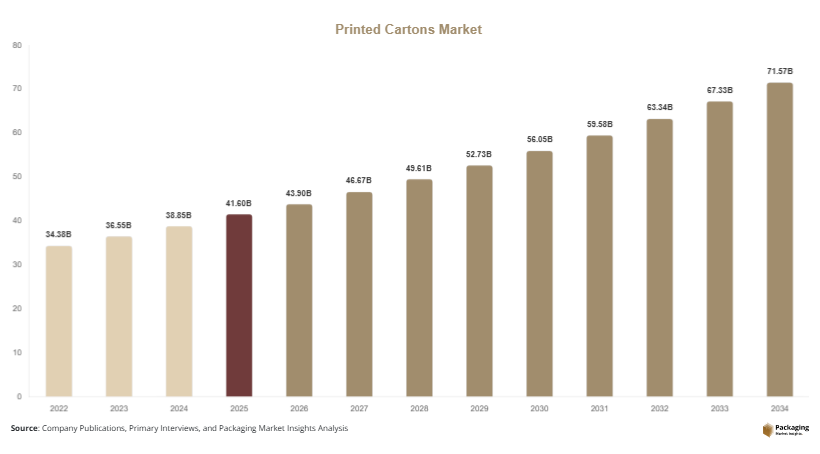
The global printed cartons market size was valued at approximately USD 41.6 billion in 2025 and is expected to reach USD 43.9 billion in 2026. By 2034, the market is projected to reach nearly USD 71.4 billion, registering a CAGR of 6.3% during 2025–2034. The printed cartons market is experiencing consistent growth due to increasing demand for visually appealing, sustainable, and customizable packaging solutions across food and beverage, healthcare, personal care, and consumer goods industries. Printed cartons are widely used for branding, product protection, and retail presentation because they provide strong print quality, structural durability, and efficient shelf visibility. The market is benefiting from the rapid expansion of retail packaging, e-commerce distribution, and premium consumer product packaging worldwide.
One of the primary growth factors driving the printed cartons market is the increasing demand for branded and customized packaging solutions. Consumer goods manufacturers are investing in high-quality carton printing technologies to improve product differentiation and customer engagement in competitive retail environments. Another major growth factor is the increasing adoption of sustainable paperboard packaging. Governments and consumers are encouraging the use of recyclable and biodegradable packaging materials, supporting demand for paper-based printed cartons across global industries.
Key Highlights
- Asia Pacific dominated the market with a 39.2% share in 2025.
- Latin America is projected to grow at the fastest CAGR of 7.1%.
- Folding cartons led the product type segment with a 48.7% share.
- Food & beverage applications dominated the market with a 42.9% share.
- Offset printing technology dominated with a 46.5% share.
- The US remained the dominant country in North America with a market size of USD 8.2 billion in 2025 and USD 8.7 billion in 2026.
Explore more data points, trends and opportunities Download Free Sample Report
Market Trends
Increasing Adoption of Digital Printing Technologies
Digital printing is becoming an important trend in the printed cartons market because manufacturers increasingly require flexible and cost-efficient packaging customization solutions. Digital printing technologies allow shorter production runs, rapid design changes, and personalized packaging without the need for traditional printing plates. Consumer brands are using digitally printed cartons for promotional campaigns, seasonal packaging, and limited-edition product launches. The growth of e-commerce and direct-to-consumer sales is further supporting demand for customized carton packaging with high-quality graphics and variable data printing capabilities. Advancements in ink technologies and automated printing systems are improving print quality and operational efficiency across packaging production facilities.
Growing Demand for Sustainable and Recyclable Carton Packaging
Sustainability continues to influence purchasing decisions across packaging industries, creating strong demand for recyclable printed carton solutions. Manufacturers are increasingly using paperboard materials sourced from recycled fibers and certified sustainable forestry operations. Brands are replacing plastic packaging formats with printed cartons to improve environmental performance and align with changing regulatory standards. Consumers also prefer packaging products with eco-friendly labeling and minimal environmental impact. Packaging companies are investing in water-based inks, biodegradable coatings, and lightweight carton structures to reduce waste generation and improve recyclability. These sustainability-focused developments are supporting long-term market growth globally.
Market Drivers
Expansion of Packaged Consumer Goods Industries
The rapid expansion of packaged consumer goods industries is a major factor driving growth in the printed cartons market. Food and beverage companies, pharmaceutical manufacturers, and personal care brands increasingly require high-quality printed cartons to improve product visibility and consumer engagement. Printed cartons provide branding space, product information display, and structural protection for packaged products during transportation and retail storage. Growing urbanization and rising disposable income are increasing consumption of packaged goods globally, particularly in emerging economies. Manufacturers are also focusing on premium packaging designs to strengthen brand positioning in competitive retail markets.
Growth of E-Commerce and Retail Packaging Demand
The growth of e-commerce and organized retail industries is significantly increasing demand for printed carton packaging solutions. Online retailers require durable packaging capable of protecting products during shipping while maintaining attractive branding and customer experience. Printed cartons support lightweight transportation, easy stacking, and efficient inventory management across distribution networks. Retail companies are increasingly adopting visually appealing carton packaging to improve shelf differentiation and promotional marketing effectiveness. Expansion of subscription box services and direct-to-consumer delivery models is also contributing to higher demand for customized printed carton solutions worldwide.
Market Restraint
Fluctuating Raw Material Prices and Production Costs
One of the primary restraints affecting the printed cartons market is the volatility in raw material prices associated with paperboard, pulp, inks, and coating materials. The production of printed cartons relies heavily on paper-based materials, and fluctuations in pulp pricing can significantly impact manufacturing costs and profit margins for packaging companies. Rising energy costs and transportation expenses also contribute to increasing operational expenditures across carton manufacturing facilities.
In addition, supply chain disruptions and shortages of raw materials may create production delays and affect delivery timelines for packaging manufacturers. For example, several carton producers experienced higher procurement costs during periods of global logistics disruptions and increased paper demand from e-commerce industries. Small and medium-sized packaging manufacturers may face difficulties in maintaining stable pricing structures because of limited purchasing power and operational flexibility. Increasing investments required for sustainable printing technologies and recyclable coating materials can further increase production expenses. These cost-related challenges may limit profit margins and affect the adoption of advanced printing solutions across price-sensitive markets during the forecast period.
Market Opportunities
Expansion of Smart and Interactive Packaging Solutions
The growing adoption of smart packaging technologies is creating significant opportunities in the printed cartons market. Brands are increasingly integrating QR codes, augmented reality features, and NFC-enabled packaging into printed cartons to improve customer engagement and product traceability. Interactive carton packaging allows consumers to access product information, promotional content, and authentication features through smartphones and digital platforms. Food, pharmaceutical, and cosmetics companies are investing in connected packaging technologies to strengthen consumer trust and improve supply chain transparency. The increasing use of digital marketing and personalized packaging campaigns is expected to support further growth in this segment.
Rising Demand for Premium and Luxury Packaging
The increasing demand for premium consumer goods is creating new opportunities for high-quality printed carton packaging solutions. Luxury cosmetics, confectionery products, beverages, and electronics manufacturers are investing in premium carton designs featuring advanced printing finishes, embossing, and specialty coatings. Consumers increasingly associate premium packaging with product quality and brand value, encouraging companies to adopt visually distinctive carton packaging. Technological advancements in high-resolution printing and decorative finishing solutions are enabling manufacturers to produce sophisticated carton designs at improved production efficiency. Expanding premium retail sectors in emerging economies will further support market growth.
Report Scope
| Report Metric | Details |
|---|---|
| Market Size in 2025 | USD 41.6 Billion |
| Market Size in 2026 | USD 43.9 Billion |
| Market Size in 2034 | USD 71.4 Billion |
| CAGR | 6.3% (2026-2034) |
| Base Year for Estimation | 2025 |
| Historical Data | 2022-2024 |
| Forecast Period | 2026-2034 |
| Report Coverage | Revenue Forecast, Competitive Landscape, Supply Chain Disruption, Growth Factors, Environment & Regulatory Landscape and Trends |
| Geographies Covered | North America, Europe, APAC, Middle East and Africa, LATAM |
| Countries Covered | U.S., Canada, U.K., Germany, France, Spain, Italy, Russia, Nordic, Benelux, Rest of Europe, China, South Korea, Japan, India, Australia, Singapore, Taiwan, South East Asia, Rest of Asia-Pacific, UAE, Turky, Saudi Arabia, South Africa, Egypt, Nigeria, Rest of MEA, Brazil, Mexico, Argentina, Chile, Colombia, Rest of LATAM |
Explore more data points, trends and opportunities Download Free Sample Report
Segmental Analysis
By Product Type
Folding cartons dominated the printed cartons market in 2024, accounting for approximately 48.7% of the total market share. Folding cartons are widely used across food, pharmaceutical, cosmetics, and household product industries because they provide lightweight construction, strong printability, and efficient storage capabilities. Manufacturers prefer folding cartons due to their cost-effectiveness and compatibility with automated packaging systems. These cartons also support high-quality graphics and branding designs, making them suitable for retail shelf presentation. The increasing demand for recyclable paper-based packaging solutions is further supporting segment growth globally.
Corrugated printed cartons are projected to register the fastest CAGR of 7.4% during the forecast period. The growth of e-commerce and logistics industries is significantly increasing demand for corrugated packaging capable of protecting products during transportation and warehousing. Corrugated printed cartons offer improved structural durability and larger branding space for shipping and retail packaging applications. Online retailers are increasingly adopting printed corrugated cartons to strengthen brand recognition and improve customer experience. Expansion of direct-to-consumer delivery services is expected to further accelerate demand within this segment.
By Application
Food & beverage applications dominated the market in 2024 with a share of approximately 42.9%. Printed cartons are extensively used for packaged snacks, beverages, frozen foods, dairy products, and bakery items because they provide branding visibility and product protection. Food manufacturers rely on carton packaging to display nutritional information, promotional content, and product identification details. Rising packaged food consumption and increasing demand for retail-ready packaging solutions are supporting continued growth within this segment. Advancements in moisture-resistant coatings and food-safe printing technologies are further improving carton performance for food applications.
Healthcare applications are expected to grow at the fastest CAGR of 7.3% during the forecast period. Pharmaceutical companies increasingly require printed cartons for medicine packaging, labeling, and regulatory compliance purposes. Printed cartons provide important product information, dosage instructions, and tamper-evident features for healthcare packaging applications. The growth of pharmaceutical manufacturing and rising demand for over-the-counter healthcare products are supporting segment expansion. Packaging companies are also investing in serialization and track-and-trace technologies to improve pharmaceutical supply chain security and regulatory compliance.
By Printing Technology
Offset printing technology dominated the market in 2024, accounting for approximately 46.5% of the total share. Offset printing is widely preferred because it provides high print quality, color consistency, and cost efficiency for large-volume carton production. Packaging manufacturers use offset printing for food cartons, pharmaceutical packaging, and premium consumer goods applications requiring detailed graphics and strong visual appeal. The technology supports a wide range of coatings and finishing solutions, improving packaging aesthetics and branding performance. Increasing demand for high-resolution packaging graphics is further supporting segment dominance.
Digital printing is projected to register the fastest CAGR of 8.2% during the forecast period. Brands increasingly require short-run packaging production, personalized designs, and rapid printing turnaround times, supporting demand for digital carton printing technologies. Digital printing enables variable data printing, customization, and reduced setup costs compared to traditional printing methods. The expansion of e-commerce marketing campaigns and promotional packaging is accelerating adoption of digitally printed cartons. Technological advancements in inkjet systems and automated digital presses are also improving production efficiency and print quality across packaging operations.
Printed Cartons Market Segmentations
By Product Type
- Folding Cartons
- Corrugated Printed Cartons
- Rigid Printed Cartons
By Application
- Food & Beverage
- Healthcare
- Personal Care & Cosmetics
- Consumer Electronics
By Printing Technology
- Offset Printing
- Flexographic Printing
- Digital Printing
- Gravure Printing
Regional Analysis
North America
North America accounted for approximately 24.7% of the global printed cartons market share in 2025 and is projected to expand at a CAGR of 5.9% during the forecast period. The region benefits from strong packaged food consumption, advanced retail infrastructure, and increasing demand for branded packaging solutions. Consumer goods manufacturers are investing in innovative carton printing technologies to improve product visibility and customer engagement. The rapid growth of e-commerce and direct-to-consumer delivery services is also supporting demand for durable and visually attractive carton packaging solutions.
The United States dominates the North American market because of its large packaging manufacturing industry and strong retail sector. A unique growth factor is the increasing use of digitally printed cartons for subscription box packaging and promotional campaigns. Retail brands are adopting customized carton printing technologies to improve consumer experience and support targeted marketing strategies across online retail platforms.
Europe
Europe represented approximately 27.1% of the global market share in 2025 and is expected to grow at a CAGR of 5.8% during the forecast period. Strong environmental regulations and increasing demand for recyclable packaging materials are supporting regional market expansion. Packaging manufacturers are focusing on sustainable paperboard solutions and eco-friendly printing technologies to comply with changing regulatory standards. Rising demand for premium food packaging and pharmaceutical cartons is also contributing significantly to regional market growth.
Germany remains the dominant country in the European printed cartons market due to its advanced printing industry and strong consumer goods manufacturing base. A unique growth factor is the increasing investment in water-based inks and recyclable carton coatings. German packaging companies are emphasizing sustainable printing technologies to reduce environmental impact and improve packaging recyclability across retail and industrial applications.
Asia Pacific
Asia Pacific accounted for approximately 39.2% of the global market share in 2025 and is projected to register a CAGR of 6.8% through 2034. Rapid urbanization, expanding retail industries, and growing packaged consumer goods consumption are supporting strong regional market growth. Countries such as China, India, Japan, and South Korea are witnessing increasing demand for printed cartons across food, healthcare, and personal care sectors. Expansion of e-commerce logistics networks and supermarket retail chains is further strengthening market demand.
China dominates the Asia Pacific market because of its large-scale packaging manufacturing industry and rapidly growing retail economy. A unique growth factor is the increasing production of export-oriented consumer goods requiring customized printed carton packaging. Domestic manufacturers are investing in high-speed printing technologies and automated carton production systems to improve operational efficiency and export competitiveness.
Middle East & Africa
The Middle East & Africa region accounted for approximately 4.6% of the global market share in 2025 and is expected to grow at a CAGR of 6.1% during the forecast period. Rising packaged food demand, urbanization, and retail sector expansion are contributing to regional market growth. Printed cartons are increasingly used for food packaging, pharmaceutical products, and personal care items because they provide branding visibility and product protection. Investments in local packaging manufacturing facilities are also supporting increased market adoption.
Saudi Arabia dominates the regional market due to expanding retail infrastructure and increasing packaged consumer goods demand. A unique growth factor is the growing investment in food and pharmaceutical packaging industries. Domestic manufacturers are adopting advanced carton printing technologies to improve packaging quality and support local production capabilities.
Latin America
Latin America held approximately 4.4% of the global printed cartons market share in 2025 and is anticipated to grow at the fastest CAGR of 7.1% during the forecast period. The expansion of organized retail chains and increasing consumption of packaged foods are driving demand for printed carton packaging solutions across the region. Food and beverage companies are increasingly investing in branded carton packaging to improve shelf visibility and consumer engagement. Growing investments in local packaging production facilities are also contributing to market expansion.
Brazil dominates the Latin American market because of its large food processing sector and growing consumer goods industry. A unique growth factor is the increasing use of printed cartons for export packaging applications. Domestic manufacturers are adopting high-quality printing solutions to improve branding performance and support international product distribution requirements.
Competitive Landscape
The global printed cartons market is highly competitive, with leading companies focusing on sustainable packaging innovation, digital printing technologies, and advanced carton manufacturing capabilities. Packaging manufacturers are investing in recyclable paperboard materials, automated printing systems, and premium finishing solutions to improve market competitiveness and strengthen customer relationships. Strategic acquisitions and regional expansion activities are also increasing across the market.
WestRock Company remains one of the leading participants in the printed cartons market due to its broad packaging portfolio and extensive global manufacturing network. The company recently expanded its sustainable printed carton product line designed for food and consumer goods applications. Other major companies include International Paper Company, Smurfit Westrock plc, Graphic Packaging International LLC, and DS Smith plc. These companies are emphasizing lightweight carton structures, digital printing capabilities, and recyclable packaging technologies to support evolving consumer and regulatory requirements.
Key Players List
- WestRock Company
- International Paper Company
- Smurfit Westrock plc
- Graphic Packaging International LLC
- DS Smith plc
- Mondi Group
- Mayr-Melnhof Karton AG
- Sonoco Products Company
- Stora Enso Oyj
- AR Packaging Group AB
- Rengo Co., Ltd.
- UFlex Limited
- Pratt Industries Inc.
- Georgia-Pacific LLC
- Packaging Corporation of America