Market Overview
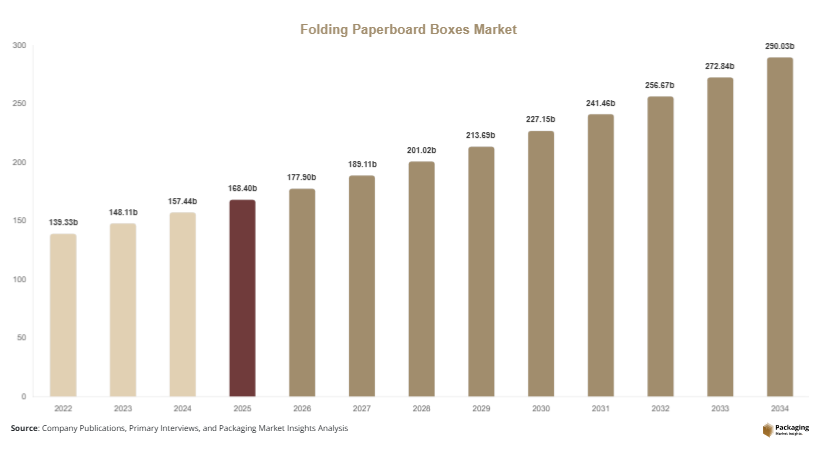
The global folding paperboard boxes market size was valued at USD 168.4 billion in 2025 and is estimated to reach USD 177.9 billion in 2026, reflecting steady momentum across food, beverage, healthcare, and personal care packaging. The market is projected to grow to USD 289.6 billion by 2034, registering a CAGR of 6.3% during 2025–2034, reflecting sustainable packaging adoption and rising consumer preference for recyclable packaging formats.
Folding paperboard boxes, made from solid bleached sulfate, coated recycled board, and folding boxboard, ship flat and assemble on demand, reducing warehousing costs. Growth is driven by tightening plastic packaging regulations, expanding organized retail and quick-service restaurant demand for brand-differentiating cartons, and advancements in digital printing that let cartons match the shelf appeal once reserved for plastic packaging. Corporate sustainability pledges also support demand as brand owners commit to recyclable packaging.
Key Highlights:
- North America dominated the folding paperboard boxes market with the largest share of 34.62% in 2025.
- Asia Pacific is expected to be the fastest-growing region in the folding paperboard boxes market during the forecast period at a CAGR of 8.14%.
- Based on material type, the solid bleached sulfate (SBS) segment dominated the folding paperboard boxes market with a share of 38.27% in 2025.
- Based on end-use, the food and beverage segment dominated the market with a share of 41.53% in 2025.
- Based on printing technology, offset printing dominated the market with a share of 46.28% in 2025.
- Based on box style, tuck-end cartons dominated the market with 35.71% share in 2025.
- The US folding paperboard boxes market size was valued at USD 44.8 billion in 2025 and is projected to reach USD 47.2 billion in 2026.
Explore more data points, trends and opportunities Download Free Sample Report
Market Trends
Rise of Sustainable and Recyclable Packaging Formats
A defining trend shaping the folding paperboard boxes market is the accelerating shift toward recyclable, biodegradable, and plastic-free packaging. Brand owners across food, cosmetics, and pharmaceutical sectors are replacing plastic clamshells and blister packs with folding cartons carrying recyclability certifications and forest-stewardship labeling. This trend is reinforced by extended producer responsibility (EPR) regulations adopted across several European and Asian markets, which impose financial obligations on companies using non-recyclable packaging. Converters are investing in water-based coatings and mono-material board structures that preserve recyclability while delivering moisture and grease resistance for food contact applications.
Integration of Smart and Digitally Printed Packaging
Another prominent trend is the growing integration of digital printing, QR codes, and augmented reality features into folding carton design. Brand owners are leveraging short-run digital printing to enable personalized packaging, seasonal promotions, and rapid SKU proliferation without incurring the setup costs associated with traditional flexographic or gravure printing. This shift toward digitally enabled packaging is also supporting anti-counterfeiting initiatives in the pharmaceutical and premium spirits categories, where traceability codes printed directly on folding cartons allow consumers and regulators to verify product authenticity, thereby strengthening supply chain transparency across the value chain.
Market Drivers
Expansion of E-Commerce and Organized Retail Channels
The rapid growth of online retail and organized brick-and-mortar chains is a significant driver for the folding paperboard boxes market. E-commerce platforms rely on folding cartons for secondary and tertiary packaging because these boxes are lightweight, stackable, and customizable with branding elements that enhance the unboxing experience. Organized retail formats such as hypermarkets and specialty stores demand visually appealing, shelf-ready packaging that folding cartons deliver cost-effectively. As online sales penetration climbs across developing economies, converters are scaling production capacity to meet this sustained demand, cementing folding paperboard boxes as a preferred packaging format.
Regulatory Push Toward Plastic Reduction
Government policies restricting single-use plastics are a critical driver accelerating adoption of folding paperboard boxes across multiple end-use industries. Numerous countries have implemented bans or levies on plastic packaging for food service, cosmetics, and retail applications, prompting manufacturers to reformulate packaging strategies around fiber-based substrates. This regulatory environment is particularly influential in the European Union, where packaging waste directives mandate minimum recycled content and recyclability thresholds. Brand owners are proactively transitioning toward folding cartons well ahead of compliance deadlines, creating durable, policy-driven demand that consistently supports long-term market growth, resilience, and continued innovation.
Market Restraint
Despite favorable growth prospects, the folding paperboard boxes market faces a notable restraint in the form of raw material price volatility and constrained pulp supply. Paperboard production is highly dependent on virgin and recycled fiber inputs, and prices for these raw materials fluctuate significantly due to seasonal pulp availability, energy costs associated with paper mills, and competing demand from other paper-based industries such as tissue and printing paper. During periods of tight pulp supply, converters often face squeezed margins because contractual pricing with brand owners does not always allow for immediate cost pass-through. For example, mill capacity closures or unplanned maintenance shutdowns in key pulp-producing regions such as North America and Scandinavia can trigger short-term price spikes that ripple through the folding carton supply chain, delaying order fulfillment and increasing lead times for converters serving time-sensitive sectors like food service and pharmaceuticals. Rising energy and logistics costs in several regions have compounded input cost pressures, making it difficult for small and mid-sized converters to maintain competitive pricing against larger, vertically integrated manufacturers. This ongoing volatility can discourage smaller brand owners from transitioning away from cheaper plastic alternatives entirely, moderating the overall pace of substitution despite favorable regulatory momentum.
Market Opportunities
Growth Potential in Pharmaceutical and Nutraceutical Packaging
The expanding pharmaceutical and nutraceutical sectors present a substantial opportunity for folding paperboard box manufacturers. As global healthcare spending rises and over-the-counter medication consumption increases, demand for tamper-evident, child-resistant, and serialization-compatible folding cartons is growing steadily. Converters that invest in specialized coatings, tamper-proof closures, and compliance with pharmaceutical packaging standards can capture premium pricing in this segment. Furthermore, the increasing popularity of nutraceutical and dietary supplement products, particularly in North America and Asia Pacific, is generating incremental demand for folding cartons that combine regulatory compliance with strong shelf presence and brand differentiation.
Emerging Markets and Rising Middle-Class Consumption
Emerging economies across Asia Pacific, Latin America, and the Middle East present considerable growth opportunities as rising disposable incomes fuel increased consumption of packaged food, personal care, and consumer electronics products. As modern retail infrastructure expands in these regions, local converters and multinational packaging companies have the opportunity to establish manufacturing footprints closer to demand centers, reducing logistics costs and improving responsiveness to regional brand owners. Strategic investments in local production capacity can position both regional and multinational manufacturers to capture a larger, more durable share of this expanding demand base over time.
Report Scope
| Report Metric | Details |
|---|---|
| Market Size in 2025 | USD 168.4 billion |
| Market Size in 2026 | USD 177.9 billion |
| Market Size in 2034 | USD 289.6 billion |
| CAGR | 6.3% (2026-2034) |
| Base Year for Estimation | 2025 |
| Historical Data | 2022-2024 |
| Forecast Period | 2026-2034 |
| Report Coverage | Revenue Forecast, Competitive Landscape, Supply Chain Disruption, Growth Factors, Environment & Regulatory Landscape and Trends |
| Geographies Covered | North America, Europe, APAC, Middle East and Africa, LATAM |
| Countries Covered | U.S., Canada, U.K., Germany, France, Spain, Italy, Russia, Nordic, Benelux, Rest of Europe, China, South Korea, Japan, India, Australia, Singapore, Taiwan, South East Asia, Rest of Asia-Pacific, UAE, Turky, Saudi Arabia, South Africa, Egypt, Nigeria, Rest of MEA, Brazil, Mexico, Argentina, Chile, Colombia, Rest of LATAM |
Explore more data points, trends and opportunities Download Free Sample Report
Segmental Analysis
By Material Type
The solid bleached sulfate (SBS) segment dominated the folding paperboard boxes market with a share of 38.27% in 2025, owing to its superior brightness, printability, and suitability for premium food, cosmetics, and pharmaceutical packaging applications. SBS board is manufactured from virgin fiber, giving it a clean, bright surface that supports high-quality graphics and branding, which remains a critical purchasing criterion for consumer-facing packaging. Brand owners in categories such as premium confectionery, cosmetics, and over-the-counter pharmaceuticals continue to favor SBS board because it meets stringent food-contact safety standards while delivering the visual appeal necessary to differentiate products on crowded retail shelves. The segment's dominance is further reinforced by its compatibility with advanced coating technologies that enhance moisture and grease resistance without compromising recyclability, a combination that continues to make SBS the preferred substrate for brand owners prioritizing shelf impact alongside sustainability credentials.
The coated recycled board (CRB) segment is projected to be the fastest-growing material type through 2034, registering a notably higher CAGR compared to the overall market average. This growth is primarily driven by increasing brand owner preference for post-consumer recycled content as sustainability commitments intensify across the consumer packaged goods industry. CRB offers a cost-effective alternative to virgin fiber board while still supporting acceptable print quality for secondary packaging and non-food applications. As recycling infrastructure improves in emerging markets and technological advancements narrow the performance gap between recycled and virgin board, converters are increasingly incorporating CRB into their product portfolios to meet both cost and sustainability targets set by major brand owners.
By End-Use
The food and beverage segment dominated the folding paperboard boxes market with a share of 41.53% in 2025, reflecting the sheer scale and diversity of applications within this industry, ranging from cereal and snack cartons to frozen food packaging and beverage carriers. This segment's leadership position is supported by consistent demand growth in packaged and convenience food consumption worldwide, alongside the food industry's early and widespread adoption of paperboard as a sustainable packaging alternative. Additionally, folding cartons offer food and beverage brand owners an efficient platform for regulatory labeling, nutritional information, and promotional messaging, all of which are essential for compliance and consumer engagement in this highly regulated and competitive industry.
The healthcare and pharmaceutical segment is expected to register the fastest CAGR among end-use categories during the forecast period, driven by rising global healthcare expenditure and increasing demand for compliant, tamper-evident medication packaging. Growth in this segment is further supported by the expanding over-the-counter and nutraceutical product categories, which require folding cartons capable of accommodating serialization codes, patient information leaflets, and child-resistant features. As pharmaceutical companies increasingly outsource packaging operations to specialized converters capable of meeting Good Manufacturing Practice standards, this segment is expected to attract sustained investment and premium pricing opportunities throughout the coming decade, while also encouraging converters to pursue certifications that qualify them for long-term supply agreements with multinational pharmaceutical manufacturers.
By Box Style
Tuck-end cartons dominated the folding paperboard boxes market by box style with a share of 35.71% in 2025, favored for their simplicity, cost efficiency, and versatility across food, personal care, and general merchandise packaging applications. These cartons require minimal adhesive or mechanical closure, allowing for faster assembly on automated packaging lines while maintaining adequate product protection during storage and transit. Their widespread compatibility with standard carton erecting and filling equipment has made tuck-end designs the default choice for many mid-volume consumer product manufacturers seeking to balance cost control with reliable packaging performance across diverse retail environments.
The auto-bottom carton segment is anticipated to grow at the fastest rate through 2034, supported by increasing automation in packaging lines across food service and e-commerce fulfillment operations. Auto-bottom cartons, which self-erect into a stable base without manual folding, are gaining preference among high-volume operations such as bakery chains, meal-kit delivery services, and retail fulfillment centers where speed and consistency of assembly directly affect operational efficiency and labor costs. As wage inflation persists and automation investment accelerates across packaging facilities globally, demand for auto-bottom carton formats is expected to outpace other box styles, reflecting a broader industry shift toward equipment-compatible, high-throughput packaging designs that support just-in-time fulfillment models increasingly favored by omnichannel retailers.
Folding Paperboard Boxes Market Segmentations
Material Type
- Solid Bleached Sulfate (SBS)
- Solid Unbleached Sulfate (SUS)
- Coated Recycled Board (CRB)
- Folding Boxboard (FBB)
Box Style
- Tuck-End Cartons
- Auto-Bottom Cartons
- Sleeve Cartons
- Gable-Top Cartons
- Others
Printing Technology
- Offset Printing
- Flexographic Printing
- Gravure Printing
- Digital Printing
End-Use
- Food and Beverage
- Healthcare and Pharmaceutical
- Personal Care and Cosmetics
- Consumer Electronics
- Tobacco
- Others
Region
- North America
- Europe
- Asia Pacific
- Middle East & Africa
- Latin America
Regional Analysis
North America
North America accounted for the largest share of the folding paperboard boxes market at 34.62% in 2025 and is projected to expand at a steady CAGR through 2034, supported by mature food and beverage, healthcare, and personal care industries. The region benefits from well-established converting infrastructure, strong recycling collection networks, and early adoption of sustainable packaging mandates, positioning it as a consistent, reliable revenue contributor throughout the entire forecast period.
The United States dominates the North American folding paperboard boxes market, driven primarily by the widespread transition of quick-service restaurant chains toward paper-based food packaging. This shift has been reinforced by state-level plastic foodware restrictions across several US states, which have prompted major restaurant chains to standardize folding carton packaging for takeout and delivery formats. Canada also contributes meaningfully to regional demand, supported by its expanding packaged food processing sector and growing retailer commitments to fiber-based packaging alternatives.
Europe
Europe held a significant share of the folding paperboard boxes market in 2025 and is expected to register moderate but stable growth through 2034, underpinned by stringent packaging waste regulations and high consumer environmental awareness across both Western and Eastern European member states. The region's well-developed forestry and pulp industries provide a reliable raw material base, supporting consistent converter output across established manufacturing hubs while limiting exposure to imported fiber price volatility.
Germany leads the European folding paperboard boxes market, supported by its position as a major hub for cosmetics, pharmaceutical, and premium food packaging manufacturing. The country's strong emphasis on circular economy principles and extended producer responsibility compliance has encouraged German converters to pioneer recyclable mono-material carton designs that are now being adopted across neighboring markets, including France, Italy, and the Benelux region, reinforcing Germany's role as a regional packaging innovation center.
Asia Pacific
Asia Pacific is projected to be the fastest-growing region in the folding paperboard boxes market, registering a CAGR of 8.14% between 2025 and 2034, driven by rapid urbanization, expanding organized retail, and rising packaged food consumption across populous economies. The region's growing manufacturing base and cost-competitive labor further support converter capacity expansion to meet both domestic and export demand, while improving logistics infrastructure reduces distribution costs for regional brand owners.
China dominates the Asia Pacific folding paperboard boxes market, supported by its position as the largest global manufacturing base for consumer electronics and food packaging exports. The country's aggressive investment in modern paper mill capacity and government-led initiatives to curb plastic waste have accelerated domestic adoption of folding cartons across retail and food service channels. India and Southeast Asian markets are also emerging as important growth contributors, supported by expanding urban middle-class populations.
Middle East & Africa
The Middle East & Africa folding paperboard boxes market held a comparatively smaller share in 2025 but is expected to witness gradual growth through 2034, supported by expanding retail infrastructure and increasing foreign direct investment in regional manufacturing capacity. Growth in this region remains closely tied to broader economic diversification efforts away from oil-dependent industries and toward consumer goods manufacturing.
The United Arab Emirates leads the Middle East & Africa folding paperboard boxes market, benefiting from its role as a regional logistics and trade hub connecting Europe, Asia, and Africa. The country's growing food processing and pharmaceutical sectors, combined with government initiatives promoting sustainable packaging in retail environments, continue to support incremental demand, while South Africa remains an important contributor within the broader African market.
Latin America
Latin America represented a modest share of the folding paperboard boxes market in 2025, with growth expected to remain steady through 2034 as regional economies stabilize and consumer packaged goods sectors expand across major national markets. The region's packaging industry continues to benefit from proximity to abundant forestry resources, which supports domestic paperboard production and reduces dependence on imported raw materials.
Brazil dominates the Latin American folding paperboard boxes market, supported by its large and growing food and beverage processing industry. The country's expanding middle-class population and increasing penetration of organized retail chains have driven consistent demand for branded folding carton packaging across both domestic consumption and regional export markets, while Mexico continues to strengthen its position as a key secondary growth market.
Competitive Landscape
The folding paperboard boxes market features a moderately consolidated competitive landscape, with several vertically integrated packaging companies controlling substantial paperboard production and converting capacity alongside a large base of regional and specialty converters. Leading companies compete primarily on the basis of production scale, sustainability credentials, printing capabilities, and geographic reach, with many pursuing capacity expansions and mergers to strengthen their positions across key end-use industries. International Paper Company holds a leading position in the global folding paperboard boxes market, supported by its extensive mill network and recent investments in expanding recycled paperboard capacity to meet growing brand owner demand for sustainable packaging materials. Other prominent participants continue to invest in digital printing technology, lightweighting innovations, and regional manufacturing footprint expansion to strengthen customer relationships and capture incremental market share across food, healthcare, and retail packaging segments worldwide, while pursuing sustainability certifications that appeal to environmentally conscious brand owners.
Key Players
- International Paper Company
- WestRock Company
- Smurfit Kappa Group
- Mondi Group
- Stora Enso Oyj
- Graphic Packaging International
- DS Smith Plc
- Huhtamaki Oyj
- Amcor Plc
- Tetra Pak International S.A.
- Sonoco Products Company
- Georgia-Pacific LLC
- Metsä Board Corporation
- Oji Holdings Corporation
- Nippon Paper Industries Co., Ltd.
- Emerald Packaging Solutions
- Clearwater Paper Corporation