Corrugated Fiberboard Market Size
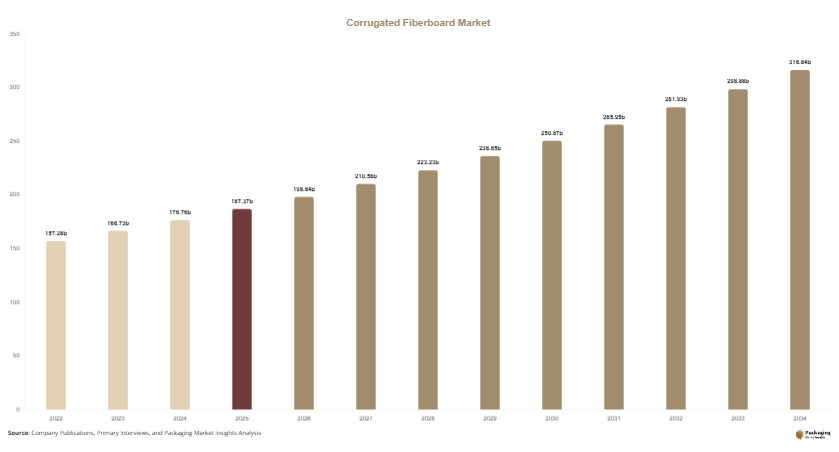
Corrugated Fiberboard market size is projected at USD 198.64 billion in 2026 and is expected to hit USD 316.82 billion by 2034 with a CAGR of 6.01%. The report delivers comprehensive quantitative analysis covering production capacity, consumption trends, pricing dynamics, supply chain performance, raw material availability, and competitive benchmarking. It further evaluates end-user demand, regional opportunities, technological advancements, and manufacturer strategies to provide a detailed competitive landscape.
The Corrugated Fiberboard Market comprises paper-based corrugated sheets and boxes manufactured using kraft linerboard and fluting medium for transportation, storage, and retail packaging. Global production exceeded 198 million metric tons in 2025, while food & beverage packaging represented nearly 38% of total demand, e-commerce & retail accounted for 34%, and industrial packaging contributed approximately 28%. Single wall products held around 61% of total production, followed by double wall at 29% and triple wall at 10%. Growing demand for recyclable transport packaging continues supporting the Corrugated Fiberboard Market.
Explore more data points, trends and opportunities Download Free Sample Report
Corrugated Fiberboard Market Trends
Rapid Expansion of Sustainable and E-commerce Packaging
The rapid expansion of e-commerce and sustainable packaging initiatives continues driving corrugated fiberboard consumption worldwide. Annual production surpassed 201 million metric tons, while more than 74% of online retailers adopted corrugated packaging as their primary shipping solution. Digital converting systems have improved manufacturing efficiency by nearly 19%, while automated box production lines increased output by approximately 22%, reinforcing the Corrugated Fiberboard Market.
Packaging manufacturers are investing heavily in lightweight yet high-strength corrugated structures. More than 69% of consumer goods companies now prioritize recyclable corrugated packaging, while recycled fiber utilization exceeds 53% across major manufacturing facilities. Investments exceeding USD 8.5 billion in advanced corrugation and digital printing technologies continue improving product performance and supporting the Corrugated Fiberboard Market.
Corrugated Fiberboard Market Drivers
Growing Demand from E-commerce and Food Packaging
The continued expansion of online retail and packaged food distribution is significantly increasing corrugated packaging consumption. E-commerce packaging demand exceeded 68 billion boxes globally in 2025, while packaged food shipments increased by approximately 8.6% year-over-year. Nearly 79% of logistics companies rely on corrugated fiberboard for product protection and transportation efficiency, accelerating investments across the Corrugated Fiberboard Market.
Corrugated Fiberboard Market Restraints
Volatility in Recycled Fiber and Kraft Paper Prices
Fluctuating prices of recycled paper and virgin kraft pulp continue affecting production costs. Recycled fiber prices experienced annual fluctuations of nearly 12%, while energy costs increased by approximately 10% across major manufacturing regions. Transportation expenses account for nearly 15% of total packaging costs, creating pricing pressure for manufacturers operating within the Corrugated Fiberboard Market.
Corrugated Fiberboard Market Opportunities
Increasing Adoption of Circular Economy Packaging
Governments and manufacturers are expanding investments in recyclable and renewable packaging materials. More than 65% of packaging producers have adopted circular economy initiatives, while recycled fiber utilization continues increasing by 7% annually. Production of eco-friendly corrugated packaging is expected to exceed 230 million metric tons before 2030, creating substantial opportunities for the Corrugated Fiberboard Market.
Challenges in Corrugated Fiberboard Market
Managing Supply Chain and Capacity Constraints
Manufacturers face challenges associated with pulp availability, transportation bottlenecks, and rising operational expenses. More than 58% of producers reported supply chain disruptions affecting delivery schedules, while maintaining board strength above 32 ECT standards increases production complexity. Capacity expansion and sustainable sourcing remain significant challenges across the Corrugated Fiberboard Market.
Report Scope
| Report Metric | Details |
|---|---|
| Market Size in 2025 | USD 187.37 billion |
| Market Size in 2026 | USD 198.64 billion |
| Market Size in 2034 | USD 316.82 billion |
| CAGR | 6.01% (2026-2034) |
| Base Year for Estimation | 2025 |
| Historical Data | 2022-2024 |
| Forecast Period | 2026-2034 |
| Report Coverage | Revenue Forecast, Competitive Landscape, Supply Chain Disruption, Growth Factors, Environment & Regulatory Landscape and Trends |
| Geographies Covered | North America, Europe, APAC, Middle East and Africa, LATAM |
| Countries Covered | U.S., Canada, U.K., Germany, France, Spain, Italy, Russia, Nordic, Benelux, Rest of Europe, China, South Korea, Japan, India, Australia, Singapore, Taiwan, South East Asia, Rest of Asia-Pacific, UAE, Turky, Saudi Arabia, South Africa, Egypt, Nigeria, Rest of MEA, Brazil, Mexico, Argentina, Chile, Colombia, Rest of LATAM |
Explore more data points, trends and opportunities Download Free Sample Report
Corrugated Fiberboard Market Segmentation
The market is segmented by type and application, with food & beverage packaging accounting for approximately 38% of global revenue and single wall corrugated fiberboard representing nearly 61% of worldwide production. Continuous innovation in lightweight packaging and recyclable materials supports increasing market penetration.
By Type
Single Wall Corrugated Fiberboard
Single wall corrugated fiberboard dominates with approximately 61% market share and annual production exceeding 121 million metric tons. It provides excellent stacking strength, lightweight construction, and cost-effective transportation, making it suitable for consumer goods and retail packaging.
Double Wall Corrugated Fiberboard
Double wall products account for nearly 29% of total demand with production exceeding 57 million metric tons annually. Enhanced compression strength, improved durability, and greater puncture resistance make these products suitable for heavy-duty industrial and export packaging.
Triple Wall Corrugated Fiberboard
Triple wall corrugated fiberboard contributes approximately 10% of global demand. Annual production exceeds 20 million metric tons, providing superior structural integrity and replacing wooden crates for heavy machinery, automotive parts, and bulk industrial shipments.
By Application
Food & Beverage Packaging
Food & beverage packaging accounts for approximately 38% of market demand. More than 75 million metric tons are utilized annually for packaged foods, beverages, fresh produce, and frozen products. High recyclability and food-safe performance continue supporting adoption.
E-commerce & Retail Packaging
E-commerce & retail packaging represents nearly 34% of global consumption. Annual usage exceeds 67 million metric tons, driven by rising parcel shipments, omnichannel retail expansion, and customized shipping box demand requiring lightweight yet durable packaging.
Industrial Packaging
Industrial packaging contributes approximately 28% of total demand. More than 56 million metric tons are consumed annually for automotive components, electronics, machinery, chemicals, and export logistics requiring high-strength protective packaging.
Corrugated Fiberboard Market Segmentations
Type
- Single Wall Corrugated Fiberboard
- Double Wall Corrugated Fiberboard
- Triple Wall Corrugated Fiberboard
Application
- Food & Beverage Packaging
- E-commerce & Retail Packaging
- Industrial Packaging
Corrugated Fiberboard Regional Outlook
North America
North America accounts for approximately 31% of global demand. The United States contributes nearly 83% of regional consumption, supported by large-scale food processing and e-commerce industries. Regional production exceeds 61 million metric tons annually.
Europe
Europe represents approximately 28% of the global market. Germany, France, Italy, Spain, and the United Kingdom collectively account for over 73% of regional production. Recycled fiber utilization exceeds 68%, supporting sustainable packaging initiatives.
Asia-Pacific
Asia-Pacific holds approximately 34% of worldwide demand and remains the largest manufacturing hub. China contributes nearly 49% of regional production, followed by India at 18%, Japan at 13%, and South Korea at 7%. Annual production exceeds 67 million metric tons.
Latin America
Latin America contributes approximately 5% of global consumption. Brazil accounts for nearly 41% of regional demand, while Mexico contributes approximately 29%, driven by expanding manufacturing and food processing industries.
Middle East & Africa
The Middle East & Africa account for approximately 2% of global demand. Investments in logistics infrastructure, industrial manufacturing, and food distribution continue increasing corrugated packaging consumption across the region.
Top players in Corrugated Fiberboard Market
- International Paper Company
- Smurfit Westrock
- Mondi plc
- DS Smith Plc
- Packaging Corporation of America
- Georgia-Pacific LLC
- Pratt Industries, Inc.
- Nine Dragons Paper Holdings Limited
- Oji Holdings Corporation
- Nippon Paper Industries Co., Ltd.
- Stora Enso Oyj
- Rengo Co., Ltd.
International Paper Company
-
Holds an estimated 14–16% global market share.
-
Operates one of the world's largest corrugated packaging manufacturing networks.
-
Strong presence across food packaging, industrial packaging, and e-commerce applications.
-
The company continues investing in sustainable fiber sourcing, automation, lightweight corrugated board technologies, and digital converting equipment. Its vertically integrated pulp and paper operations strengthen supply chain efficiency while supporting large-scale production and customized packaging solutions for global customers.
Smurfit Westrock
-
Accounts for approximately 12–14% of the global market.
-
Maintains a leading position across Europe and the Americas.
-
Extensive manufacturing network supports high-volume corrugated packaging production.
-
The company focuses on recyclable packaging innovation, circular economy initiatives, digital printing, and advanced corrugation technologies. Continuous investments in capacity expansion and sustainable packaging solutions enhance its competitive position across food, retail, industrial, and e-commerce packaging markets.