Floor Displays Market Size
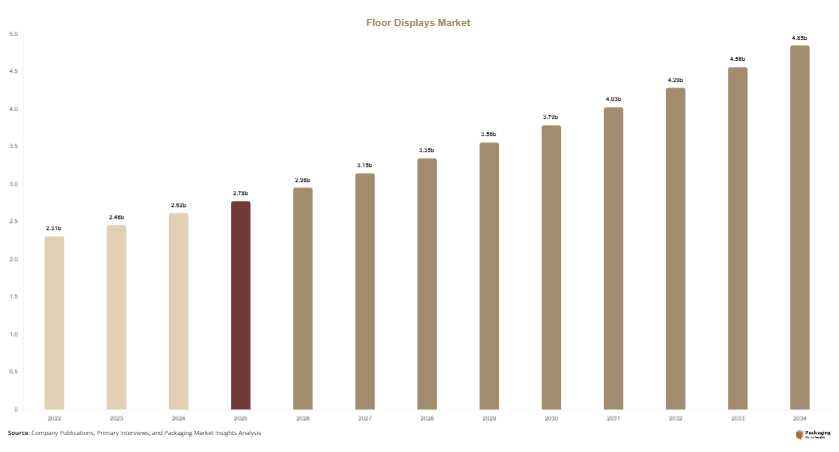
Floor Displays market size is projected at USD 2.96 billion in 2026 and is expected to hit USD 4.85 billion by 2034 with a CAGR of 6.38%.
The market expansion is supported by increasing investments in point-of-purchase merchandising, retail branding strategies, and product visibility solutions across organized retail networks. The report evaluates detailed segmentation by type and application while providing competitive landscape analysis, regional performance, technological developments, production capacity, and strategic initiatives influencing the global market.
The Floor Displays market consists of free-standing merchandising structures designed to improve product visibility, increase impulse purchases, and optimize retail floor space across supermarkets, convenience stores, specialty retailers, and promotional campaigns. Global production exceeded 188 million display units in 2025, with corrugated displays accounting for nearly 58% of total manufacturing volume, while permanent displays represented approximately 31% of installed retail assets. Organized retail penetration surpassed 64% across developed economies, creating stronger demand for customized display systems. Rising investments in sustainable materials, digital printing, and modular merchandising continue to strengthen the Floor Displays market.
Explore more data points, trends and opportunities Download Free Sample Report
Floor Displays Market Trends
Increasing Adoption of Sustainable and Digitally Printed Displays
Retailers are rapidly replacing conventional merchandising fixtures with recyclable corrugated and digitally printed floor displays. More than 72 million recyclable display units were produced during 2025, representing nearly 38% of worldwide production. Digital printing adoption exceeded 61% among premium retail brands, reducing lead times by approximately 28% while improving campaign customization. Growing sustainability initiatives continue to influence the Floor Displays market.
Manufacturers are integrating lightweight materials, modular assembly systems, and QR-enabled promotional features into floor displays. Nearly 46% of newly launched display solutions now incorporate smart branding elements, while customized retail campaigns increased by 34% year-over-year. Demand from food, beverages, cosmetics, and consumer electronics continues to expand production volumes, reinforcing the Floor Displays market.
Floor Displays Drivers
Growing Retail Expansion and In-Store Marketing Investments
The rapid expansion of supermarkets, convenience stores, and organized retail chains is significantly increasing demand for floor display solutions. Retail promotional spending increased by approximately 8.6% during 2025, while impulse purchases generated through point-of-sale displays contributed nearly 20% of retail promotional sales. Annual production capacity exceeded 190 million units, supported by investments exceeding USD 430 million in automated display manufacturing. Continuous retail modernization supports long-term expansion of the Floor Displays market.
Floor Displays Restraints
Fluctuating Raw Material Prices and Short Product Lifecycles
Volatility in paperboard, plastics, and metal prices continues to pressure manufacturing costs. Corrugated board prices fluctuated by nearly 11%, while steel component costs increased by 9% during recent procurement cycles. Temporary promotional displays typically remain in stores for only 30–90 days, increasing replacement frequency and logistics expenses. These factors create cost pressures across the Floor Displays market.
Floor Displays Opportunities
Growth in Omnichannel Retail and Sustainable Display Manufacturing
Retailers increasingly require flexible merchandising systems supporting seasonal promotions and omnichannel campaigns. Sustainable display demand expanded by nearly 15% annually, while recyclable material utilization exceeded 68% across newly manufactured displays. Investments in automated digital printing and modular display production continue to improve manufacturing efficiency by approximately 22%, creating attractive opportunities within the Floor Displays market.
Challenges in Floor Displays Market
Balancing Customization with Production Efficiency
Retail customers increasingly demand personalized display formats with shorter delivery schedules. More than 48% of orders require customized dimensions, branding, or structural modifications, reducing economies of scale. Manufacturers must simultaneously maintain production utilization above 80% while minimizing material waste below 5%, creating operational challenges throughout the Floor Displays market.
Report Scope
| Report Metric | Details |
|---|---|
| Market Size in 2025 | USD 2.78 billion |
| Market Size in 2026 | USD 2.96 billion |
| Market Size in 2034 | USD 4.85 billion |
| CAGR | 6.38% (2026-2034) |
| Base Year for Estimation | 2025 |
| Historical Data | 2022-2024 |
| Forecast Period | 2026-2034 |
| Report Coverage | Revenue Forecast, Competitive Landscape, Supply Chain Disruption, Growth Factors, Environment & Regulatory Landscape and Trends |
| Geographies Covered | North America, Europe, APAC, Middle East and Africa, LATAM |
| Countries Covered | U.S., Canada, U.K., Germany, France, Spain, Italy, Russia, Nordic, Benelux, Rest of Europe, China, South Korea, Japan, India, Australia, Singapore, Taiwan, South East Asia, Rest of Asia-Pacific, UAE, Turky, Saudi Arabia, South Africa, Egypt, Nigeria, Rest of MEA, Brazil, Mexico, Argentina, Chile, Colombia, Rest of LATAM |
Explore more data points, trends and opportunities Download Free Sample Report
Floor Displays Market Segmentation
The market is segmented according to display type and application, with permanent floor displays accounting for nearly 42% of revenue, while retail store applications contribute approximately 47% of overall industry demand. Continuous innovation in materials and design improves merchandising efficiency across all segments.
By Type
Permanent Floor Displays
Permanent displays account for around 42% of total revenue with annual production exceeding 48 million units. These systems utilize metal, wood, and high-strength composite materials, offering service lives exceeding 5 years while supporting higher product loads and premium merchandising.
Semi-Permanent Floor Displays
Semi-permanent displays represent nearly 30% of the market. Manufacturers produced approximately 36 million units utilizing reinforced corrugated structures and hybrid materials suitable for promotional campaigns lasting 6–12 months while reducing logistics costs.
Temporary Floor Displays
Temporary displays contribute approximately 28% of demand, with production exceeding 104 million units annually. Lightweight corrugated construction, digital printing compatibility, and easy assembly make them ideal for seasonal campaigns, new product launches, and promotional events.
By Application
Retail Stores
Retail stores represent approximately 47% of market demand, deploying over 82 million display units annually. Product visibility improvements increase impulse purchasing rates by nearly 18%, making floor displays essential merchandising tools.
Supermarkets & Hypermarkets
This segment accounts for nearly 35% of industry demand with more than 65 million units installed each year. Large-format stores utilize floor displays extensively for FMCG, beverages, snacks, and household products, supporting high promotional turnover.
Specialty Stores
Specialty retailers contribute roughly 18% of demand while emphasizing premium branding, customized graphics, and modular construction. Production for this segment exceeded 28 million units, particularly across cosmetics, electronics, and lifestyle products.
Floor Displays Market Segmentations
Type
- Permanent Floor Displays
- Semi-Permanent Floor Displays
- Temporary Floor Displays
Application
- Retail Stores
- Supermarkets & Hypermarkets
- Specialty Stores
Floor Displays Regional Outlook
North America
North America accounts for approximately 34% of global revenue. The United States contributes nearly 82% of regional demand, supported by advanced retail infrastructure and annual production exceeding 54 million display units. Canada continues expanding retail modernization, strengthening regional manufacturing.
Europe
Europe represents around 28% of global demand. Germany, the United Kingdom, France, and Italy collectively account for over 71% of regional consumption. Sustainable display adoption surpassed 63%, supported by strict environmental regulations and expanding recyclable packaging initiatives.
Asia-Pacific
Asia-Pacific contributes nearly 30% of worldwide revenue and records the fastest manufacturing expansion. China produces over 58 million units annually, while India, Japan, South Korea, and Southeast Asia continue increasing organized retail penetration above 11% annually, supporting higher display installations.
Latin America
Latin America accounts for approximately 5% of global demand. Brazil and Mexico generate more than 68% of regional sales, supported by expanding supermarket networks and rising investments in branded merchandising solutions.
Middle East & Africa
The Middle East & Africa contributes nearly 3% of the market. Retail expansion in the UAE, Saudi Arabia, and South Africa continues increasing demand for promotional display systems across supermarkets, convenience stores, and specialty retail channels.
Top players in Floor Displays Market
- Smurfit Westrock
- DS Smith
- Georgia-Pacific LLC
- Menasha Packaging Company LLC
- Creative Displays Now
- Fencor Packaging Group
- International Paper
- Packaging Corporation of America
- Pratt Industries
- Felbro Displays
- Great Northern Corporation
- Marketing Alliance Group
- Mondi Group
- Sonoco Products Company
- HH Global
Smurfit Westrock
-
Holds an estimated 11% global market share.
-
Strong presence across North America and Europe.
-
Operates extensive corrugated packaging and retail display manufacturing facilities.
-
Invests heavily in sustainable materials, digital printing, and customized retail merchandising solutions while serving leading FMCG, beverage, and consumer goods companies through integrated supply chain capabilities.
DS Smith
-
Accounts for approximately 8% global market share.
-
Leading supplier of recyclable retail display systems.
-
Strong European manufacturing network with expanding international operations.
-
Focuses on circular economy principles, lightweight display engineering, and automated production technologies while supporting multinational retailers with innovative promotional merchandising solutions.