Market Overview
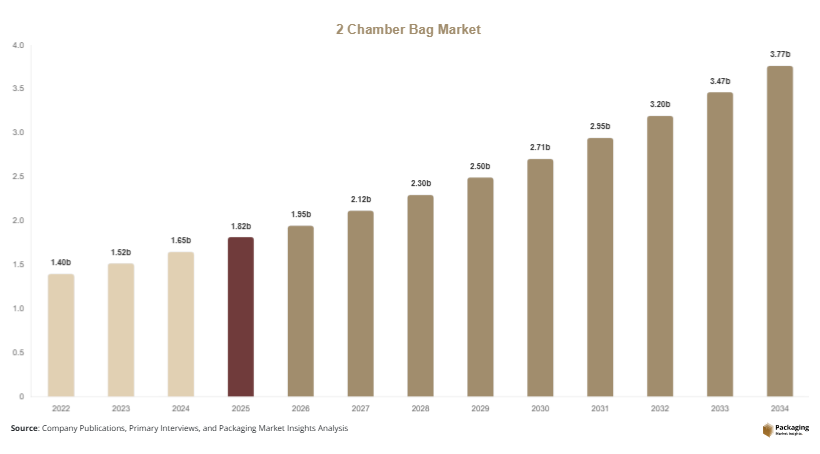
The global 2 Chamber Bag Market size was valued at USD 1.82 billion in 2025 and is estimated to reach USD 1.95 billion in 2026. The market is projected to reach USD 3.78 billion by 2034, expanding at a CAGR of 8.6% during the forecast period (2025–2034). Rising hospital admissions, increasing prevalence of chronic diseases requiring infusion therapy, and growing demand for ready-to-use pharmaceutical packaging solutions continue to support long-term market growth.
The 2 Chamber Bag Market is witnessing stable expansion as healthcare providers increasingly adopt advanced intravenous (IV) therapy systems that improve drug compatibility, patient safety, and clinical efficiency. Two-chamber bags are designed with separate compartments that allow medications and diluents to remain isolated until administration, reducing contamination risks and extending product shelf life. These products have become increasingly valuable for hospitals, specialty clinics, ambulatory surgical centers, and home healthcare providers that require convenient and sterile drug preparation solutions. Pharmaceutical manufacturers are also investing in innovative multilayer films and advanced sealing technologies that improve product reliability while meeting evolving regulatory standards.
Key Highlights:
- North America dominated the 2 Chamber Bag Market with the largest share of 38.41% in 2025.
- Asia Pacific is expected to be the fastest-growing regional market during the forecast period at a CAGR of 10.2%.
- Based on product type, the EVA bags segment dominated the market with a 52.84% share in 2025.
- Based on application, the Parenteral Nutrition segment accounted for the largest market share of 44.26% in 2025.
- Based on end use, Hospitals dominated the market with a 61.33% share in 2025.
- The U.S. 2 Chamber Bag Market was valued at USD 0.53 billion in 2025 and is projected to reach USD 0.57 billion in 2026.
Explore more data points, trends and opportunities Download Free Sample Report
Market Trends
Growing Adoption of Ready-to-Use Drug Delivery Systems
Healthcare providers are increasingly adopting ready-to-use infusion products that simplify medication preparation and improve workflow efficiency. Two-chamber bags eliminate multiple preparation steps by keeping components separated until administration, helping reduce medication errors and contamination risks. Hospitals also benefit from shorter preparation times and better inventory management. Pharmaceutical companies are introducing chamber bags compatible with a broader range of biologics, antibiotics, and nutritional formulations. As healthcare facilities continue emphasizing operational efficiency and patient safety, ready-to-use infusion packaging solutions are expected to become a preferred option across both inpatient and outpatient settings.
Development of Advanced Sustainable Packaging Materials
Manufacturers are investing in multilayer polymer films, PVC-free materials, and recyclable packaging technologies that improve durability while supporting sustainability goals. Modern chamber bags provide enhanced oxygen barriers, chemical resistance, and extended shelf stability without compromising flexibility. Regulatory agencies and healthcare organizations increasingly encourage environmentally responsible medical packaging, prompting suppliers to develop innovative materials with lower environmental impact. Continuous research into lightweight polymers and improved sterilization compatibility is enabling manufacturers to reduce production costs while maintaining high-quality performance, making advanced sustainable packaging an important industry trend.
Market Drivers
Rising Demand for Intravenous Therapies
The growing burden of chronic diseases, infectious disorders, and critical care treatments continues to increase demand for intravenous medications worldwide. Hospitals increasingly require packaging systems that ensure sterility, minimize preparation time, and reduce medication waste. Two-chamber bags provide convenient storage of drugs and diluents before administration, supporting safer infusion practices. The increasing number of surgeries, intensive care admissions, and oncology treatments further strengthens demand for these products. Healthcare providers continue adopting advanced infusion systems to improve clinical efficiency while maintaining consistent treatment quality across diverse patient populations.
Expansion of Hospital and Home Healthcare Services
Healthcare delivery models are shifting toward home-based infusion therapy and decentralized patient care. This transition increases demand for convenient pharmaceutical packaging solutions that require minimal preparation. Two-chamber bags improve ease of handling while reducing contamination risks during transportation and administration. Government investments in healthcare infrastructure, growing hospital construction activities, and expanding access to specialty treatments also contribute to market growth. Pharmaceutical manufacturers continue collaborating with healthcare providers to develop customized chamber bag solutions that meet evolving clinical and logistical requirements across multiple treatment environments.
Market Restraint
High Manufacturing Costs and Regulatory Compliance Requirements
Despite favorable market prospects, the production of two-chamber bags involves sophisticated manufacturing equipment, sterile filling technologies, and strict quality assurance processes that increase overall production costs. Manufacturers must comply with extensive regulatory standards governing medical packaging, pharmaceutical compatibility, and sterilization validation before commercialization. These requirements often extend product development timelines and require continuous investment in quality management systems. Smaller manufacturers may face challenges in meeting international certification standards, limiting market participation. In addition, fluctuations in polymer raw material prices and supply chain disruptions can affect profitability. For example, pharmaceutical companies introducing new biologic formulations frequently require customized chamber bag validation studies, increasing both development costs and regulatory complexity before product approval.
Market Opportunities
Growth of Personalized Medicine
Personalized medicine is expanding rapidly as healthcare providers increasingly tailor treatments according to individual patient characteristics. Two-chamber bags provide flexible packaging solutions that support customized drug formulations while maintaining component stability until administration. Pharmaceutical companies developing targeted therapies increasingly require packaging systems that preserve sensitive biologic ingredients. As precision medicine expands across oncology, rare diseases, and specialty therapeutics, demand for advanced chamber bag technologies is expected to increase steadily. Manufacturers investing in flexible production capabilities are well positioned to benefit from this long-term opportunity.
Expansion Across Emerging Healthcare Markets
Developing economies continue investing significantly in hospitals, pharmaceutical manufacturing, and healthcare accessibility. Countries throughout Asia, Latin America, and the Middle East are modernizing healthcare infrastructure while increasing adoption of advanced infusion technologies. Growing awareness regarding infection prevention and medication safety also supports greater utilization of two-chamber bag systems. International manufacturers are expanding production facilities and distribution networks to serve these high-growth markets. Strategic partnerships with regional pharmaceutical companies and healthcare providers offer additional opportunities for sustained revenue growth during the forecast period.
Report Scope
| Report Metric | Details |
|---|---|
| Market Size in 2025 | USD 1.82 billion |
| Market Size in 2026 | USD 1.95 billion |
| Market Size in 2034 | USD 3.78 billion |
| CAGR | 8.6% (2026-2034) |
| Base Year for Estimation | 2025 |
| Historical Data | 2022-2024 |
| Forecast Period | 2026-2034 |
| Report Coverage | Revenue Forecast, Competitive Landscape, Supply Chain Disruption, Growth Factors, Environment & Regulatory Landscape and Trends |
| Geographies Covered | North America, Europe, APAC, Middle East and Africa, LATAM |
| Countries Covered | U.S., Canada, U.K., Germany, France, Spain, Italy, Russia, Nordic, Benelux, Rest of Europe, China, South Korea, Japan, India, Australia, Singapore, Taiwan, South East Asia, Rest of Asia-Pacific, UAE, Turky, Saudi Arabia, South Africa, Egypt, Nigeria, Rest of MEA, Brazil, Mexico, Argentina, Chile, Colombia, Rest of LATAM |
Explore more data points, trends and opportunities Download Free Sample Report
Segmental Analysis
By Product Type
The EVA Bags segment dominated the market with a 52.84% share in 2024 due to superior flexibility, transparency, and compatibility with numerous pharmaceutical formulations. EVA materials provide excellent durability while minimizing interactions between packaging and drug components. Hospitals increasingly prefer EVA bags because they support safe storage, transportation, and administration of intravenous medications. Manufacturers continue investing in multilayer EVA technologies that improve oxygen barrier performance and extend shelf stability for sensitive formulations.
The Polypropylene Bags segment is projected to register the fastest CAGR of 9.8% through 2034. Growing demand for recyclable medical packaging and enhanced chemical resistance contributes to strong segment growth. Polypropylene materials offer improved heat resistance and compatibility with modern sterilization processes. Increasing sustainability initiatives across healthcare systems further encourage adoption of polypropylene chamber bags for pharmaceutical packaging applications.
By Application
The Parenteral Nutrition segment accounted for 44.26% of the market in 2024. Rising prevalence of gastrointestinal disorders, premature births, and critical care requirements supports demand for nutritional infusion products. Two-chamber bags enable safe storage of nutritional components while maintaining product stability until administration. Hospitals increasingly utilize these systems to reduce contamination risks and improve preparation efficiency. Continuous growth in intensive care services further supports segment expansion.
The Antibiotic Delivery segment is anticipated to record the highest CAGR of 9.5% during the forecast period. Increasing antimicrobial treatment programs, rising infectious disease cases, and expanding outpatient infusion services drive segment growth. Pharmaceutical companies continue developing ready-to-administer antibiotic formulations using chamber bag technology to improve treatment convenience and minimize medication preparation errors across healthcare facilities.
By End Use
The Hospitals segment held the largest 61.33% market share in 2024 owing to high patient admissions, increasing surgical procedures, and widespread intravenous therapy utilization. Hospitals prioritize sterile packaging systems that reduce preparation time while supporting efficient pharmacy operations. Continuous investments in healthcare infrastructure and patient safety initiatives further strengthen hospital demand for two-chamber bags. Growing adoption of biologic therapies also contributes to sustained segment leadership.
The Home Healthcare segment is expected to grow at the fastest CAGR of 10.4% during the forecast period. Rising preference for home-based infusion therapy, aging populations, and increasing chronic disease management outside hospitals create strong growth opportunities. Two-chamber bags simplify medication administration while reducing contamination risks for caregivers and patients. Advances in portable infusion devices and supportive reimbursement policies continue accelerating segment expansion.
2 Chamber Bag Market Segmentations
Product Type
- EVA Bags
- Polypropylene Bags
- PVC Bags
- Others
Application
- Parenteral Nutrition
- Antibiotic Delivery
- Chemotherapy
- Others
End Use
- Hospitals
- Ambulatory Surgical Centers
- Home Healthcare
- Specialty Clinics
Regional Analysis
North America
North America accounted for 38.41% of the global market in 2025 and is expected to expand at a CAGR of 8.1% through 2034. The region benefits from advanced healthcare infrastructure, high healthcare spending, and widespread adoption of ready-to-use pharmaceutical products. Hospitals increasingly invest in infusion systems that improve patient safety while reducing medication preparation time.
The United States remains the dominant country due to strong pharmaceutical manufacturing capabilities and continuous innovation in intravenous drug delivery systems. A major growth factor is increasing demand for biologic therapies requiring specialized sterile packaging solutions. Canada also contributes through expanding hospital modernization initiatives.
Europe
Europe represented 27.34% of the global market in 2025 and is projected to grow at a CAGR of 8.0%. Strong regulatory standards encourage adoption of high-quality pharmaceutical packaging, while healthcare providers increasingly prioritize medication safety and operational efficiency. The region continues investing in advanced hospital infrastructure and pharmaceutical innovation.
Germany dominates the regional market owing to its strong pharmaceutical manufacturing base and healthcare technology expertise. Growing demand for environmentally sustainable medical packaging serves as a unique growth factor supporting broader adoption of advanced chamber bag technologies across hospitals and pharmaceutical companies.
Asia Pacific
Asia Pacific accounted for 22.81% of global revenue in 2025 and is anticipated to register the fastest CAGR of 10.2% during the forecast period. Expanding healthcare infrastructure, rising healthcare expenditure, and increasing pharmaceutical production contribute significantly to regional market growth. Demand for intravenous therapies continues increasing across both public and private healthcare systems.
China leads the regional market due to rapid pharmaceutical manufacturing expansion and large patient populations requiring infusion therapies. Government investment in healthcare modernization and domestic pharmaceutical production represents a key growth factor driving sustained demand for advanced chamber bag packaging systems.
Middle East & Africa
The Middle East & Africa captured 6.07% of the global market in 2025 and is expected to grow at a CAGR of 8.4%. Rising healthcare investments, hospital construction projects, and increasing awareness regarding infection prevention continue supporting adoption of sterile pharmaceutical packaging products throughout the region.
Saudi Arabia dominates regional demand through ongoing healthcare transformation programs and expanding pharmaceutical manufacturing investments. Growing public healthcare spending and modernization of hospital facilities create favorable conditions for wider utilization of advanced intravenous packaging solutions.
Latin America
Latin America represented 5.37% of the market in 2025 and is forecast to grow at a CAGR of 8.7%. Increasing healthcare expenditure, expanding pharmaceutical production, and greater access to hospital services contribute to market development. Governments continue supporting modernization of healthcare delivery systems across major economies.
Brazil remains the leading country due to its expanding pharmaceutical sector and improving hospital infrastructure. A unique growth factor is increasing local production of intravenous medications, encouraging greater adoption of compatible chamber bag packaging technologies throughout the healthcare industry.
Competitive Landscape
The global 2 Chamber Bag Market remains moderately consolidated, with leading manufacturers focusing on product innovation, strategic partnerships, and expansion of sterile manufacturing capabilities. Companies continue investing in advanced polymer technologies, sustainable packaging materials, and pharmaceutical collaborations to strengthen their competitive positions. Product differentiation increasingly depends on drug compatibility, packaging performance, regulatory compliance, and manufacturing efficiency.
Baxter International Inc. remains the market leader due to its broad intravenous therapy portfolio and extensive global distribution network. The company recently expanded production capacity for advanced infusion packaging solutions to support increasing healthcare demand. Other leading companies continue pursuing acquisitions, regional expansion, and research initiatives to strengthen their market presence and diversify product offerings.
Key Players
- Baxter International Inc.
- B. Braun SE
- Fresenius Kabi AG
- Otsuka Pharmaceutical Factory Inc.
- ICU Medical Inc.
- Renolit SE
- Sippex IV Bag Technologies
- Technoflex
- Sealed Air Corporation
- West Pharmaceutical Services Inc.
- Nipro Corporation
- Amcor plc
- Wipak Group
- SSY Group Limited
- Kraton Corporation