Fiber Bale Packaging Market Size and Growth
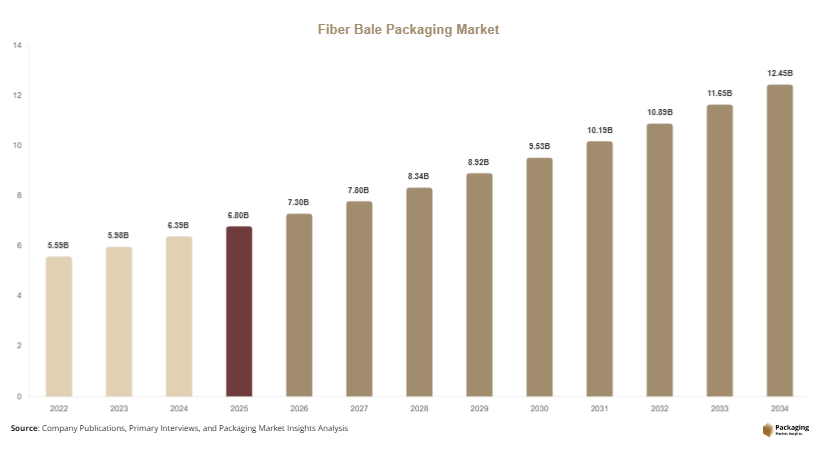
The global fiber bale packaging market size was valued at approximately USD 6.8 billion in 2025 and is projected to reach USD 7.3 billion in 2026. Over the forecast period, the market is expected to grow to nearly USD 12.6 billion by 2034, expanding at a CAGR of 6.9% from 2025 to 2034. The growth trajectory reflects the rising need for durable and cost-effective packaging solutions for compressed fiber materials such as cotton, wool, synthetic fibers, and recycled textiles. The fiber bale packaging market is experiencing steady growth due to increasing demand for efficient packaging solutions in industries such as textiles, agriculture, recycling, and industrial manufacturing.
One of the key growth factors is the expansion of the global textile industry, which relies heavily on bale packaging for storage and transportation of raw fibers. Fiber bale packaging provides efficient handling, reduces material loss, and ensures protection during long-distance shipping. Another important factor is the increasing emphasis on recycling and waste management. Recycled fibers are often compressed into bales for easier transport and processing, which drives demand for robust packaging solutions. Additionally, the growing agricultural sector, particularly in cotton-producing regions, is contributing to market growth by increasing the need for reliable bale packaging.
Key Highlights:
- Asia Pacific dominated the market with a 36.8% share in 2025, while Latin America is projected to grow at the fastest CAGR of 7.3%.
- Cotton fiber packaging led the type segment with a 42.5% share, while synthetic fiber packaging is expected to grow at a CAGR of 7.1%.
- Plastic-based wrapping dominated with a 51.7% share, while biodegradable materials are forecasted to grow at a CAGR of 6.8%.
- Textile industry applications led the segment with 46.2% share, while recycling applications are expected to grow at a CAGR of 7.4%.
- China remained the dominant country with a market size of USD 1.9 billion in 2025 and USD 2.1 billion in 2026.
Explore more data points, trends and opportunities Download Free Sample Report
Market Trends
Shift Toward Sustainable and Biodegradable Packaging Materials
The fiber bale packaging market is witnessing a gradual transition toward sustainable and biodegradable materials as environmental concerns gain importance. Traditional plastic-based wraps and straps are being replaced with eco-friendly alternatives such as biodegradable films and natural fiber-based bindings. This shift is driven by regulatory pressures and corporate sustainability goals aimed at reducing plastic waste. Manufacturers are investing in research to develop packaging solutions that maintain durability while minimizing environmental impact. This trend is particularly prominent in regions with strict environmental regulations, where companies are actively adopting green packaging solutions to meet compliance requirements and enhance brand reputation.
Increasing Automation in Bale Packaging Processes
Automation is becoming a key trend in the fiber bale packaging industry, improving efficiency and consistency in packaging operations. Advanced machinery is being used to compress, wrap, and secure fiber bales with minimal manual intervention. Automated systems help reduce labor costs, increase production speed, and ensure uniform packaging quality. This trend is especially relevant in large-scale textile and recycling facilities, where high volumes of fiber materials need to be processed quickly. The integration of smart technologies and monitoring systems further enhances operational efficiency, enabling real-time tracking and quality control. As industries continue to adopt automation, the demand for advanced packaging equipment is expected to rise.
Market Drivers
Expansion of the Textile and Apparel Industry
The growth of the global textile and apparel industry is a major factor driving the fiber bale packaging market. Increasing demand for clothing and textile products is leading to higher production of raw fibers such as cotton, wool, and synthetic materials. These fibers are typically compressed into bales for efficient storage and transportation, creating demand for reliable packaging solutions. Fiber bale packaging ensures that materials remain protected from moisture, contamination, and physical damage during transit. As textile production continues to expand, particularly in emerging economies, the demand for fiber bale packaging is expected to grow steadily.
Rising Focus on Recycling and Waste Management
The increasing emphasis on recycling and waste management is another significant driver for the market. Recycled fibers from textiles, paper, and plastics are often compressed into bales for easier handling and transportation. Fiber bale packaging solutions provide the necessary strength and durability to secure these materials during transit. Governments and organizations are promoting recycling initiatives to reduce environmental impact, which is driving demand for efficient packaging solutions. As recycling activities continue to increase globally, the need for fiber bale packaging is expected to rise, supporting market growth.
Market Restraint
Fluctuations in Raw Material Prices and Supply Chain Challenges
The fiber bale packaging market faces challenges related to fluctuations in raw material prices and supply chain disruptions. Materials such as plastics, metals, and natural fibers used in packaging are subject to price volatility due to changes in global supply and demand. These fluctuations can increase production costs and affect profit margins for manufacturers. Additionally, supply chain disruptions caused by geopolitical factors, transportation issues, or natural disasters can impact the availability of raw materials. For example, delays in the supply of plastic resins can lead to production slowdowns, affecting the overall market. These challenges can hinder market growth, particularly for small and medium-sized enterprises.
Market Opportunities
Growth in Emerging Economies and Agricultural Expansion
Emerging economies present significant opportunities for the fiber bale packaging market due to rapid industrialization and agricultural expansion. Countries in Asia, Africa, and Latin America are increasing production of crops such as cotton, which requires efficient packaging for transportation and storage. The growth of the textile industry in these regions further supports demand for fiber bale packaging. Additionally, government initiatives aimed at boosting agricultural productivity are creating new opportunities for packaging manufacturers. Companies that expand their presence in these markets can benefit from increasing demand and favorable economic conditions.
Advancements in Packaging Technology and Material Innovation
Technological advancements in packaging materials and equipment are creating new growth opportunities in the market. Innovations such as high-strength straps, moisture-resistant wraps, and smart packaging solutions are improving the performance and reliability of fiber bale packaging. These advancements help reduce material loss, enhance product protection, and improve operational efficiency. Additionally, the development of lightweight and recyclable materials is supporting sustainability initiatives. As manufacturers continue to invest in research and development, the adoption of advanced packaging solutions is expected to increase, driving market growth.
Report Scope
| Report Metric | Details |
|---|---|
| Market Size in 2025 | USD 6.8 Billion |
| Market Size in 2026 | USD 7.3 Billion |
| Market Size in 2034 | USD 12.6 Billion |
| CAGR | 6.9% (2026-2034) |
| Base Year for Estimation | 2025 |
| Historical Data | 2022-2024 |
| Forecast Period | 2026-2034 |
| Report Coverage | Revenue Forecast, Competitive Landscape, Supply Chain Disruption, Growth Factors, Environment & Regulatory Landscape and Trends |
| Geographies Covered | North America, Europe, APAC, Middle East and Africa, LATAM |
| Countries Covered | U.S., Canada, U.K., Germany, France, Spain, Italy, Russia, Nordic, Benelux, Rest of Europe, China, South Korea, Japan, India, Australia, Singapore, Taiwan, South East Asia, Rest of Asia-Pacific, UAE, Turky, Saudi Arabia, South Africa, Egypt, Nigeria, Rest of MEA, Brazil, Mexico, Argentina, Chile, Colombia, Rest of LATAM |
Explore more data points, trends and opportunities Download Free Sample Report
Segmental Analysis
By Type
Cotton fiber packaging accounted for the largest share of the market in 2024, contributing approximately 42.5% of total revenue. This dominance is attributed to the widespread use of cotton in the textile industry and the need for efficient packaging solutions for transportation and storage. Cotton fibers are typically compressed into bales, requiring strong and durable packaging materials to ensure protection. The increasing production of cotton, particularly in emerging economies, is further supporting the growth of this segment.
Synthetic fiber packaging is expected to grow at the fastest CAGR of 7.1% during the forecast period. This growth is driven by the increasing use of synthetic fibers in various applications, including textiles, automotive, and industrial products. Synthetic fibers require specialized packaging solutions to maintain quality and prevent damage during transit. Advances in packaging materials are improving the performance and reliability of packaging solutions for synthetic fibers, supporting segment growth.
By Material
Plastic-based packaging dominated the market in 2024 with a share of approximately 51.7%. This dominance is due to the material’s durability, flexibility, and cost-effectiveness. Plastic wraps and straps provide excellent protection against moisture and contamination, making them suitable for fiber bale packaging. The widespread availability of plastic materials and their adaptability to different packaging designs further contribute to their strong market position.
Biodegradable materials are expected to grow at a CAGR of 6.8% during the forecast period. These materials offer an environmentally friendly alternative to traditional plastic packaging, reducing environmental impact. The increasing focus on sustainability and regulatory compliance is driving the adoption of biodegradable packaging solutions. Advances in material technology are improving the strength and durability of these materials, making them suitable for fiber bale packaging applications.
By Application
The textile industry accounted for the largest share of the market in 2024, contributing approximately 46.2% of total revenue. The extensive use of fiber bale packaging in the textile industry for storing and transporting raw materials is driving demand. Packaging solutions help maintain the quality of fibers and prevent contamination during transit. The growth of the global textile industry is further supporting this segment.
Recycling applications are expected to grow at the fastest CAGR of 7.4% during the forecast period. The increasing emphasis on recycling and waste management is driving demand for efficient packaging solutions for recycled fibers. Fiber bale packaging helps compress and secure recycled materials, making them easier to transport and process. This trend is expected to support segment growth.
Fiber Bale Packaging Market Segmentations
By Product Type
- Cotton Fiber Packaging
- Synthetic Fiber Packaging
- Wool Fiber Packaging
By Application
- Textile Industry
- Recycling Industry
- Agriculture
- Industrial Manufacturing
By Material
- Plastic
- Metal
- Biodegradable Materials
Regional Analysis
North America
North America accounted for approximately 21.6% of the fiber bale packaging market in 2025 and is projected to grow at a CAGR of 5.8% through 2034. The region benefits from a well-established textile and recycling industry, which drives demand for efficient packaging solutions. Additionally, the presence of advanced logistics infrastructure supports the adoption of standardized packaging methods. Increasing focus on sustainability is also encouraging the use of eco-friendly packaging materials, contributing to market growth.
The United States dominates the regional market due to its strong industrial base and advanced recycling systems. A unique growth factor in this region is the increasing adoption of automated packaging systems, which improve efficiency and reduce labor costs. This trend is expected to support market expansion in the coming years.
Europe
Europe held a market share of around 18.9% in 2025 and is expected to grow at a CAGR of 5.6% during the forecast period. The region’s growth is driven by stringent environmental regulations and the adoption of sustainable packaging solutions. Industries such as textiles and recycling are major contributors to demand. Additionally, investments in advanced packaging technologies are supporting market growth.
Germany is the leading country in the European market, supported by its strong manufacturing sector. A unique growth factor is the focus on circular economy practices, which promote the use of recyclable and reusable packaging materials. This trend is driving innovation and adoption of sustainable packaging solutions.
Asia Pacific
Asia Pacific dominated the market with a 36.8% share in 2025 and is projected to grow at a CAGR of 7.2% through 2034. The region’s growth is driven by rapid industrialization, expanding textile production, and increasing agricultural activities. Countries such as China and India play a key role in driving market demand due to their large-scale production capabilities.
China is the dominant country in the region, supported by its extensive textile manufacturing industry. A unique growth factor is the increasing export of textile products, which requires efficient packaging solutions for transportation. This trend is expected to strengthen the region’s market position.
Middle East & Africa
The Middle East & Africa region accounted for approximately 9.2% of the market in 2025 and is expected to grow at a CAGR of 6.1% over the forecast period. The region is witnessing increased adoption of fiber bale packaging solutions due to growing agricultural and industrial activities. Investments in infrastructure development are also supporting market growth.
South Africa is a key market in this region, driven by its agricultural sector. A unique growth factor is the increasing production of cotton and other fibers, which requires efficient packaging for storage and transportation. This trend is expected to support market expansion.
Latin America
Latin America held a market share of 13.5% in 2025 and is projected to grow at the fastest CAGR of 7.3% during the forecast period. The region is experiencing growth in agricultural and textile industries, which drives demand for fiber bale packaging solutions. Increasing trade activities further support market growth.
Brazil dominates the regional market due to its strong agricultural base and growing textile industry. A unique growth factor is the expansion of cotton production, which increases demand for bale packaging solutions. This trend is expected to drive market growth in the region.
Competitive Landscape
The fiber bale packaging market is moderately fragmented, with several global and regional players competing based on product quality, pricing, and innovation. Companies are focusing on developing durable and sustainable packaging solutions to meet evolving customer demands. Strategic partnerships and acquisitions are common as companies aim to expand their market presence and enhance their product offerings.
Signode Industrial Group is a leading player in the market, known for its comprehensive range of packaging solutions. The company has recently introduced advanced strapping solutions designed to improve efficiency and reduce material usage. Other key players are also investing in research and development to enhance product performance and sustainability, contributing to overall market growth.
Key Players List
- Signode Industrial Group
- Cordstrap B.V.
- FROMM Group
- Mosca GmbH
- Polychem Corporation
- Samuel Strapping Systems
- Linder GmbH
- Dynaric, Inc.
- Teufelberger Holding AG
- Bale Ties International
- Tytan International
- PAC Strapping Products, Inc.
- Cyklop International
- M.J. Maillis Group
- Titan Umreifungstechnik GmbH