Trash Bag Market Size
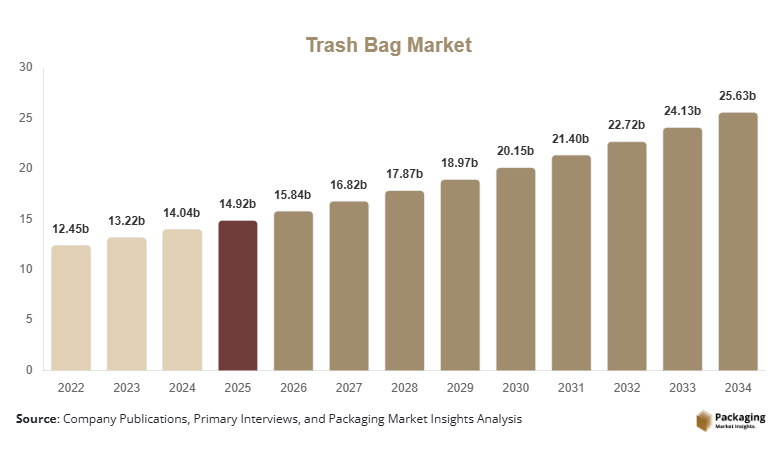
Trash Bag market size is projected at USD 15.84 billion in 2026 and is expected to hit USD 25.63 billion by 2034 with a CAGR of 6.2%. The report evaluates production capacity, consumption trends, pricing analysis, product segmentation, and the competitive landscape across global markets. More than 39 billion units of trash bags are produced annually, with demand supported by municipal waste management, commercial facilities, and residential consumption.
Trash bags are flexible polymer-based waste collection products manufactured using high-density polyethylene (HDPE), low-density polyethylene (LDPE), linear low-density polyethylene (LLDPE), recycled plastics, and biodegradable materials. Global production exceeded 8.7 million metric tons in 2025, with residential applications accounting for nearly 52% of total demand, commercial applications contributing 31%, and industrial uses representing 17%. More than 76% of urban households utilize disposable trash bags regularly, reinforcing the Trash Bag market.
Explore more data points, trends and opportunities Download Free Sample Report
Trash Bag Trends
Increasing Adoption of Sustainable and Recycled Trash Bags
Growing environmental regulations and corporate sustainability targets are accelerating the adoption of recycled-content and biodegradable trash bags. Production of recycled trash bags surpassed 2.4 million metric tons during 2025, increasing by 15% year-over-year. Manufacturers are incorporating 30%–80% recycled resin into premium products while maintaining tensile strength above 18 MPa, supporting evolving Trash Bag market trends.
Smart manufacturing technologies, multilayer extrusion, and downgauging techniques are reducing raw material consumption by nearly 12% while increasing production efficiency by 17%. Demand from hospitality, healthcare, and retail sectors expanded by 10%, while automated packaging facilities increased output to over 42 billion units annually, strengthening the Trash Bag market.
Trash Bag Market Drivers
Rising Urbanization and Municipal Waste Generation
Rapid urbanization and increasing municipal solid waste generation are driving the consumption of trash bags worldwide. Global municipal waste exceeded 2.3 billion metric tons annually, while urban population surpassed 58% of the world's total population. Public sanitation investments increased by 14%, and commercial cleaning services expanded by 11%, accelerating Trash Bag market growth.
Trash Bag Market Restraints
Volatility in Plastic Resin Prices
Fluctuating prices of polyethylene and recycled polymers continue to affect manufacturing profitability. Resin costs account for approximately 60% of production expenses, while price volatility ranged between 9% and 20% during recent years. Compliance with plastic reduction policies has increased operational costs by nearly 8%, impacting the Trash Bag market.
Trash Bag Market Opportunities
Expansion of Biodegradable and Compostable Product Lines
Demand for compostable and bio-based trash bags continues to expand across municipalities and institutional users. Production of biodegradable trash bags increased by 18% during 2025, while government procurement programs across more than 40 countries encouraged sustainable alternatives. Investments exceeding USD 850 million in green polymer technologies continue creating opportunities within the Trash Bag market.
Challenges in Trash Bag Market
Balancing Durability with Environmental Compliance
Manufacturers must improve puncture resistance and load-bearing capacity while reducing plastic content. Product development expenses increased by 13%, while certification costs for compostable products rose by nearly 9%. Achieving high tear resistance with recycled polymers remains a technical challenge for the Trash Bag market.
Report Scope
| Report Metric | Details |
|---|---|
| Market Size in 2025 | USD 14.92 billion |
| Market Size in 2026 | USD 15.84 billion |
| Market Size in 2034 | USD 25.63 billion |
| CAGR | 6.2% (2026-2034) |
| Base Year for Estimation | 2025 |
| Historical Data | 2022-2024 |
| Forecast Period | 2026-2034 |
| Report Coverage | Revenue Forecast, Competitive Landscape, Supply Chain Disruption, Growth Factors, Environment & Regulatory Landscape and Trends |
| Geographies Covered | North America, Europe, APAC, Middle East and Africa, LATAM |
| Countries Covered | U.S., Canada, U.K., Germany, France, Spain, Italy, Russia, Nordic, Benelux, Rest of Europe, China, South Korea, Japan, India, Australia, Singapore, Taiwan, South East Asia, Rest of Asia-Pacific, UAE, Turky, Saudi Arabia, South Africa, Egypt, Nigeria, Rest of MEA, Brazil, Mexico, Argentina, Chile, Colombia, Rest of LATAM |
Explore more data points, trends and opportunities Download Free Sample Report
Trash Bag Market Segmentation
Drawstring trash bags account for approximately 46% of market revenue, followed by flat seal bags with 32% and star seal bags with 22%. Residential applications dominate with nearly 52% of global consumption, supported by annual production exceeding 39 billion units.
By Type
Drawstring trash bags represent the largest segment with nearly 46% market share. Annual production exceeds 18 billion units, offering superior closure systems, enhanced carrying strength above 20 kg, and improved leak resistance for household and commercial waste management.
Flat seal trash bags account for approximately 32% of demand with production surpassing 12 billion units annually. These products are widely used for light-duty waste collection and offer economical manufacturing through high-speed blown film extrusion using HDPE and LLDPE blends.
Star seal trash bags contribute around 22% of market demand, with production exceeding 9 billion units annually. Their leak-proof bottom seal distributes weight evenly, reducing stress concentration and making them suitable for food service, healthcare, and heavy-duty waste collection.
By Application
Residential applications account for nearly 52% of total demand, consuming more than 20 billion units annually. Increasing urban households, improved sanitation awareness, and widespread retail availability continue driving consumption. Premium drawstring products have achieved penetration exceeding 62% among developed markets.
Commercial applications represent approximately 31% of the market with consumption exceeding 12 billion units annually. Hotels, restaurants, offices, schools, and retail outlets require durable trash bags with enhanced puncture resistance and higher load capacities for daily waste disposal operations.
Industrial applications contribute nearly 17% of market demand, utilizing more than 7 billion units annually. Manufacturing facilities, construction sites, warehouses, and logistics centers require heavy-duty trash bags with thickness ranging from 40–120 microns to handle hazardous and bulky waste materials.
Trash Bag Market Segmentations
Type
- Drawstring Trash Bags
- Flat Seal Trash Bags
- Star Seal Trash Bags
Application
- Residential
- Commercial
- Industrial
Trash Bag Regional Outlook
North America
North America accounts for approximately 29% of global revenue, supported by production exceeding 2.4 million metric tons annually. The United States contributes nearly 83% of regional demand through strong residential consumption, commercial cleaning services, and municipal waste collection programs.
Europe
Europe represents around 27% of global demand with annual production exceeding 2.1 million metric tons. Germany, France, Italy, and the United Kingdom collectively account for more than 72% of regional consumption, driven by sustainability regulations and high recycling rates.
Asia-Pacific
Asia-Pacific dominates with approximately 36% of global revenue and production exceeding 3.3 million metric tons annually. China contributes nearly 45% of regional output, followed by India, Japan, and South Korea. Rapid urbanization, population growth, and expanding retail sectors continue supporting market expansion.
Latin America
Latin America accounts for nearly 5% of the global market. Brazil and Mexico collectively contribute over 66% of regional demand, supported by increasing municipal waste collection and rising residential consumption.
Middle East & Africa
The Middle East & Africa represent approximately 3% of global demand. Saudi Arabia, the UAE, and South Africa continue investing in urban sanitation infrastructure, while institutional waste management projects increased by nearly 9% during 2025.
Top players in Trash Bag Market
- Berry Global Inc.
- Novolex Holdings LLC
- The Clorox Company (Glad)
- Reynolds Consumer Products Inc.
- Inteplast Group
- Poly-America L.P.
- International Plastics Inc.
- Four Star Plastics
- Plasta Group
- Hospeco Brands Group
Berry Global Inc.
-
Estimated market share of approximately 13%.
-
Strong global manufacturing footprint with integrated resin processing.
-
Extensive portfolio covering residential, commercial, and industrial trash bags.
-
The company emphasizes recycled-content products, multilayer extrusion technology, and sustainable packaging solutions. Continuous investments in automation and capacity expansion improve production efficiency while supporting growing demand from retail chains, institutional customers, and municipal waste management agencies. Strategic partnerships and product innovation strengthen its competitive position in developed and emerging markets.
Novolex Holdings LLC
-
Estimated market share of approximately 11%.
-
Major supplier of waste management and foodservice packaging products.
-
Strong presence across North America with diversified manufacturing facilities.
-
The company focuses on durable, recycled, and compostable trash bag solutions while expanding production capabilities through advanced film extrusion technologies. Investments in circular economy initiatives and environmentally responsible product development continue supporting long-term competitiveness and customer retention across commercial, industrial, and institutional sectors.