Industrial Plastic Bag Market Size and Growth
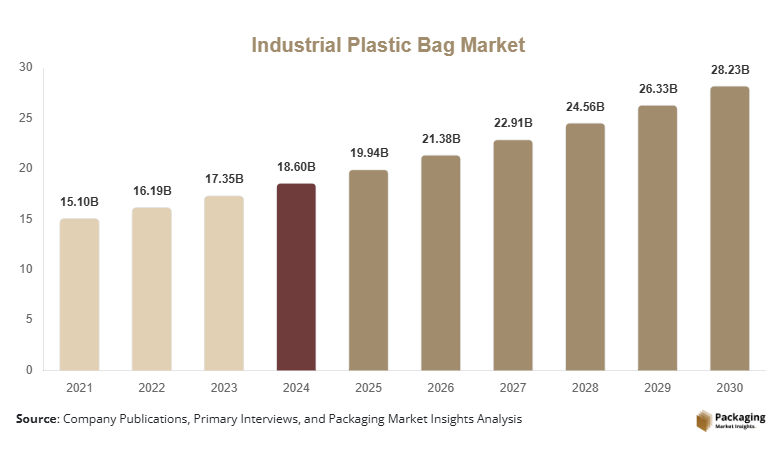
The global industrial plastic bag market size was valued at approximately USD 18.6 billion in 2024 and is projected to grow from around USD 19.94 billion in 2025 to reach nearly USD 28.23 billion by 2030, expanding at a CAGR of about 7.2% during the forecast period (2025–2030). The market growth is primarily supported by the rapid expansion of industrial production and logistics operations globally, which has fueled demand for durable, cost-effective, and customizable packaging solutions for bulk storage and transportation. Increasing e-commerce activities and the shift toward lightweight, flexible packaging options have further reinforced market adoption across diverse industries, including food processing, pharmaceuticals, chemicals, and retail.
Industrial plastic bags are increasingly preferred for their strength, resistance to moisture, and compatibility with automation in industrial operations. Additionally, evolving regulations promoting recyclable and high-performance polymers have accelerated the deployment of advanced materials in industrial packaging, creating a balanced ecosystem of sustainability and efficiency.
Key Highlights
- Polyethylene-based industrial plastic bags, particularly LDPE and HDPE, dominated global demand, supported by their cost efficiency, flexibility, chemical resistance, and suitability for bulk industrial packaging across chemicals, food processing, and logistics applications.
- Biodegradable and recyclable plastic bags are gaining accelerated adoption, as manufacturers respond to tightening environmental regulations and growing sustainability mandates from industrial buyers across North America and Europe.
- Asia Pacific led the global market, driven by large-scale manufacturing activity, export-oriented supply chains, and expanding construction and agricultural sectors in China, India, and Southeast Asian economies.
- Packaging remained the largest application segment, supported by rising industrial output, global trade recovery, and increasing demand for moisture-resistant, lightweight packaging solutions in transportation and logistics operations.
Explore more data points, trends and opportunities Download Free Sample Report
Latest Market Trends
Adoption of Biodegradable and Recyclable Materials
Increasing environmental awareness and regulatory pressures have led manufacturers to incorporate biodegradable and recyclable polymers into industrial plastic bags. Companies are integrating post-consumer recycled content and bio-based plastics, minimizing environmental impact while maintaining functional performance. This trend is also stimulating research in lightweight multi-layered bags that offer durability while enhancing sustainability credentials.
Integration of Smart Packaging Solutions
The industrial plastic bag market is witnessing a gradual shift toward smart packaging with features such as QR codes, RFID tagging, and tamper-evident seals. These innovations facilitate inventory tracking, quality control, and anti-counterfeiting measures across logistics and supply chains. This trend aligns with the broader digitization of industrial operations, offering added value in industries such as pharmaceuticals, chemicals, and food processing.
Market Drivers
Expansion of Industrial Manufacturing
The ongoing growth of industrial sectors, particularly in emerging economies, has increased the requirement for efficient and cost-effective packaging solutions. Industrial plastic bags provide a reliable option for handling bulk raw materials, chemicals, and finished goods, supporting streamlined production and storage operations.
Growth in E-commerce and Logistics
Rising e-commerce activities have generated substantial demand for industrial plastic bags for secure and flexible packaging of goods during transit. The need for lightweight yet durable bags capable of protecting products against moisture, dust, and mechanical stress is driving adoption across both domestic and international logistics channels.
Market Restraints
Environmental Concerns and Regulatory Challenges
Despite technological advancements, the industrial plastic bag market faces challenges due to increasing environmental regulations and concerns over plastic waste. Governments in Europe, North America, and parts of Asia are implementing stringent guidelines on single-use plastics and encouraging recycling programs. Compliance with these regulations increases production costs and can constrain market expansion. Additionally, rising consumer awareness regarding ecological impacts may shift demand toward alternative packaging solutions, potentially affecting growth in traditional plastic bag segments.
Market Opportunities
Biodegradable and Compostable Bag Segment
The growing emphasis on sustainability presents significant opportunities for biodegradable and compostable industrial plastic bags. Manufacturers investing in bio-based polymers and compostable designs are positioned to capture market share from environmentally conscious industries such as food processing and pharmaceuticals.
Expansion in Emerging Markets
Emerging economies in the Asia Pacific, Africa, and Latin America are witnessing rapid industrialization, urbanization, and e-commerce penetration. This creates potential for industrial plastic bag adoption in the chemical, food, and logistics sectors, particularly where cost-efficient and high-capacity packaging solutions are needed.
Report Scope
| Report Metric | Details |
|---|---|
| Market Size in 2024 | USD 18.6 Billion |
| Market Size in 2025 | USD 19.94 Billion |
| Market Size in 2030 | USD 28.23 Billion |
| CAGR | 7.2% (2025-2030) |
| Base Year for Estimation | 2024 |
| Historical Data | 2021-2023 |
| Forecast Period | 2025-2030 |
| Report Coverage | Revenue Forecast, Competitive Landscape, Supply Chain Disruption, Growth Factors, Environment & Regulatory Landscape and Trends |
| Geographies Covered | North America, Europe, APAC, Middle East and Africa, LATAM |
| Countries Covered | U.S., Canada, U.K., Germany, France, Spain, Italy, Russia, Nordic, Benelux, Rest of Europe, China, South Korea, Japan, India, Australia, Singapore, Taiwan, South East Asia, Rest of Asia-Pacific, UAE, Turky, Saudi Arabia, South Africa, Egypt, Nigeria, Rest of MEA, Brazil, Mexico, Argentina, Chile, Colombia, Rest of LATAM |
Explore more data points, trends and opportunities Download Free Sample Report
Segmental Analysis
By Material Type
The LDPE subsegment accounted for a dominant 35% share of the industrial plastic bag market by material in 2024. This leading position was primarily due to LDPE’s flexibility, lightweight nature, and chemical resistance, making it suitable for industrial packaging, transportation of goods, and bulk storage applications. Its cost-effectiveness and ease of manufacturing have further strengthened its adoption across industries such as chemicals, food processing, and logistics.
The HDPE subsegment is projected to be the fastest-growing material segment, demonstrating a CAGR of 8.1% from 2025 to 2030. The growth will be fueled by increasing demand for stronger, puncture-resistant bags capable of carrying heavier industrial materials. HDPE’s durability, moisture resistance, and ability to withstand mechanical stress make it ideal for chemical, pharmaceutical, and construction applications, positioning it for substantial market expansion in the forecast period.
Linear Low-Density Polyethylene (LLDPE), Polypropylene (PP), Polyvinyl Chloride (PVC), and Biodegradable Plastics also contribute to market growth. Among these, biodegradable plastics are expected to gain traction due to growing environmental regulations and increasing industrial adoption of eco-friendly packaging solutions.
By Application
The packaging subsegment represented a significant 50% share of the industrial plastic bag market by application in 2024. This dominance was driven by extensive use in the transport and storage of raw materials, bulk goods, and finished products across industries. Industrial plastic bags offer protection from moisture, dust, and contamination, making them indispensable for supply chain and warehouse operations globally.
The construction subsegment is projected to achieve the fastest CAGR of 7.6% from 2025 to 2030. This growth will be fueled by increasing demand for heavy-duty plastic bags for transporting cement, sand, aggregates, and construction waste. Their durability, resistance to tearing, and ability to withstand rough handling make them a preferred choice for construction and infrastructure projects.
Agriculture, consumer products, medical and healthcare, and transportation and logistics segments also contribute to overall market growth. Notably, the medical and healthcare subsegment is expected to see accelerated adoption, driven by the need for sterile and moisture-resistant bags for pharmaceuticals and medical supply handling.
Industrial Plastic Bag Market Segmentations
By Material Type
- Low-density Polyethylene (LDPE)
- Linear Low-density Polyethylene (LLDPE)
- High-density Polyethylene (HDPE)
- Polypropylene (PP)
- Polyvinyl Chloride (PVC)
- Biodegradable Plastics
By Application
- Packaging
- Construction
- Agriculture
- Consumer Products
- Medical and Healthcare
- Transportation and Logistics
Regional Analysis
North America
North America accounted for approximately 22% of the industrial plastic bag market in 2025. The region is expected to grow at a CAGR of 7.8% from 2025 to 2033. Growth in this region is fueled by automation in industrial operations and stringent regulatory frameworks promoting standardized, recyclable packaging solutions.
The United States dominated the regional market, driven by high demand from chemicals, pharmaceuticals, and logistics industries. Adoption of advanced manufacturing techniques, along with the integration of smart packaging solutions, has enabled operational efficiency and improved product traceability, further strengthening market penetration.
Europe
Europe contributed 18% of the global market share in 2025 and is projected to register a CAGR of 6.9% during 2025–2033. Growth is driven by strict environmental regulations, coupled with a strong focus on sustainable packaging practices and recycling programs.
Germany emerged as the dominant country in Europe, supported by high industrial output, advanced logistics infrastructure, and government incentives promoting the adoption of eco-friendly plastic bags in the chemical and pharmaceutical sectors.
Asia Pacific
Asia Pacific led the global market with a 38% share in 2025 and is projected to grow at a CAGR of 7.1% through 2033. Rapid industrialization, growing e-commerce sectors, and large-scale chemical and food manufacturing activities have contributed significantly to market expansion.
China is the regional leader, with growth supported by expanding manufacturing output, high-volume exports, and increasing demand for cost-efficient, high-strength industrial bags suitable for bulk transport and storage.
Middle East & Africa
The Middle East & Africa accounted for 10% of the global industrial plastic bag market in 2025, with an expected CAGR of 6.5% from 2025–2033. The region is experiencing growth due to rising industrial activities, particularly in oil & gas, chemicals, and logistics sectors.
Saudi Arabia drives regional growth, leveraging investments in industrial parks and modern supply chain infrastructures, which require reliable packaging solutions for transporting raw materials and finished products efficiently.
Latin America
Latin America held a 12% share in 2025, expected to grow at a CAGR of 6.8% from 2025–2033. The market expansion is supported by rising industrial output, growth in e-commerce logistics, and regional government initiatives promoting local manufacturing.
Brazil led the market in Latin America, driven by the chemical and agricultural industries requiring robust industrial plastic bags for bulk storage, transportation, and export of goods.
Competitive Landscape
The industrial plastic bag market is moderately consolidated, with global and regional players competing on quality, innovation, and sustainability. Berry Global Inc. is a market leader, offering a diverse portfolio of HDPE, LDPE, and biodegradable industrial bags. The company recently launched a line of compostable industrial bags aimed at the chemical and food sectors, enhancing its sustainability profile.
Other notable players include Inteplast Group, Novolex, Uflex Limited, Winpak Ltd., and Mondi Group, focusing on expanding production capacities, adopting eco-friendly materials, and strengthening distribution networks. Companies are also investing in smart packaging features and custom solutions to cater to diverse industrial applications, providing competitive differentiation. The market is witnessing steady mergers, collaborations, and technological partnerships, aimed at improving material performance, cost-efficiency, and regulatory compliance in global operations.
Key Players in the Industrial Plastic Bag Market
- Berry Global Inc.
- Inteplast Group
- Novolex
- Uflex Limited
- Winpak Ltd.
- Mondi Group
- Sigma Plastics Group
- Poly-Pak Industries
- Sealed Air Corporation
- SCG Packaging
- Sigma Aldrich Packaging
- Huhtamaki Group
- Amcor Limited
- Cosmo Films Ltd.
- Glenroy Inc.