Garbage Bags Market Size
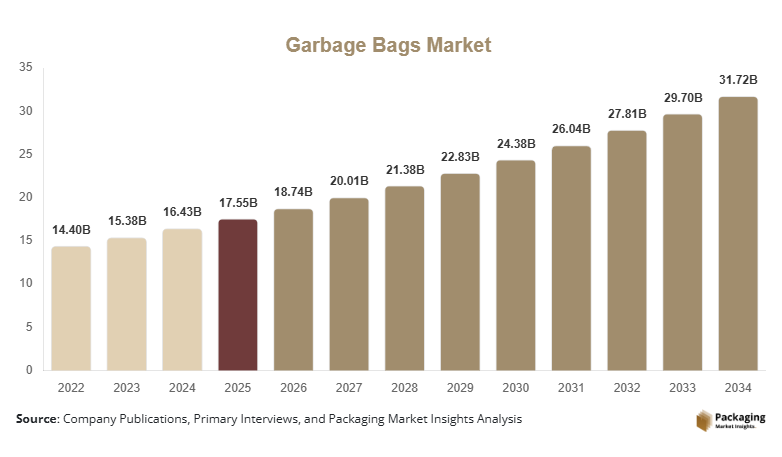
The garbage bags market size is projected at USD 18.74 billion in 2026 and is expected to hit USD 31.82 billion by 2034 with a CAGR of 6.8%. The report provides an in-depth assessment of production capacity, raw material trends, consumption patterns, technology developments, and competitive benchmarking across major economies. It also delivers detailed segmentation and regional analysis to support strategic business decisions.
The garbage bags market comprises disposable and reusable waste collection bags manufactured primarily from polyethylene and biodegradable materials for residential, commercial, and industrial waste management. Global production exceeded 1.28 trillion bags in 2026, while manufacturing utilization averaged 84.3% across key production facilities. Residential applications contributed approximately 49.2% of total demand, commercial applications accounted for 32.8%, and industrial users represented 18.0%. Recycled-content garbage bag penetration exceeded 29%, reinforcing the garbage bags market.
Explore more data points, trends and opportunities Download Free Sample Report
Garbage Bags Market Trends
Rising Adoption of Recycled and Sustainable Garbage Bags
Manufacturers are increasing the use of post-consumer recycled polyethylene and biodegradable resins to comply with environmental regulations. Sustainable garbage bag production exceeded 365 billion units in 2026, increasing by 22% year over year. More than 45% of newly installed extrusion lines are capable of processing recycled resin blends, while downgauging technologies reduced raw material consumption by 13%, strengthening the garbage bag market.
Growing urbanization and municipal waste generation continue to drive product demand. Global municipal solid waste exceeded 2.4 billion metric tons, while garbage bag usage penetration surpassed 88% across organized residential waste collection systems. Smart manufacturing technologies improved production efficiency by 17%, and automated packaging systems reduced operating costs by 10%, supporting the garbage bags market.
Garbage Bags Market Drivers
Increasing Municipal Waste Generation and Urbanization
Urban populations accounted for more than 57% of the global population in 2026, while municipal waste collection volumes exceeded 2.4 billion metric tons annually. Residential garbage bag consumption increased by 8.6%, and commercial procurement expanded by 10.9% due to hospitality, healthcare, and retail sectors. These factors continue supporting garbage bag market growth.
Garbage Bags Market Restraints
Environmental Regulations on Conventional Plastic Products
More than 90 countries implemented restrictions on single-use plastic products by 2026. Virgin polyethylene prices fluctuated between 11% and 18%, while compliance and certification costs increased by approximately 8%. Manufacturers relying on conventional plastic materials continue to face pricing and regulatory pressure across the garbage bag market.
Garbage Bags Market Opportunities
Expansion of Circular Economy and Recycled Resin Utilization
Global investments in recycled plastic processing exceeded USD 1.8 billion during 2026. Recycled polyethylene utilization increased by 27%, while demand for biodegradable garbage bags grew by 24%. Public procurement initiatives and sustainability mandates continue creating significant opportunities within the garbage bags market.
Challenges in Garbage Bags Market
Balancing Durability with Sustainable Material Adoption
Biodegradable garbage bags remain 20–35% more expensive than conventional alternatives. Manufacturing rejection rates average 4.1%, while recycled resin quality variations fluctuate by approximately 14% annually. Maintaining tear resistance, load capacity, and environmental compliance remains a major challenge for the garbage bag market.
Report Scope
| Report Metric | Details |
|---|---|
| Market Size in 2025 | USD 17.55 Billion |
| Market Size in 2026 | USD 18.74 Billion |
| Market Size in 2034 | USD 31.82 Billion |
| CAGR | 6.8% (2026-2034) |
| Base Year for Estimation | 2025 |
| Historical Data | 2022-2024 |
| Forecast Period | 2026-2034 |
| Report Coverage | Revenue Forecast, Competitive Landscape, Supply Chain Disruption, Growth Factors, Environment & Regulatory Landscape and Trends |
| Geographies Covered | North America, Europe, APAC, Middle East and Africa, LATAM |
| Countries Covered | U.S., Canada, U.K., Germany, France, Spain, Italy, Russia, Nordic, Benelux, Rest of Europe, China, South Korea, Japan, India, Australia, Singapore, Taiwan, South East Asia, Rest of Asia-Pacific, UAE, Turkey, Saudi Arabia, South Africa, Egypt, Nigeria, Rest of MEA, Brazil, Mexico, Argentina, Chile, Colombia, Rest of LATAM |
Explore more data points, trends and opportunities Download Free Sample Report
Garbage Bags Market Segmentation
The market is segmented by material and end user. HDPE products account for nearly 44% of total production due to cost efficiency and strength, while residential applications dominate with approximately 49% of global demand driven by household waste management.
By Material
High-Density Polyethylene (HDPE) accounted for approximately 44% of production, exceeding 563 billion bags annually. HDPE bags provide excellent puncture resistance, lightweight construction, and thickness ranging from 8–20 microns, making them suitable for household and commercial waste collection.
Low-Density Polyethylene (LDPE) represented nearly 31% of total production, exceeding 397 billion bags annually. LDPE garbage bags offer superior flexibility and enhanced tear resistance and are widely used for heavy-duty waste disposal applications.
Linear Low-Density Polyethylene (LLDPE) contributed approximately 25% of production with more than 320 billion bags manufactured annually. LLDPE products provide high tensile strength, improved elongation exceeding 400%, and better load-bearing performance for industrial waste management.
By End User
Residential remained the leading application with approximately 49% market share. Annual consumption exceeded 627 billion bags, while household penetration surpassed 91% across urban residential waste management systems.
Commercial accounted for nearly 33% of total demand, exceeding 422 billion bags annually. Hotels, restaurants, hospitals, shopping centers, and office complexes utilize heavy-duty garbage bags to support daily waste handling requirements.
Industrial represented approximately 18% of global demand with production exceeding 230 billion bags annually. Manufacturing facilities, warehouses, and construction sites require high-capacity garbage bags featuring greater puncture resistance and load-bearing capability.
Garbage Bags Market Segmentations
Material
- High-Density Polyethylene (HDPE)
- Low-Density Polyethylene (LDPE)
- Linear Low-Density Polyethylene (LLDPE)
End User
- Residential
- Commercial
- Industrial
Garbage Bags Market Regional Outlook
North America
North America accounted for approximately 29% of global demand, producing more than 371 billion bags annually. The United States contributed nearly 83% of regional consumption owing to advanced municipal waste management systems and high household usage.
Europe
Europe represented approximately 27% of the market. Germany, France, Italy, and the United Kingdom accounted for nearly 68% of regional production. Demand for recycled-content garbage bags exceeded 41% of total regional consumption due to stringent environmental regulations.
Asia-Pacific
The Asia-Pacific region led the market with approximately 36% share and production exceeding 461 billion bags annually. China contributed nearly 47% of regional manufacturing, followed by India, Japan, and South Korea. Rapid urbanization and expanding waste collection infrastructure continue supporting regional demand.
Latin America
Latin America accounted for approximately 5% of global demand. Brazil and Mexico generated more than 66% of regional production, supported by growing urban populations and increasing investments in municipal waste management.
Middle East & Africa
The Middle East & Africa represented approximately 3% of global demand. Saudi Arabia, the UAE, and South Africa remained key regional contributors due to infrastructure development, hospitality growth, and expanding municipal sanitation programs.
Top Players In Garbage Bags Market
- Berry Global Inc.
- Reynolds Consumer Products Inc.
- Novolex Holdings LLC
- Inteplast Group
- Cosmoplast Industrial Company LLC
- Four Star Plastics
- International Plastics Inc.
- Poly-America L.P.
- The Clorox Company
- Thantawan Industry PLC
- BioBag International AS
- Alpha Omega Plastics
Berry Global Inc.
- Estimated global market share: 12–14%
- Strong global manufacturer of flexible packaging and waste management products.
- Berry Global operates advanced blown film extrusion facilities capable of producing high-performance garbage bags using virgin, recycled, and sustainable polyethylene materials. The company continues investing in circular economy initiatives, downgauging technologies, and recycled resin integration while supplying residential, commercial, healthcare, and industrial customers through an extensive global manufacturing and distribution network.
Reynolds Consumer Products Inc.
- Estimated global market share: 9–11%
- Leading supplier of consumer household waste management products.
- Reynolds Consumer Products manufactures a broad portfolio of garbage bags under recognized consumer brands while focusing on product durability, odor control technologies, and recycled material incorporation. Investments in manufacturing automation, product innovation, and retail distribution continue strengthening its market position across North America and international markets.