BOPP Bags Market Size
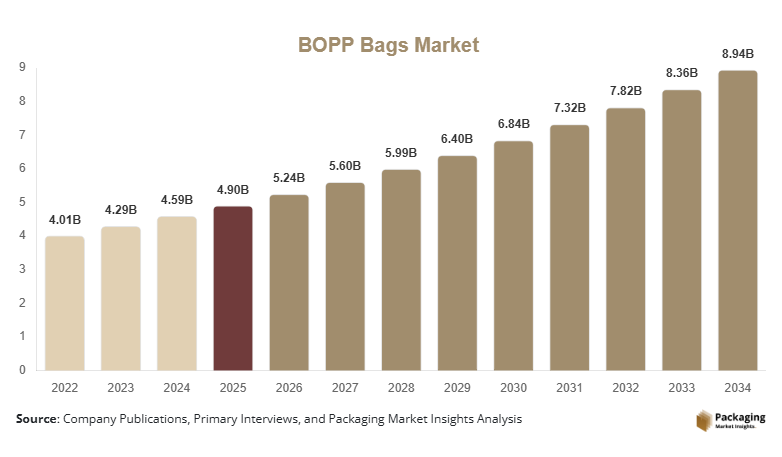
The BOPP bag market size is projected at USD 5.24 billion in 2026 and is expected to hit USD 8.92 billion by 2034 with a CAGR of 6.9%. Rising demand for durable flexible packaging, increasing agricultural exports, and expanding industrial packaging applications continue supporting industry expansion. The report evaluates production capacity, material innovations, market segmentation, regional performance, and competitive landscape across major manufacturing economies.
BOPP (Biaxially Oriented Polypropylene) bags are woven polypropylene bags laminated with BOPP film to provide superior printability, moisture resistance, and mechanical strength. Global production exceeded 43.8 billion bags during 2025, while food and agriculture accounted for approximately 48% of total consumption. Laminated products represented nearly 39% of production, and industrial packaging contributed over 31% of demand, reinforcing the BOPP bags market.
Explore more data points, trends and opportunities Download Free Sample Report
BOPP Bags Trends
Increasing Adoption of High-Definition Printed Packaging
Manufacturers continue investing in advanced gravure and flexographic printing technologies to improve product branding and shelf appeal. More than 18.5 billion printed BOPP bags were manufactured during 2025, while high-definition printing adoption increased to approximately 46%. Digital quality inspection systems improved production efficiency by 14%, strengthening the BOPP bags market.
Demand for recyclable and lightweight packaging continues expanding across the food, pet food, fertilizer, and animal feed industries. Annual production exceeded 44 billion bags, while recyclable BOPP packaging adoption increased by 17%. Lightweight laminated structures reduced material consumption by nearly 12%, supporting sustainability initiatives and reinforcing the BOPP bags market.
BOPP Bags Drivers
Growing Demand from Food and Agricultural Packaging
The expansion of packaged food, grains, rice, flour, sugar, and animal feed industries continues driving BOPP bag consumption. Agricultural packaging demand increased by 10% during 2025, while global shipments exceeded 20 billion bags annually. Nearly 68% of premium agricultural packaging utilizes laminated BOPP bags due to superior moisture resistance and print quality, supporting the BOPP bags market.
BOPP Bags Restraints
Fluctuating Polypropylene Resin Prices
Raw material price volatility remains a major concern for manufacturers. Polypropylene resin prices fluctuated by 9%–13% during 2025, while transportation costs increased approximately 8%. Profit margins declined across small manufacturers representing nearly 34% of industry participants, influencing the BOPP bags market.
BOPP Bags Opportunities
Expansion of Sustainable and Recyclable Packaging
Packaging manufacturers continue developing mono-material recyclable BOPP structures to comply with sustainability regulations. Investments in recyclable flexible packaging increased by 16%, while demand for recyclable industrial bags expanded by 19% during 2025. These developments create significant opportunities for the BOPP bag market.
Challenges in BOPP Bags
Competition from Alternative Flexible Packaging
Paper bags, woven polyethylene bags, and biodegradable packaging continue increasing competition. Approximately 28% of packaging buyers are evaluating alternative sustainable materials, while regulatory compliance costs increased by 11% during 2025. Manufacturers continue improving recyclability and product performance to maintain competitiveness in the BOPP bags market.
Report Scope
| Report Metric | Details |
|---|---|
| Market Size in 2025 | USD 4.90 Billion |
| Market Size in 2026 | USD 5.24 Billion |
| Market Size in 2034 | USD 8.92 Billion |
| CAGR | 6.9% (2026-2034) |
| Base Year for Estimation | 2025 |
| Historical Data | 2022-2024 |
| Forecast Period | 2026-2034 |
| Report Coverage | Revenue Forecast, Competitive Landscape, Supply Chain Disruption, Growth Factors, Environment & Regulatory Landscape and Trends |
| Geographies Covered | North America, Europe, APAC, Middle East and Africa, LATAM |
| Countries Covered | U.S., Canada, U.K., Germany, France, Spain, Italy, Russia, Nordic, Benelux, Rest of Europe, China, South Korea, Japan, India, Australia, Singapore, Taiwan, South East Asia, Rest of Asia-Pacific, UAE, Turky, Saudi Arabia, South Africa, Egypt, Nigeria, Rest of MEA, Brazil, Mexico, Argentina, Chile, Colombia, Rest of LATAM |
Explore more data points, trends and opportunities Download Free Sample Report
BOPP Bags Market Segmentation
The market is segmented by product type and end-use industry. Woven BOPP bags accounted for approximately 46% of total revenue during 2025, while food & agriculture remained the largest application with nearly 48% market share because of increasing packaged commodity exports.
By Product Type
Woven BOPP bags dominated the market with approximately 46% share. Annual production exceeded 20 billion bags, providing high tensile strength, moisture resistance, and excellent print quality for agricultural and food packaging.
Laminated BOPP bags represented nearly 39% of market demand. Production exceeded 17 billion bags, offering enhanced barrier protection, glossy appearance, and superior durability suitable for premium retail packaging.
Valve BOPP bags accounted for approximately 15% of total production. More than 6.5 billion bags were manufactured annually for cement, chemicals, fertilizers, and powdered materials requiring automated filling operations.
By Application
Food & agriculture remained the leading application with approximately 48% market share. More than 21 billion bags were utilized annually for grains, flour, sugar, rice, seeds, pet food, and animal feed, with organized food packaging penetration exceeding 65%.
Chemicals & fertilizers represented approximately 30% of market demand. Industrial packaging exceeded 13 billion bags annually while maintaining high resistance to moisture, puncture, and transportation damage.
Building materials accounted for nearly 22% of global consumption. Cement, gypsum, construction chemicals, and mineral products increasingly utilize valve BOPP bags capable of supporting automated high-speed filling systems.
BOPP Bags Market Segmentations
Product Type
- Woven BOPP Bags
- Laminated BOPP Bags
- Valve BOPP Bags
- Block Bottom BOPP Bags
Application
- Food & Agriculture
- Chemicals & Fertilizers
- Building Materials
- Animal Feed
- Retail Packaging
Distribution Channel
- Direct Sales
- Industrial Packaging Distributors
- Online Sales
- OEM Suppliers
BOPP Bags Regional Outlook
North America
North America accounted for approximately 24% of global revenue during 2025. The United States represented nearly 79% of regional demand, with annual production exceeding 8.6 billion bags. Food processing and industrial packaging remained key demand drivers.
Europe
Europe contributed approximately 27% of global market revenue. Germany, France, Italy, Spain, and Poland collectively produced over 10 billion bags annually. Sustainable packaging adoption exceeded 43%, supporting regional market expansion.
Asia-Pacific
Asia-Pacific held approximately 41% market share and remained the fastest-growing regional market. China, India, Vietnam, Indonesia, and Japan manufactured more than 18 billion bags annually. Agricultural exports and industrial manufacturing supported annual demand growth exceeding 8%.
Latin America
Latin America accounted for nearly 5% of global demand. Brazil, Argentina,Chemicals,co represented more than 71% of regional consumption driven by agricultural packaging and fertilizer industries.
Middle East & Africa
Middle East & Africa represented approximately 3% of total revenue. Infrastructure development, food security initiatives, and fertilizer demand continued supporting regional packaging consumption.
Top Players In BOPP Bags
- Mondi plc
- LC Packaging International BV
- Muscat Polymers Pvt. Ltd.
- Umasree Texplast Pvt. Ltd.
- Berry Global Inc.
- NNZ Group
- Shri Balaji Polyplast
- Emmbi Industries Limited
- Flexituff Ventures International Ltd.
- United Bags, Inc.
Mondi plc Estimated market share: 13%–15% Leading global supplier of industrial flexible packaging and sustainable packaging solutions. Strong manufacturing footprint across Europe, Asia, and the Americas. The company focuses on recyclable BOPP packaging, advanced printing technologies, lightweight laminated structures, and customized industrial packaging solutions. Continuous investment in sustainable product development and production efficiency strengthens its competitive market position. LC Packaging International BV Estimated market share: 9%–11% Major international manufacturer and distributor of woven polypropylene and BOPP packaging products. Extensive presence across agriculture, food processing, chemicals, and industrial packaging sectors. The company emphasizes durable woven packaging, high-quality printing capabilities, global distribution networks, and customized packaging solutions while expanding recyclable product offerings for international customers.