Sustainable Plastic Packaging Market Size and Growth
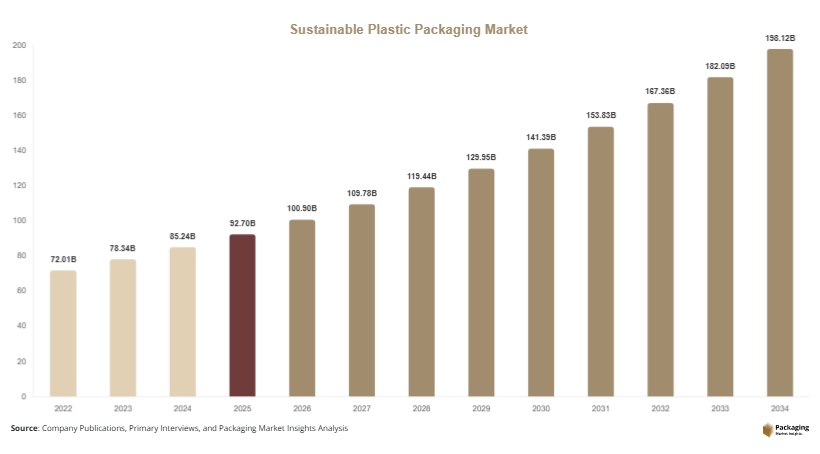
The global Sustainable Plastic Packaging Market size was valued at approximately USD 92.7 billion in 2025 and is projected to reach USD 198.5 billion by 2034, expanding at a CAGR of 8.8% during the forecast period (2025–2034). The market is gaining steady momentum as industries transition toward eco-conscious packaging solutions to reduce environmental impact while maintaining functionality and cost efficiency. Sustainable plastic packaging includes recyclable, biodegradable, and bio-based plastics designed to minimize waste and carbon footprint across sectors such as food & beverage, healthcare, and consumer goods.
A key global factor supporting the growth of the sustainable plastic packaging market is the increasing enforcement of environmental regulations and sustainability commitments by governments and corporations. Policies such as plastic bans, recycling mandates, and extended producer responsibility programs are encouraging manufacturers to adopt sustainable alternatives and invest in innovation.
Key Highlights:
- Europe dominated the market with a 33.6% share in 2025, while Asia Pacific is projected to grow at the fastest CAGR of 10.2%.
- By material type, recyclable plastics led with a 52.4% share, while biodegradable plastics are expected to grow at a CAGR of 10.9%.
- By packaging type, flexible packaging held the largest share at 44.1%, whereas rigid packaging is projected to grow at a CAGR of 9.4%.
- Germany led the market with USD 12.3 billion in 2025 and is estimated to reach USD 13.2 billion in 2026.
Explore more data points, trends and opportunities Download Free Sample Report
Market Trends
Shift Toward Bio-Based and Compostable Plastics
The sustainable plastic packaging market is witnessing a growing shift toward bio-based and compostable materials. Manufacturers are increasingly adopting plant-based polymers such as polylactic acid (PLA) and polyhydroxyalkanoates (PHA) to reduce reliance on fossil fuels. These materials offer improved environmental performance and align with regulatory requirements and consumer expectations for sustainable products.
Integration of Lightweight Packaging Solutions
Another significant trend in the sustainable plastic packaging market is the development of lightweight packaging designs. Companies are optimizing material usage without compromising strength or durability, which reduces transportation costs and carbon emissions. Lightweight solutions are particularly gaining traction in the food & beverage and e-commerce sectors.
Market Drivers
Growing Demand for Eco-Friendly Packaging
The rising consumer preference for environmentally friendly packaging solutions is a major driver for the sustainable plastic packaging market. Consumers are becoming more conscious of the environmental impact of plastic waste, prompting brands to adopt sustainable packaging to maintain competitiveness and meet evolving expectations.
Corporate Sustainability Initiatives
Companies across industries are implementing sustainability goals to reduce their environmental footprint. These initiatives include increasing the use of recycled materials and improving packaging recyclability. Such commitments are driving investments in sustainable plastic packaging solutions and fostering market growth.
Market Restraint
High Cost of Sustainable Materials
A major restraint in the sustainable plastic packaging market is the higher cost associated with sustainable materials compared to conventional plastics. Bio-based and biodegradable plastics often require advanced production processes and raw materials, leading to increased costs. Additionally, limited availability of these materials and supply chain constraints further impact pricing. These factors can discourage small and medium-sized enterprises from adopting sustainable packaging solutions, thereby slowing market growth.
Market Opportunities
Advancements in Recycling Technologies
Innovations in recycling technologies are creating new opportunities in the sustainable plastic packaging market. Advanced sorting, chemical recycling, and material recovery processes are improving the quality and availability of recycled plastics. These developments enable manufacturers to produce high-performance sustainable packaging while reducing reliance on virgin materials.
Expansion in E-Commerce Packaging
The rapid growth of e-commerce presents a significant opportunity for sustainable plastic packaging solutions. Companies are increasingly focusing on eco-friendly packaging to reduce environmental impact and enhance brand image. Sustainable packaging designs that offer durability and cost efficiency are expected to gain traction in this segment.
Report Scope
| Report Metric | Details |
|---|---|
| Market Size in 2025 | USD 92.7 Billion |
| Market Size in 2026 | USD 100.9 Billion |
| Market Size in 2034 | USD 198.5 Billion |
| CAGR | 8.8% (2026-2034) |
| Base Year for Estimation | 2025 |
| Historical Data | 2022-2024 |
| Forecast Period | 2026-2034 |
| Report Coverage | Revenue Forecast, Competitive Landscape, Supply Chain Disruption, Growth Factors, Environment & Regulatory Landscape and Trends |
| Geographies Covered | North America, Europe, APAC, Middle East and Africa, LATAM |
| Countries Covered | U.S., Canada, U.K., Germany, France, Spain, Italy, Russia, Nordic, Benelux, Rest of Europe, China, South Korea, Japan, India, Australia, Singapore, Taiwan, South East Asia, Rest of Asia-Pacific, UAE, Turky, Saudi Arabia, South Africa, Egypt, Nigeria, Rest of MEA, Brazil, Mexico, Argentina, Chile, Colombia, Rest of LATAM |
Explore more data points, trends and opportunities Download Free Sample Report
Segmental Analysis
By Material Type
Recyclable plastics dominated the sustainable plastic packaging market with a 52.4% share in 2025 due to their cost efficiency and compatibility with existing recycling infrastructure.
Biodegradable plastics are expected to grow at the fastest CAGR of 10.9%, driven by increasing demand for compostable packaging solutions and regulatory support.
By Packaging Type
Flexible packaging held the largest share of 44.1% in 2025 in the sustainable plastic packaging market due to its lightweight and cost-effective nature.
Rigid packaging is projected to grow at a CAGR of 9.4%, supported by its durability and increasing use in various industries.
By Process Type
Mechanical recycling-based packaging dominated the market in 2025 due to its widespread adoption and cost advantages.
Chemical recycling-based packaging is expected to grow at a notable CAGR due to its ability to produce high-quality recycled materials.
By End-Use Industry
The food & beverage segment accounted for the largest share in 2025 due to high demand for packaged products and sustainable solutions.
Healthcare is projected to grow at a CAGR of 9.5%, driven by the need for safe and sustainable packaging.
By Application
Primary packaging dominated the sustainable plastic packaging market in 2025 due to its direct interaction with products and high demand across industries.
Secondary packaging is expected to grow at a steady CAGR, supported by increasing demand for sustainable logistics solutions.
Sustainable Plastic Packaging Market Segmentations
Material Type
- Recyclable Plastics
- Biodegradable Plastics
- Bio-Based Plastics
Packaging Type
- Flexible Packaging
- Rigid Packaging
Process Type
- Mechanical Recycling-Based Packaging
- Chemical Recycling-Based Packaging
End-Use Industry
- Food & Beverage
- Healthcare
- Personal Care & Cosmetics
- Industrial
Application
- Primary Packaging
- Secondary Packaging
Regional Analysis
North America
North America accounted for 25.7% of the sustainable plastic packaging market share in 2025 and will grow at a CAGR of 8.1% during the forecast period. The region’s established packaging industry and increasing adoption of sustainable solutions contributed to market expansion.
The United States dominated the regional market due to its strong focus on sustainability and innovation. The country’s initiatives to reduce plastic waste and promote recycling supported the adoption of sustainable packaging solutions.
Europe
Europe held the largest share of 33.6% in the sustainable plastic packaging market in 2025 and is expected to grow at a CAGR of 8.4% through 2034. Strict environmental regulations and high recycling targets supported market growth.
Germany emerged as the dominant country due to its advanced manufacturing capabilities and strong regulatory framework. The country’s focus on sustainable development encouraged the adoption of eco-friendly packaging solutions.
Asia Pacific
Asia Pacific accounted for 27.8% of the sustainable plastic packaging market share in 2025 and is projected to grow at the fastest CAGR of 10.2% during the forecast period. Rapid urbanization and increasing consumer demand for packaged goods supported market growth.
China led the regional market due to its large-scale manufacturing base and growing investments in sustainable technologies. The country’s focus on reducing environmental impact boosted market expansion.
Middle East & Africa
The Middle East & Africa held a 6.4% share of the sustainable plastic packaging market in 2025 and is expected to grow at a CAGR of 9.0% through 2034. Increasing awareness of environmental issues and investments in sustainable infrastructure supported market growth.
The United Arab Emirates dominated the region due to its initiatives to promote sustainability and reduce plastic waste. The country’s focus on innovation contributed to market development.
Latin America
Latin America accounted for 6.5% of the sustainable plastic packaging market share in 2025 and is projected to grow at a CAGR of 8.9% during the forecast period. Growing demand for packaged goods and increasing environmental awareness supported market growth.
Brazil emerged as the dominant country due to its expanding consumer base and focus on sustainable packaging solutions. The country’s efforts to improve waste management practices contributed to market expansion.
Competitive Landscape
The sustainable plastic packaging market is characterized by the presence of established global players focusing on innovation and sustainability. Companies are investing in research and development to enhance material performance and reduce environmental impact.
Amcor plc emerged as a leading player due to its strong portfolio of sustainable packaging solutions and global presence. The company recently introduced recyclable and lightweight packaging products to meet evolving industry demands.
Other key players such as Berry Global Inc., Sealed Air Corporation, and Mondi Group are focusing on expanding their sustainable product offerings and improving operational efficiency. Strategic partnerships and investments in advanced technologies are helping companies strengthen their market position.
Key Players List
- Amcor plc
- Berry Global Inc.
- Sealed Air Corporation
- Mondi Group
- Huhtamaki Oyj
- Sonoco Products Company
- DS Smith plc
- Smurfit Kappa Group
- Plastipak Holdings Inc.
- Coveris Holdings S.A.
- Constantia Flexibles
- Novolex Holdings, Inc.
- AptarGroup, Inc.
- UFlex Ltd.
- Clondalkin Group