Polyethylene Furanoate PEF Barrier Resin Market Size
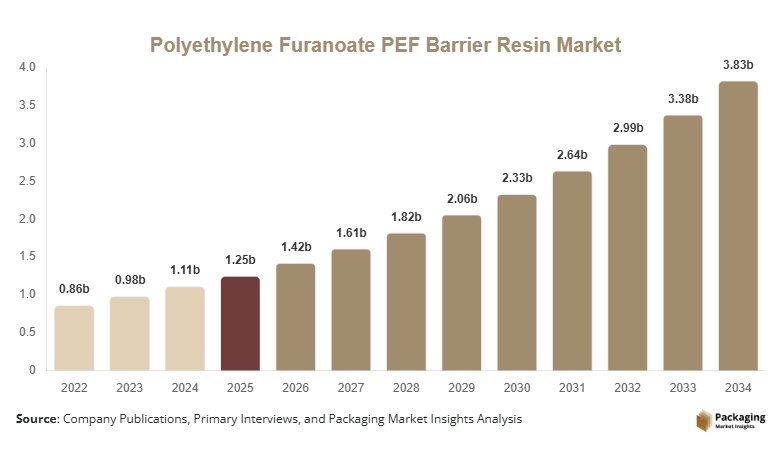
Polyethylene Furanoate PEF Barrier Resin market size is projected at USD 1.42 billion in 2026 and is expected to hit USD 3.86 billion by 2034 with a CAGR of 13.2%. The market analysis provides detailed segmentation by type, application, and geography while evaluating production capacity, technology adoption, competitive positioning, and strategic developments. The report covers historical trends from 2022–2024, the base year 2025, and forecast analysis from 2026–2034 to provide comprehensive Polyethylene Furanoate PEF Barrier Resin market insights.
Polyethylene Furanoate (PEF) Barrier Resin is an advanced bio-based polyester material developed from renewable resources such as plant-derived furandicarboxylic acid (FDCA) and bio-based ethylene glycol. The resin offers superior oxygen barrier properties, carbon dioxide retention, thermal stability, and recyclability compared with conventional polyethylene terephthalate (PET). Global PEF resin production capacity reached approximately 95,000 metric tons in 2025, supported by investments in bio-polymer manufacturing facilities across Europe, North America, and Asia-Pacific. Beverage packaging accounted for nearly 42% of early adoption, while food packaging contributed around 35% due to increasing demand for sustainable barrier materials. Growing regulatory pressure on plastic waste reduction, with more than 60% of packaging companies targeting recyclable or renewable materials by 2030, is strengthening Polyethylene Furanoate PEF Barrier Resin market demand.
Explore more data points, trends and opportunities Download Free Sample Report
Polyethylene Furanoate PEF Barrier Resin Trends
Increasing Adoption of Bio-Based High Barrier Packaging Materials
The transition toward renewable polymers is accelerating the Polyethylene Furanoate PEF Barrier Resin market trend, with bio-based resin adoption increasing by nearly 18% annually between 2022 and 2025. Packaging manufacturers produced over 140 billion beverage containers globally in 2025, creating significant demand for materials with improved oxygen barrier performance. PEF provides approximately 10 times higher oxygen barrier properties than PET and enhances shelf life for sensitive products by 20–40%. Food, beverage, and pharmaceutical sectors are increasingly adopting PEF-based packaging solutions as sustainability commitments expand across more than 75% of multinational consumer goods companies, supporting Polyethylene Furanoate PEF Barrier Resin market growth.
Advancements in Production Technologies and Commercial Scaling
Technology improvements in FDCA production and polymerization processes are driving commercialization of Polyethylene Furanoate PEF Barrier Resin. Advanced fermentation technologies have improved bio-feedstock conversion efficiency by approximately 25%, while pilot-scale facilities are increasing production output from thousands to tens of thousands of tons annually. Around 30% of new sustainable packaging investments announced between 2024 and 2026 included bio-polymer technologies. Companies are focusing on reducing production costs, improving mechanical strength, and achieving compatibility with existing PET recycling infrastructure, creating strong Polyethylene Furanoate PEF Barrier Resin market opportunities.
Polyethylene Furanoate PEF Barrier Resin Drivers
Growing Demand for Sustainable and Recyclable Packaging Solutions
The rising focus on environmental sustainability is a major driver for the Polyethylene Furanoate PEF Barrier Resin market. More than 70% of global packaging producers have introduced sustainability targets, while governments in over 50 countries have implemented regulations supporting renewable materials. PEF resin consumption in beverage packaging increased by approximately 22% between 2022 and 2025 due to lower carbon footprint advantages compared with petroleum-based plastics. The material can reduce greenhouse gas emissions by nearly 40–50% depending on feedstock sources, encouraging adoption across food, beverage, and healthcare packaging industries.
Polyethylene Furanoate PEF Barrier Resin Restraints
High Production Costs and Limited Commercial Availability
High manufacturing costs remain a significant restraint for Polyethylene Furanoate PEF Barrier Resin market expansion. PEF production costs are currently estimated to be 20–35% higher than conventional PET due to limited FDCA availability and specialized processing requirements. Global PEF production capacity remains below 150,000 tons annually compared with PET capacity exceeding 80 million tons, creating supply limitations. Limited commercial-scale facilities and higher investment requirements of USD 100–300 million for advanced production plants restrict faster market penetration.
Polyethylene Furanoate PEF Barrier Resin Opportunities
Expansion of Bio-Based Packaging Applications Across Industries
Increasing applications in premium beverages, dairy packaging, and pharmaceutical containers create significant opportunities for Polyethylene Furanoate PEF Barrier Resin market development. The global sustainable packaging sector is expected to account for more than 55% of new packaging investments by 2030. PEF adoption in high-performance packaging applications is projected to increase by over 25% annually as brands seek improved barrier performance and lower environmental impact. Emerging economies in Asia-Pacific and Latin America are expected to add more than 40% of future packaging demand growth.
Challenges in Polyethylene Furanoate PEF Barrier Resin
Supply Chain Development and Recycling Infrastructure Limitations
The Polyethylene Furanoate PEF Barrier Resin market faces challenges related to raw material availability, recycling systems, and manufacturing infrastructure. Currently, fewer than 20 large-scale facilities worldwide produce FDCA-based polymers, creating supply chain dependency. Recycling compatibility requires additional investment, with approximately 30% of existing recycling plants requiring modifications for advanced bio-polyesters. Industry participants must overcome technical and economic barriers to achieve large-scale commercialization.
Report Scope
| Report Metric | Details |
|---|---|
| Market Size in 2025 | USD 1.25 billion |
| Market Size in 2026 | USD 1.42 billion |
| Market Size in 2034 | USD 3.86 billion |
| CAGR | 13.2% (2026-2034) |
| Base Year for Estimation | 2025 |
| Historical Data | 2022-2024 |
| Forecast Period | 2026-2034 |
| Report Coverage | Revenue Forecast, Competitive Landscape, Supply Chain Disruption, Growth Factors, Environment & Regulatory Landscape and Trends |
| Geographies Covered | North America, Europe, APAC, Middle East and Africa, LATAM |
| Countries Covered | U.S., Canada, U.K., Germany, France, Spain, Italy, Russia, Nordic, Benelux, Rest of Europe, China, South Korea, Japan, India, Australia, Singapore, Taiwan, South East Asia, Rest of Asia-Pacific, UAE, Turky, Saudi Arabia, South Africa, Egypt, Nigeria, Rest of MEA, Brazil, Mexico, Argentina, Chile, Colombia, Rest of LATAM |
Explore more data points, trends and opportunities Download Free Sample Report
Polyethylene Furanoate PEF Barrier Resin Market Segmentation
The Polyethylene Furanoate PEF Barrier Resin market segmentation is categorized by type and application. Bio-based PEF Resin dominated the market with approximately 48% share in 2025 due to sustainability advantages, while beverage packaging represented nearly 42% of total consumption. Increasing adoption across food and healthcare sectors is expected to diversify market distribution through 2034.
By Type
Bio-based PEF Resin
Bio-based PEF Resin accounted for nearly 48% of the Polyethylene Furanoate PEF Barrier Resin market share in 2025, with production exceeding 45,000 metric tons. This segment benefits from renewable feedstocks and reduced carbon emissions of approximately 40%. Bio-based PEF provides excellent oxygen barrier properties, thermal resistance above 85°C, and high recyclability, making it suitable for sustainable packaging applications.
Modified PEF Resin
Modified PEF Resin represented around 30% market share in 2025, supported by demand for enhanced mechanical performance and processing compatibility. Production volumes exceeded 28,000 tons globally, with manufacturers focusing on improved flexibility, impact resistance, and compatibility with existing manufacturing equipment. Modified variants are increasingly used in specialty packaging applications requiring customized barrier performance.
High Barrier PEF Resin
High Barrier PEF Resin captured approximately 22% share in 2025 due to superior gas barrier capabilities. The segment produced nearly 20,000 metric tons and is preferred for carbonated beverages, sensitive foods, and pharmaceutical packaging. These resins offer 5–10 times improved barrier properties compared with traditional PET materials.
By Application
Food Packaging
Food packaging accounted for approximately 35% of Polyethylene Furanoate PEF Barrier Resin market consumption in 2025. More than 50,000 tons of PEF-based materials were utilized for processed foods, dairy products, and fresh food applications. Improved shelf life by 20–35% and resistance to oxygen transmission are major factors supporting adoption.
Beverage Packaging
Beverage packaging dominated with nearly 42% market share in 2025, representing consumption of over 60,000 metric tons. PEF bottles provide improved carbonation retention, transparency, and recyclability. Beverage manufacturers are adopting PEF solutions as sustainability regulations increase across Europe, North America, and Asia.
Pharmaceutical Packaging
Pharmaceutical packaging contributed approximately 15% share, with demand exceeding 20,000 tons in 2025. PEF's chemical resistance, barrier protection, and stability make it suitable for medicine bottles, healthcare containers, and specialty packaging requiring extended product protection.
Polyethylene Furanoate PEF Barrier Resin Market Segmentations
Type
- Bio-based PEF Resin
- Modified PEF Resin
- High Barrier PEF Resin
Application
- Food Packaging
- Beverage Packaging
- Pharmaceutical Packaging
Polyethylene Furanoate PEF Barrier Resin Regional Outlook
North America
North America accounted for approximately 28% of the Polyethylene Furanoate PEF Barrier Resin market share in 2025, with production exceeding 25,000 tons. The United States contributed nearly 80% of regional demand due to strong beverage and sustainable packaging industries. Food and beverage applications represented more than 70% of regional consumption.
Europe
Europe represented around 32% market share in 2025, supported by strict plastic reduction regulations and renewable material adoption. Countries including Germany, Netherlands, France, and Belgium contributed over 75% of regional consumption. Sustainable packaging initiatives and circular economy programs are increasing PEF demand.
Asia-Pacific
Asia-Pacific held approximately 30% share in 2025, driven by China, Japan, South Korea, and India. Regional consumption exceeded 28,000 tons, with beverage packaging accounting for nearly 45%. Growing manufacturing investments and increasing environmental awareness are accelerating adoption.
Latin America and Middle East & Africa
These regions accounted for approximately 10% combined market share in 2025. Rising packaged food demand and sustainability initiatives are expected to support future growth, with consumption projected to increase above 15% annually through 2034.
Top players in Polyethylene Furanoate PEF Barrier Resin Market
- Avantium N.V.
- BASF SE
- Corbion N.V.
- Eastman Chemical Company
- Mitsubishi Chemical Group
- Toyobo Co., Ltd.
- Toray Industries Inc.
- Danone S.A.
- The Coca-Cola Company
- PepsiCo Inc.
- Synvina
- Sulzer Ltd.
Avantium N.V.
-
Holds a leading position in PEF resin technology development with strong focus on FDCA-based polymers.
-
Operates advanced pilot and commercial-scale facilities supporting future production expansion.
-
The company contributes significantly to global PEF innovation, with technology partnerships covering more than 20 international packaging applications.
-
Focuses on renewable materials that can reduce carbon emissions by 40% or more compared with conventional plastics.
BASF SE
-
BASF maintains a strong position through polymer expertise, sustainable material development, and global manufacturing capabilities.
-
The company supports advanced bio-based resin research and chemical recycling technologies.
-
BASF’s packaging material portfolio serves multiple industries, including food, beverage, and healthcare sectors.
-
Its global presence across more than 80 countries strengthens its competitive positioning in sustainable polymer markets.