Odor Scavenging Masterbatches For Recycled Polyolefins Market Size
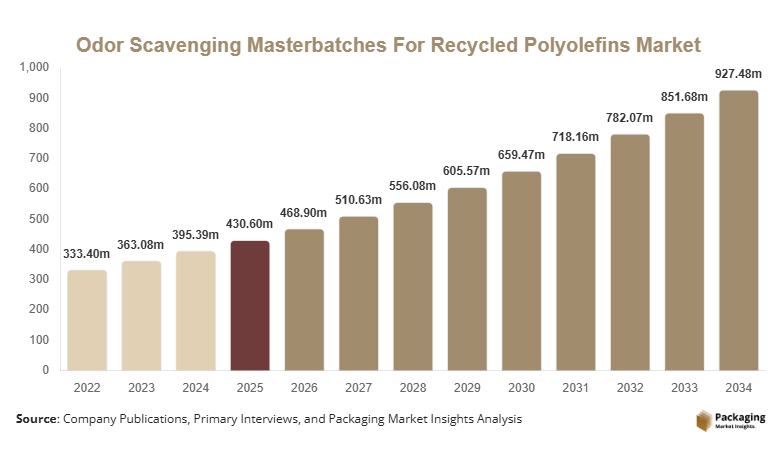
Odor Scavenging Masterbatches For Recycled Polyolefins market size is projected at USD 468.9 million in 2026 and is expected to hit USD 928.4 million by 2034 with a CAGR of 8.9%. The market expansion is supported by increasing recycled polymer utilization, regulatory emphasis on circular economy initiatives, and rising investments in polymer compounding technologies. Comprehensive segmentation across product types and applications, together with competitive landscape assessment covering manufacturers, production capacity, and innovation activities, provides a detailed understanding of the industry outlook.
The Odor Scavenging Masterbatches For Recycled Polyolefins market comprises additive concentrates specifically formulated to neutralize volatile organic compounds (VOCs), sulfur compounds, aldehydes, and residual contaminants generated during recycled polyolefin processing. Global production of recycled polyolefins exceeded 78 million tons in 2025, while odor scavenging masterbatch consumption surpassed 142 thousand tons, with packaging accounting for approximately 46% of total demand, automotive 28%, and consumer goods nearly 18%. Penetration of odor-control masterbatches in premium recycled polyethylene and polypropylene applications has exceeded 39%, reinforcing the importance of the Odor Scavenging Masterbatches For Recycled Polyolefins market.
Explore more data points, trends and opportunities Download Free Sample Report
Odor Scavenging Masterbatches For Recycled Polyolefins Market Trends
Increasing Integration of Advanced Adsorption Technologies
Manufacturers are increasingly incorporating activated mineral systems, molecular sieves, zeolites, and hybrid adsorption technologies into masterbatch formulations. Annual production of advanced odor scavenging compounds exceeded 61 thousand tons during 2025, while adoption across food-contact recycled packaging increased by 24% year-over-year. Automated extrusion systems and precision dosing technologies have improved additive dispersion efficiency above 95%, strengthening the Odor Scavenging Masterbatches For Recycled Polyolefins market.
Growing investments in chemical recycling and closed-loop plastics processing are driving demand for high-performance odor removal additives. More than 420 recycling facilities globally upgraded compounding lines during 2025, while recycled polypropylene utilization increased by 14% and recycled polyethylene demand expanded by 11%. Advanced masterbatches capable of reducing VOC emissions by over 70% are experiencing rapid commercialization across industrial applications, supporting the Odor Scavenging Masterbatches For Recycled Polyolefins market.
Odor Scavenging Masterbatches For Recycled Polyolefins Drivers
Expansion of Circular Economy and High-Quality Recycled Plastics Production
Government recycling targets exceeding 55% across several developed economies, combined with increasing recycled resin consumption of more than 80 million tons, are accelerating additive demand. Brand owners continue increasing recycled content targets from 25% to 50%, while premium packaging applications require odor reduction efficiencies above 65%. Production capacity additions exceeding 350 thousand tons annually continue supporting the Odor Scavenging Masterbatches For Recycled Polyolefins market.
Odor Scavenging Masterbatches For Recycled Polyolefins Restraints
High Formulation Costs and Feedstock Quality Variability
Performance inconsistency resulting from mixed plastic waste streams remains a major challenge. Premium odor scavenging additives may increase compound costs by 8%–15%, while fluctuating recycled resin contamination levels of 3%–12% reduce formulation consistency. Small recyclers with capacities below 10 thousand tons annually often face limited adoption because of cost sensitivity, affecting market expansion.
Odor Scavenging Masterbatches For Recycled Polyolefins Opportunities
Growing Demand for Food-Grade and Premium Recycled Polyolefins
Food packaging manufacturers are increasing certified recycled polymer procurement by over 18% annually. High-performance odor scavengers capable of reducing aldehydes and sulfur compounds below 10 ppm are opening new commercial opportunities. Investments exceeding USD 1.8 billion in advanced recycling infrastructure globally are expected to stimulate higher additive consumption across premium applications.
Challenges in Odor Scavenging Masterbatches For Recycled Polyolefins
Maintaining Long-Term Performance Across Diverse Polymer Streams
Recycled polyolefins differ substantially in contamination levels, polymer degradation, and VOC composition. Manufacturers must optimize additive loading between 1% and 5% while preserving tensile strength above 90% of virgin polymer performance. Continuous R&D investment and laboratory validation increase development costs by approximately 12%, creating technical complexity across commercial production.
Report Scope
| Report Metric | Details |
|---|---|
| Market Size in 2025 | USD 430.6 million |
| Market Size in 2026 | USD 468.9 million |
| Market Size in 2034 | USD 928.4 million |
| CAGR | 8.9% (2026-2034) |
| Base Year for Estimation | 2025 |
| Historical Data | 2022-2024 |
| Forecast Period | 2026-2034 |
| Report Coverage | Revenue Forecast, Competitive Landscape, Supply Chain Disruption, Growth Factors, Environment & Regulatory Landscape and Trends |
| Geographies Covered | North America, Europe, APAC, Middle East and Africa, LATAM |
| Countries Covered | U.S., Canada, U.K., Germany, France, Spain, Italy, Russia, Nordic, Benelux, Rest of Europe, China, South Korea, Japan, India, Australia, Singapore, Taiwan, South East Asia, Rest of Asia-Pacific, UAE, Turky, Saudi Arabia, South Africa, Egypt, Nigeria, Rest of MEA, Brazil, Mexico, Argentina, Chile, Colombia, Rest of LATAM |
Explore more data points, trends and opportunities Download Free Sample Report
Odor Scavenging Masterbatches For Recycled Polyolefins Market Segmentation
The market is segmented according to additive chemistry and application, with Organic Odor Scavengers accounting for nearly 41% of total consumption, while Recycled Packaging contributes approximately 46% of industry demand due to strict quality requirements.
By Type
Organic Odor Scavengers
Organic formulations account for around 41% market share with annual production exceeding 58 thousand tons. These additives effectively neutralize aldehydes, ketones, and VOCs while maintaining excellent compatibility with recycled polyethylene and polypropylene compounds.
Inorganic Odor Scavengers
Holding approximately 35% share, inorganic masterbatches utilize mineral adsorbents including zeolites and activated compounds. Production surpassed 49 thousand tons, offering thermal stability above 230°C and efficient sulfur compound adsorption.
Hybrid Odor Scavengers
Hybrid products contribute nearly 24% of demand while demonstrating combined chemical neutralization and physical adsorption. Production exceeded 35 thousand tons, reducing odor intensity by more than 75% across demanding recycling applications.
By Application
Recycled Packaging
Packaging represents approximately 46% of demand, consuming over 65 thousand tons annually. Usage penetration exceeds 42% in food-contact recycled polyolefin packaging where odor reduction, VOC control, and consumer acceptance remain critical performance requirements.
Automotive Components
Automotive applications contribute around 28% market share. More than 39 thousand tons of odor scavenging masterbatches are incorporated into recycled interior trim, underbody components, and storage systems while complying with stringent vehicle VOC emission standards.
Consumer Goods
Consumer products account for approximately 18% of demand with production exceeding 26 thousand tons annually. Applications include household products, furniture, storage containers, and reusable products requiring improved appearance, odor neutrality, and recycled material acceptance.
Odor Scavenging Masterbatches For Recycled Polyolefins Market Segmentations
Type
- Organic Odor Scavengers
- Inorganic Odor Scavengers
- Hybrid Odor Scavengers
Application
- Recycled Packaging
- Automotive Components
- Consumer Goods
Odor Scavenging Masterbatches For Recycled Polyolefins Regional Outlook
North America
North America accounts for approximately 27% of global demand, supported by over 15 million tons of recycled polyolefin production annually. The United States contributes nearly 82% of regional consumption, while Canada continues expanding recycled packaging investments.
Europe
Europe represents around 34% of global demand owing to stringent recycling regulations and circular economy initiatives. Germany, France, Italy, and the Netherlands collectively account for more than 61% of regional production, supported by advanced polymer recycling infrastructure.
Asia-Pacific
Asia-Pacific holds nearly 31% market share with China producing over 28 million tons of recycled polyolefins annually. Japan, South Korea, and India continue investing in high-performance masterbatch manufacturing and recycling capacity expansion.
Middle East & Africa and South America
These regions jointly contribute approximately 8% of global consumption. Brazil, Saudi Arabia, South Africa, and the UAE continue increasing recycled polymer production while expanding packaging and industrial manufacturing sectors.
Top players in Odor Scavenging Masterbatches For Recycled Polyolefins
- Clariant AG
- Avient Corporation
- Ampacet Corporation
- Tosaf Group
- Plastika Kritis S.A.
- LyondellBasell Industries
- Gabriel-Chemie Group
- Sukano AG
- RTP Company
- PolyOne Specialty Compounds
- Penn Color Inc.
- Americhem Inc.
Clariant AG
-
Estimated market share: 11%–13%
-
Strong presence in sustainable additive technologies and premium recycling solutions.
-
Broad portfolio of odor control masterbatches designed for recycled polyethylene and polypropylene applications.
-
Extensive global manufacturing footprint supports high-volume industrial customers and packaging producers.
Avient Corporation
-
Estimated market share: 9%–11%
-
Strong specialization in customized polymer formulations for recycled plastics.
-
Focuses on advanced adsorption technologies, regulatory compliance, and sustainable compound development.
-
Significant investments in innovation and customer-specific masterbatch solutions strengthen global competitiveness.