Lightweight Packaging Market Size and Growth
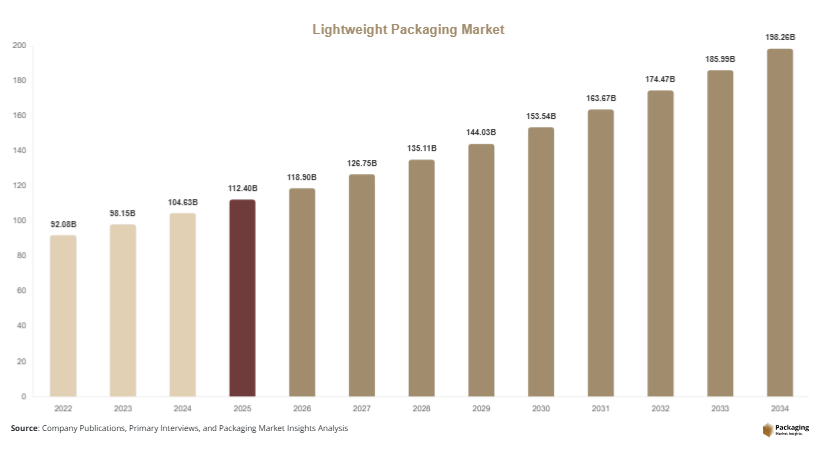
The global lightweight packaging market size was valued at approximately USD 112.4 billion in 2025 and is projected to reach USD 118.9 billion in 2026. By 2034, the market is forecast to reach nearly USD 198.6 billion, growing at a CAGR of 6.6% during 2025–2034. Rising consumer demand for convenient packaging, increasing pressure to reduce packaging waste, and strong growth in e-commerce logistics are among the primary factors supporting market expansion.
The lightweight packaging market is experiencing steady expansion due to increasing demand for cost-efficient, sustainable, and transportation-friendly packaging solutions across food & beverage, healthcare, personal care, industrial, and e-commerce industries. Lightweight packaging reduces overall packaging material consumption while improving logistics efficiency and lowering trahnsportation costs. Manufacturers are increasingly adopting lightweight plastics, thin-wall containers, flexible packaging films, and fiber-based solutions to meet sustainability goals and reduce carbon emissions across supply chains.
Key Highlights
- Asia Pacific dominated the market with a 36.8% share in 2025.
- Latin America is projected to grow at the fastest CAGR of 7.4%.
- Flexible packaging accounted for 44.7% market share in 2025.
- Food & beverage applications led the market with a 48.5% share.
- Plastic materials represented 57.2% market share in 2025.
- The US remained the leading country in North America with a market size of USD 18.9 billion in 2025 and USD 20.1 billion in 2026.
Explore more data points, trends and opportunities Download Free Sample Report
Market Trends
Increasing Adoption of Mono-Material Flexible Packaging
A major trend influencing the lightweight packaging market is the growing adoption of mono-material flexible packaging solutions designed to improve recyclability and reduce material consumption. Packaging manufacturers are replacing multi-layer structures with lightweight mono-material films that simplify recycling processes while maintaining product protection. Food and beverage companies are increasingly using lightweight pouches, sachets, and stand-up bags to reduce transportation costs and improve shelf efficiency. For example, snack and frozen food brands are deploying thin-gauge recyclable polyethylene packaging to minimize packaging waste. This trend is expected to strengthen as regulatory authorities and retailers promote recyclable packaging systems across global supply chains.
Rising Integration of Lightweight Packaging in E-Commerce Logistics
Another key trend is the increasing use of lightweight packaging solutions in e-commerce and direct-to-consumer shipping operations. Online retailers are focusing on reducing package weight to lower shipping expenses and improve fulfillment efficiency. Corrugated packaging manufacturers are introducing lightweight box structures and protective packaging materials optimized for parcel delivery. For instance, several e-commerce platforms are implementing lightweight paper cushioning and recyclable mailer packaging to reduce logistics costs. Future growth in online retail activity and automated warehouse operations is expected to increase demand for durable yet lightweight protective packaging materials.
Market Drivers
Rising Demand for Sustainable and Material-Efficient Packaging
The increasing demand for sustainable and material-efficient packaging is a major growth driver for the lightweight packaging market. Consumer brands and packaging manufacturers are reducing packaging weight to lower raw material consumption and minimize environmental impact. Lightweight packaging contributes to lower greenhouse gas emissions during transportation and reduces landfill waste generation. For example, beverage companies are introducing lightweight PET bottles with thinner wall structures to improve sustainability performance while maintaining durability. Governments and environmental organizations are also encouraging manufacturers to adopt material reduction strategies as part of broader circular economy initiatives.
Growth in E-Commerce and Global Logistics Operations
Rapid growth in e-commerce and global logistics operations is another important factor driving the market. Lightweight packaging reduces shipping costs by lowering package weight and improving transport efficiency. Online retailers are increasingly using lightweight corrugated boxes, flexible mailers, and protective films to optimize shipping performance. For example, electronics and personal care companies are redesigning packaging structures to reduce dimensional weight charges during parcel delivery. Rising cross-border trade activity and increasing investments in automated fulfillment infrastructure are expected to further support market demand.
Market Restraint
Concerns Regarding Packaging Durability and Product Protection
One of the major restraints affecting the lightweight packaging market is the challenge of maintaining product protection and packaging durability while reducing material usage. Lightweight packaging structures may offer lower resistance to punctures, compression, and moisture exposure compared to heavier conventional packaging materials. This issue is particularly significant in industrial goods, electronics, and fragile food products where strong protective performance is required during transportation and storage.
For example, thin-wall packaging designs may experience structural deformation during long-distance shipping or automated handling operations. Flexible packaging films with reduced thickness can also face limitations in barrier protection for oxygen-sensitive and moisture-sensitive products. Manufacturers must invest in advanced material engineering and testing processes to ensure packaging integrity while minimizing weight.
Another challenge involves balancing sustainability goals with packaging functionality. Lightweight materials sometimes require specialized coatings or multi-layer barrier systems that can complicate recycling processes. Small manufacturers may also face higher costs associated with transitioning to lightweight packaging technologies and redesigning production lines. In emerging markets, inconsistent recycling infrastructure and limited access to advanced lightweight materials can restrict adoption. These challenges may slow market expansion in applications requiring high-performance protective packaging solutions.
Market Opportunities
Expansion of Lightweight Packaging in Healthcare Applications
The healthcare industry presents significant opportunities for lightweight packaging manufacturers due to increasing demand for portable and material-efficient pharmaceutical packaging solutions. Medical device companies and pharmaceutical manufacturers are adopting lightweight blister packs, pouches, and flexible packaging formats to improve transportation efficiency and reduce storage space requirements. For example, lightweight sterile packaging systems are increasingly being used for single-use medical products and diagnostic kits. Future opportunities are expected to emerge from sustainable healthcare packaging initiatives and growth in home-based medical care services.
Growth in Recyclable Fiber-Based Lightweight Packaging
The increasing demand for recyclable and renewable packaging materials is creating new growth opportunities for lightweight fiber-based packaging solutions. Packaging companies are investing in molded fiber structures, lightweight paper packaging, and recyclable corrugated systems to reduce plastic usage and improve environmental performance. Retailers and foodservice operators are also adopting lightweight paper-based packaging to meet sustainability targets and reduce packaging taxes. For instance, beverage and takeaway food brands are introducing lightweight fiber cups and recyclable paper trays across retail operations. Continued innovation in barrier-coated paper materials is expected to support future market expansion.
Report Scope
| Report Metric | Details |
|---|---|
| Market Size in 2025 | USD 112.4 Billion |
| Market Size in 2026 | USD 118.9 Billion |
| Market Size in 2034 | USD 198.6 Billion |
| CAGR | 6.6% (2026-2034) |
| Base Year for Estimation | 2025 |
| Historical Data | 2022-2024 |
| Forecast Period | 2026-2034 |
| Report Coverage | Revenue Forecast, Competitive Landscape, Supply Chain Disruption, Growth Factors, Environment & Regulatory Landscape and Trends |
| Geographies Covered | North America, Europe, APAC, Middle East and Africa, LATAM |
| Countries Covered | U.S., Canada, U.K., Germany, France, Spain, Italy, Russia, Nordic, Benelux, Rest of Europe, China, South Korea, Japan, India, Australia, Singapore, Taiwan, South East Asia, Rest of Asia-Pacific, UAE, Turky, Saudi Arabia, South Africa, Egypt, Nigeria, Rest of MEA, Brazil, Mexico, Argentina, Chile, Colombia, Rest of LATAM |
Explore more data points, trends and opportunities Download Free Sample Report
Segmental Analysis
By Packaging Type
Flexible packaging dominated the lightweight packaging market with approximately 44.7% share in 2024 due to its low material consumption, transportation efficiency, and versatility across food, beverage, healthcare, and personal care applications. Flexible pouches, films, and sachets are widely used because they require less raw material compared to rigid packaging while offering strong barrier protection and shelf-life performance. Food manufacturers increasingly prefer stand-up pouches and lightweight films for snacks, dairy products, and frozen foods due to reduced storage and shipping costs. For example, beverage concentrate brands are replacing rigid plastic containers with lightweight refill pouches to improve sustainability performance and lower logistics expenses. Rising demand for convenience-oriented and resealable packaging formats continues to strengthen segment growth globally.
Lightweight corrugated packaging is expected to register the fastest CAGR of 7.2% during the forecast period due to increasing e-commerce shipments and sustainable transportation packaging demand. Retailers and logistics companies are adopting lightweight corrugated boxes with optimized structural designs to reduce dimensional weight and material usage. Packaging manufacturers are introducing recycled paperboard structures and honeycomb reinforcement technologies to improve durability without increasing package weight. Future growth opportunities are expected to emerge from automated warehouse systems and recyclable protective packaging innovations designed for high-volume parcel delivery operations.
By Material
Plastic materials accounted for nearly 57.2% market share in 2024 due to their flexibility, lightweight properties, and cost efficiency across multiple packaging applications. Lightweight plastic materials such as polyethylene, polypropylene, and PET are extensively used in beverage bottles, food packaging films, and healthcare packaging products. Manufacturers are reducing resin usage through downgauging technologies and advanced polymer engineering to improve sustainability performance while maintaining package strength. For example, beverage producers are deploying ultra-lightweight PET bottle designs that lower transportation emissions and reduce packaging costs. Continued advancements in recyclable mono-material plastics and bio-based polymer technologies are expected to support segment expansion.
Paper and paperboard materials are projected to grow at the fastest CAGR of 7.5% during the forecast period due to increasing demand for recyclable and renewable packaging alternatives. Foodservice operators, retailers, and e-commerce companies are adopting lightweight paper packaging formats to reduce plastic usage and meet sustainability targets. Packaging suppliers are introducing molded fiber trays, lightweight corrugated structures, and recyclable paper mailers optimized for transportation efficiency. Future developments in water-resistant coatings and high-strength fiber technologies are expected to expand paper-based lightweight packaging applications across retail and industrial sectors.
By End-Use
Food & beverage applications dominated the lightweight packaging market with approximately 48.5% share in 2024 due to rising consumption of packaged foods, takeaway meals, and ready-to-drink beverages. Lightweight packaging improves transportation efficiency, reduces packaging waste, and supports convenience-oriented consumer preferences. Food manufacturers are increasingly adopting lightweight flexible pouches, thin-wall containers, and recyclable beverage bottles to lower logistics costs and improve shelf appeal. For example, dairy and snack brands are replacing heavy rigid packaging with lightweight flexible alternatives to enhance sustainability performance and reduce material usage. Increasing online grocery delivery activity is further strengthening demand for lightweight food packaging systems.
Healthcare applications are projected to register the fastest CAGR of 7.3% during the forecast period due to growing demand for portable and material-efficient medical packaging solutions. Pharmaceutical companies are adopting lightweight blister packs, flexible sterile packaging, and compact medical device packaging to improve storage efficiency and reduce transportation costs. Healthcare providers are also increasing the use of lightweight single-use packaging systems for diagnostics and homecare applications. Future growth opportunities are expected to emerge from sustainable pharmaceutical packaging initiatives and expansion of temperature-sensitive medical product distribution networks.
Lightweight Packaging Market Segmentations
By Packaging Type
- Flexible Packaging
- Lightweight Corrugated Packaging
- Thin-Wall Rigid Packaging
- Molded Fiber Packaging
By Material
- Plastic Materials
- Paper & Paperboard
- Aluminum
- Bio-Based Materials
By End-User
- Food & Beverage
- Healthcare
- Personal Care & Cosmetics
- Industrial Packaging
- E-Commerce & Retail
By Distribution Channel
- Direct Sales
- Packaging Distributors
- Online B2B Platforms
- Retail Packaging Suppliers
- Industrial Supply Networks
Regional Analysis
North America
North America accounted for approximately 27.9% of the lightweight packaging market share in 2025 and is projected to grow at a CAGR of 6.1% during the forecast period. The region benefits from strong e-commerce growth, advanced packaging manufacturing infrastructure, and increasing demand for sustainable logistics solutions. Food, healthcare, and consumer goods companies are investing in lightweight packaging technologies to improve transportation efficiency and reduce packaging waste generation.
The United States dominates the regional market due to its large retail and e-commerce industries. A unique growth factor is the rapid adoption of lightweight protective packaging systems in automated fulfillment centers. Major retailers and logistics providers are deploying lightweight corrugated materials and recyclable mailers to reduce shipping costs and improve operational sustainability across supply chain networks.
Europe
Europe represented approximately 24.8% market share in 2025 and is expected to expand at a CAGR of 6.3% during the forecast period. Strong environmental regulations and circular economy initiatives are encouraging the adoption of lightweight recyclable packaging materials across multiple industries. Food manufacturers and consumer goods companies are focusing on packaging reduction strategies to comply with packaging waste directives and sustainability goals.
Germany leads the European market due to its advanced packaging technology sector and strong industrial manufacturing base. A unique growth factor is the increasing use of lightweight fiber-based packaging in automotive and industrial supply chains. German manufacturers are developing recyclable transport packaging systems that reduce material usage while maintaining durability during international logistics operations.
Asia Pacific
Asia Pacific dominated the lightweight packaging market with a 36.8% share in 2025 and is projected to register a CAGR of 7.1% during the forecast period. Rapid urbanization, expanding food delivery services, and strong manufacturing growth are driving demand for lightweight packaging solutions across the region. Countries such as China, India, Japan, and South Korea are experiencing rising adoption of flexible packaging and lightweight transportation packaging materials.
China dominates the regional market because of its large manufacturing sector and expanding e-commerce industry. A unique growth factor is the rapid development of lightweight packaging materials for export-oriented logistics operations. Chinese packaging companies are investing in thin-wall plastic containers, lightweight corrugated systems, and recyclable flexible packaging technologies to support growing domestic and international trade activity.
Middle East & Africa
The Middle East & Africa accounted for nearly 4.9% market share in 2025 and is expected to grow at a CAGR of 5.8% during the forecast period. The region is witnessing increasing adoption of lightweight food packaging and transportation packaging solutions driven by retail expansion and infrastructure development. Growing demand for cost-efficient packaging systems is encouraging packaging suppliers to introduce lightweight and recyclable materials.
The United Arab Emirates dominates the regional market due to strong logistics infrastructure and rapid retail modernization. A unique growth factor is the expansion of lightweight packaging demand in aviation catering and hospitality industries. Foodservice operators and retail suppliers are increasingly adopting lightweight recyclable packaging to improve operational efficiency and reduce waste generation.
Latin America
Latin America represented approximately 5.6% market share in 2025 and is projected to grow at the fastest CAGR of 7.4% during the forecast period. Expanding retail activity, growing packaged food consumption, and rising investments in sustainable packaging manufacturing are supporting regional market growth. Flexible packaging and lightweight beverage packaging are gaining popularity across foodservice and consumer goods sectors.
Brazil dominates the Latin American market due to its strong beverage and agricultural export industries. A unique growth factor is the increasing adoption of lightweight export packaging systems for processed food and agricultural products. Packaging manufacturers are developing thin-wall containers and lightweight corrugated packaging formats to improve logistics efficiency and reduce shipping expenses.
Competitive Landscape
The lightweight packaging market is highly competitive, with companies focusing on sustainable material innovation, downgauging technologies, and recyclable packaging solutions. Major market participants include Amcor plc, Berry Global Inc., Sealed Air Corporation, Mondi Group, and Sonoco Products Company. Among these companies, Amcor plc remains a leading player due to its extensive flexible packaging portfolio and strong investment in recyclable lightweight packaging technologies.
Manufacturers are expanding production capabilities for lightweight flexible films, recyclable corrugated packaging, and thin-wall plastic containers to meet rising global demand. Strategic collaborations with food, beverage, and e-commerce companies are supporting product innovation and packaging optimization initiatives. Recent developments include the introduction of mono-material recyclable pouches, lightweight PET packaging systems, and high-strength fiber-based transport packaging designed to improve logistics efficiency and sustainability performance.
Key Players List
- Amcor plc
- Berry Global Inc.
- Sealed Air Corporation
- Mondi Group
- Sonoco Products Company
- DS Smith plc
- WestRock Company
- Huhtamaki Oyj
- Smurfit Kappa Group
- Constantia Flexibles
- Graphic Packaging International
- Coveris Holdings S.A.
- AptarGroup Inc.
- ProAmpac LLC
- UFlex Ltd.