Starch Based Bioplastics Market Size and Growth
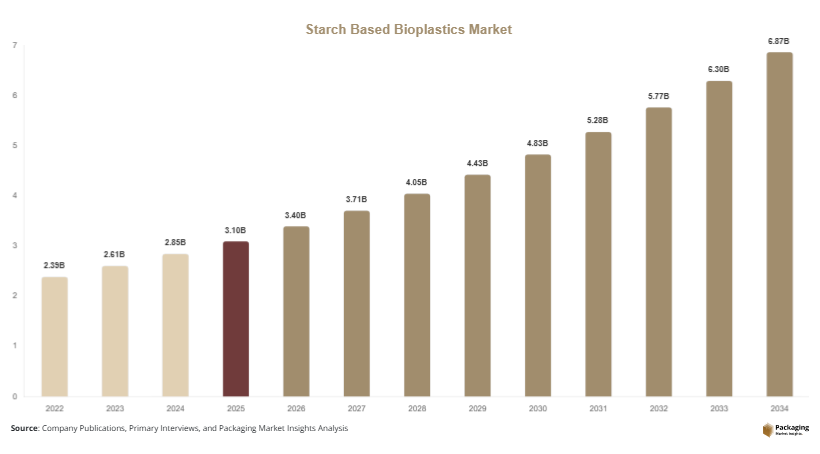
The global starch based bioplastics market is projected to grow from USD 3.1 billion in 2025 to USD 6.9 billion by 2034, registering a CAGR of 9.2% during 2025–2034. In 2026, the market size is estimated at USD 3.4 billion, driven by increasing adoption of biodegradable materials in packaging and agriculture.
Several key growth factors are shaping the market. First, regulatory pressure on single-use plastics is increasing globally, particularly in Europe and Asia Pacific, leading to higher demand for compostable alternatives. Second, the expansion of sustainable packaging in food delivery and retail sectors is significantly boosting consumption of starch-based bioplastics. Third, technological improvements in bio-polymer blending are enhancing material durability and expanding application scope.
Key Highlights
- Asia Pacific dominated the market with a 37.4% share in 2025.
- Latin America is projected to grow at the fastest CAGR of 6.2%.
- Starch-PLA blends led the material segment with a 41.8% share.
- Packaging applications dominated with a 49.5% share.
- Food & beverage packaging led with 43.1% sharey.
- The US remained the dominant country with a market size of USD 11.2 billion in 2025 and USD 11.9 billion in 2026.
Explore more data points, trends and opportunities Download Free Sample Report
Market Trends
Shift Toward Compostable Packaging in FMCG and Food Delivery
A major trend in the starch based bioplastics market is the increasing adoption of compostable packaging in FMCG and food delivery services. Companies are replacing conventional plastic bags, containers, and wraps with starch-based biodegradable alternatives. For example, global food delivery platforms in Europe and Asia are partnering with packaging suppliers to introduce compostable cutlery and containers made from starch blends. This shift is driven by rising consumer awareness and regulatory pressure on single-use plastics. In countries like India and Indonesia, food delivery growth has significantly increased demand for biodegradable packaging. In the future, compostable packaging is expected to become standard in urban food service industries as governments enforce stricter waste management policies.
Advancements in Starch Polymer Blending Technologies
Another key trend is the development of advanced polymer blending technologies that improve the performance of starch-based bioplastics. Pure starch materials are often brittle and moisture-sensitive, but blending with PLA, PHA, and PBS significantly enhances durability, flexibility, and heat resistance. For instance, European bioplastic manufacturers are developing hybrid starch films used in grocery packaging and agricultural applications. These innovations are expanding the usability of starch-based materials beyond disposable products. In the future, nano-reinforced starch composites and bio-additive integration are expected to further enhance mechanical performance and broaden industrial adoption.
Market Drivers
Government Regulations on Single-Use Plastics
The implementation of strict regulations banning single-use plastics is a major driver for the starch based bioplastics market. Governments across Europe, Asia, and North America are enforcing policies that encourage biodegradable alternatives. For example, the European Union’s circular economy policies have accelerated adoption of compostable packaging in retail and food service sectors. Similarly, India’s ban on selected plastic items has significantly boosted demand for starch-based alternatives. This regulatory pressure directly drives manufacturers to adopt bioplastic solutions, creating strong market momentum.
Rising Demand for Sustainable Packaging in Food Industry
The food industry is a major consumer of starch-based bioplastics due to increasing demand for eco-friendly packaging. Consumers are increasingly preferring brands that use sustainable materials. For example, supermarkets in the U.S. and Germany are adopting compostable produce bags and trays made from starch blends. This shift is supported by rising online grocery delivery services that require biodegradable packaging. As food consumption patterns evolve, demand for sustainable packaging continues to expand across global supply chains.
Market Restraint
A key restraint in the starch based bioplastics market is the relatively high production cost compared to conventional petroleum-based plastics. Starch-based materials require specialized processing, blending, and composting infrastructure, which increases manufacturing expenses.
Additionally, performance limitations such as low moisture resistance and reduced mechanical strength restrict their use in certain industrial applications. For example, in high-moisture food packaging, starch-based materials may degrade faster than required, limiting their applicability. These factors slow down widespread adoption in cost-sensitive markets.
Market Opportunities
Expansion of Agricultural Applications
Agricultural applications present a major opportunity for the starch based bioplastics market. Biodegradable mulch films, seed coatings, and plant pots made from starch-based materials are increasingly being used in sustainable farming practices. For example, farmers in Europe and China are adopting starch-based mulch films that naturally decompose in soil, reducing plastic waste and labor costs associated with removal. This segment is expected to expand rapidly as sustainable agriculture practices gain global attention.
Growth in Circular Economy Infrastructure
The development of circular economy systems presents another major opportunity. Governments and private companies are investing in composting facilities and biodegradable waste management systems that support bioplastic degradation. For instance, cities in Europe are expanding industrial composting networks that allow starch-based plastics to be processed efficiently. This infrastructure development will significantly enhance adoption rates in the coming years.
Report Scope
| Report Metric | Details |
|---|---|
| Market Size in 2025 | USD 3.1 Billion |
| Market Size in 2026 | USD 3.4 Billion |
| Market Size in 2034 | USD 6.9 Billion |
| CAGR | 9.2% (2026-2034) |
| Base Year for Estimation | 2025 |
| Historical Data | 2022-2024 |
| Forecast Period | 2026-2034 |
| Report Coverage | Revenue Forecast, Competitive Landscape, Supply Chain Disruption, Growth Factors, Environment & Regulatory Landscape and Trends |
| Geographies Covered | North America, Europe, APAC, Middle East and Africa, LATAM |
| Countries Covered | U.S., Canada, U.K., Germany, France, Spain, Italy, Russia, Nordic, Benelux, Rest of Europe, China, South Korea, Japan, India, Australia, Singapore, Taiwan, South East Asia, Rest of Asia-Pacific, UAE, Turky, Saudi Arabia, South Africa, Egypt, Nigeria, Rest of MEA, Brazil, Mexico, Argentina, Chile, Colombia, Rest of LATAM |
Explore more data points, trends and opportunities Download Free Sample Report
Segmental Analysis
Type
The starch-PLA blend segment dominated with a 2024 market share of 41.8%, driven by its balanced mechanical strength, flexibility, and biodegradability. This segment is widely used in packaging films, disposable cutlery, and food containers. For example, European supermarkets use starch-PLA blended bags for fresh produce packaging due to their compostability and durability. Their compatibility with existing processing technologies makes them the most commercially viable option in the starch bioplastics market.
The starch-PHA blend segment is also gaining traction but remains smaller in scale due to higher production costs.
The fastest-growing segment is starch-PHA blends, with a CAGR of 10.1%, driven by superior biodegradability and marine compostability. These materials are increasingly used in premium packaging and medical applications. Future outlook suggests strong expansion as production costs decline and marine pollution regulations tighten globally.
Material
Blended starch materials dominated with a 2024 share of 46.3%, due to improved performance characteristics and widespread industrial adoption. These blends are used in packaging, agriculture, and disposable products.
Pure starch materials are limited due to low durability but remain important in low-cost applications.
The fastest-growing segment is modified starch composites, driven by innovation in bio-additives and reinforcement technologies. CAGR stands at 9.8%, supported by advancements in nano-fillers and moisture-resistant coatings.
End-Use
Packaging dominated with a 2024 share of 49.5%, driven by strong demand from food delivery, retail, and FMCG industries. Starch-based bioplastics are widely used in compostable bags, containers, and wraps.
Agriculture is the fastest-growing segment with a CAGR of 10.4%, driven by adoption of biodegradable mulch films and seed coatings. For example, large farming operations in Europe and Asia are replacing plastic films with starch-based alternatives to improve soil sustainability.
Starch Based Bioplastics Market Segmentations
By Type
- Starch-PLA Blends
- Starch-PHA Blends
- Pure Starch Bioplastics
By Material
- Blended Starch
- Modified Starch
- Pure Starch
By End-User
- Packaging
- Agriculture
- Consumer Goods
- Healthcare
- Industrial Applications
Regional Analysis
North America
North America accounted for approximately 25.6% share of the starch based bioplastics market in 2025, with a projected CAGR of 8.7% through 2034. The region benefits from strong environmental regulations, growing consumer awareness, and increasing adoption of sustainable packaging in retail and food industries. The United States and Canada are leading markets, driven by corporate sustainability commitments and regulatory initiatives.
A key growth factor is the rising adoption of compostable packaging in food delivery and retail sectors. For example, major restaurant chains in the U.S. are replacing plastic cutlery and containers with starch-based alternatives. Retailers are also introducing biodegradable produce bags to reduce plastic usage. Government policies supporting bio-based materials further strengthen market growth.
The United States dominates the region due to its strong food service industry and sustainability initiatives. A unique growth driver is the expansion of corporate ESG programs that require large-scale transition to biodegradable packaging. For instance, several U.S. grocery chains have committed to eliminating plastic bags and shifting toward starch-based compostable alternatives, accelerating market adoption.
Europe
Europe held around 28.1% market share in 2025, growing at a CAGR of 9.0%. The region is a global leader in sustainability regulations and circular economy initiatives. Countries such as Germany, France, Italy, and the UK are major contributors.
A key growth factor is strict EU regulations on plastic waste reduction. For example, European supermarkets are widely adopting compostable packaging for fresh produce and bakery products. The region also benefits from strong consumer demand for eco-friendly products.
Germany dominates the region due to advanced bioplastic manufacturing capabilities. A unique driver is the widespread integration of industrial composting systems that support starch-based material degradation. For instance, German municipalities have established composting infrastructure that processes biodegradable packaging efficiently.
Asia Pacific
Asia Pacific dominated the market with a 37.4% share in 2025, and is projected to grow at a CAGR of 10.1%. The region is driven by rapid urbanization, population growth, and increasing plastic bans in countries such as India, China, and Thailand.
A key growth factor is government-led plastic restriction policies. For example, India’s ban on single-use plastics has significantly increased demand for biodegradable packaging alternatives. China is also investing heavily in bioplastic production capacity.
China dominates the region due to its large manufacturing base. A unique growth driver is expansion of domestic biopolymer production facilities integrated with agricultural feedstock supply chains, enabling cost-efficient production of starch-based materials.
Middle East & Africa
Middle East & Africa accounted for 5.9% share in 2025, with a CAGR of 8.3%. Growth is driven by rising environmental awareness and gradual adoption of sustainable packaging in urban retail sectors.
A key growth factor is increasing government initiatives for waste reduction. For example, the UAE is implementing sustainability programs targeting plastic waste reduction in retail and hospitality sectors.
The UAE dominates the region due to its strong retail and tourism industries. A unique driver is adoption of eco-friendly packaging in luxury hospitality services, where starch-based bioplastics are being used in food packaging and catering operations.
Latin America
Latin America held around 3.0% share in 2025, and is projected to grow at the fastest CAGR of 6.2%. Brazil and Mexico dominate the region due to expanding food delivery services and agricultural applications.
A key growth factor is increasing demand for sustainable packaging in urban food systems. For example, Brazil’s expanding food delivery sector is adopting compostable packaging made from starch blends.
Brazil dominates the region due to strong agricultural production. A unique driver is use of biodegradable mulch films in large-scale farming operations, improving soil sustainability and reducing plastic waste.
Competitive Landscape
The starch based bioplastics market is moderately fragmented with strong competition among global biopolymer manufacturers focusing on innovation, capacity expansion, and sustainability. Major companies include Novamont, NatureWorks LLC, BASF SE, BioBag International, and Futerro. Among these, Novamont leads due to its strong portfolio of starch-based biodegradable products and integrated supply chain.
Companies are investing in R&D for improved polymer blends, expanding production facilities, and forming partnerships with packaging and agricultural firms. Strategic collaborations with food service providers are also increasing to promote compostable packaging adoption.
Key Players List
- Novamont S.p.A.
- NatureWorks LLC
- BASF SE
- BioBag International AS
- Futerro SA
- Rodenburg Biopolymers
- Plantic Technologies
- Corbion NV
- Danimer Scientific
- Biotec GmbH
- Tianan Biologic Materials
- Mitsubishi Chemical Group
- Cardia Bioplastics
- Green Dot Bioplastics
- Kingfa Sci & Tech Co.