Security Printing Market Size and Growth
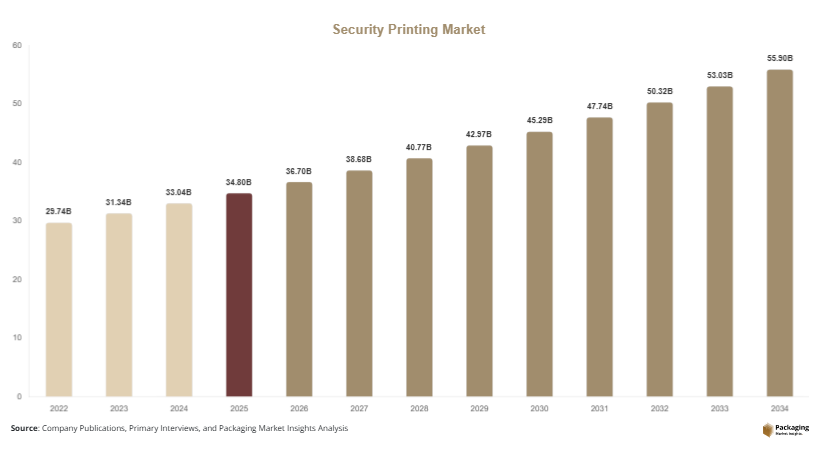
The global security printing market size was valued at USD 34.8 billion in 2025 and is estimated to reach USD 36.7 billion in 2026. The market is projected to attain approximately USD 55.9 billion by 2034, expanding at a CAGR of 5.4% during the forecast period (2025–2034). Demand remains strong due to increasing issuance of secure identity documents, expansion of banking infrastructure, and growing implementation of product authentication technologies.
The security printing market continues to play a critical role across government, banking, healthcare, education, transportation, and commercial sectors. Security printing involves specialized printing technologies, substrates, inks, and authentication features designed to prevent counterfeiting, forgery, and unauthorized duplication of valuable documents and products. Growing concerns regarding identity theft, document fraud, counterfeit currency, fake certificates, and illicit trade are encouraging governments and private organizations to adopt advanced security printing solutions.
Key Highlights
- Asia Pacific dominated the market with a 38.6% share in 2025.
- Latin America is projected to grow at the fastest CAGR of 6.3% during the forecast period.
- Holograms led the type segment with a 31.4% share.
- Paper-based substrates dominated the material segment with a 57.2% share.
- Banking & financial applications led the end-use segment with a 34.8% share.
- The US remained the dominant country with a market size of USD 5.7 billion in 2025 and USD 6.0 billion in 2026.
Explore more data points, trends and opportunities Download Free Sample Report
Market Trends
Integration of Digital Authentication with Security Printing
Security printing providers are increasingly combining physical security elements with digital authentication technologies. Printed QR codes, NFC-enabled labels, RFID tags, and serialized barcodes are being integrated into documents and packaging to enhance traceability and verification. Governments and brand owners are adopting hybrid authentication systems that allow instant verification through mobile devices. For example, pharmaceutical companies are using digitally authenticated labels to verify product legitimacy across supply chains. The future impact of this trend will be significant as businesses seek scalable anti-counterfeiting systems that combine physical security with real-time digital validation, creating new opportunities for advanced security printing providers.
Rising Adoption of Advanced Holographic and Optical Features
The use of holograms, color-shifting inks, microtext, and optical variable devices is expanding across currencies, passports, tax stamps, and branded products. These technologies provide multiple layers of protection while remaining difficult to replicate. Financial institutions and government agencies continue to invest in sophisticated optical security features to stay ahead of counterfeiters. For instance, several countries are introducing next-generation passport designs incorporating multi-dimensional holographic layers. The long-term impact of this trend includes increased demand for specialized equipment, secure substrates, and customized printing technologies that offer stronger authentication and improved document integrity.
Market Drivers
Increasing Counterfeit Activities Across Industries
Counterfeiting remains one of the largest challenges for governments and businesses worldwide. Fake pharmaceuticals, counterfeit luxury goods, forged certificates, and fraudulent financial documents create significant economic losses. As a result, organizations are investing heavily in security printing solutions to strengthen authentication and verification processes. Security labels, holograms, and serialized documents help reduce fraud while improving consumer confidence. Pharmaceutical manufacturers, for example, increasingly use tamper-evident security labels to prevent counterfeit drug distribution. This growing need for anti-counterfeiting measures continues to support the expansion of the security printing market.
Growing Government Investments in Secure Identity Documents
Governments worldwide are modernizing identity management systems to improve security and reduce fraud. National ID programs, biometric passports, voter cards, visas, and tax documentation require advanced security printing technologies. The implementation of secure printing features such as watermarks, microprinting, and UV-reactive inks enhances document authenticity. For example, several countries have upgraded passport production facilities to incorporate advanced anti-forgery features. The increasing issuance of secure identification documents is expected to remain a major growth driver throughout the forecast period.
Market Restraint
High Cost of Advanced Security Printing Technologies
Despite growing demand, the security printing market faces challenges related to the high cost of advanced security technologies. Specialized inks, holographic films, RFID components, secure substrates, and sophisticated printing equipment require substantial investment. Small and medium-sized enterprises often find it difficult to adopt comprehensive security printing solutions due to budget constraints. Additionally, maintaining secure production environments and complying with regulatory standards increases operational expenses. For example, implementing RFID-enabled authentication systems can significantly raise production costs compared to conventional labeling methods. These financial barriers may limit adoption in cost-sensitive industries and emerging economies. Furthermore, frequent technological upgrades are necessary to counter evolving counterfeit techniques, creating ongoing capital requirements. While large organizations can absorb these costs, smaller companies may delay investments, affecting overall market penetration and growth in certain regions.
Market Opportunities
Expansion of Pharmaceutical Serialization Programs
The growing implementation of pharmaceutical serialization regulations presents significant opportunities for security printing providers. Drug manufacturers are increasingly required to include unique identifiers, tamper-evident features, and track-and-trace capabilities on packaging. Security printing technologies support compliance while improving supply chain transparency. Advanced labels, secure barcodes, and digital authentication systems are becoming essential components of pharmaceutical packaging. As healthcare regulations continue to evolve globally, demand for specialized security printing solutions is expected to increase substantially, creating long-term revenue opportunities for market participants.
Increasing Demand for Brand Protection Solutions
Brand owners across luxury goods, cosmetics, electronics, and consumer products are investing in security printing to protect their products from unauthorized replication. Security labels, holograms, and digital verification features help companies safeguard brand reputation while improving customer trust. For example, premium cosmetics brands increasingly use serialized authentication labels that consumers can verify through mobile applications. Future opportunities are expected to emerge from e-commerce growth, international trade expansion, and increasing consumer awareness regarding product authenticity. These factors will encourage broader adoption of advanced security printing technologies across commercial sectors.
Report Scope
| Report Metric | Details |
|---|---|
| Market Size in 2025 | USD 34.8 Billion |
| Market Size in 2026 | USD 36.7 Billion |
| Market Size in 2034 | USD 55.9 Billion |
| CAGR | 5.4% (2026-2034) |
| Base Year for Estimation | 2025 |
| Historical Data | 2022-2024 |
| Forecast Period | 2026-2034 |
| Report Coverage | Revenue Forecast, Competitive Landscape, Supply Chain Disruption, Growth Factors, Environment & Regulatory Landscape and Trends |
| Geographies Covered | North America, Europe, APAC, Middle East and Africa, LATAM |
| Countries Covered | U.S., Canada, U.K., Germany, France, Spain, Italy, Russia, Nordic, Benelux, Rest of Europe, China, South Korea, Japan, India, Australia, Singapore, Taiwan, South East Asia, Rest of Asia-Pacific, UAE, Turky, Saudi Arabia, South Africa, Egypt, Nigeria, Rest of MEA, Brazil, Mexico, Argentina, Chile, Colombia, Rest of LATAM |
Explore more data points, trends and opportunities Download Free Sample Report
Segmental Analysis
By Type
Holograms dominated the type segment and accounted for approximately 31.4% of the market share in 2024. Their widespread adoption stems from their effectiveness in preventing duplication and enhancing visual authentication. Holograms are extensively used in passports, banknotes, certificates, and branded products. Governments and corporations value holographic security features because they provide immediate visual verification while remaining difficult to replicate. Continuous innovation in multi-layer holographic technologies has further strengthened their market position.
RFID-based security printing is expected to be the fastest-growing subsegment, registering a CAGR of 7.1% during the forecast period. Growth is driven by increasing demand for real-time tracking, inventory management, and digital authentication. RFID-enabled labels allow businesses to monitor products throughout supply chains while reducing counterfeiting risks. Adoption is rising across pharmaceuticals, logistics, and retail sectors. Future developments in smart packaging and connected supply chains are expected to accelerate demand.
By Material
Paper-based substrates held the largest share of approximately 57.2% in 2024. Paper remains widely used for currency, certificates, passports, tax stamps, and official documentation due to its compatibility with multiple security features. Watermarks, microprinting, embedded threads, and UV-reactive elements can be effectively integrated into paper-based materials. Government agencies continue to rely heavily on paper substrates for secure document production, supporting segment dominance.
Polymer substrates are projected to record the fastest CAGR of 6.8% through 2034. These materials offer enhanced durability, resistance to environmental conditions, and improved integration of advanced security technologies. Polymer-based banknotes and identity cards are increasingly being adopted in several countries due to their longer lifespan and higher security performance. Ongoing investments in durable identification systems and secure transaction documents are expected to support future growth.
By End-Use
Banking and financial institutions accounted for approximately 34.8% of the market share in 2024, making them the leading end-use segment. Security printing plays a vital role in protecting checks, certificates, transaction records, and financial instruments from fraud. Banks continue to implement advanced printing technologies to reduce counterfeiting and strengthen transaction security. Growing digital banking activities have also encouraged integration of printed security features with digital authentication platforms.
Pharmaceuticals are expected to be the fastest-growing end-use segment, expanding at a CAGR of 6.9% during the forecast period. Rising concerns regarding counterfeit medicines and increasingly stringent serialization regulations are driving demand. Security labels, tamper-evident packaging, and track-and-trace technologies are becoming standard requirements across pharmaceutical supply chains. Future growth will be supported by healthcare expansion, regulatory compliance initiatives, and increased focus on patient safety.
Security Printing Market Segmentations
By Type
- Holograms
- Watermarks
- RFID Security Printing
- Microprinting
- Security Threads
- Others
By Material
- Paper
- Polymer
- Plastic Films
- Composite Materials
By End-User
- Banking & Financial Services
- Government & Identity Documents
- Pharmaceuticals
- Consumer Goods
- Transportation & Tickets
- Education & Certificates
Regional Analysis
North America
North America accounted for approximately 26.8% of the security printing market share in 2025 and is projected to grow at a CAGR of 5.1% through 2034. The region benefits from strong demand for secure financial documents, government identification programs, and advanced anti-counterfeiting measures. Financial institutions continue investing in secure transaction documentation, while pharmaceutical manufacturers increasingly adopt authentication technologies to combat counterfeit products. Growing cybersecurity concerns are also encouraging organizations to integrate printed security features with digital verification systems.
The United States dominates the regional market due to extensive adoption of advanced document security technologies. A unique growth driver is the continuous modernization of federal identification and border security programs. Government agencies are upgrading passports, visas, and identification cards with enhanced security features. Another important trend involves increasing deployment of RFID-enabled security labels across logistics and healthcare sectors, supporting market expansion.
Europe
Europe held around 24.3% of the global market share in 2025 and is expected to register a CAGR of 5.0% during the forecast period. The region has stringent regulations regarding product authentication, pharmaceutical traceability, and secure documentation. Growing efforts to reduce counterfeit goods in cross-border trade continue to stimulate demand for advanced security printing solutions. Investments in secure tax stamps and government-issued certificates further contribute to market growth.
Germany represents the leading country within Europe. A unique growth driver is the region's emphasis on industrial product authentication and export protection. German manufacturers increasingly use advanced security labels and holographic technologies to protect high-value industrial equipment and components. The growing use of track-and-trace systems across manufacturing supply chains is strengthening demand for security printing products.
Asia Pacific
Asia Pacific dominated the market with a 38.6% share in 2025 and is forecast to expand at a CAGR of 6.2% through 2034. Rapid economic growth, expanding banking infrastructure, and increasing issuance of government identity documents are supporting regional demand. Rising counterfeit activities in consumer goods and pharmaceuticals have prompted governments and businesses to adopt stronger authentication technologies. Growth in e-commerce activities is also increasing the need for secure packaging and labeling solutions.
China remains the dominant country in Asia Pacific. A unique growth factor is the country's large-scale manufacturing ecosystem, which requires extensive anti-counterfeiting measures across export-oriented industries. Companies are increasingly incorporating security labels and serialized printing features into product packaging to enhance supply chain transparency and protect brand integrity. This trend continues to support strong regional growth.
Middle East & Africa
The Middle East & Africa accounted for approximately 5.7% of the global market share in 2025 and is expected to grow at a CAGR of 5.8%. Governments across the region are investing in national identification systems, secure passports, and border control initiatives. Rising urbanization and growing healthcare infrastructure are creating additional demand for authentication labels and pharmaceutical security printing solutions. Expansion of financial services is also supporting market development.
Saudi Arabia leads the regional market. A unique growth driver is the country's digital transformation strategy, which includes modernization of identity management and government documentation systems. Secure printing technologies are being integrated into official documents to improve verification processes. Increasing deployment of advanced authentication features within government services continues to drive market growth.
Latin America
Latin America represented approximately 4.6% of the security printing market in 2025 and is projected to grow at the fastest CAGR of 6.3% through 2034. The region is witnessing increasing efforts to combat document fraud, counterfeit products, and illicit trade. Governments and businesses are adopting secure labels, tax stamps, and authentication systems to improve regulatory compliance and consumer safety. Expansion of retail and pharmaceutical sectors is further supporting demand.
Brazil is the dominant country in the region. A unique growth factor is the increasing use of secure tax stamps and product verification labels to strengthen regulatory enforcement. Manufacturers across food, beverage, and pharmaceutical industries are implementing security printing solutions to improve traceability. The growing focus on supply chain transparency is expected to create additional growth opportunities across Latin America.
Competitive Landscape
The security printing market is moderately consolidated, with leading companies focusing on technological innovation, strategic partnerships, capacity expansion, and product development. Market participants continue to invest in advanced authentication technologies that combine physical security elements with digital verification platforms.
De La Rue plc remains a leading company in the market due to its strong portfolio of banknote printing, authentication technologies, and secure government documentation solutions. The company recently expanded its digital authentication capabilities to complement traditional security printing products.
Other major participants include Giesecke+Devrient, Crane NXT, Veridos GmbH, and SICPA Holding SA. These companies are actively developing next-generation holograms, secure inks, RFID-enabled solutions, and track-and-trace technologies. Strategic collaborations with governments and financial institutions remain key competitive strategies.
Growing demand for anti-counterfeiting technologies across pharmaceuticals, retail, and consumer goods sectors is encouraging market participants to broaden their product portfolios. Investments in sustainable substrates, smart labels, and digital security integration are expected to shape competition over the coming years.
Key Players List
- De La Rue plc
- Giesecke+Devrient GmbH
- SICPA Holding SA
- Crane NXT Co.
- Veridos GmbH
- CCL Industries Inc.
- 3M Company
- Authentix Inc.
- Infineon Technologies AG
- OpSec Security Group plc
- HID Global Corporation
- Uflex Limited
- Zebra Technologies Corporation
- Avery Dennison Corporation
- SATO Holdings Corporation