Anti Counterfeit Packaging Market Size and Growth
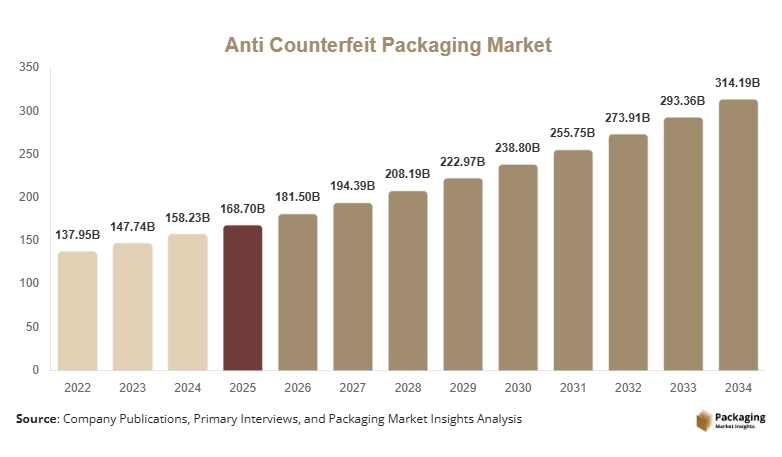
The global anti counterfeit packaging market was valued at approximately USD 168.7 billion in 2025 and is expected to reach nearly USD 181.5 billion in 2026. By 2034, the market is forecast to attain around USD 337.4 billion, registering a CAGR of 7.1% during 2025–2034. Anti counterfeit packaging solutions include holograms, RFID tags, tamper-evident seals, smart labels, serialization technologies, and authentication systems designed to protect products from duplication and illegal distribution. The anti counterfeit packaging market is experiencing significant growth due to rising concerns regarding product authenticity, increasing global trade activities, and stronger regulatory requirements across pharmaceutical, food, cosmetics, and consumer goods industries.
One of the primary growth factors driving the market is the increasing prevalence of counterfeit pharmaceutical products worldwide. Governments and healthcare organizations are strengthening regulations to ensure drug traceability and patient safety. Pharmaceutical companies are investing heavily in serialization and track-and-trace technologies to comply with global standards and reduce counterfeit risks. Another major factor supporting market growth is the expansion of e-commerce platforms. Online retail channels have increased the circulation of counterfeit products, encouraging manufacturers to adopt advanced authentication packaging technologies to protect brand reputation and consumer trust.
Key Highlights
- Asia Pacific dominated the market with a 36.9% share in 2025.
- Latin America is projected to grow at the fastest CAGR of 7.8%.
- Authentication technologies led the technology segment with a 42.6% share.
- Pharmaceutical applications dominated with a 38.7% share.
- RFID-based packaging solutions accounted for 29.8% of the market sharey.
- The US remained the dominant country with a market size of USD 24.3 billion in 2025 and USD 26.1 billion in 2026.
Explore more data points, trends and opportunities Download Free Sample Report
Market Trends
Integration of Smart Authentication Technologies
The integration of smart authentication technologies is becoming a major trend within the anti counterfeit packaging market. Companies are increasingly adopting QR codes, NFC tags, RFID chips, and blockchain-enabled systems to improve product traceability and verification. Consumers can now scan packaging using smartphones to confirm authenticity and access product origin information. This trend is particularly strong in pharmaceutical, luxury cosmetics, and premium beverage industries where counterfeit risks are high. Smart authentication technologies also help manufacturers monitor supply chain movement and detect unauthorized distribution channels. As digital infrastructure improves globally, the adoption of connected packaging solutions is expected to accelerate further.
Rising Adoption of Sustainable Security Packaging
Sustainability considerations are increasingly influencing anti counterfeit packaging strategies across industries. Packaging companies are developing recyclable holograms, eco-friendly tamper-evident labels, and biodegradable authentication materials to align with environmental regulations. Brands are seeking security packaging solutions that provide protection against counterfeiting without increasing packaging waste. Food and beverage manufacturers, in particular, are focusing on lightweight and recyclable anti counterfeit packaging systems to improve sustainability performance. The combination of environmental responsibility and product protection is encouraging innovation in sustainable security technologies, supporting the long-term evolution of the anti counterfeit packaging industry.
Market Drivers
Increasing Counterfeit Pharmaceutical Products
The growing circulation of counterfeit pharmaceutical products is one of the strongest drivers supporting the anti counterfeit packaging market. Counterfeit medicines create serious public health risks and financial losses for pharmaceutical manufacturers worldwide. Governments are implementing stricter serialization and drug traceability regulations to improve patient safety and reduce illegal product distribution. Pharmaceutical companies are increasingly adopting tamper-evident seals, RFID tracking, and unique serialization codes to comply with regulatory standards. Anti counterfeit packaging technologies help manufacturers maintain supply chain transparency and strengthen consumer confidence. Rising healthcare spending and global pharmaceutical trade are expected to continue supporting demand for advanced packaging security solutions.
Expansion of E-Commerce and Global Trade
The rapid expansion of e-commerce platforms and cross-border trade is significantly increasing the demand for anti counterfeit packaging technologies. Online retail channels often expose consumers to counterfeit goods, particularly in cosmetics, electronics, luxury items, and nutritional supplements. Manufacturers are investing in authentication packaging systems to protect brand image and improve product verification across digital sales channels. Track-and-trace technologies allow companies to monitor distribution networks and identify unauthorized sellers. The growing complexity of global supply chains is also encouraging adoption of secure packaging solutions that provide real-time visibility and authenticity assurance throughout product transportation and retail operations.
Market Restraint
High Implementation Costs and Technology Integration Challenges
One of the major restraints affecting the anti counterfeit packaging market is the high implementation cost associated with advanced authentication technologies. Small and medium-sized manufacturers often face financial challenges when adopting RFID systems, blockchain-based traceability platforms, or serialization technologies. These solutions require investment in specialized equipment, software integration, employee training, and supply chain infrastructure upgrades. The cost burden can be particularly significant for companies operating in low-margin industries such as food processing and consumer packaged goods.
Technology integration complexity also creates operational challenges across multi-regional supply chains. Different countries may follow varying serialization regulations and authentication standards, making standardization difficult for global manufacturers. For example, pharmaceutical exporters often need to comply with multiple labeling and traceability regulations depending on destination markets. In some developing economies, limited digital infrastructure and insufficient scanning systems can reduce the effectiveness of advanced anti counterfeit packaging technologies. Additionally, counterfeiters continuously adapt their techniques, forcing companies to invest regularly in upgraded security features. These factors may slow adoption rates among cost-sensitive businesses and create barriers for smaller industry participants.
Market Opportunities
Growth of Blockchain-Based Traceability Systems
Blockchain-enabled packaging verification systems are creating strong growth opportunities in the anti counterfeit packaging market. Blockchain technology provides secure and tamper-resistant digital records that improve supply chain transparency and product authentication. Pharmaceutical companies, luxury goods manufacturers, and food producers are increasingly exploring blockchain integration to monitor product movement from manufacturing facilities to retail channels. Consumers can verify product origin and authenticity using smartphone-enabled scanning systems connected to blockchain platforms. This technology also improves regulatory compliance and reduces risks associated with unauthorized product substitution. As digital supply chain management becomes more widespread, blockchain-based anti counterfeit solutions are expected to witness increasing adoption globally.
Increasing Demand from Food and Beverage Industry
The food and beverage industry is emerging as a major opportunity area for anti counterfeit packaging providers. Rising concerns regarding food safety, product adulteration, and counterfeit alcoholic beverages are encouraging manufacturers to adopt advanced authentication packaging solutions. QR-code labels, tamper-evident caps, and holographic seals are increasingly used for packaged foods, infant formula, and premium beverages. Consumers are becoming more aware of product authenticity and are seeking transparency regarding sourcing and manufacturing practices. The expansion of international food trade and premium food exports is expected to create sustained demand for secure packaging technologies during the forecast period.
Report Scope
| Report Metric | Details |
|---|---|
| Market Size in 2025 | USD 168.7 Billion |
| Market Size in 2026 | USD 181.5 Billion |
| Market Size in 2034 | USD 337.4 Billion |
| CAGR | 7.1% (2026-2034) |
| Base Year for Estimation | 2025 |
| Historical Data | 2022-2024 |
| Forecast Period | 2026-2034 |
| Report Coverage | Revenue Forecast, Competitive Landscape, Supply Chain Disruption, Growth Factors, Environment & Regulatory Landscape and Trends |
| Geographies Covered | North America, Europe, APAC, Middle East and Africa, LATAM |
| Countries Covered | U.S., Canada, U.K., Germany, France, Spain, Italy, Russia, Nordic, Benelux, Rest of Europe, China, South Korea, Japan, India, Australia, Singapore, Taiwan, South East Asia, Rest of Asia-Pacific, UAE, Turky, Saudi Arabia, South Africa, Egypt, Nigeria, Rest of MEA, Brazil, Mexico, Argentina, Chile, Colombia, Rest of LATAM |
Explore more data points, trends and opportunities Download Free Sample Report
Segmental Analysis
By Technology
Authentication technologies dominated the anti counterfeit packaging market in 2024 and accounted for approximately 42.6% of the global market share. This segment includes holograms, color-shifting inks, tamper-evident labels, and security printing systems used across pharmaceutical, food, and cosmetics industries. Manufacturers prefer authentication technologies because they provide visible product verification and improve consumer confidence. Holographic labels and tamper-proof seals are widely adopted due to their affordability and ease of implementation. Rising concerns regarding counterfeit drugs and branded consumer products continue to support strong demand for authentication-based packaging systems across global supply chains.
Track-and-trace technologies are expected to register the fastest CAGR of 8.1% during the forecast period. These systems include RFID tags, serialization platforms, QR-code tracking, and blockchain-based verification tools. Companies are increasingly investing in digital traceability solutions to improve supply chain transparency and regulatory compliance. Pharmaceutical manufacturers, in particular, are adopting serialization systems to comply with global healthcare regulations. Growth in e-commerce retail and cross-border product movement is also encouraging adoption of advanced tracking technologies that allow manufacturers and consumers to monitor product authenticity in real time.
By Packaging Format
Labels dominated the packaging format segment in 2024 and held approximately 37.9% of the market share. Security labels are widely used because they offer flexibility, affordability, and compatibility across multiple packaging formats. Holographic labels, barcode labels, and tamper-evident stickers are commonly used in pharmaceuticals, packaged foods, cosmetics, and electronics industries. Labels provide visual authentication and help companies strengthen brand protection without major changes to packaging design. Growing adoption of smart labels integrated with QR codes and digital verification features is further supporting segment expansion in both developed and emerging markets.
RFID-enabled packaging solutions are anticipated to witness the fastest growth during the forecast period, expanding at a CAGR of 8.4%. RFID technologies improve inventory monitoring, supply chain visibility, and product authentication across complex distribution systems. Retailers and pharmaceutical companies are increasingly adopting RFID tags because they provide automated product tracking and reduce risks associated with counterfeit goods. Technological advancements in low-cost RFID chips and cloud-based inventory management systems are supporting wider adoption. Increased demand for real-time logistics monitoring in e-commerce operations is also accelerating growth within this segment.
By End-Use Industry
Pharmaceutical applications dominated the market in 2024 with a share of approximately 38.7%. Pharmaceutical companies face strict regulatory requirements regarding serialization, traceability, and patient safety, making anti counterfeit packaging technologies essential across drug manufacturing and distribution operations. Tamper-evident closures, unique serial numbers, and track-and-trace systems are widely used to reduce counterfeit medicine circulation. Rising healthcare spending and increasing global pharmaceutical trade are also supporting demand for secure packaging solutions. Additionally, growing adoption of digital healthcare systems is improving implementation of advanced product authentication technologies within pharmaceutical supply chains.
Food and beverage applications are projected to grow at the fastest CAGR of 7.5% during the forecast period. Rising concerns regarding counterfeit alcoholic beverages, infant formula, and premium packaged foods are encouraging manufacturers to invest in authentication packaging solutions. Consumers are increasingly demanding transparency regarding product sourcing and manufacturing practices. Food producers are adopting QR-code verification systems, holographic seals, and tamper-proof closures to improve consumer trust and protect brand reputation. Expanding international trade of packaged food products is expected to further strengthen growth within this segment.
Anti Counterfeit Packaging Market Segmentations
By Technology
- Authentication Technologies
- Track-and-Trace Technologies
- Tamper-Evident Technologies
- RFID and Smart Packaging Technologies
By Packaging Format
- Labels
- Tapes
- Pouches and Sachets
- RFID-Enabled Packaging
By End-Use Industry
- Pharmaceuticals
- Food and Beverage
- Cosmetics and Personal Care
- Consumer Electronics
- Industrial Products
Regional Analysis
North America
North America accounted for approximately 27.5% of the global anti counterfeit packaging market share in 2025 and is projected to grow at a CAGR of 6.6% during the forecast period. Strong pharmaceutical regulations, advanced digital infrastructure, and increasing concerns regarding counterfeit consumer goods are driving market expansion across the region. Companies are investing heavily in RFID tracking systems, smart labels, and serialization technologies to strengthen supply chain security. The growing popularity of e-commerce and direct-to-consumer retail channels is also increasing demand for authentication packaging solutions.
The United States dominates the North American market because of its large pharmaceutical industry and advanced retail distribution network. One unique growth factor is the strong adoption of track-and-trace regulations for prescription drugs and medical products. Pharmaceutical companies are continuously implementing advanced authentication systems to comply with healthcare regulations and improve product transparency throughout distribution channels.
Europe
Europe represented approximately 29.1% of the global market share in 2025 and is expected to expand at a CAGR of 6.7% during the forecast period. The region benefits from strict anti-counterfeiting regulations and strong consumer awareness regarding product authenticity. Luxury goods manufacturers, cosmetics companies, and pharmaceutical producers are increasingly investing in authentication packaging technologies to reduce illegal product circulation. The European market is also witnessing strong adoption of sustainable anti counterfeit labels and recyclable security materials due to environmental regulations.
Germany remains the dominant country within the European market due to its advanced manufacturing sector and strong pharmaceutical export industry. One unique growth factor is the increasing use of digital authentication technologies for premium automotive components and industrial equipment packaging. Companies are integrating QR-based verification systems to improve product traceability and reduce counterfeit risks across industrial supply chains.
Asia Pacific
Asia Pacific dominated the anti counterfeit packaging market with a 36.9% share in 2025 and is expected to register a CAGR of 7.5% during the forecast period. Rapid industrialization, rising exports of branded consumer goods, and increasing counterfeit product circulation are major factors supporting market growth. Governments across the region are implementing stricter packaging and labeling regulations to improve product safety and export quality standards. Expanding pharmaceutical production and growing e-commerce activity are also contributing to rising demand for anti counterfeit packaging technologies.
China dominates the regional market because of its large manufacturing sector and strong export-oriented economy. One unique growth factor is the increasing adoption of QR-code authentication systems among food, beverage, and cosmetics manufacturers. Companies are using digital verification technologies to improve consumer trust and strengthen international trade compliance for exported products.
Middle East & Africa
The Middle East & Africa region accounted for approximately 3.8% of the global market share in 2025 and is projected to grow at a CAGR of 7.0% during the forecast period. Rising concerns regarding counterfeit pharmaceuticals, imported food products, and luxury goods are supporting demand for authentication packaging solutions. Governments are increasingly focusing on healthcare regulations and customs monitoring to reduce illegal trade activities. Packaging companies are also introducing tamper-evident labels and holographic security technologies to improve product verification capabilities across retail channels.
Saudi Arabia dominates the regional market due to increasing pharmaceutical imports and expansion of organized retail infrastructure. One unique growth factor is the growing demand for secure packaging solutions for premium perfumes and cosmetic products. Luxury product distributors are increasingly adopting authentication labels and tamper-proof seals to reduce counterfeit product circulation in retail markets.
Latin America
Latin America represented approximately 2.7% of the global market share in 2025 and is expected to witness the fastest CAGR of 7.8% during the forecast period. Increasing counterfeit food products, alcoholic beverages, and pharmaceuticals are driving market demand across the region. Governments are strengthening packaging regulations and customs monitoring systems to improve product safety standards. Rising consumer awareness regarding counterfeit goods and expansion of branded retail channels are also supporting growth in anti counterfeit packaging adoption.
Brazil remains the dominant country within the Latin American market because of its growing pharmaceutical industry and expanding packaged food sector. One unique growth factor is the increasing use of authentication packaging technologies for alcoholic beverage exports. Beverage manufacturers are implementing QR-code verification systems and tamper-evident closures to strengthen product authenticity in international markets.
Competitive Landscape
The anti counterfeit packaging market is characterized by strong competition among global packaging technology providers, authentication solution developers, and security printing companies. Major participants are focusing on digital traceability technologies, sustainable authentication materials, and smart packaging integration to strengthen market presence. Companies are also investing in mergers, acquisitions, and product innovation strategies to expand their customer base across pharmaceutical, food, and consumer goods industries.
3M Company remains one of the leading participants in the market due to its broad portfolio of authentication technologies and global distribution capabilities. In 2024, the company launched advanced tamper-evident labeling solutions designed for pharmaceutical and medical device packaging applications. Other major companies operating in the market include Avery Dennison Corporation, Zebra Technologies Corporation, SICPA Holding SA, and CCL Industries Inc. These companies are focusing on RFID innovation, digital serialization platforms, and holographic security technologies to address rising global demand for anti counterfeit packaging solutions.
Key Players List
- 3M Company
- Avery Dennison Corporation
- Zebra Technologies Corporation
- SICPA Holding SA
- CCL Industries Inc.
- DuPont de Nemours Inc.
- SATO Holdings Corporation
- AlpVision SA
- Authentix Inc.
- Honeywell International Inc.
- Uflex Limited
- Applied DNA Sciences Inc.
- De La Rue plc
- Brady Corporation
- Optel Group
- Alien Technology LLC
- NanoMatriX Technologies Limited