Security Printing Services Market Size and Growth
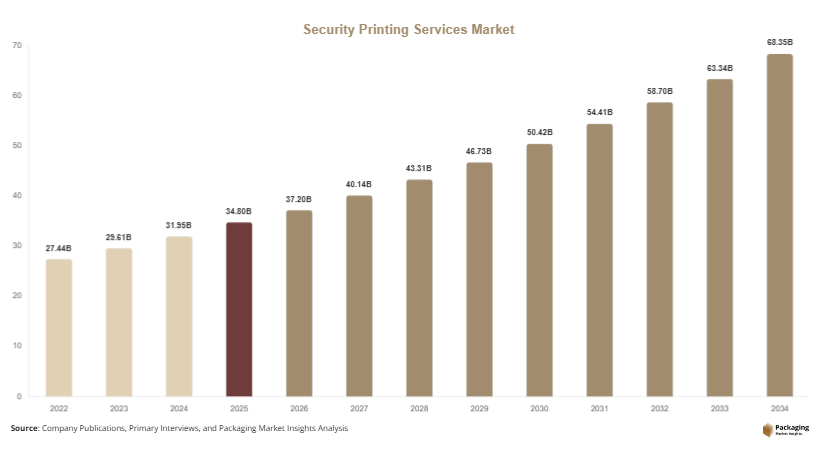
The global security printing services market is estimated at USD 34.8 billion in 2025, and it is projected to reach USD 37.2 billion in 2026. By 2034, the market is expected to expand to USD 68.5 billion, registering a CAGR of 7.9% (2025–2034). This growth is driven by rising demand for secure identification systems, increasing digital payment ecosystems, and heightened concerns regarding fraud and identity theft.
The security printing services market is an essential segment of the global printing and authentication industry, focused on the production of secure documents and materials designed to prevent counterfeiting, forgery, and unauthorized duplication. These services are widely used for banknotes, passports, identity cards, certificates, tax stamps, tickets, cheques, and secure labels. The market is increasingly becoming critical as governments, financial institutions, and enterprises strengthen identity verification systems and adopt advanced anti-counterfeit technologies.
Key Highlights:
- Asia Pacific dominated the market with a 37.4% share in 2025.
- Latin America is projected to grow at the fastest CAGR of 6.2%.
- Banknote printing services led the type segment with a 32.8% share.
- Paper-based security materials dominated with a 51.5% share.
- Government & financial institutions led the segment with 46.2% share.
- The US remained the dominant country with a market size of USD 9.8 billion in 2025 and USD 10.4 billion in 2026.
Explore more data points, trends and opportunities Download Free Sample Report
Market Trends
Increasing Adoption of Digital and Hybrid Security Printing Technologies
A major trend in the security printing services market is the integration of digital technologies with traditional printing methods to create hybrid security solutions. Governments and enterprises are increasingly adopting digital authentication features such as QR codes, blockchain verification, and encrypted data embedding within printed documents. For example, modern passports now include embedded chips that store biometric data alongside printed security features. Similarly, financial institutions are incorporating dynamic QR codes in transaction receipts for real-time verification. This trend is expected to accelerate as digital identity ecosystems expand globally, enabling seamless integration between physical and digital authentication systems.
Expansion of Multi-Layered Anti-Counterfeit Printing Solutions
Another key trend is the growing demand for multi-layered anti-counterfeit printing technologies. Security documents now incorporate multiple protection layers such as holograms, microtext, color-shifting inks, and UV-visible features. For instance, central banks across Europe and Asia are issuing banknotes with advanced holographic strips and tactile features to prevent duplication. Pharmaceutical companies are also adopting tamper-proof labels with serialized codes to ensure product authenticity. In the future, security printing will increasingly rely on AI-powered verification systems and machine-readable features, strengthening fraud prevention across both public and private sectors.
Market Drivers
Rising Government Initiatives for Secure Identification Systems
One of the primary drivers of the security printing services market is the global expansion of secure identification systems. Governments are increasingly issuing biometric ID cards, digital passports, and national identity programs to enhance citizen verification and border security. For example, countries in Asia and Africa are implementing national digital ID systems linked to secure printed credentials. This has significantly increased demand for high-security printing services incorporating biometric data, holograms, and encrypted features. The expansion of e-governance platforms further supports this trend, ensuring secure access to public services.
Growth in Financial Security and Currency Printing Demand
Another key driver is the increasing demand for secure financial documents, including currency notes, cheques, bonds, and certificates. Central banks are continuously upgrading banknote designs with advanced security features to prevent counterfeiting. For instance, newly issued banknotes in several countries now include polymer substrates, transparent windows, and color-shifting elements. Additionally, the expansion of digital banking has not reduced demand for secure physical documents, as financial institutions still rely on printed security instruments for regulatory and transactional purposes.
Market Restraint
High Cost of Advanced Security Printing Technologies
One of the major restraints in the security printing services market is the high cost associated with advanced security printing technologies. Features such as holographic foils, biometric embedding, and polymer-based substrates require specialized machinery and materials, significantly increasing production costs. Small-scale governments and private organizations often face budget constraints when adopting these technologies. Additionally, frequent upgrades to security features are required to stay ahead of counterfeiters, further increasing operational expenses. For example, upgrading national ID systems or banknote designs involves large-scale investment in printing infrastructure, limiting adoption in cost-sensitive regions.
Market Opportunities
Expansion of Digital Identity and E-Governance Systems
The rapid growth of digital identity programs presents a major opportunity for the security printing services market. Governments are increasingly integrating physical secure documents with digital identity platforms, enabling hybrid authentication systems. For example, national ID cards are now linked with digital databases, allowing secure access to banking, healthcare, and government services. This integration creates demand for advanced printing solutions that combine physical and digital security features. In the future, security printing will play a key role in supporting global digital governance ecosystems.
Increasing Demand from Pharmaceutical and Luxury Goods Industries
Another significant opportunity lies in the pharmaceutical and luxury goods sectors, where counterfeiting risks are high. Security printing is increasingly used for tamper-proof packaging, authentication labels, and serialized tracking codes. For example, pharmaceutical companies use secure printing on medicine packaging to prevent counterfeit drugs, while luxury brands use holographic labels to verify product authenticity. This trend is expected to grow as consumer awareness increases and regulatory frameworks become stricter across global markets.
Report Scope
| Report Metric | Details |
|---|---|
| Market Size in 2025 | USD 34.8 Billion |
| Market Size in 2026 | USD 37.2 Billion |
| Market Size in 2034 | USD 68.5 Billion |
| CAGR | 7.9% (2026-2034) |
| Base Year for Estimation | 2025 |
| Historical Data | 2022-2024 |
| Forecast Period | 2026-2034 |
| Report Coverage | Revenue Forecast, Competitive Landscape, Supply Chain Disruption, Growth Factors, Environment & Regulatory Landscape and Trends |
| Geographies Covered | North America, Europe, APAC, Middle East and Africa, LATAM |
| Countries Covered | U.S., Canada, U.K., Germany, France, Spain, Italy, Russia, Nordic, Benelux, Rest of Europe, China, South Korea, Japan, India, Australia, Singapore, Taiwan, South East Asia, Rest of Asia-Pacific, UAE, Turky, Saudi Arabia, South Africa, Egypt, Nigeria, Rest of MEA, Brazil, Mexico, Argentina, Chile, Colombia, Rest of LATAM |
Explore more data points, trends and opportunities Download Free Sample Report
Segmental Analysis
By Type
Banknote printing services dominated with a 32.8% share in 2024, driven by continuous currency circulation and periodic redesign of banknotes by central banks. Governments invest heavily in upgrading currency security features, including holograms and polymer substrates. For example, several countries in Asia have introduced next-generation banknotes with enhanced anti-counterfeit properties.
Digital security printing solutions are the fastest-growing segment with a CAGR of 7.3%, driven by the integration of digital authentication systems. These include QR-coded documents, blockchain-linked certificates, and electronically verifiable IDs. Future growth will be supported by hybrid physical-digital identity systems.
By Material
Paper-based security materials dominated with a 51.5% share in 2024, due to widespread use in currency, passports, and certificates. Paper remains the most widely used substrate for secure documents due to its compatibility with advanced security features.
Polymer-based substrates are the fastest-growing segment with a CAGR of 6.7%, driven by durability and enhanced security capabilities. Countries are increasingly adopting polymer banknotes to reduce counterfeit risks and extend circulation life.
By End-Use
Government & financial institutions dominated with a 46.2% share in 2024, driven by demand for secure identity documents and currency printing. Governments remain the largest consumers of security printing services.
Corporate security printing is the fastest-growing segment with a CAGR of 6.9%, driven by increasing brand protection needs in pharmaceuticals, electronics, and luxury goods industries.
Security Printing Services Market Segmentations
By Type
- Banknote Printing Services
- Identity Document Printing
- Secure Label Printing
- Tax Stamp Printing
- Cheque & Financial Document Printing
- Digital Security Printing Solutions
By Material
- Paper-Based Security Substrates
- Polymer-Based Substrates
- Hybrid Security Materials
- Metallic Security Foils
- Security Inks & Coatings
By End-User
- Government & Public Sector
- Banking & Financial Institutions
- Pharmaceutical Industry
- Corporate Enterprises
- Luxury Goods & Brand Protection
- Transport & Ticketing Services
Regional Analysis
North America
North America accounted for 28.7% market share in 2025, with a CAGR of 7.4%. The region benefits from advanced security infrastructure, strong financial systems, and high adoption of digital identity solutions. Demand is driven by government initiatives and financial security printing.
The United States dominates the region due to its strong federal identification and financial systems. A key growth driver is the expansion of biometric passport and digital ID programs integrated with secure printing technologies. For example, U.S. government agencies are increasingly adopting chip-enabled identity documents to enhance border security and fraud prevention.
Europe
Europe held 24.3% market share in 2025, with a CAGR of 7.2%. The region is characterized by strict regulatory frameworks, advanced printing technologies, and strong demand for anti-counterfeit solutions. Security printing is widely used in banking and government sectors.
Germany leads the region due to its advanced printing technology ecosystem. A key driver is the production of high-security euro banknotes incorporating multi-layered authentication features. European central banks continuously upgrade currency designs to stay ahead of counterfeit threats.
Asia Pacific
Asia Pacific dominated with 37.4% market share in 2025, and is projected to grow at a CAGR of 8.5%. Rapid population growth, government digitization programs, and expanding financial systems are key growth drivers.
China remains the dominant country due to its large-scale identity and financial documentation systems. A key driver is the national digital ID expansion program, which integrates secure printed credentials with centralized biometric databases.
Middle East & Africa
The region accounted for 5.6% market share in 2025, with a CAGR of 6.8%. Growth is driven by increasing government modernization initiatives, border security enhancements, and financial system expansion.
The UAE dominates the region due to its advanced e-governance systems. A key driver is the adoption of smart identity cards integrated with secure printing features for public service access and immigration control.
Latin America
Latin America held 3.9% market share in 2025, with a CAGR of 6.2%, the fastest among all regions. Growth is driven by increasing government digitization and financial modernization efforts.
Brazil leads the region due to its national identity modernization programs. A key driver is the rollout of biometric identity cards with embedded security printing features to reduce fraud and improve citizen verification systems.
Competitive Landscape
The security printing services market is moderately consolidated, with major players focusing on advanced anti-counterfeit technologies, digital integration, and global expansion. Key companies include De La Rue plc, Giesecke+Devrient GmbH, Security Printing and Minting Corporation of India Ltd. (SPMCIL), Oberthur Fiduciaire, and Crane Currency. Among these, De La Rue plc leads the market due to its strong global presence and expertise in banknote and identity document printing.
Companies are investing in biometric security integration, blockchain authentication, and advanced printing materials. Strategic collaborations with governments and financial institutions are also increasing to enhance secure document issuance systems.
Key Players List
- De La Rue plc
- Giesecke+Devrient GmbH
- SPMCIL
- Oberthur Fiduciaire
- Crane Currency
- HID Global
- Document Security Systems Inc.
- AlpVision SA
- CCL Industries Inc.
- SICPA Holding SA
- Royal Joh. Enschedé
- Fort Wayne Metals Security Division
- Louisenthal GmbH
- Uflex Security Printing Division
- Bundesdruckerei GmbH