Interior Packaging Market Size and Growth
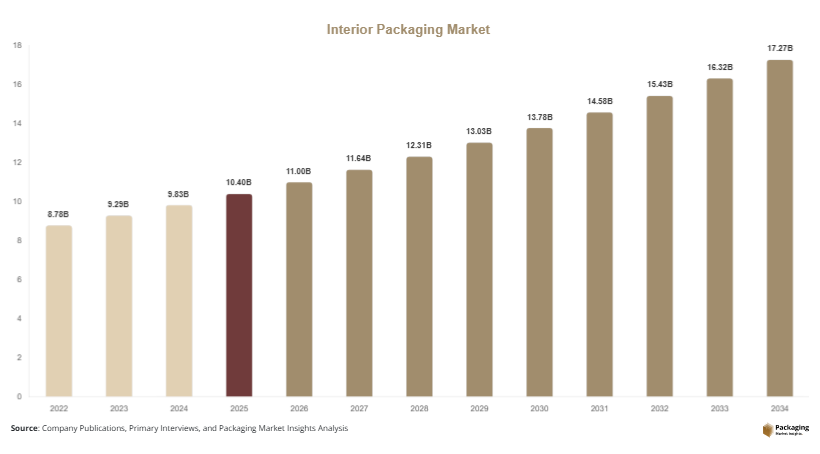
The global interior packaging market size is estimated at USD 10.4 billion in 2025 and is projected to reach USD 11.0 billion in 2026. By 2034, the market is expected to reach USD 18.6 billion, expanding at a CAGR of 5.8% (2025–2034). The interior packaging market plays a critical role in protecting goods during storage, handling, and transportation by using cushioning, void fill, wrapping, and compartment-based solutions. The market is witnessing steady expansion due to increasing global trade, growth in e-commerce shipments, and rising demand for safe transportation of fragile and high-value products.
Several structural growth factors are supporting this expansion. First, the rapid growth of e-commerce and direct-to-consumer logistics is increasing the need for protective packaging materials that minimize product damage during last-mile delivery. Second, the expansion of electronics manufacturing, particularly in Asia and North America, is driving demand for anti-static and shock-absorbing interior packaging solutions. Third, the pharmaceutical and healthcare sectors are increasing usage of temperature-sensitive and contamination-resistant packaging formats to maintain product integrity during transit.
Key Highlights:
- Asia Pacific dominated the market with a 37.4% share in 2025.
- Latin America is projected to grow at the fastest CAGR of 6.2%.
- Antioxidants led the type segment with a 29.6% share.
- Plastic packaging dominated with a 52.3% share.
- Food & beverage applications led the segment with 43.1% share.
- China remained the dominant country with a market size of USD 11.2 billion in 2025 and USD 11.9 billion in 2026.
Explore more data points, trends and opportunities Download Free Sample Report
Market Trends
Shift Toward Sustainable Interior Packaging Materials
The interior packaging market is experiencing a strong shift toward eco-friendly materials such as molded pulp, corrugated inserts, recycled paper cushioning, and biodegradable foam alternatives. This transition is driven by regulatory pressure on single-use plastics and corporate sustainability commitments across retail, electronics, and logistics industries. For example, several e-commerce companies in Europe have started replacing polyethylene foam inserts with molded fiber trays for electronics and cosmetics packaging. In the automotive aftermarket, recyclable cardboard partition systems are increasingly used instead of EPS foam for spare part protection. This trend is expected to expand further as brands integrate circular economy models into packaging design. Over the forecast period, sustainability-driven material innovation will become a key differentiator, especially in North America and Europe, where environmental compliance standards are stricter.
Adoption of Modular and Precision-Cut Packaging Designs
Another significant trend is the rising adoption of modular and precision-cut interior packaging systems that are tailored to specific product geometries. These solutions reduce material waste while improving protection efficiency during transport. Industries such as electronics, medical devices, and aerospace components are increasingly using die-cut foam, thermoformed trays, and custom inserts to ensure zero-movement packaging. For instance, semiconductor manufacturers in South Korea are deploying anti-static precision inserts to prevent micro-damage during shipment. In the pharmaceutical sector, modular partition systems are used to separate vials and prevent breakage. The future impact of this trend will include higher automation compatibility, reduced packaging time, and improved logistics efficiency across global supply chains.
Market Drivers
Expansion of E-commerce and Omnichannel Retail
The rapid growth of e-commerce platforms is one of the strongest drivers of the interior packaging market. As online retail expands globally, the need for protective packaging that ensures product safety during last-mile delivery has increased significantly. Products such as electronics, glassware, cosmetics, and apparel require cushioning materials to prevent damage. For example, Amazon and Alibaba logistics networks use layered interior packaging systems to reduce return rates caused by transit damage. The growth of same-day delivery services has further increased demand for lightweight, cost-efficient protective packaging. As a result, manufacturers are developing scalable interior packaging solutions compatible with automated fulfillment centers.
Growth in Electronics and Automotive Component Logistics
The electronics and automotive sectors are heavily dependent on interior packaging for safe transportation of sensitive components. Semiconductor chips, circuit boards, sensors, and automotive spare parts require anti-static and shock-resistant packaging solutions. For example, automotive suppliers in Germany and Japan use custom thermoformed trays for engine control modules and electronic sensors. Similarly, electronics manufacturers in China and Taiwan use foam-based inserts for smartphone and battery shipping. The increasing complexity of supply chains in these industries is driving continuous demand for precision interior packaging systems that minimize damage risk and ensure compliance with quality standards.
Market Restraint
Fluctuating Raw Material Costs and Plastic Dependency
One of the major restraints affecting the interior packaging market is the volatility in raw material prices, particularly for plastics, polymers, and specialty foams. Many traditional interior packaging solutions still rely on petroleum-based materials such as EPS foam, polyethylene, and polyurethane, which are highly sensitive to crude oil price fluctuations. This creates cost instability for manufacturers and end-users. For example, logistics companies in North America have reported increased packaging costs during periods of oil price spikes, directly affecting operating margins. Additionally, the transition toward sustainable materials often involves higher production costs, limiting adoption among small and medium enterprises. While biodegradable alternatives are emerging, they are not yet fully cost-competitive or scalable in all regions, which continues to restrain overall market expansion.
Market Opportunities
Growth of Biodegradable and Molded Fiber Packaging Solutions
The increasing focus on sustainability presents a major opportunity for biodegradable interior packaging solutions. Molded fiber, recycled pulp, and compostable cushioning materials are gaining traction across food delivery, electronics, and retail packaging applications. For instance, electronics brands in Europe are introducing molded pulp inserts for smartphones and laptops to reduce plastic waste. Governments in several countries are also promoting bans on expanded polystyrene, creating new opportunities for fiber-based alternatives. Over the forecast period, advancements in material engineering will improve strength, moisture resistance, and cost efficiency of biodegradable packaging, making it a mainstream option across industries.
Integration of Smart and Sensor-Based Packaging
The emergence of smart packaging technologies presents another high-growth opportunity. Interior packaging embedded with sensors, RFID tags, and IoT tracking systems enables real-time monitoring of temperature, shock, and humidity conditions during transit. This is particularly valuable in pharmaceuticals and high-value electronics logistics. For example, cold chain shipments of vaccines increasingly use sensor-enabled packaging inserts to ensure compliance with storage conditions. In the future, AI-integrated logistics systems will further enhance predictive damage detection, enabling companies to reduce losses and improve supply chain transparency.
Report Scope
| Report Metric | Details |
|---|---|
| Market Size in 2025 | USD 10.4 Billion |
| Market Size in 2026 | USD 11.0 Billion |
| Market Size in 2034 | USD 18.6 Billion |
| CAGR | 5.8% (2026-2034) |
| Base Year for Estimation | 2025 |
| Historical Data | 2022-2024 |
| Forecast Period | 2026-2034 |
| Report Coverage | Revenue Forecast, Competitive Landscape, Supply Chain Disruption, Growth Factors, Environment & Regulatory Landscape and Trends |
| Geographies Covered | North America, Europe, APAC, Middle East and Africa, LATAM |
| Countries Covered | U.S., Canada, U.K., Germany, France, Spain, Italy, Russia, Nordic, Benelux, Rest of Europe, China, South Korea, Japan, India, Australia, Singapore, Taiwan, South East Asia, Rest of Asia-Pacific, UAE, Turky, Saudi Arabia, South Africa, Egypt, Nigeria, Rest of MEA, Brazil, Mexico, Argentina, Chile, Colombia, Rest of LATAM |
Explore more data points, trends and opportunities Download Free Sample Report
Segmental Analysis
Type Segment
The dominant subsegment in 2024 was foam-based interior packaging, holding approximately 34.6% market share. Foam materials such as EPS and polyurethane are widely used due to their superior shock absorption, lightweight properties, and cost efficiency. Industries such as electronics, automotive, and fragile goods shipping rely heavily on foam inserts for product protection. For example, smartphone manufacturers in Asia use foam cushioning to secure devices during international shipments. Despite environmental concerns, foam remains dominant due to its performance reliability.
The fastest-growing subsegment is molded fiber packaging, projected to grow at a CAGR of 7.4%. This growth is driven by sustainability regulations and consumer preference for eco-friendly packaging. Molded fiber is increasingly used in electronics, cosmetics, and food delivery packaging. Its biodegradability and recyclability make it a preferred alternative to plastic foam.
Material Segment
Plastic-based materials dominated with 38.9% share in 2024, driven by widespread use of polyethylene and polypropylene in protective inserts. Their durability and flexibility make them suitable for industrial logistics and e-commerce packaging. For example, automotive spare parts logistics often uses plastic dividers for multi-component shipments.
The fastest-growing subsegment is biodegradable materials, growing at a CAGR of 7.9%, supported by regulatory bans on plastic and corporate sustainability initiatives. Innovations in bio-based polymers and recycled pulp are improving material performance and scalability.
End-Use Segment
E-commerce & retail logistics dominated with 41.2% market share in 2024, as rapid online shopping growth drives demand for protective packaging. Companies like Amazon, Alibaba, and Walmart rely heavily on interior packaging to reduce return rates.
The fastest-growing segment is pharmaceutical & healthcare logistics, with a CAGR of 8.1%, driven by rising biologics shipments and temperature-sensitive drug distribution. Interior packaging ensures stability, sterility, and compliance during transport.
Interior Packaging Market Segmentations
By Type
- Foam Packaging
- Molded Fiber Packaging
- Paper-Based Inserts
- Plastic Dividers
By Material
- Plastic
- Paper & Pulp
- Biodegradable Polymers
- Hybrid Composites
By End-User
- E-commerce & Retail
- Electronics
- Automotive
- Healthcare & Pharmaceuticals
Regional Analysis
North America
North America accounted for approximately 28.5% of the global interior packaging market in 2025, with a projected CAGR of 5.4% during the forecast period. The region’s growth is driven by strong e-commerce penetration, advanced logistics infrastructure, and high demand from electronics and healthcare industries. Increasing investments in automated warehouses are also boosting demand for standardized interior packaging systems that are compatible with robotic handling.
The United States dominates the regional market due to its large retail and industrial base. A key growth driver is the expansion of pharmaceutical distribution networks, particularly for biologics and temperature-sensitive drugs. For example, U.S.-based healthcare logistics providers use specialized insulated interior packaging to ensure compliance with FDA transport guidelines.
Europe
Europe held around 24.2% market share in 2025, with a CAGR of 5.2%. The region is strongly influenced by sustainability regulations and circular economy policies that encourage recyclable packaging adoption. Demand is increasing across automotive, cosmetics, and premium consumer goods sectors.
Germany leads the European market, driven by its strong automotive manufacturing industry. A unique growth driver is the adoption of recyclable interior packaging in electric vehicle component logistics. Automotive suppliers in Germany are increasingly replacing foam-based inserts with molded paper alternatives to meet sustainability targets.
Asia Pacific
Asia Pacific dominated with 37.4% market share in 2025 and is projected to grow at a CAGR of 6.6%, the highest globally. Rapid industrialization, expanding electronics manufacturing, and booming e-commerce activity are key growth drivers. Countries such as China, Japan, South Korea, and India are major contributors.
China is the dominant country in the region, supported by large-scale electronics exports. A key driver is the integration of automated packaging systems in manufacturing hubs, particularly in Shenzhen and Guangdong, where precision interior packaging is used for semiconductor and smartphone exports.
Middle East & Africa
The region accounted for 6.8% market share in 2025, with a CAGR of 5.1%. Growth is supported by increasing logistics development, retail expansion, and rising import-export activity. Infrastructure investments in UAE and Saudi Arabia are improving supply chain efficiency.
The UAE dominates the region, driven by its role as a global logistics hub. A key growth factor is the expansion of re-export trade through Dubai ports, increasing demand for durable interior packaging solutions for electronics and luxury goods.
Latin America
Latin America held 3.1% market share in 2025, but is projected to grow at a CAGR of 6.2%, the fastest among emerging regions. Growth is supported by expanding e-commerce penetration and rising industrial exports from Brazil and Mexico.
Brazil leads the regional market, driven by growth in food and beverage exports. A unique growth driver is the increasing use of recyclable interior packaging in agricultural product logistics, especially for coffee and fruit exports to North America and Europe.
Competitive Landscape
The interior packaging market is moderately consolidated, with key players focusing on material innovation, sustainability, and global supply chain expansion. Leading companies include Sonoco ThermoSafe, Cold Chain Technologies, Pelton Shepherd Industries, Sofrigam SA, and Cryopak Industries. These companies are investing in biodegradable materials, smart packaging integration, and automated production systems.
Sonoco ThermoSafe is considered a market leader due to its extensive global cold chain packaging portfolio and strong pharmaceutical partnerships. The company has recently expanded its molded fiber packaging production capacity to meet rising sustainability demand.
Cold Chain Technologies is focusing on high-performance insulated interior packaging solutions for healthcare logistics, particularly in vaccine distribution.
Strategic collaborations with logistics providers and e-commerce companies are becoming common, as firms aim to improve last-mile delivery efficiency and reduce damage rates.
Key Players List
- Sonoco ThermoSafe
- Cold Chain Technologies
- Pelton Shepherd Industries
- Sofrigam SA
- Cryopak Industries
- Huhtamaki Oyj
- Sealed Air Corporation
- DS Smith Plc
- Smurfit Kappa Group
- Storopack Hans Reichenecker
- Pregis LLC
- Ranpak Holdings
- ProAmpac LLC
- FP International
- Polymer Logistics