Inserts Dividers Market Size and Growth
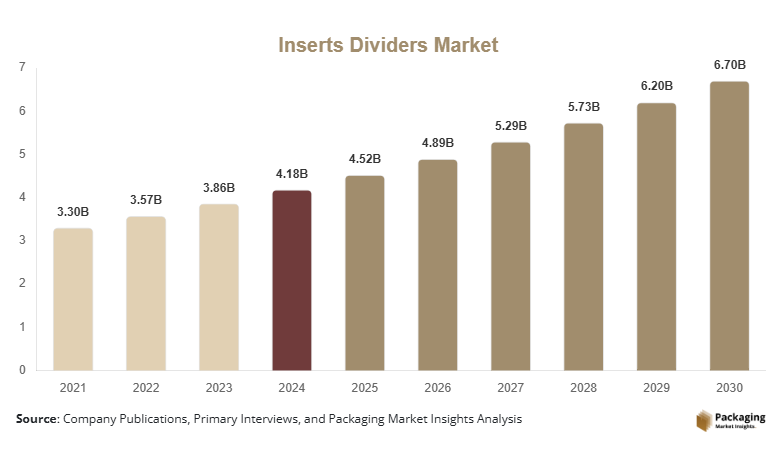
The global inserts dividers market size was valued at approximately USD 4.18 billion in 2024 and is projected to grow from around USD 4.52 billion in 2025 to reach nearly USD 6.71 billion by 2030, expanding at a CAGR of about 8.2% during the forecast period (2025–2030). Inserts and dividers are essential secondary packaging components used to separate, protect, and stabilize products during transportation and storage across industries such as food & beverages, pharmaceuticals, electronics, and industrial goods.
One of the primary global factors supporting market growth was the rapid expansion of organized logistics and warehousing infrastructure, particularly driven by e-commerce penetration and omnichannel retail models. The increased movement of high-value, fragile, and temperature-sensitive goods has intensified the need for customized inserts and dividers that reduce product damage, improve packaging efficiency, and optimize load management. Additionally, manufacturers have increasingly adopted automation-compatible packaging components, further strengthening demand for standardized and precision-engineered inserts and dividers.
The market outlook remains favorable as sustainability initiatives, material innovation, and rising cross-border trade continue to shape packaging strategies globally. Companies are shifting from traditional loose-fill packaging to structured divider systems to enhance supply chain reliability and cost control.
Key Highlights
- North America accounted for a dominant 34.6% market share in 2024, while Asia Pacific is expected to be the fastest-growing region with a CAGR of 9.6%.
- By material, the cardboard subsegment led the market, while the plastic subsegment is projected to grow at the fastest CAGR of 9.5%.
- By application, the is Office Supplies subsegment dominated, whereas industrial storage is anticipated to expand rapidly at a CAGR of 8.8%.
- The United States dominated country-level demand with a 2024 market value of USD 1.02 billion, increasing to USD 1.10 billion in 2025.
Explore more data points, trends and opportunities Download Free Sample Report
Latest Market Trends
Rising Adoption of Sustainable Packaging Inserts
Sustainability has emerged as a defining trend in the Inserts Dividers Market. Packaging manufacturers and end users are increasingly transitioning toward recyclable, biodegradable, and compostable materials such as molded pulp, paperboard, and fiber-based inserts. This trend has been reinforced by corporate sustainability commitments and tightening regulations related to plastic packaging waste. Brands are prioritizing inserts and dividers that offer structural integrity while reducing environmental impact, leading to increased innovation in fiber molding technologies and water-based adhesives.
Growth of Customization and Precision Packaging
Another significant trend shaping the market is the growing demand for custom-designed inserts and dividers. Industries such as electronics, medical devices, and premium consumer goods require precise packaging solutions to protect complex product geometries. Advances in CAD-based design, CNC cutting, and thermoforming have enabled manufacturers to deliver tailored solutions at scale. This trend has improved packaging performance, reduced material waste, and enhanced unboxing experiences, especially in direct-to-consumer shipments.
Market Drivers
Expansion of E-commerce and Omnichannel Distribution
The rapid growth of global e-commerce platforms has significantly driven demand for inserts and dividers. Online retail requires robust secondary packaging to withstand long-distance transportation, multiple handling points, and varied climatic conditions. Inserts and dividers help prevent product movement, reduce breakage rates, and lower return costs, making them essential components of modern fulfillment operations.
Increasing Demand for Product Protection in Industrial Logistics
Industrial sectors such as automotive components, chemicals, and heavy machinery parts increasingly rely on structured packaging systems. Inserts and dividers improve load stability and facilitate efficient stacking and palletization. As industrial supply chains become more complex and geographically dispersed, manufacturers are investing in standardized divider systems to improve operational efficiency and minimize damage-related losses.
Market Restraints
High Cost of Customized and Multi-Material Inserts
One of the major restraints affecting the Inserts Dividers Market is the relatively high cost associated with customized and multi-material packaging solutions. Custom inserts often require specialized tooling, design engineering, and low-volume production runs, which increase per-unit costs. Small and medium-sized enterprises may find it difficult to justify these investments, particularly in price-sensitive markets. Additionally, fluctuations in raw material prices, especially for paperboard and specialty polymers, further pressure margins and limit adoption in cost-driven applications.
Market Opportunities
Growth in Pharmaceutical and Healthcare Packaging
The pharmaceutical and healthcare sectors present strong growth opportunities for the Inserts Dividers Market. The rising production of injectable drugs, diagnostic kits, and medical devices requires precise and contamination-resistant packaging. Inserts and dividers designed for sterile and temperature-controlled environments are expected to witness increased demand, particularly in emerging healthcare markets.
Automation-Compatible Packaging Solutions
As warehouses and packaging lines increasingly adopt automation and robotics, there is a growing demand for inserts and dividers that are compatible with automated handling systems. Lightweight, uniform, and machine-feedable divider designs offer significant potential for adoption. Manufacturers that align product development with automation trends are likely to gain competitive advantages over the forecast period.
Report Scope
| Report Metric | Details |
|---|---|
| Market Size in 2024 | USD 4.18 Billion |
| Market Size in 2025 | USD 4.52 Billion |
| Market Size in 2030 | USD 6.71 Billion |
| CAGR | 8.2% (2025-2030) |
| Base Year for Estimation | 2024 |
| Historical Data | 2021-2023 |
| Forecast Period | 2025-2030 |
| Report Coverage | Revenue Forecast, Competitive Landscape, Supply Chain Disruption, Growth Factors, Environment & Regulatory Landscape and Trends |
| Geographies Covered | North America, Europe, APAC, Middle East and Africa, LATAM |
| Countries Covered | U.S., Canada, U.K., Germany, France, Spain, Italy, Russia, Nordic, Benelux, Rest of Europe, China, South Korea, Japan, India, Australia, Singapore, Taiwan, South East Asia, Rest of Asia-Pacific, UAE, Turky, Saudi Arabia, South Africa, Egypt, Nigeria, Rest of MEA, Brazil, Mexico, Argentina, Chile, Colombia, Rest of LATAM |
Explore more data points, trends and opportunities Download Free Sample Report
Segmental Analysis
By Material Type
The Cardboard subsegment accounted for a dominant 42% share of the global market by material in 2024. This significant share was primarily due to its cost-effectiveness, recyclability, and ease of manufacturing, which make it highly suitable for both industrial and consumer packaging applications. Cardboard inserts are extensively used in retail packaging, office storage, and shipping operations due to their lightweight yet durable properties. Additionally, the material’s compatibility with automated packaging lines and its ability to be custom-cut or folded have reinforced its adoption across multiple industries.
The Plastic subsegment is projected to be the fastest-growing, demonstrating a CAGR of 9.5% from 2025 to 2030. This growth will be fueled by the increasing demand for durable, moisture-resistant, and lightweight inserts that provide enhanced protection for high-value and fragile products. Plastic inserts, made from polypropylene, polyethylene, and polystyrene, offer excellent barrier properties, impact resistance, and design flexibility, making them ideal for electronics, medical devices, and premium consumer goods packaging.
By Application
The Office Supplies subsegment represented a significant 35% share of the Inserts Dividers Market by application in 2024. This leading position was due to the widespread use of dividers in filing systems, drawer organizers, and stationery packaging, where organizational efficiency is highly valued. The ease of customization, low cost, and ability to standardize office storage solutions contributed to the strong demand in this segment globally.
The Industrial Storage subsegment is projected to achieve the fastest CAGR of 8.8% from 2025 to 2030. This growth will be driven by the increasing need for protective, standardized, and load-stable inserts in industrial warehouses and logistics centers. Inserts and dividers in industrial storage applications help prevent product movement, reduce damage, and optimize stacking, particularly for heavy machinery parts, automotive components, and bulk shipments. The rise in automated warehouse systems is expected to further boost adoption in this segment.
By Design Type
The Standard Inserts subsegment accounted for a dominant 38% share of the Inserts Dividers Market by design type in 2024. Their leading position was supported by versatility, cost efficiency, and ease of integration into a variety of packaging formats. Standard inserts are widely used across retail, household, and office applications due to their availability in predefined sizes and configurations, making them a convenient choice for high-volume packaging needs.
The Custom Inserts subsegment is projected to grow at the fastest CAGR of 10.2% from 2025 to 2030. This growth is expected to be driven by the increasing demand for product-specific packaging solutions that offer tailored protection for fragile or high-value items. Custom inserts enable companies to optimize product presentation, enhance user experience, and reduce material waste. Industries such as electronics, medical devices, and premium consumer goods are expected to continue investing in custom insert solutions to meet specialized packaging requirements.
Inserts Dividers Market Segmentations
By Material
- EPS (Expanded Polystyrene)
- PUF (Polyurethane Foam)
- PIR (Polyisocyanurate)
- Phenolic Foam
- Aerogel
By Application
- Perishables (Food & Beverages)
- Pharmaceuticals & Healthcare
- Electronics & Semi-conductors
- Chemicals & Petrochemicals
- Industrial Products
Closure Type
- Hinge
- Sliding
- Telescopic
- Vacuum-sealed
Regional Analysis
North America
North America held approximately 34.2% of the Inserts Dividers Market share in 2025 and was projected to grow at a CAGR of 7.1% from 2025 to 2033. The region’s mature logistics infrastructure and high penetration of e-commerce platforms supported steady demand for structured packaging solutions. The widespread adoption of automation in warehousing and fulfillment centers further reinforced market expansion.
The United States dominated the regional market due to its large consumer base and advanced packaging ecosystem. Strong demand from food & beverage, pharmaceuticals, and electronics manufacturing supported sustained growth. Investments in sustainable packaging innovation and compliance with environmental regulations also contributed to increased adoption of fiber-based inserts.
Europe
Europe accounted for nearly 27.8% market share in 2025 and is expected to expand at a CAGR of 6.8% through 2033. The region’s growth was supported by stringent packaging waste regulations and a strong emphasis on circular economy principles. European manufacturers increasingly favored recyclable and reusable inserts to align with regulatory frameworks.
Germany emerged as the dominant country, driven by its robust industrial manufacturing sector and export-oriented economy. High demand for protective packaging in automotive components and industrial machinery shipments contributed significantly to market growth.
Asia Pacific
Asia Pacific represented around 24.6% of the market in 2025 and is anticipated to grow at the fastest CAGR of 9.6% from 2025 to 2033. Rapid industrialization, expanding e-commerce penetration, and increasing consumer goods production fueled regional demand. The growth of regional manufacturing hubs further strengthened packaging requirements.
China led the Asia Pacific market due to its large-scale manufacturing output and expanding domestic consumption. Government support for logistics infrastructure and export growth played a key role in accelerating demand for inserts and dividers.
Middle East & Africa
The Middle East & Africa region held approximately 7.1% market share in 2025 and is projected to grow at a CAGR of 6.4%. Growth was driven by rising investments in logistics hubs and industrial zones, particularly in Gulf Cooperation Council (GCC) countries.
The United Arab Emirates dominated the region, supported by its strategic position as a global trade and logistics hub. Increased demand for protective packaging in re-export activities contributed to steady market expansion.
Latin America
Latin America accounted for about 6.3% of the market in 2025 and is expected to register a CAGR of 6.7% through 2033. Growth was supported by expanding food processing and consumer goods industries.
Brazil emerged as the leading country due to its large domestic manufacturing base and improving logistics infrastructure. Rising packaged food exports further supported demand for inserts and dividers.
Competitive Landscape
The Inserts Dividers Market is moderately fragmented, with global and regional players competing on material innovation, customization capabilities, and cost efficiency. Leading companies focus on expanding sustainable product portfolios and strengthening regional manufacturing footprints.
DS Smith Plc emerged as a market leader due to its integrated packaging solutions and strong emphasis on recyclable fiber-based inserts. In 2024, the company introduced a new range of lightweight corrugated dividers designed for automated packing lines. Other prominent players continue to invest in design optimization and digital printing to enhance product differentiation.
Key Players List
- DS Smith Plc
- Smurfit Kappa Group
- International Paper Company
- WestRock Company
- Packaging Corporation of America
- Sonoco Products Company
- Mondi Group
- Huhtamaki Oyj
- UFP Industries, Inc.
- Orora Packaging Australia Pty Ltd
- Nefab Group
- Sealed Air Corporation
- Stora Enso Oyj
- Georgia-Pacific LLC
- Pratt Industries