Packaging Nets Market Size and Growth
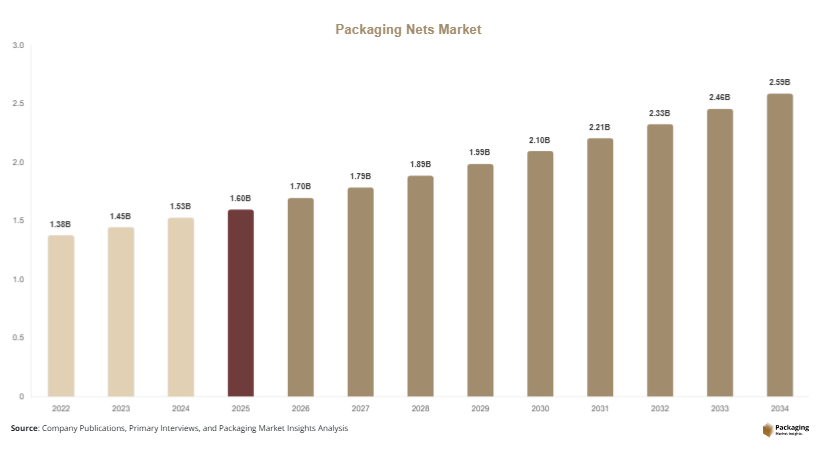
The global packaging nets market size was valued at approximately USD 1.6 billion in 2025 and is projected to reach USD 1.7 billion in 2026. Over the forecast period, the market is expected to expand to nearly USD 2.6 billion by 2034, registering a compound annual growth rate (CAGR) of 5.4% from 2025 to 2034. This growth reflects increasing adoption of lightweight and breathable packaging materials that improve product visibility and extend shelf life. The packaging nets market is experiencing steady growth, driven by rising demand for efficient and cost-effective packaging solutions across food, agriculture, and industrial sectors.
One of the primary growth factors is the rising demand for fresh produce packaging, particularly fruits and vegetables, where packaging nets provide ventilation and reduce spoilage. The growing global population and increasing consumption of packaged food products are contributing to the demand for effective packaging solutions. Another significant factor is the expansion of retail and supermarket chains, which require packaging that enhances product presentation while maintaining freshness. Additionally, the increasing focus on reducing packaging weight and material usage is encouraging the adoption of net-based packaging solutions.
Key Highlights:
- Asia Pacific dominated the market with a 40.2% share in 2025, while Latin America is projected to grow at the fastest CAGR of 6.1%.
- Extruded nets led the type segment with a 45.6% share, while knitted nets are expected to grow at a CAGR of 5.9%.
- Plastic-based nets dominated with a 62.4% share, while biodegradable nets are forecasted to grow at a CAGR of 6.3%.
- Food & agriculture applications led the segment with 52.7% share, while industrial packaging is expected to grow at a CAGR of 5.7%.
- China remained the dominant country with a market size of USD 280 million in 2025 and USD 295 million in 2026.
Explore more data points, trends and opportunities Download Free Sample Report
Market Trends
Increasing Adoption of Sustainable and Biodegradable Net Materials
The packaging nets market is witnessing a shift toward environmentally sustainable materials as regulatory pressure and consumer awareness increase. Manufacturers are focusing on developing biodegradable and recyclable net packaging solutions to reduce environmental impact. Traditional plastic nets are being replaced with materials derived from renewable resources or designed for easier recycling. This trend is particularly prominent in Europe and Asia Pacific, where environmental regulations are stricter. Companies are investing in research and development to create nets that maintain durability while meeting sustainability requirements, ensuring continued market relevance.
Growing Demand for Enhanced Product Visibility and Shelf Appeal
Retailers and consumers are placing greater emphasis on product visibility and presentation, driving the demand for packaging nets. These nets allow consumers to easily view the product, which is especially important for fresh produce such as fruits and vegetables. Packaging nets also enhance shelf appeal by providing an attractive and organized display. This trend is supported by the expansion of modern retail formats, including supermarkets and hypermarkets. Manufacturers are designing nets in various colors and patterns to improve branding and product differentiation, further contributing to market growth.
Market Drivers
Expansion of Fresh Produce and Food Packaging Industry
The increasing consumption of fresh fruits and vegetables is a major driver of the packaging nets market. Packaging nets provide ventilation, which helps maintain product freshness and reduce spoilage during transportation and storage. The growth of the global food industry, coupled with rising health awareness among consumers, is driving demand for fresh produce packaging. Additionally, the expansion of organized retail and food distribution networks is increasing the need for efficient packaging solutions that can handle large volumes while maintaining product quality.
Cost Efficiency and Lightweight Packaging Solutions
Packaging nets offer cost advantages compared to traditional packaging materials due to their lightweight nature and reduced material usage. This makes them an attractive option for manufacturers and distributors looking to optimize logistics costs. The ability to pack multiple items in a single net also improves handling efficiency. As companies focus on reducing operational costs and improving supply chain efficiency, the demand for packaging nets is expected to increase. These benefits are particularly important in industries where large volumes of products are transported over long distances.
Market Restraint
Environmental Concerns Related to Plastic Waste
Despite their advantages, packaging nets made from plastic materials face challenges due to environmental concerns. Increasing regulations on plastic usage and waste management are limiting the adoption of traditional plastic nets. For example, several countries have implemented restrictions on single-use plastics, which affects the production and use of plastic-based packaging nets. Manufacturers are required to invest in alternative materials, which may increase costs and require new production processes. These challenges can slow market growth, particularly in regions with strict environmental policies.
Market Opportunities
Development of Eco-Friendly and Recyclable Net Solutions
The growing focus on sustainability presents significant opportunities for the packaging nets market. Manufacturers are developing eco-friendly net packaging solutions that meet regulatory requirements and consumer expectations. Innovations such as biodegradable polymers and recyclable materials are gaining traction. These solutions not only reduce environmental impact but also enhance brand image. Companies that invest in sustainable packaging technologies are likely to gain a competitive advantage in the market.
Expansion in Emerging Markets and Agricultural Sectors
Emerging markets offer strong growth potential for packaging nets due to increasing agricultural production and rising demand for packaged food products. Countries in Asia, Africa, and Latin America are experiencing growth in agricultural exports, which requires efficient packaging solutions. Packaging nets are widely used for transporting produce such as onions, potatoes, and citrus fruits. As these markets continue to develop, the demand for packaging nets is expected to increase, creating opportunities for manufacturers to expand their operations.
Report Scope
| Report Metric | Details |
|---|---|
| Market Size in 2025 | USD 1.6 Billion |
| Market Size in 2026 | USD 1.7 Billion |
| Market Size in 2034 | USD 2.6 Billion |
| CAGR | 5.4% (2026-2034) |
| Base Year for Estimation | 2025 |
| Historical Data | 2022-2024 |
| Forecast Period | 2026-2034 |
| Report Coverage | Revenue Forecast, Competitive Landscape, Supply Chain Disruption, Growth Factors, Environment & Regulatory Landscape and Trends |
| Geographies Covered | North America, Europe, APAC, Middle East and Africa, LATAM |
| Countries Covered | U.S., Canada, U.K., Germany, France, Spain, Italy, Russia, Nordic, Benelux, Rest of Europe, China, South Korea, Japan, India, Australia, Singapore, Taiwan, South East Asia, Rest of Asia-Pacific, UAE, Turky, Saudi Arabia, South Africa, Egypt, Nigeria, Rest of MEA, Brazil, Mexico, Argentina, Chile, Colombia, Rest of LATAM |
Explore more data points, trends and opportunities Download Free Sample Report
Segmental Analysis
By Type
Extruded nets dominated the packaging nets market in 2024, accounting for approximately 45.6% of the total share. These nets are widely used due to their strength, flexibility, and cost-effectiveness. They are suitable for packaging a variety of products, including fruits, vegetables, and industrial goods. The manufacturing process allows for consistent quality and high production volumes, making extruded nets a preferred choice among manufacturers.
Knitted nets are expected to be the fastest-growing segment, with a CAGR of 5.9%. These nets offer enhanced flexibility and aesthetic appeal, making them suitable for premium packaging applications. The growing demand for visually appealing packaging solutions is driving the adoption of knitted nets.
By Material
Plastic-based nets dominated the market in 2024, accounting for 62.4% of the total share. These nets are widely used due to their durability and cost-effectiveness. They provide excellent strength and are suitable for heavy-duty applications. The availability of various polymer types allows manufacturers to customize nets based on specific requirements.
Biodegradable nets are expected to be the fastest-growing segment, with a CAGR of 6.3%. These nets are made from environmentally friendly materials and are gaining popularity due to increasing sustainability concerns. The adoption of biodegradable nets is supported by regulatory initiatives and consumer demand for eco-friendly packaging.
By Application
Food & agriculture dominated the application segment in 2024, accounting for 52.7% of the market share. Packaging nets are widely used for transporting fresh produce, as they provide ventilation and reduce spoilage. The growth of the food industry is driving demand for these packaging solutions.
Industrial packaging is expected to be the fastest-growing segment, with a CAGR of 5.7%. Packaging nets are used for handling and transporting industrial goods, providing cost-effective and efficient solutions. The growth of manufacturing industries is supporting this segment.
Packaging Nets Market Segmentations
By Product Type
- Extruded Nets
- Knitted Nets
By Application
- Food & Agriculture
- Industrial Packaging
- Retail Packaging
By Material
- Plastic Nets
- Biodegradable Nets
Regional Analysis
North America
North America accounted for approximately 20.4% of the packaging nets market share in 2025 and is projected to grow at a CAGR of 4.8% during the forecast period. The region benefits from a well-established food processing and distribution industry. Demand for packaging nets is driven by the need for efficient packaging solutions for fresh produce and industrial applications. The presence of advanced logistics infrastructure supports market growth.
The United States dominates the North American market due to its large agricultural sector and organized retail industry. A unique growth factor in this region is the increasing adoption of sustainable packaging practices, which is driving demand for eco-friendly net solutions. Companies are focusing on reducing environmental impact while maintaining packaging efficiency.
Europe
Europe held a market share of around 21.7% in 2025 and is expected to grow at a CAGR of 5.1%. The region is characterized by strong environmental regulations and a focus on sustainability. These factors are encouraging the adoption of biodegradable and recyclable packaging nets. The region’s advanced retail infrastructure also supports demand.
Germany leads the European market, supported by its strong manufacturing and agricultural sectors. A key growth factor in Europe is the emphasis on circular economy practices, which is driving innovation in sustainable packaging solutions.
Asia Pacific
Asia Pacific dominated the packaging nets market with a 40.2% share in 2025 and is projected to grow at a CAGR of 5.8%. The region’s growth is driven by increasing agricultural production and rising demand for packaged food products. Countries such as China and India are major contributors to market expansion.
China remains the dominant country in this region due to its large agricultural output and export activities. A unique growth factor is the expansion of food processing industries, which is increasing demand for efficient packaging solutions.
Middle East & Africa
The Middle East & Africa region accounted for 8.3% of the market share in 2025 and is projected to grow at a CAGR of 5.6%. Growth is supported by increasing agricultural activities and demand for packaged food products. The region is also witnessing improvements in logistics infrastructure.
South Africa leads the market in this region, driven by its agricultural sector. A unique growth factor is the increasing export of fresh produce, which requires reliable packaging solutions.
Latin America
Latin America held a market share of 9.4% in 2025 and is expected to grow at the fastest CAGR of 6.1%. The region is experiencing growth due to rising agricultural exports and demand for packaged food products. Packaging nets are widely used for transporting produce.
Brazil dominates the Latin American market due to its large agricultural industry. A key growth factor is the expansion of export-oriented agriculture, which is driving demand for packaging nets.
Competitive Landscape
The packaging nets market is moderately competitive, with several global and regional players focusing on innovation and sustainability. Companies are investing in advanced manufacturing technologies to improve product quality and reduce environmental impact. Strategic partnerships and expansions are common strategies used to strengthen market presence.
Intermas Group is considered a leading player in the market, known for its focus on innovative net packaging solutions. The company recently introduced a range of biodegradable packaging nets designed to meet sustainability requirements. Other key players, including Lenzing Plastics GmbH, SWM International, and Conwed Plastics, are also investing in research and development to enhance their product offerings and expand their market reach.
Key Players List
- Intermas Group
- Lenzing Plastics GmbH
- SWM International
- Conwed Plastics
- Tampico Net Company
- Giro Pack Inc.
- Agrigrip Packaging
- EXPO-NET Danmark A/S
- Capway Systems Inc.
- Schur Flexibles Group
- Uflex Ltd.
- Knitting Nets Pvt. Ltd.
- Changzhou Yuyang Plastic Co., Ltd.
- Dongguan Xinhai Environmental Protection Material Co., Ltd.
- Haining Fuxing Compound New Material Co., Ltd.