Packaging Inserts And Cushions Market Size and Growth
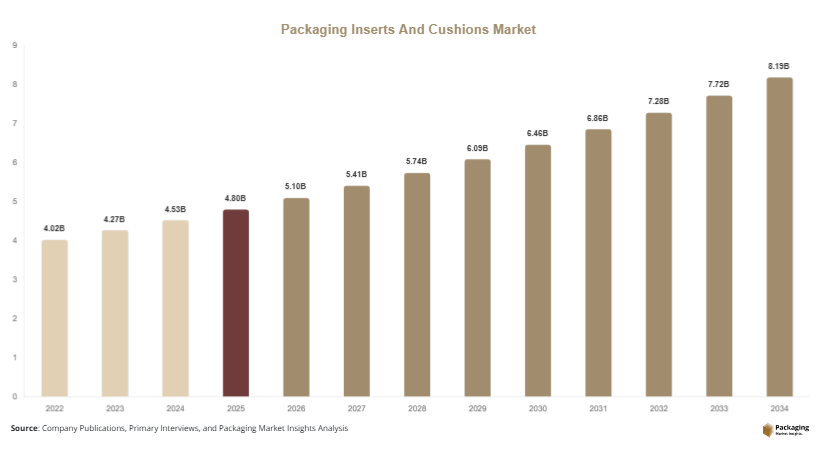
The packaging inserts and cushions market is experiencing steady growth due to the rising need for protective packaging solutions across industries such as electronics, e-commerce, automotive, and consumer goods. The market size was valued at approximately USD 4.8 billion in 2025 and is expected to reach USD 5.1 billion in 2026. Over the forecast period, the market is projected to expand at a CAGR of 6.1% from 2025 to 2034, reaching nearly USD 8.6 billion by 2034.
Packaging inserts and cushions play a critical role in protecting products from damage during storage and transportation. These materials include foam inserts, molded pulp, corrugated partitions, air pillows, and paper-based cushioning systems. The rapid expansion of global e-commerce has significantly increased demand for reliable packaging solutions that ensure product safety during last-mile delivery. With higher shipping volumes and increased handling, the need for effective cushioning materials has become more pronounced.
Key Highlights:
- Market projected to reach USD 8.6 billion by 2034
- CAGR of 6.1% from 2025 to 2034
- Strong demand from e-commerce and electronics industries
- Growing adoption of sustainable cushioning materials
- Technological advancements in protective packaging solutions
Explore more data points, trends and opportunities Download Free Sample Report
Market Trends
Increasing Shift Toward Sustainable Cushioning Materials
The packaging inserts and cushions market is witnessing a significant shift toward environmentally friendly materials. Companies are increasingly adopting paper-based and molded pulp solutions as alternatives to traditional plastic foams. These materials are biodegradable, recyclable, and align with sustainability goals set by governments and corporations. Retailers and e-commerce companies are also prioritizing eco-friendly packaging to meet consumer expectations. This trend is encouraging manufacturers to invest in innovative materials that offer both protection and environmental benefits. As sustainability becomes a key purchasing factor, demand for green cushioning solutions is expected to rise steadily.
Growth of Customized and Product-Specific Packaging Inserts
Customization is becoming a key trend in the packaging inserts and cushions market, driven by the need for precise product protection. Manufacturers are developing inserts tailored to specific product shapes and sizes, ensuring optimal fit and reducing material waste. This trend is particularly important in industries such as electronics, cosmetics, and luxury goods, where product presentation and protection are critical. Advanced manufacturing technologies, including CNC cutting and 3D modeling, are enabling the production of highly customized inserts. This approach not only enhances product safety but also improves customer experience, making it an important trend shaping the market.
Market Drivers
Rapid Expansion of E-commerce Industry
The rapid growth of e-commerce is a major driver of the packaging inserts and cushions market. Online retail platforms require packaging solutions that can protect products during transit and handling. With increasing shipment volumes, the risk of product damage has become a significant concern for retailers. Packaging inserts and cushions provide shock absorption and structural support, reducing the likelihood of damage. E-commerce companies are also focusing on optimizing packaging designs to improve efficiency and reduce costs. As online shopping continues to grow, the demand for effective cushioning solutions is expected to increase significantly.
Rising Demand for Protective Packaging in Electronics Sector
The electronics industry is a key contributor to the growth of the packaging inserts and cushions market. Electronic devices are often fragile and require specialized packaging solutions to prevent damage during transportation. Packaging inserts made from foam, molded pulp, and other materials provide the necessary protection. The increasing demand for consumer electronics such as smartphones, laptops, and home appliances is driving the need for advanced cushioning solutions. Manufacturers are also focusing on developing lightweight and cost-effective materials that offer high performance, further supporting market growth.
Market Restraint
Environmental Concerns Related to Plastic-Based Materials
One of the major restraints in the packaging inserts and cushions market is the environmental impact of plastic-based cushioning materials such as polyurethane foam and expanded polystyrene. These materials are widely used due to their excellent protective properties, but they pose significant challenges in terms of recyclability and waste management. Governments and regulatory bodies are implementing strict regulations to reduce plastic waste, which is increasing pressure on manufacturers to adopt sustainable alternatives.
For example, companies that rely heavily on plastic cushioning materials may face higher costs when transitioning to eco-friendly solutions. Additionally, the performance of some biodegradable materials may not match that of traditional plastics, creating challenges in certain applications. This restraint is forcing companies to invest in research and development to find suitable alternatives while maintaining product performance and cost efficiency.
Market Opportunities
Development of Biodegradable and Compostable Cushioning Solutions
The growing focus on sustainability presents significant opportunities for innovation in the packaging inserts and cushions market. Manufacturers are developing biodegradable and compostable materials that provide effective cushioning while reducing environmental impact. These solutions are gaining popularity in industries such as food, electronics, and consumer goods. Companies that invest in sustainable materials are likely to gain a competitive advantage as consumers and regulators increasingly prioritize eco-friendly packaging. This opportunity is expected to drive long-term growth and innovation in the market.
Expansion in Emerging Markets
Emerging markets offer substantial growth opportunities for the packaging inserts and cushions market due to increasing industrialization and rising demand for packaged goods. Countries in Asia Pacific, Latin America, and Africa are experiencing growth in e-commerce and manufacturing sectors, creating demand for protective packaging solutions. The expansion of retail infrastructure and rising disposable incomes are also contributing to market growth. Companies are investing in local production facilities to meet demand and reduce costs. This trend is expected to create new opportunities for market expansion in developing regions.
Report Scope
| Report Metric | Details |
|---|---|
| Market Size in 2025 | USD 4.8 Billion |
| Market Size in 2026 | USD 5.1 Billion |
| Market Size in 2034 | USD 8.6 Billion |
| CAGR | 6.1% (2026-2034) |
| Base Year for Estimation | 2025 |
| Historical Data | 2022-2024 |
| Forecast Period | 2026-2034 |
| Report Coverage | Revenue Forecast, Competitive Landscape, Supply Chain Disruption, Growth Factors, Environment & Regulatory Landscape and Trends |
| Geographies Covered | North America, Europe, APAC, Middle East and Africa, LATAM |
| Countries Covered | U.S., Canada, U.K., Germany, France, Spain, Italy, Russia, Nordic, Benelux, Rest of Europe, China, South Korea, Japan, India, Australia, Singapore, Taiwan, South East Asia, Rest of Asia-Pacific, UAE, Turky, Saudi Arabia, South Africa, Egypt, Nigeria, Rest of MEA, Brazil, Mexico, Argentina, Chile, Colombia, Rest of LATAM |
Explore more data points, trends and opportunities Download Free Sample Report
Segmental Analysis
By Material Type
Foam-based inserts dominated the market in 2024, accounting for approximately 48% share. This dominance is due to their excellent shock absorption and cushioning properties. Foam materials are widely used in packaging fragile products such as electronics and glassware. They provide high protection and are available in various densities and shapes, making them suitable for different applications. Despite environmental concerns, foam-based inserts remain popular due to their performance advantages.
Paper-based cushioning is expected to be the fastest-growing segment, with a CAGR of 6.9%. Growth is driven by increasing demand for sustainable packaging solutions. Paper-based materials are recyclable and biodegradable, making them an attractive alternative to plastic-based inserts. Innovations in material design are improving their performance, enabling wider adoption across industries.
By Product Type
Molded pulp inserts held the largest share in 2024, accounting for around 42% of the market. These inserts are widely used due to their sustainability and cost-effectiveness. Molded pulp is biodegradable and provides adequate protection for various products. It is commonly used in packaging electronics, food items, and consumer goods.
Air pillows and bubble wraps are expected to be the fastest-growing segment, with a CAGR of 6.5%. These solutions are lightweight and cost-effective, making them suitable for e-commerce applications. They provide cushioning and fill void spaces in packaging, reducing the risk of damage during transit. The increasing demand for efficient packaging solutions is driving growth in this segment.
By End-Use Industry
The electronics industry dominated the market in 2024, accounting for approximately 45% share. This is due to the high demand for protective packaging solutions for fragile electronic products. Packaging inserts and cushions play a critical role in preventing damage during transportation and storage. The increasing demand for consumer electronics is driving growth in this segment.
The e-commerce sector is expected to be the fastest-growing, with a CAGR of 7.1%. The growth of online shopping is increasing demand for protective packaging solutions. Packaging inserts and cushions are essential for ensuring product safety during delivery. This trend is expected to continue as e-commerce expands globally.
Packaging Inserts And Cushions Market Segmentations
Material Type
- Foam
- Paper & Paperboard
- Plastic
- Others
Product Type
- Molded Pulp Inserts
- Foam Inserts
- Air Pillows
- Bubble Wraps
End-Use Industry
- Electronics
- E-commerce
- Food & Beverage
- Automotive
Regional Analysis
North America
North America accounted for approximately 30% market share in 2025, with a projected CAGR of 5.8%. The region benefits from a well-established e-commerce sector and high demand for protective packaging solutions. The presence of major packaging companies and advanced logistics infrastructure supports market growth. Additionally, increasing focus on sustainable packaging is driving innovation in cushioning materials.
The United States dominates the regional market due to its large consumer base and advanced retail ecosystem. A unique growth factor is the increasing demand for same-day delivery services, which requires efficient and reliable packaging solutions. This is boosting the adoption of high-performance cushioning materials.
Europe
Europe held around 25% market share in 2025, with a forecast CAGR of 6.0%. The region is characterized by strong environmental regulations and a focus on sustainability. The adoption of recyclable and biodegradable cushioning materials is driving market growth. Countries such as Germany, France, and the United Kingdom are key contributors.
Germany is the dominant country in Europe. A unique growth factor is the implementation of strict packaging waste regulations, which encourage the use of eco-friendly materials. This is driving innovation in sustainable cushioning solutions.
Asia Pacific
Asia Pacific accounted for approximately 28% market share in 2025 and is expected to grow at a CAGR of 6.8%. The region is driven by rapid urbanization, population growth, and expanding e-commerce sector. Increasing demand for consumer electronics is also contributing to market growth.
China leads the regional market. A unique growth factor is the growth of cross-border e-commerce, which requires reliable packaging solutions for international shipping. This is boosting demand for advanced cushioning materials.
Middle East & Africa
The Middle East & Africa region held about 9% market share in 2025, with a projected CAGR of 5.9%. The market is growing steadily due to increasing urbanization and development of the retail sector. The adoption of protective packaging solutions is increasing across industries.
The United Arab Emirates is a key market. A unique growth factor is the growth of the logistics and warehousing sector, which is driving demand for packaging inserts and cushions. This supports market expansion.
Latin America
Latin America accounted for nearly 8% market share in 2025, with a forecast CAGR of 6.2%. The region is experiencing steady growth due to increasing demand for packaged goods and expansion of e-commerce.
Brazil dominates the regional market. A unique growth factor is the increasing demand for durable packaging for exports, which requires effective cushioning solutions. This is driving investment in advanced packaging technologies.
Competitive Landscape
The packaging inserts and cushions market is moderately competitive, with several global and regional players focusing on innovation and sustainability. Companies are investing in research and development to create advanced cushioning solutions that meet evolving market demands. Strategic partnerships and acquisitions are common as companies aim to expand their market presence.
Sealed Air Corporation is a leading player in the market, known for its innovative packaging solutions. A recent development includes the introduction of sustainable cushioning materials designed to reduce environmental impact. Other major players such as Pregis LLC, Storopack Hans Reichenecker GmbH, Sonoco Products Company, and Ranpak Holdings Corp are also focusing on eco-friendly solutions and technological advancements.
Key Players List
- Sealed Air Corporation
- Pregis LLC
- Storopack Hans Reichenecker GmbH
- Sonoco Products Company
- Ranpak Holdings Corp
- Smurfit Kappa Group
- DS Smith Plc
- WestRock Company
- International Paper Company
- Huhtamaki Oyj
- UFP Technologies, Inc.
- ACH Foam Technologies
- JSP Corporation
- BASF SE
- Dow Inc.