Bubble Wrap Packaging Market Size and Growth
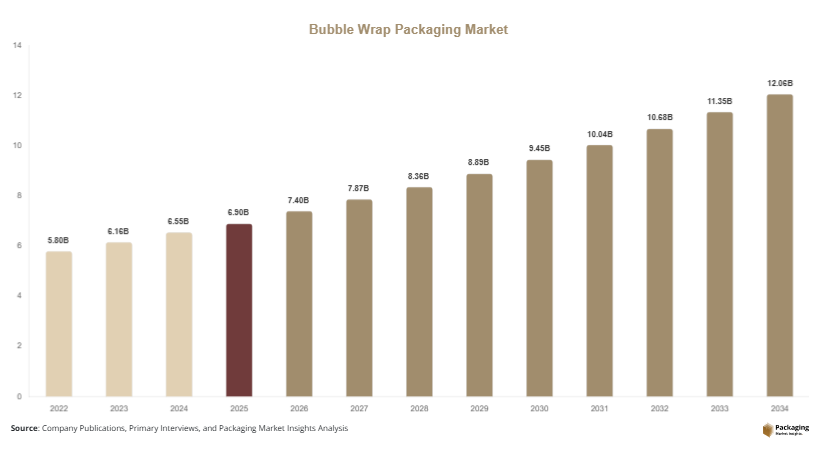
The global bubble wrap packaging market size is estimated at USD 6.9 billion in 2025, which is projected to reach USD 7.4 billion in 2026. Over the forecast period from 2025 to 2034, the market is expected to reach USD 12.8 billion by 2034, registering a CAGR of 6.3%. The bubble wrap packaging market is witnessing consistent growth due to increasing demand for protective packaging solutions across industries such as e-commerce, electronics, pharmaceuticals, and consumer goods. Bubble wrap packaging, made primarily from polyethylene materials, is widely used to protect fragile items during storage and transportation.
The expansion of e-commerce platforms has significantly increased the need for protective packaging materials that ensure product safety during transit. Bubble wrap packaging offers cushioning properties, lightweight structure, and cost efficiency, making it suitable for a wide range of applications. Additionally, the growing demand for consumer electronics and fragile goods has further strengthened market growth.
Key Market Insights:
- Asia Pacific dominated the market with a 38.2% share in 2025.
- Latin America is projected to grow at the fastest CAGR of 6.9%.
- Small bubble wraps led the type segment with a 41.6% share.
- Plastic-based materials dominated with a 78.4% share.
- E-commerce applications led the segment with 46.3% share.
- China remained the dominant country with a market size of USD 1.9 billion in 2025 and USD 2.1 billion in 2026.
Explore more data points, trends and opportunities Download Free Sample Report
Market Trends
Rising adoption of sustainable and recyclable bubble wrap solutions
The increasing focus on environmental sustainability is influencing the bubble wrap packaging market. Traditional plastic-based bubble wraps are being replaced with recyclable and biodegradable alternatives. Manufacturers are developing materials that reduce environmental impact while maintaining protective performance. For instance, companies are introducing paper-based bubble wraps and recycled polyethylene solutions to meet sustainability goals.
This trend is expected to gain momentum as regulatory frameworks become stricter and consumer awareness increases. In the future, the adoption of circular economy practices and eco-friendly materials will reshape the market. Companies investing in sustainable innovations are likely to gain a competitive advantage.
Integration of advanced protective features in packaging materials
The demand for specialized packaging solutions is driving innovation in bubble wrap products. Manufacturers are incorporating features such as anti-static properties, temperature resistance, and enhanced cushioning performance. These advancements are particularly relevant for industries such as electronics and pharmaceuticals.
For example, anti-static bubble wraps are widely used to protect sensitive electronic components from damage. Temperature-resistant bubble wraps are being adopted for pharmaceutical shipments. In the future, the integration of smart packaging technologies and advanced materials will expand application areas and improve product performance.
Market Drivers
Growth of e-commerce and logistics industry
The rapid expansion of e-commerce platforms is a major driver of the bubble wrap packaging market. Online retail requires reliable packaging solutions to protect products during transit. Bubble wrap packaging provides cushioning and reduces the risk of damage, making it widely used in the industry.
For instance, e-commerce companies use bubble wrap for packaging electronics, glassware, and other fragile items. The increasing volume of online orders is driving demand for protective packaging solutions. As logistics networks expand, the need for efficient packaging will continue to grow.
Increasing demand for consumer electronics and fragile goods
The rising demand for consumer electronics and fragile goods is contributing to market growth. Products such as smartphones, laptops, and glass items require protective packaging to prevent damage during transportation. Bubble wrap packaging is widely used for these applications due to its cushioning properties.
For example, electronics manufacturers use bubble wrap to ensure safe delivery of products. The growth of the electronics industry is expected to drive demand for bubble wrap packaging. As consumer spending increases, the demand for protective packaging will rise.
Market Restraint
Environmental concerns related to plastic-based packaging
One of the key challenges in the bubble wrap packaging market is the environmental impact of plastic materials. Traditional bubble wraps are made from non-biodegradable plastics, which contribute to waste and pollution. This has led to increasing regulatory restrictions and consumer concerns.
For example, governments in several regions are implementing regulations to reduce plastic usage. Companies are under pressure to adopt sustainable alternatives, which can increase production costs. These factors can limit market growth and create challenges for manufacturers.
Market Opportunities
Development of biodegradable and eco-friendly packaging materials
The growing demand for sustainable packaging solutions presents significant opportunities in the market. Manufacturers are focusing on developing biodegradable and recyclable bubble wrap materials to address environmental concerns.
For instance, companies are introducing paper-based bubble wraps and compostable materials. These innovations are expected to gain traction as sustainability becomes a priority. In the future, advancements in material science will enable the development of high-performance eco-friendly packaging solutions.
Expansion in emerging markets and industrial sectors
Emerging markets offer growth opportunities for the bubble wrap packaging market. Rapid industrialization and increasing consumer spending are driving demand for packaged goods. This is creating a need for protective packaging solutions.
For example, countries in Asia Pacific and Latin America are experiencing growth in manufacturing and retail sectors. The expansion of these industries is expected to drive demand for bubble wrap packaging. In the future, improving infrastructure and logistics networks will support market growth.
Report Scope
| Report Metric | Details |
|---|---|
| Market Size in 2025 | USD 6.9 Billion |
| Market Size in 2026 | USD 7.4 Billion |
| Market Size in 2034 | USD 12.8 Billion |
| CAGR | 6.3% (2026-2034) |
| Base Year for Estimation | 2025 |
| Historical Data | 2022-2024 |
| Forecast Period | 2026-2034 |
| Report Coverage | Revenue Forecast, Competitive Landscape, Supply Chain Disruption, Growth Factors, Environment & Regulatory Landscape and Trends |
| Geographies Covered | North America, Europe, APAC, Middle East and Africa, LATAM |
| Countries Covered | U.S., Canada, U.K., Germany, France, Spain, Italy, Russia, Nordic, Benelux, Rest of Europe, China, South Korea, Japan, India, Australia, Singapore, Taiwan, South East Asia, Rest of Asia-Pacific, UAE, Turky, Saudi Arabia, South Africa, Egypt, Nigeria, Rest of MEA, Brazil, Mexico, Argentina, Chile, Colombia, Rest of LATAM |
Explore more data points, trends and opportunities Download Free Sample Report
Segmental Analysis
By Type
Small bubble wraps dominated the market in 2024 with a 41.6% share, driven by their widespread use in packaging lightweight and fragile items. These wraps provide effective cushioning and are cost-efficient, making them suitable for industries such as e-commerce and retail. For example, small bubble wraps are commonly used for packaging electronics accessories and glassware.
Anti-static bubble wraps are the fastest-growing segment, with a projected CAGR of 6.8%. These wraps are designed to protect electronic components from static electricity damage. The growth is driven by increasing demand in the electronics industry. Future innovations in material properties are expected to enhance performance and expand applications.
By Material
Plastic-based materials dominated the market with a 78.4% share in 2024, driven by their durability and cost efficiency. These materials are widely used in bubble wrap packaging due to their flexibility and cushioning properties. For instance, polyethylene is commonly used to manufacture bubble wraps for various applications.
Biodegradable materials are the fastest-growing segment, with a CAGR of 7.1%. This growth is driven by increasing environmental concerns and regulatory pressures. Manufacturers are developing eco-friendly alternatives to reduce plastic waste. Future advancements in material science are expected to support market growth.
By End-Use
E-commerce accounted for the largest share of 46.3% in 2024, driven by the need for protective packaging in online retail. Bubble wrap packaging is widely used to ensure safe delivery of products. For example, e-commerce companies use bubble wrap for packaging fragile items.
Pharmaceuticals is the fastest-growing segment, with a CAGR of 6.7%. The increasing demand for temperature-sensitive and fragile medical products is driving the need for protective packaging solutions. Bubble wrap provides cushioning and protection, making it suitable for pharmaceutical applications. As the healthcare industry expands, demand for bubble wrap packaging will increase.
Bubble Wrap Packaging Market Segmentations
By Product Type
- Small Bubble Wrap
- Large Bubble Wrap
- Anti-Static Bubble Wrap
By Material
- Plastic-Based
- Biodegradable Materials
By End-Use
- E-commerce
- Electronics
- Pharmaceuticals
- Food & Beverage
Regional Analysis
North America
North America accounted for approximately 24.5% of the global market share in 2025 and is projected to grow at a CAGR of 5.7% through 2034. The region benefits from a well-established e-commerce ecosystem, advanced logistics infrastructure, and high consumer spending on packaged goods. The increasing demand for protective packaging in industries such as electronics, healthcare, and retail is driving market growth. Sustainability initiatives are also influencing the market, with companies adopting recyclable materials and eco-friendly packaging solutions to comply with regulations and consumer expectations.
The United States dominates the regional market due to its large e-commerce sector and strong manufacturing base. A unique growth driver is the increasing demand for customized packaging solutions that enhance customer experience. For example, companies are using bubble wrap with branding and innovative designs to improve product presentation. This trend is expected to support market growth in the region.
Europe
Europe held a 22.1% market share in 2025 and is expected to grow at a CAGR of 5.5% during the forecast period. The region’s focus on sustainability and strict environmental regulations are shaping the market. Countries such as Germany, France, and the UK are leading the adoption of eco-friendly packaging materials. The demand for recyclable and biodegradable bubble wrap solutions is increasing as companies aim to reduce their environmental footprint.
Germany is the dominant country in the region, driven by its strong industrial base and export-oriented economy. A unique growth driver is the increasing demand for protective packaging in the automotive and electronics industries. For instance, manufacturers use bubble wrap to protect components during transportation. This trend is expected to support market growth.
Asia Pacific
Asia Pacific emerged as the largest regional market with a 38.2% share in 2025 and is projected to grow at a CAGR of 6.5%. Rapid industrialization, urbanization, and expanding e-commerce sectors are driving market growth in the region. Countries such as China, India, and Japan are major contributors to market expansion. The growing demand for consumer electronics and packaged goods is boosting the need for bubble wrap packaging.
China dominates the Asia Pacific market due to its large manufacturing base and growing consumer market. A significant growth driver is the expansion of the export sector, which requires protective packaging solutions. For example, Chinese manufacturers use bubble wrap to ensure safe delivery of goods. Government support for manufacturing and exports is also contributing to market growth.
Middle East & Africa
The Middle East & Africa region accounted for 6.8% of the market share in 2025 and is expected to grow at a CAGR of 5.9%. The region’s growth is driven by increasing investments in infrastructure and industrial sectors. Countries such as the UAE and South Africa are focusing on expanding their logistics and retail sectors, boosting demand for protective packaging solutions.
The UAE is a key market in the region, supported by its strategic location and growing trade activities. A unique growth driver is the increasing demand for packaging solutions in the oil and gas industry. For example, companies use bubble wrap to protect equipment during transportation. This trend is expected to support market growth.
Latin America
Latin America held a 8.4% market share in 2025 and is projected to grow at the fastest CAGR of 6.9%. The region is experiencing growth due to expanding retail and e-commerce sectors. Countries such as Brazil and Mexico are key contributors to market expansion. The rising demand for protective packaging in consumer goods is driving growth.
Brazil dominates the regional market, supported by its large consumer base. A key growth driver is the expansion of the food and beverage industry, which requires protective packaging for transportation. For instance, companies use bubble wrap to protect glass bottles and fragile items. The region’s focus on improving logistics infrastructure is expected to support market growth.
Competitive Landscape
The bubble wrap packaging market is characterized by moderate competition, with global and regional players focusing on product innovation, sustainability, and cost efficiency. Companies are investing in research and development to introduce advanced materials and improve product performance.
Sealed Air Corporation is identified as a leading player due to its strong portfolio of protective packaging solutions and continuous innovation. The company focuses on sustainable packaging and advanced technologies to meet evolving market demands. Other key players are adopting strategies such as mergers, acquisitions, and partnerships to expand their market presence.
Recent developments include the introduction of biodegradable bubble wrap materials, advancements in manufacturing technologies, and increased focus on recyclable packaging solutions. Companies are also leveraging automation to improve efficiency and reduce costs. These strategies are expected to drive competition and innovation in the market.
Key Players
- Sealed Air Corporation
- Pregis LLC
- Storopack Hans Reichenecker GmbH
- Smurfit Kappa Group
- DS Smith Plc
- Intertape Polymer Group
- Veritiv Corporation
- Automated Packaging Systems
- Polyair Inter Pack Inc.
- Inflatable Packaging Inc.
- Barton Jones Packaging Ltd.
- Jiffy Packaging Co.
- Shorr Packaging Corp.
- ProAmpac LLC
- Uline Inc.