Easy Open Packaging Market Size and Growth
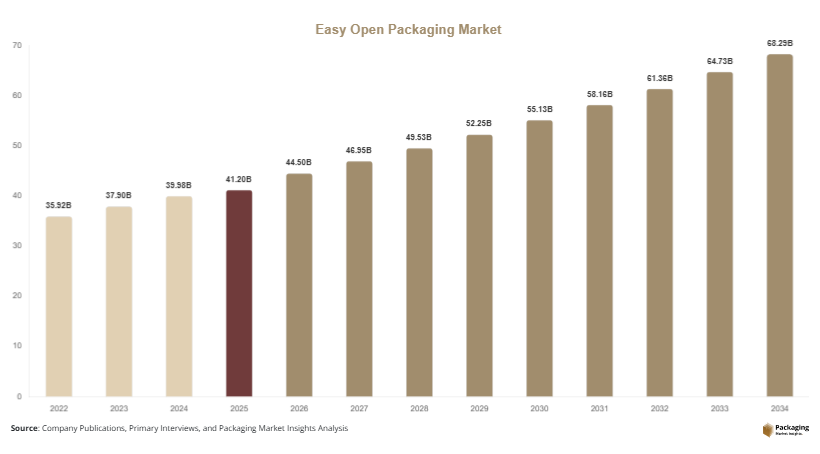
The easy open packaging market size was valued at USD 41.2 billion in 2025 and is projected to reach USD 44.5 billion in 2026, further expanding to approximately USD 71.8 billion by 2034, registering a CAGR of 5.5% during the forecast period (2025–2034). Easy open packaging includes features such as tear notches, peelable seals, resealable closures, and ergonomic designs that enable consumers to open packages with minimal effort. The global easy open packaging market is experiencing steady growth as industries focus on enhancing user convenience, accessibility, and product safety.
A key growth factor driving the market is the increasing demand for convenience-oriented packaging, particularly among urban consumers and aging populations. Easy open features improve accessibility for elderly individuals and people with limited hand strength, making them an essential design consideration. Another important factor is the expansion of the food and beverage sector, where packaging convenience plays a crucial role in influencing purchasing decisions. Additionally, the growth of healthcare and pharmaceutical industries is supporting demand for packaging that ensures safety while remaining user-friendly.
Key Highlights
- Asia Pacific dominated the market with a 36.9% share in 2025, while Latin America is projected to grow at the fastest CAGR of 6.3%.
- Tear-notch packaging led the type segment with a 28.7% share, while resealable closures are expected to grow at a CAGR of 6.4%.
- Plastic-based packaging dominated with a 51.6% share, while paper-based packaging is forecasted to grow at a CAGR of 5.8%.
- Food & beverage applications led the segment with 45.2% share, while pharmaceutical packaging is expected to grow at a CAGR of 6.2%.
- China remained the dominant country with a market size of USD 9.6 billion in 2025 and USD 10.3 billion in 2026.
Explore more data points, trends and opportunities Download Free Sample Report
Market Trends
Increasing integration of user-centric and ergonomic packaging designs
Manufacturers are placing greater emphasis on user-friendly and ergonomic packaging designs to enhance consumer experience. Easy open features such as tear notches, peelable lids, and zip locks are being refined to reduce the effort required to access products. This trend is particularly relevant for elderly consumers and individuals with limited dexterity, who benefit from packaging that can be opened without tools. Companies are also conducting usability testing to optimize design and ensure consistent performance. As convenience becomes a key differentiator in competitive markets, brands are investing in ergonomic packaging solutions to improve customer satisfaction and build long-term loyalty.
Adoption of sustainable and easy-open material innovations
Sustainability is influencing the development of easy open packaging solutions, leading to the adoption of eco-friendly materials and designs. Manufacturers are focusing on creating packaging that is both easy to open and recyclable or biodegradable. Innovations in paper-based and mono-material structures are enabling improved recyclability without compromising functionality. Additionally, advancements in adhesive technologies and peelable films are supporting the development of sustainable easy open features. As regulatory frameworks become stricter and consumers prioritize environmentally responsible products, the integration of sustainability into easy open packaging is expected to gain further momentum.
Market Drivers
Rising demand for convenience and accessibility in packaging
The growing demand for convenience is a major driver of the easy open packaging market. Consumers are increasingly seeking packaging solutions that are simple to use and require minimal effort to open. This is particularly important in fast-paced urban environments, where ease of use directly impacts purchasing decisions. Easy open packaging features enhance user experience by eliminating the need for tools and reducing frustration during product access. Additionally, the aging global population is creating demand for accessible packaging solutions that cater to individuals with reduced hand strength. These factors are driving the adoption of easy open packaging across multiple industries.
Expansion of food, beverage, and healthcare industries
The growth of food, beverage, and healthcare sectors is significantly contributing to the demand for easy open packaging solutions. In the food industry, convenient packaging enhances product usability and supports on-the-go consumption trends. Easy open features such as resealable closures and peelable seals help maintain product freshness and improve storage. In the healthcare sector, packaging must balance safety with accessibility, ensuring that products can be opened easily while maintaining sterility. The increasing demand for packaged foods and pharmaceutical products is driving the adoption of innovative easy open packaging solutions, supporting market growth.
Market Restraint
Balancing packaging integrity with ease of opening
One of the key challenges in the easy open packaging market is maintaining a balance between ease of opening and product protection. Packaging must be secure enough to prevent contamination, leakage, and tampering while remaining easy for consumers to open. Achieving this balance requires advanced material selection and precise manufacturing processes, which can increase production costs. For example, in pharmaceutical packaging, strict safety requirements may limit the extent to which easy open features can be implemented. Similarly, in food packaging, maintaining freshness and preventing spoilage is critical. These challenges create complexities for manufacturers and may limit the adoption of certain easy open solutions.
Market Opportunities
Growing demand in emerging markets
Emerging economies present significant opportunities for the easy open packaging market due to increasing urbanization and rising disposable incomes. Consumers in these regions are adopting modern lifestyles, leading to higher demand for convenient packaging solutions. The expansion of retail and e-commerce platforms is further supporting market growth. Easy open packaging offers a practical solution for improving product accessibility and enhancing user experience. As local manufacturers adopt advanced packaging technologies, the market is expected to witness strong growth in emerging regions.
Technological advancements in smart and functional packaging
Advancements in smart and functional packaging technologies are creating new opportunities for the easy open packaging market. Features such as tamper-evident seals, freshness indicators, and interactive elements are being integrated into packaging designs. These innovations enhance product safety and provide additional value to consumers. Easy open features can be combined with smart technologies to create packaging solutions that are both functional and informative. As industries continue to adopt advanced packaging technologies, the demand for innovative easy open solutions is expected to increase.
Report Scope
| Report Metric | Details |
|---|---|
| Market Size in 2025 | USD 41.2 Billion |
| Market Size in 2026 | USD 44.5 Billion |
| Market Size in 2034 | USD 71.8 Billion |
| CAGR | 5.5% (2026-2034) |
| Base Year for Estimation | 2025 |
| Historical Data | 2022-2024 |
| Forecast Period | 2026-2034 |
| Report Coverage | Revenue Forecast, Competitive Landscape, Supply Chain Disruption, Growth Factors, Environment & Regulatory Landscape and Trends |
| Geographies Covered | North America, Europe, APAC, Middle East and Africa, LATAM |
| Countries Covered | U.S., Canada, U.K., Germany, France, Spain, Italy, Russia, Nordic, Benelux, Rest of Europe, China, South Korea, Japan, India, Australia, Singapore, Taiwan, South East Asia, Rest of Asia-Pacific, UAE, Turky, Saudi Arabia, South Africa, Egypt, Nigeria, Rest of MEA, Brazil, Mexico, Argentina, Chile, Colombia, Rest of LATAM |
Explore more data points, trends and opportunities Download Free Sample Report
Segmental Analysis
By Type
Tear-notch packaging accounted for the largest share in 2024, holding approximately 28.7% of the market. This segment is widely used due to its simplicity and cost-effectiveness. Tear notches allow consumers to open packaging quickly without requiring additional tools. They are commonly used in food, beverage, and personal care products. The ease of integration into existing packaging designs makes tear-notch solutions highly popular among manufacturers. Additionally, they do not significantly increase production costs, making them suitable for large-scale applications.
Resealable closures are expected to be the fastest-growing segment, registering a CAGR of 6.4% during the forecast period. These closures provide convenience and help maintain product freshness after opening. They are widely used in food packaging, particularly for snacks and perishable items. The growing demand for reusable and convenient packaging solutions is driving the adoption of resealable closures. Technological advancements in zipper and adhesive systems are further enhancing their performance.
By Material
Plastic-based packaging dominated the market in 2024, accounting for approximately 51.6% of the share. Plastics offer flexibility, durability, and compatibility with various easy open features. They are widely used in food, beverage, and healthcare packaging due to their protective properties. The ability to incorporate tear notches, peelable seals, and resealable closures makes plastic a preferred material.
Paper-based packaging is projected to grow at the fastest CAGR of 5.8% during the forecast period. The increasing focus on sustainability is driving the adoption of paper-based materials. These materials are recyclable and environmentally friendly. Innovations in coating and barrier technologies are improving their performance, making them suitable for a wider range of applications.
By Application
Food and beverage applications dominated the market in 2024, accounting for approximately 45.2% of the total share. Easy open packaging enhances convenience and supports on-the-go consumption trends. Features such as resealable closures and peelable seals help maintain product freshness and improve user experience.
Pharmaceutical applications are expected to grow at the fastest CAGR of 6.2% during the forecast period. The need for safe and accessible packaging in the healthcare sector is driving demand. Easy open features improve accessibility while maintaining product safety. Advancements in packaging technologies are supporting the growth of this segment.
Easy Open Packaging Market Segmentations
By Type
- Tear Notch Packaging
- Peelable Seals
- Resealable Closures
- Easy Open Lids
By Material
- Plastic
- Paper
- Aluminum
- Composite Materials
By Application
- Food & Beverage
- Pharmaceuticals
- Personal Care
- Industrial
Regional Analysis
North America
North America accounted for approximately 25.4% of the easy open packaging market share in 2025 and is projected to grow at a CAGR of 4.9% during the forecast period. The region benefits from strong demand across food, healthcare, and personal care industries. Advanced packaging technologies and consumer preference for convenience support market growth.
The United States dominates the regional market due to its large consumer base and high adoption of innovative packaging solutions. A unique growth factor in this region is the increasing focus on accessibility standards, encouraging manufacturers to design user-friendly packaging.
Europe
Europe held a 22.1% market share in 2025 and is expected to register a CAGR of 5.2% through 2034. The region’s growth is driven by stringent regulations and increasing consumer awareness regarding sustainability and convenience. Demand for recyclable and easy open packaging is particularly strong.
Germany leads the European market due to its advanced manufacturing capabilities. A unique growth factor is the implementation of strict packaging regulations that promote innovation in easy open and sustainable solutions.
Asia Pacific
Asia Pacific dominated the market with a 36.9% share in 2025 and is projected to grow at a CAGR of 6.1% during the forecast period. Rapid urbanization, population growth, and increasing demand for packaged goods are driving market expansion.
China remains the dominant country due to its large manufacturing base. A unique growth factor is the rapid growth of e-commerce and food delivery services, increasing demand for convenient packaging.
Middle East & Africa
The Middle East & Africa region accounted for 7.5% of the market share in 2025 and is expected to grow at a CAGR of 5.6%. The market is supported by increasing demand for packaged goods and improvements in retail infrastructure.
Saudi Arabia leads the regional market due to economic development. A unique growth factor is the expansion of healthcare infrastructure, driving demand for easy open pharmaceutical packaging.
Latin America
Latin America held a 8.1% share in 2025 and is projected to grow at a CAGR of 6.3% during the forecast period. The region is experiencing increased demand for convenient packaging solutions.
Brazil dominates the regional market, supported by its large population. A unique growth factor is the adoption of cost-effective and user-friendly packaging solutions by local manufacturers.
Competitive Landscape
The easy open packaging market is moderately fragmented, with several global and regional players competing based on innovation and product quality. Companies are focusing on developing advanced packaging solutions that enhance user convenience while maintaining product integrity.
Amcor plc is a leading player in the market, known for its innovative packaging solutions. The company has recently introduced new easy open packaging designs aimed at improving consumer experience. Other major players are also investing in research and development to enhance product functionality. Strategic partnerships and acquisitions are common strategies used to expand market presence.
Key Players List
- Amcor plc
- Berry Global Inc.
- Sealed Air Corporation
- Mondi Group
- Sonoco Products Company
- Huhtamaki Oyj
- Constantia Flexibles
- ProAmpac LLC
- Coveris Holdings S.A.
- Clondalkin Group
- Winpak Ltd.
- Uflex Ltd.
- Glenroy Inc.
- Transcontinental Inc.
- Scholle IPN