Inverted Pouches Market Size and Growth
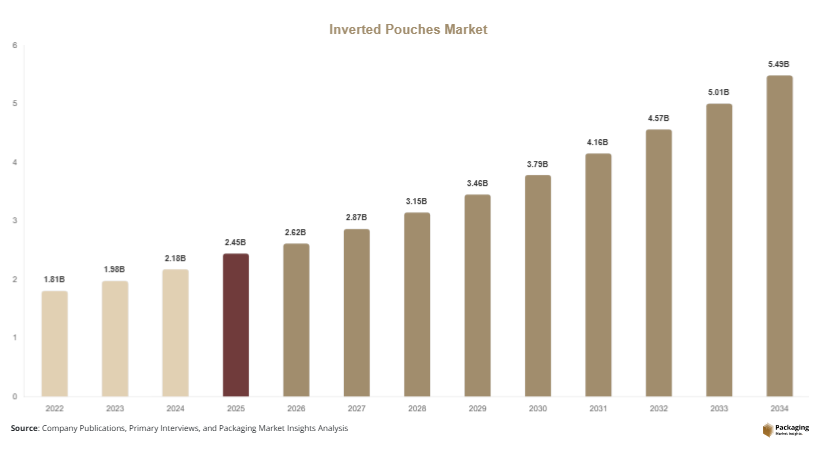
The global inverted pouches market size is estimated at USD 2.45 billion in 2025, and it is projected to reach USD 2.62 billion in 2026. By 2034, the market is expected to attain USD 5.48 billion, growing at a CAGR of 9.7% (2025–2034). This growth reflects rising demand for sustainable packaging alternatives and increasing consumer preference for convenient dispensing formats.
The inverted pouches market is witnessing steady expansion as packaging manufacturers and end-use industries increasingly adopt convenient, lightweight, and cost-efficient flexible packaging solutions. Inverted pouches, designed with a bottom dispensing cap and stand-up structure, are widely used in food, beverages, personal care, household cleaning products, and industrial liquids. Their ability to provide controlled dispensing, reduced product waste, and enhanced shelf visibility is driving strong adoption across global retail channels.
Key Highlights
- Asia Pacific dominated the market with 36.8% share in 2025.
- Latin America is expected to grow fastest at 10.4% CAGR.
- Food & beverage applications led with 42.5% share.
- Plastic-based inverted pouches held 58.3% share.
- Stand-up inverted pouches dominated with 61.2% share.
- The US recorded a market size of USD 0.62 billion in 2025 and USD 0.66 billion in 2026.
Explore more data points, trends and opportunities Download Free Sample Report
Market Trends
Shift Toward Recyclable Mono-Material Pouches
One of the most significant trends shaping the inverted pouches market is the transition toward recyclable mono-material packaging solutions. Traditional multilayer pouches, while durable, are difficult to recycle due to mixed polymer structures. As environmental regulations tighten across Europe and North America, manufacturers are developing single-material polyethylene (PE) and polypropylene (PP) inverted pouches that maintain barrier performance while improving recyclability. For example, leading packaging converters are introducing mono-PE inverted pouches for sauces and liquid detergents. This trend is expected to accelerate as brand owners commit to circular economy goals and sustainable packaging commitments.
Expansion of Smart Dispensing and Anti-Drip Designs
Another major trend is the increasing adoption of smart dispensing and anti-drip technology in inverted pouches. Consumers demand cleaner, more controlled pouring experiences, particularly in food condiments, personal care liquids, and household cleaning products. Manufacturers are responding with advanced valve systems, precision spouts, and vacuum-assisted dispensing mechanisms. For instance, premium ketchup and shampoo brands are adopting inverted pouch formats that reduce product wastage and improve user convenience. In the future, integration of smart caps with usage tracking sensors may further enhance product differentiation in premium packaging segments.
Market Drivers
Rising Demand for Convenient Packaging Formats
The growing demand for convenience-oriented packaging is a major driver of the inverted pouches market. Modern consumers prefer packaging that is easy to store, use, and dispose of, particularly in fast-moving urban lifestyles. Inverted pouches offer superior usability compared to traditional bottles due to their gravity-assisted dispensing design. For example, sauces, syrups, and liquid soaps packaged in inverted pouches reduce the need for shaking or squeezing, improving user experience. The food service industry is also increasingly adopting these pouches for bulk dispensing in restaurants and catering services, supporting operational efficiency.
Growth in E-Commerce and Retail Packaging Innovation
The rapid expansion of e-commerce platforms is significantly contributing to market growth. Online retail requires durable yet lightweight packaging that minimizes shipping costs and prevents leakage during transportation. Inverted pouches are well-suited for this purpose due to their flexible structure and reduced material usage. For instance, personal care brands selling shampoo and lotion through online channels are increasingly shifting to inverted pouch formats to reduce packaging damage and improve customer satisfaction. Additionally, subscription-based delivery models in food and household products are further driving demand for efficient flexible packaging formats.
Market Restraint
Limited Recycling Infrastructure and Material Compatibility Issues
Despite strong growth potential, the inverted pouches market faces challenges related to limited recycling infrastructure and material compatibility issues. Although mono-material innovations are emerging, a large portion of inverted pouches still consists of multilayer laminates combining plastic, aluminum, and adhesive layers. These complex structures are difficult to recycle in most developing economies, leading to environmental concerns and regulatory pressure.
For example, in regions such as Southeast Asia and parts of Latin America, waste management systems are not fully equipped to process flexible packaging waste, resulting in landfill accumulation. This limits the adoption of inverted pouches among environmentally conscious consumers and corporate buyers. Additionally, fluctuations in raw material prices, particularly polyethylene and polypropylene, create cost uncertainty for manufacturers.
Another issue is product compatibility. Certain highly acidic or reactive liquids require specialized barrier layers, which further complicates recyclability. As a result, packaging companies must balance performance, cost, and sustainability, which can slow down large-scale adoption in certain industries. Until recycling infrastructure improves globally, this restraint will continue to influence market dynamics.
Market Opportunities
Expansion in Food Delivery and Quick-Service Restaurants
The growing global food delivery and quick-service restaurant (QSR) industry presents a major opportunity for inverted pouch manufacturers. These pouches are increasingly used for condiments such as ketchup, mayonnaise, sauces, and dressings due to their ease of use and reduced wastage. For example, large QSR chains are replacing traditional sachets with inverted pouches to improve customer convenience and reduce packaging waste. In the future, bulk dispensing systems using large-capacity inverted pouches in commercial kitchens could significantly expand demand.
Growth in Personal Care and Home Care Segments
The personal care and home care sectors are rapidly adopting inverted pouches for products such as shampoos, liquid soaps, detergents, and disinfectants. This shift is driven by consumer preference for refillable and cost-efficient packaging formats. For instance, refill pouch systems in retail stores allow consumers to reuse bottles, reducing plastic consumption. Brands are also using inverted pouches to differentiate premium product lines with ergonomic and mess-free dispensing designs. As sustainability awareness increases, this segment is expected to become one of the fastest-growing application areas.
Report Scope
| Report Metric | Details |
|---|---|
| Market Size in 2025 | USD 2.45 Billion |
| Market Size in 2026 | USD 2.62 Billion |
| Market Size in 2034 | USD 5.48 Billion |
| CAGR | 9.7% (2026-2034) |
| Base Year for Estimation | 2025 |
| Historical Data | 2022-2024 |
| Forecast Period | 2026-2034 |
| Report Coverage | Revenue Forecast, Competitive Landscape, Supply Chain Disruption, Growth Factors, Environment & Regulatory Landscape and Trends |
| Geographies Covered | North America, Europe, APAC, Middle East and Africa, LATAM |
| Countries Covered | U.S., Canada, U.K., Germany, France, Spain, Italy, Russia, Nordic, Benelux, Rest of Europe, China, South Korea, Japan, India, Australia, Singapore, Taiwan, South East Asia, Rest of Asia-Pacific, UAE, Turky, Saudi Arabia, South Africa, Egypt, Nigeria, Rest of MEA, Brazil, Mexico, Argentina, Chile, Colombia, Rest of LATAM |
Explore more data points, trends and opportunities Download Free Sample Report
Segmental Analysis
By Type
Stand-up inverted pouches dominated the market with a 2024 share of 61.2%, driven by their superior shelf visibility and ease of dispensing. These pouches are widely used in food, beverages, and personal care applications. Their ergonomic structure allows them to stand upright, making them ideal for retail display and consumer convenience. For example, ketchup, mayonnaise, and shampoo brands prefer stand-up formats due to their premium appearance and user-friendly design.
The fastest-growing subsegment is spout-based inverted pouches, projected to grow at a CAGR of 10.2%. Growth is driven by increasing demand for controlled dispensing and reduced product wastage. These pouches are gaining popularity in liquid detergents and baby food applications. Future innovations include anti-leak valves and smart dispensing caps, improving functionality and expanding use cases.
By Material
Plastic-based inverted pouches accounted for 58.3% share in 2024, driven by low cost, flexibility, and strong barrier properties. Polyethylene and polypropylene are widely used due to their durability and compatibility with various liquid products. These materials are particularly dominant in food and household cleaning segments.
Biodegradable and bio-based materials are the fastest-growing segment with a CAGR of 11.1%. Growth is supported by environmental regulations and rising consumer demand for sustainable packaging. Companies are investing in PLA-based and compostable films for future-ready packaging solutions. This shift is expected to reshape material innovation across the industry.
By End-Use
Food & beverage dominated with a 2024 share of 44.8%, driven by high consumption of sauces, condiments, syrups, and liquid dairy products. Inverted pouches are widely used in restaurants, retail packaging, and institutional catering due to their convenience and cost efficiency.
Personal care is the fastest-growing segment with a CAGR of 9.9%, driven by increasing use of shampoos, lotions, and soaps in refillable pouch formats. Growth is further supported by sustainability initiatives and consumer preference for reusable containers.
Inverted Pouches Market Segmentations
By Product Type
- Stand-up Inverted Pouches
- Flat Inverted Pouches
- Spout-based Inverted Pouches
- Custom-shaped Inverted Pouches
By Material
- Plastic (PE, PP) Based Pouches
- Biodegradable & Compostable Materials
- Aluminum Laminated Pouches
- Paper-based Hybrid Pouches
By End-User
- Food & Beverage
- Personal Care & Cosmetics
- Household Cleaning Products
- Industrial Liquids
- Healthcare & Pharmaceutical Products
Regional Analysis
North America
North America accounted for 33.5% market share in 2025, with a CAGR of 9.2% (2025–2034). The region benefits from strong demand for convenient packaging formats across food, personal care, and household cleaning industries. High consumer awareness regarding product usability and sustainability is further driving adoption of inverted pouches. Retailers and brand owners are increasingly shifting toward lightweight packaging solutions to reduce logistics costs and improve shelf efficiency.
The United States dominates the regional market due to its advanced packaging industry and strong presence of FMCG companies. A unique growth factor is the rising adoption of premium dispensing solutions in personal care products such as shampoos and lotions. For example, major U.S. brands are transitioning to inverted pouch formats in subscription-based home delivery models, improving customer retention and reducing packaging waste.
Europe
Europe held 28.1% market share in 2025, growing at a CAGR of 9.5%. The region is strongly influenced by sustainability regulations and circular economy initiatives, which encourage adoption of recyclable packaging materials. Demand for mono-material inverted pouches is particularly high in countries with strict environmental policies.
Germany leads the European market due to its strong chemical and packaging manufacturing base. A key growth factor is the integration of recyclable packaging mandates in retail supply chains. For example, supermarket chains in Germany are actively replacing rigid plastic bottles with inverted pouch alternatives in cleaning and food categories to reduce plastic footprint.
Asia Pacific
Asia Pacific dominated with 36.8% share in 2025, and is expected to grow at a CAGR of 10.6%, the highest globally. Rapid urbanization, rising disposable income, and expansion of packaged food consumption are major drivers. The region also benefits from large-scale manufacturing capabilities and low production costs.
China is the dominant country due to its strong FMCG production ecosystem. A unique growth factor is the expansion of domestic e-commerce platforms that promote flexible packaging formats. For instance, Chinese online food and personal care brands are increasingly using inverted pouches for direct-to-consumer shipments, improving logistics efficiency and reducing product damage.
Middle East & Africa
Middle East & Africa accounted for 5.9% share in 2025, with a CAGR of 8.7%. The region is gradually adopting flexible packaging solutions driven by retail modernization and rising urban consumption. Demand is particularly strong in food and beverage applications.
Saudi Arabia leads the regional market due to expanding retail chains and hospitality industry growth. A key growth factor is the increasing use of inverted pouches in hotel and catering services for condiments and hygiene products, improving operational convenience and reducing packaging waste.
Latin America
Latin America held 9.7% market share in 2025, with a CAGR of 10.4%, making it one of the fastest-growing regions. Rising FMCG penetration and expanding retail infrastructure are key drivers. Countries like Brazil and Mexico are witnessing strong adoption of flexible packaging formats.
Brazil dominates the regional market due to its strong food processing industry. A unique growth factor is the increasing adoption of cost-efficient packaging in local food brands targeting price-sensitive consumers. For example, inverted pouches are widely used for sauces and dairy-based products in supermarket private labels.
Competitive Landscape
The inverted pouches market is moderately fragmented, with global packaging companies and regional converters competing through innovation, sustainability, and cost efficiency. Key players include Amcor plc, Mondi Group, Sealed Air Corporation, Huhtamaki Group, and Berry Global Inc. Among these, Amcor plc is considered a leading player due to its strong focus on recyclable packaging solutions and global manufacturing footprint.
Companies are investing in mono-material technologies, advanced barrier films, and lightweight packaging designs to meet sustainability targets. Strategic collaborations with FMCG brands are increasing to develop customized dispensing solutions. Recent developments include expansion of recyclable pouch production lines and introduction of high-barrier spout packaging for premium food applications.
Key Players List
- Amcor plc
- Mondi Group
- Berry Global Inc.
- Sealed Air Corporation
- Huhtamaki Group
- Constantia Flexibles
- Glenroy Inc.
- ProAmpac
- Uflex Ltd.
- Smurfit Kappa Group
- Coveris Holdings
- Scholle IPN
- Winpak Ltd.
- Flair Flexible Packaging
- Clondalkin Group