Single Dose Detergent Packaging Market Size
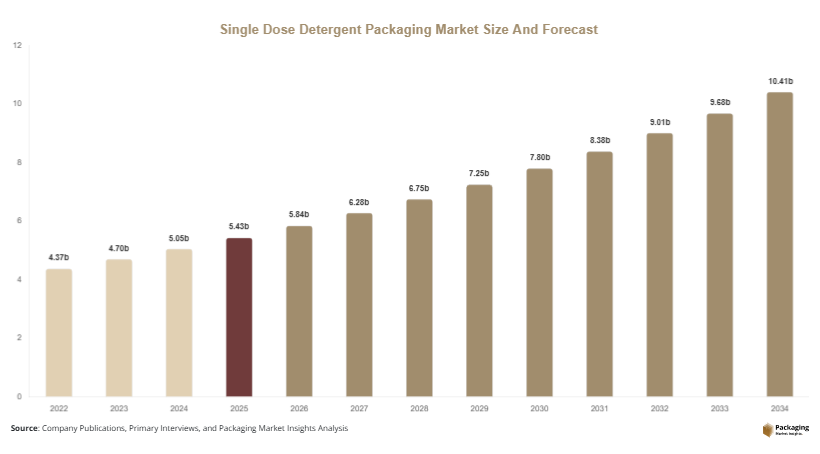
Single Dose Detergent Packaging market size is projected at USD 5.84 billion in 2026 and is expected to hit USD 10.41 billion by 2034 with a CAGR of 7.49%. Increasing demand for convenient household cleaning products, sustainable packaging technologies, and automated filling systems continues to reshape the competitive environment. The report evaluates industry performance through detailed segmentation, production analysis, consumption trends, technological developments, and competitive benchmarking across major regional markets.
The market represents packaging solutions specifically designed for unit-dose laundry and dishwashing detergents, offering accurate dosage, moisture protection, and consumer convenience. Global production exceeded 82 billion single-dose packs during 2025, while household penetration surpassed 39% across developed economies. Water-soluble packaging accounted for nearly 68% of industry output, with automated production facilities operating at utilization rates above 84%. Commercial cleaning applications contributed approximately 23% of total consumption, reinforcing long-term expansion of the Single Dose Detergent Packaging Market.
Explore more data points, trends and opportunities Download Free Sample Report
Single Dose Detergent Packaging Market Trends
Rising Adoption of Sustainable Water-Soluble Packaging
Manufacturers are accelerating investments in biodegradable and water-soluble packaging technologies to reduce plastic waste and improve product safety. More than 56 billion PVOH-based detergent packs were manufactured globally during 2025, while sustainable material adoption increased from 46% to 59% within three years. High-speed packaging lines now exceed 1,500 units per minute, improving productivity while minimizing material waste. These developments continue strengthening the Single Dose Detergent Packaging Market.
Growing environmental regulations are encouraging the replacement of conventional multilayer plastics with recyclable and renewable alternatives. Paper-supported secondary packaging expanded by 18%, while renewable material utilization exceeded 27% of new packaging launches during 2025. Smart packaging technologies incorporating QR codes and product authentication also recorded adoption rates above 21%, supporting premium product positioning across the Single Dose Detergent Packaging Market.
Single Dose Detergent Packaging Market Drivers
Growing Consumer Preference for Convenient Unit-Dose Cleaning Solutions
Increasing urbanization and busy lifestyles continue driving demand for pre-measured detergent formats. Household consumption of single-dose detergent products expanded by 11.2% during 2025, with production surpassing 85 billion units globally. Premium detergent brands reported adoption increases exceeding 16%, while automated packaging investments grew by 22% year-over-year. Continuous innovation in moisture-resistant films further supports the Single Dose Detergent Packaging Market.
Single Dose Detergent Packaging Market Restraints
Volatility in Raw Material Costs and Regulatory Compliance
Fluctuating prices of PVOH resins, specialty polymers, and packaging additives continue affecting manufacturing margins. Raw material expenses accounted for nearly 48% of total production costs, while polymer prices fluctuated by more than 14% during 2025. Compliance investments related to packaging safety standards increased by approximately 12%, creating additional financial pressure across global manufacturers.
Single Dose Detergent Packaging Market Opportunities
Expansion Across Emerging Household and Institutional Cleaning Markets
Emerging economies continue offering attractive investment opportunities through rising disposable incomes and expanding modern retail networks. Household detergent consumption increased by 9.8% across developing regions, while institutional cleaning demand expanded by 13%. New production facilities added more than 7 billion units of annual packaging capacity, creating significant opportunities for innovative manufacturers.
Challenges in Single Dose Detergent Packaging Market
Maintaining Child Safety While Improving Consumer Convenience
Manufacturers face increasing pressure to balance convenience with stringent child-resistant packaging requirements. More than 70% of newly launched products incorporated advanced locking features, while packaging validation costs increased by 15%. Production redesigns and compliance testing continue extending product development timelines by nearly 20%, challenging operational efficiency.
Report Scope
| Report Metric | Details |
|---|---|
| Market Size in 2025 | USD 5.43 billion |
| Market Size in 2026 | USD 5.84 billion |
| Market Size in 2034 | USD 10.41 billion |
| CAGR | 7.49% (2026-2034) |
| Base Year for Estimation | 2025 |
| Historical Data | 2022-2024 |
| Forecast Period | 2026-2034 |
| Report Coverage | Revenue Forecast, Competitive Landscape, Supply Chain Disruption, Growth Factors, Environment & Regulatory Landscape and Trends |
| Geographies Covered | North America, Europe, APAC, Middle East and Africa, LATAM |
| Countries Covered | U.S., Canada, U.K., Germany, France, Spain, Italy, Russia, Nordic, Benelux, Rest of Europe, China, South Korea, Japan, India, Australia, Singapore, Taiwan, South East Asia, Rest of Asia-Pacific, UAE, Turky, Saudi Arabia, South Africa, Egypt, Nigeria, Rest of MEA, Brazil, Mexico, Argentina, Chile, Colombia, Rest of LATAM |
Explore more data points, trends and opportunities Download Free Sample Report
Single Dose Detergent Packaging Market Segmentation
Packaging innovations, material selection, and application-specific performance define the competitive landscape. Water-soluble packaging remains dominant with nearly 68% market share, while PVOH materials contribute approximately 61% of total production volume owing to superior dissolution characteristics.
By Packaging Type
Water-Soluble Pouches dominate with approximately 68% share and annual production exceeding 56 billion units. High moisture resistance, rapid dissolution below 40°C, automated filling compatibility, and reduced product wastage make them the preferred packaging solution for premium detergent brands.
Blister Packs account for nearly 19% of total demand, producing over 15 billion units annually. They provide enhanced child resistance, superior product visibility, improved transportation stability, and accurate single-dose dispensing for institutional cleaning products.
Sachets contribute roughly 13% of industry volume, exceeding 11 billion units annually. Their lightweight construction, lower manufacturing cost, flexible printing capability, and suitability for travel-sized products support continued market adoption.
By Material
Polyvinyl Alcohol (PVOH) represents around 61% of material consumption, offering complete water solubility, excellent oxygen barriers, rapid dissolution, and compatibility with high-speed packaging systems exceeding 1,500 packs per minute.
Plastic Films account for approximately 27% share due to superior mechanical strength, puncture resistance, moisture protection, and cost-effective production for industrial detergent packaging.
Paper-Based Materials contribute nearly 12% of demand through recyclable secondary packaging, improved sustainability credentials, premium shelf presentation, and compatibility with automated carton filling operations.
Single Dose Detergent Packaging Market Size And Forecast Segmentations
Packaging Type
- Water-Soluble Pouches
- Blister Packs
- Sachets
Material
- Polyvinyl Alcohol (PVOH)
- Plastic Films
- Paper-Based Materials
Single Dose Detergent Packaging Regional Outlook
North America
North America accounted for approximately 34% of global revenue during 2025, supported by production exceeding 25 billion units. The United States contributed nearly 81% of regional demand, while Canada represented approximately 14% through expanding premium detergent consumption and automated packaging investments.
Europe
Europe captured nearly 30% of the global market with production surpassing 22 billion units. Germany, France, Italy, and the United Kingdom collectively generated more than 72% of regional demand, supported by strong sustainability regulations and widespread adoption of biodegradable packaging materials.
Asia-Pacific
Asia-Pacific represented approximately 28% market share and produced over 24 billion units annually. China contributed around 43% of regional production, followed by Japan, India, and South Korea. Rapid urbanization and increasing household detergent consumption continue accelerating regional expansion.
Latin America
Latin America accounted for nearly 5% of global demand. Brazil generated over 48% of regional consumption, while Mexico experienced double-digit growth through retail expansion and increasing adoption of premium detergent formats.
Middle East & Africa
The Middle East & Africa contributed approximately 3% of industry revenue. The UAE, Saudi Arabia, and South Africa remained leading consumers, supported by commercial cleaning demand and expanding hospitality infrastructure.
Top players in Single Dose Detergent Packaging Market
- ProAmpac
- Amcor plc
- Mondi plc
- Constantia Flexibles
- Berry Global Inc.
- Sealed Air Corporation
- Huhtamaki Oyj
- Coveris Holdings
- Glenroy Inc.
- Sonoco Products Company
- Winpak Ltd.
- Clondalkin Group
ProAmpac
-
Estimated market share: 12–14%
-
Strong global presence across flexible packaging manufacturing.
-
Extensive investment in recyclable and water-soluble packaging technologies.
-
Advanced converting facilities with high-speed production capabilities.
-
Strong partnerships with detergent manufacturers supporting customized packaging solutions and continuous product innovation across consumer and institutional cleaning applications.
Amcor plc
-
Estimated market share: 10–12%
-
Global leadership in flexible and sustainable packaging.
-
Significant investment in recyclable film structures and lightweight packaging.
-
Broad manufacturing footprint serving multinational detergent brands.
-
Continuous research into advanced barrier materials, digital printing, and sustainable packaging platforms strengthens long-term competitive positioning across developed and emerging markets.