Gusseted Pouches Market Size and Growth
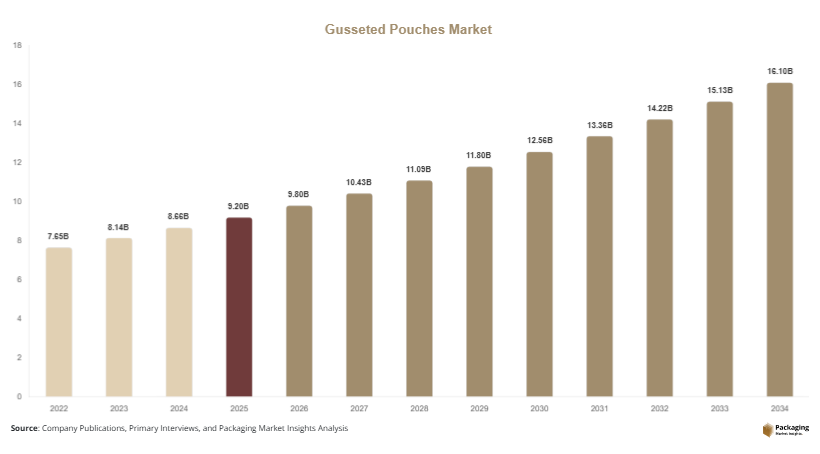
The gusseted pouches market size was valued at approximately USD 9.2 billion in 2025 and is projected to reach USD 9.8 billion in 2026. Over the forecast period, the market is expected to grow to USD 17.1 billion by 2034, registering a CAGR of 6.4% from 2025 to 2034. The growth trajectory reflects rising consumption of packaged goods and the shift toward lightweight, cost-efficient packaging formats. The global gusseted pouches market is experiencing steady expansion due to increasing demand for flexible packaging solutions across multiple industries, including food & beverage, pharmaceuticals, and personal care.
Gusseted pouches are flexible packaging solutions with expandable sides or bottoms, allowing higher storage capacity compared to flat pouches. These pouches are widely used for packaging dry foods, pet food, coffee, grains, and powders due to their durability and space efficiency. The increasing need for packaging formats that optimize shelf space and improve product visibility is a major factor contributing to the growth of the gusseted pouches market.
Market Insights:
- Asia Pacific dominated the market with a 39.1% share in 2025, while Latin America is projected to grow at the fastest CAGR of 6.9%.
- Side gusseted pouches led the type segment with a 46.8% share, while flat bottom pouches are expected to grow at a CAGR of 6.7%.
- Plastic-based materials dominated with a 54.2% share, while paper-based materials are forecasted to grow at a CAGR of 6.5%.
- Food & beverage applications led the segment with 47.6% share, while personal care packaging is expected to grow at a CAGR of 6.6%.
- China remained the dominant country with a market size of USD 2.3 billion in 2025 and USD 2.5 billion in 2026.
Explore more data points, trends and opportunities Download Free Sample Report
Market Trends
Increasing Preference for Sustainable and Recyclable Flexible Packaging
The gusseted pouches market is witnessing a shift toward sustainable packaging solutions as environmental concerns gain importance among consumers and regulatory bodies. Manufacturers are focusing on developing recyclable, compostable, and bio-based materials to reduce environmental impact. Flexible packaging formats such as gusseted pouches require less material compared to rigid alternatives, making them more resource-efficient. Companies are also introducing mono-material pouches to improve recyclability and comply with sustainability regulations. This trend is particularly evident in developed regions where environmental policies are strict, and brands are under pressure to adopt eco-friendly packaging solutions.
Rising Demand for Premium Packaging and Product Differentiation
Another significant trend in the gusseted pouches market is the growing demand for premium packaging solutions that enhance product visibility and brand identity. Advanced printing technologies, including digital and high-definition printing, are enabling manufacturers to create visually appealing designs. Features such as resealable zippers, spouts, and transparent windows are being integrated to improve functionality and consumer convenience. This trend is especially prominent in the food, beverage, and personal care industries, where packaging plays a crucial role in influencing purchasing decisions. As competition intensifies, brands are increasingly using gusseted pouches to differentiate their products in the market.
Market Drivers
Growth in Packaged Food Consumption and Changing Lifestyles
The increasing consumption of packaged food products is a major driver of the gusseted pouches market. Urbanization, rising disposable incomes, and busy lifestyles are encouraging consumers to opt for convenient and ready-to-use food products. Gusseted pouches are widely used for packaging snacks, coffee, grains, and pet food due to their durability and ability to preserve freshness. The demand for portion-controlled and resealable packaging is also contributing to market growth. As consumer preferences continue to evolve, the need for flexible and efficient packaging solutions is expected to increase.
Expansion of E-Commerce and Retail Distribution Channels
The rapid growth of e-commerce and organized retail is another key factor driving the gusseted pouches market. Online shopping requires packaging solutions that are lightweight, durable, and capable of protecting products during transit. Gusseted pouches meet these requirements by offering strong sealing and resistance to external damage. Additionally, the expansion of supermarkets and hypermarkets is increasing the demand for attractive and space-efficient packaging formats. As retail and e-commerce sectors continue to expand globally, the adoption of gusseted pouches is expected to grow.
Market Restraint
Challenges Related to Recycling and Environmental Regulations
One of the primary restraints in the gusseted pouches market is the complexity of recycling multi-layer flexible packaging materials. Many gusseted pouches are made from a combination of plastic films, aluminum layers, and barrier coatings, which are difficult to separate and recycle. This poses challenges for waste management systems and limits the adoption of these pouches in regions with strict environmental regulations. For instance, in certain European countries, policies promoting circular economy practices are restricting the use of non-recyclable packaging. Additionally, the lack of adequate recycling infrastructure in developing regions further complicates the issue. These challenges may hinder market growth unless manufacturers invest in developing sustainable alternatives.
Market Opportunities
Innovation in Bio-Based and Compostable Packaging Materials
The development of bio-based and compostable materials presents a significant opportunity for the gusseted pouches market. Manufacturers are investing in research and development to create eco-friendly packaging solutions that maintain performance while reducing environmental impact. Materials such as plant-based polymers and biodegradable films are gaining traction as alternatives to conventional plastics. These innovations are helping companies meet regulatory requirements and cater to environmentally conscious consumers. As sustainability becomes a key focus area, the adoption of bio-based gusseted pouches is expected to increase.
Growth in Emerging Markets and Industrial Applications
Emerging markets offer substantial growth opportunities for the gusseted pouches market. Rapid industrialization, urbanization, and increasing consumption of packaged goods are driving demand in regions such as Asia Pacific, Latin America, and the Middle East. Additionally, the use of gusseted pouches in industrial applications, including chemicals, fertilizers, and bulk materials, is expanding. These pouches provide efficient storage and transportation solutions for various products. As industries continue to grow in emerging economies, the demand for flexible packaging solutions is expected to rise.
Report Scope
| Report Metric | Details |
|---|---|
| Market Size in 2025 | USD 9.2 Billion |
| Market Size in 2026 | USD 9.8 Billion |
| Market Size in 2034 | USD 17.1 Billion |
| CAGR | 6.4% (2026-2034) |
| Base Year for Estimation | 2025 |
| Historical Data | 2022-2024 |
| Forecast Period | 2026-2034 |
| Report Coverage | Revenue Forecast, Competitive Landscape, Supply Chain Disruption, Growth Factors, Environment & Regulatory Landscape and Trends |
| Geographies Covered | North America, Europe, APAC, Middle East and Africa, LATAM |
| Countries Covered | U.S., Canada, U.K., Germany, France, Spain, Italy, Russia, Nordic, Benelux, Rest of Europe, China, South Korea, Japan, India, Australia, Singapore, Taiwan, South East Asia, Rest of Asia-Pacific, UAE, Turky, Saudi Arabia, South Africa, Egypt, Nigeria, Rest of MEA, Brazil, Mexico, Argentina, Chile, Colombia, Rest of LATAM |
Explore more data points, trends and opportunities Download Free Sample Report
Segmental Analysis
By Type
Side gusseted pouches dominated the gusseted pouches market in 2024, accounting for approximately 46.8% of total revenue. These pouches are widely used for packaging coffee, tea, and dry food products due to their ability to expand and hold larger volumes. Their cost-effectiveness and efficient use of space make them a preferred choice for manufacturers.
Flat bottom pouches are expected to grow at the fastest CAGR of 6.7% during the forecast period. These pouches offer improved stability and shelf presentation, making them suitable for premium products. The increasing demand for aesthetically appealing packaging is driving growth in this segment.
By Application
The food & beverage segment dominated the market in 2024, accounting for 47.6% of total revenue. Gusseted pouches are widely used for packaging snacks, coffee, grains, and pet food. The increasing consumption of packaged food products is driving demand in this segment.
The personal care segment is expected to grow at a CAGR of 6.6%. The use of flexible packaging for products such as shampoos, lotions, and powders is increasing due to its convenience and cost-effectiveness.
By End-Use
The food processing industry dominated the gusseted pouches market in 2024, accounting for a significant share of total revenue. The use of gusseted pouches in this industry helps maintain product freshness and extend shelf life.
The retail sector is expected to grow at a CAGR of 6.5%. The increasing number of supermarkets and hypermarkets is driving demand for attractive and space-efficient packaging solutions.
Gusseted Pouches Market Segmentations
By Type
- Side Gusseted Pouches
- Bottom Gusseted Pouches
- Flat Bottom Pouches
By Application
- Food & Beverage
- Personal Care
- Pharmaceutical
- Industrial
By End-Use
- Food Processing
- Retail
- Industrial
- Healthcare
Regional Analysis
North America
North America accounted for approximately 22.8% of the gusseted pouches market share in 2025 and is projected to grow at a CAGR of 6.1% during the forecast period. The region benefits from a well-developed food processing industry and high adoption of flexible packaging solutions. Increasing demand for convenience food and beverages is supporting market growth.
The United States dominates the regional market due to its large consumer base and advanced packaging industry. A key growth factor is the rising demand for premium packaging solutions that enhance product visibility and shelf appeal.
Europe
Europe held a share of approximately 25.6% in 2025 and is expected to grow at a CAGR of 6.3%. The region is characterized by strong environmental regulations and a focus on sustainable packaging. These factors are encouraging manufacturers to adopt recyclable and eco-friendly materials.
Germany is a leading market in Europe, supported by its strong manufacturing sector. A unique growth factor is the increasing adoption of flexible packaging in the food and beverage industry to reduce material usage and improve efficiency.
Asia Pacific
Asia Pacific dominated the gusseted pouches market with a share of 39.1% in 2025 and is projected to grow at a CAGR of 6.9%. Rapid urbanization and increasing disposable incomes are driving demand for packaged goods in the region.
China leads the regional market due to its large population and expanding industrial base. A key growth factor is the growing demand for cost-effective packaging solutions in the food and retail sectors.
Middle East & Africa
The Middle East & Africa region accounted for approximately 5.1% of the market in 2025 and is expected to grow at a CAGR of 5.9%. The region’s growth is supported by increasing urbanization and rising demand for packaged food products.
The United Arab Emirates is a key market in the region. A unique growth factor is the expansion of the retail and hospitality sectors, which is driving demand for flexible packaging solutions.
Latin America
Latin America held a share of approximately 6.4% in 2025 and is projected to grow at the fastest CAGR of 6.9%. The region’s growth is driven by increasing consumption of packaged food and beverages.
Brazil dominates the market in Latin America. A key growth factor is the expansion of the food processing industry, which is increasing demand for gusseted pouches.
Competitive Landscape
The gusseted pouches market is moderately competitive, with several global and regional players operating in the industry. Companies are focusing on product innovation, sustainability, and expansion strategies to strengthen their market position. Strategic partnerships and mergers are also common in the market.
Amcor plc is a leading player, known for its advanced flexible packaging solutions. The company has recently introduced recyclable pouch materials to address environmental concerns. Other players are investing in new technologies to improve product performance and meet evolving consumer demands.
Key Players List
- Amcor plc
- Berry Global Inc.
- Mondi Group
- Sealed Air Corporation
- Sonoco Products Company
- Huhtamaki Oyj
- ProAmpac LLC
- Coveris Holdings S.A.
- Clondalkin Group
- Winpak Ltd.
- Constantia Flexibles
- Uflex Ltd.
- Glenroy, Inc.
- Swiss Pac Pvt. Ltd.
- Printpack Inc.